
Europe and Africa Can Europe act as a


- Slides: 52
Europe and Africa Can Europe act as a Responsible Global Player?
Today • • • European responsibilities… Cotonou agreement, beyond post colonialism? 10 th European Development Fund Civil society and the Cotonou Agreement EU-Africa dialogue Lunch • Workshops on influencing European aid to ACP countries
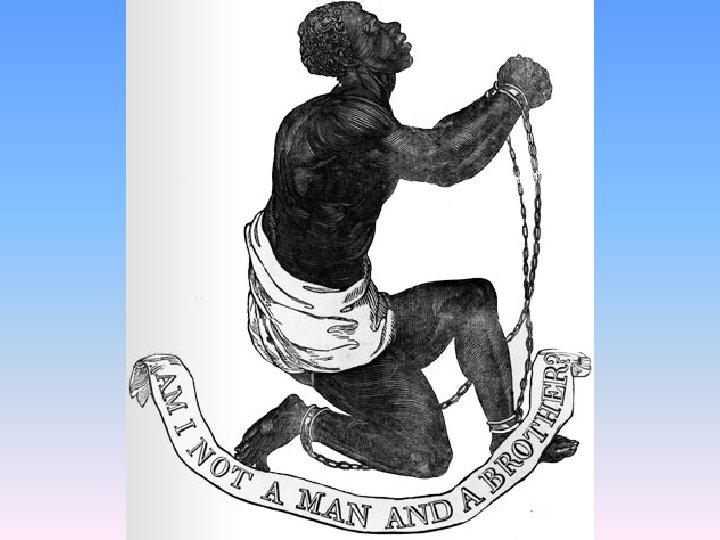
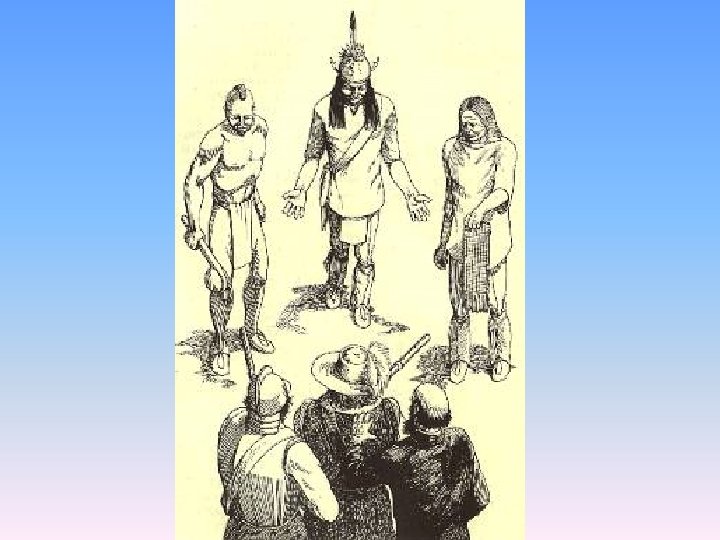
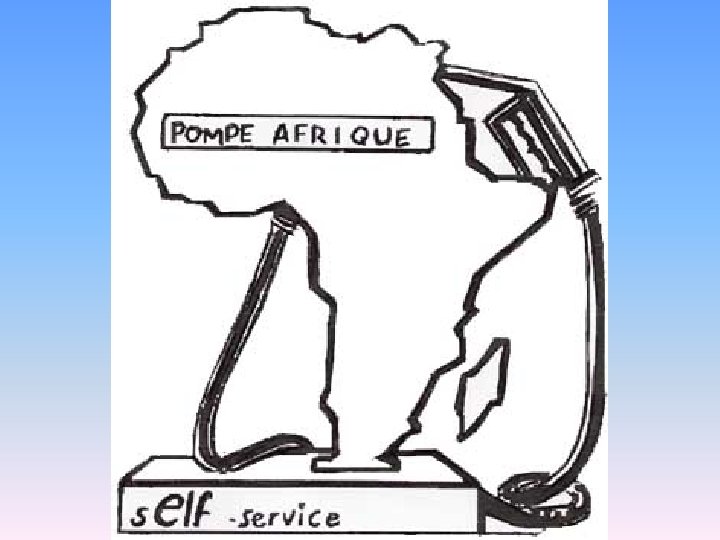
What common history?
Europe today?
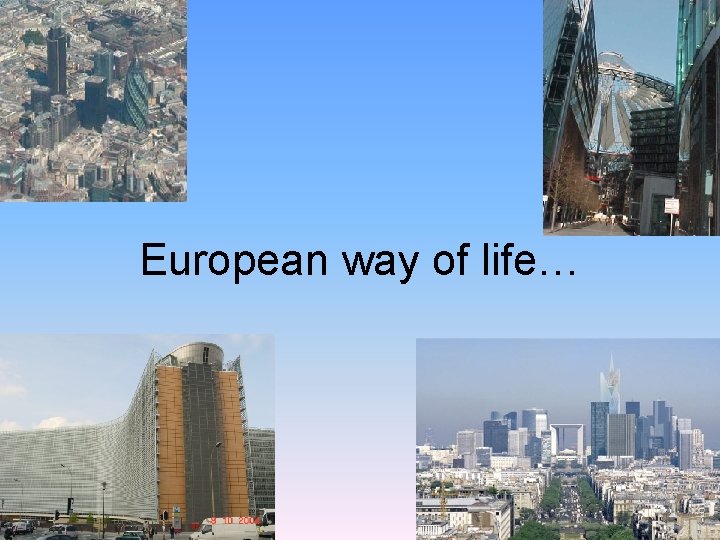
European way of life…
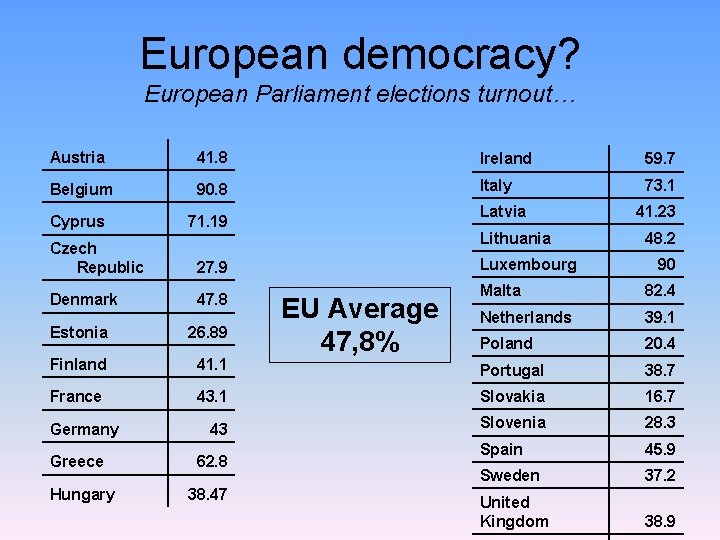
European democracy? European Parliament elections turnout… Austria 41. 8 Ireland 59. 7 Belgium 90. 8 Italy 73. 1 Cyprus 71. 19 Czech Republic 27. 9 Denmark 47. 8 Latvia Lithuania Luxembourg EU Average 47, 8% 41. 23 48. 2 90 Malta 82. 4 Netherlands 39. 1 Poland 20. 4 Portugal 38. 7 Estonia 26. 89 Finland 41. 1 France 43. 1 Slovakia 16. 7 43 Slovenia 28. 3 Spain 45. 9 Sweden 37. 2 United Kingdom 38. 9 Germany Greece Hungary 62. 8 38. 47
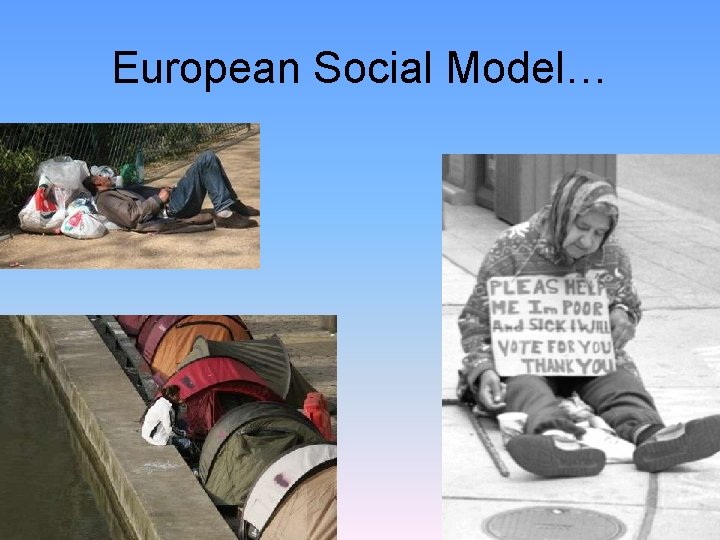
European Social Model…
- Europe’s responsibility - Europe’s model imperfect Europe should be responsible and remain modest
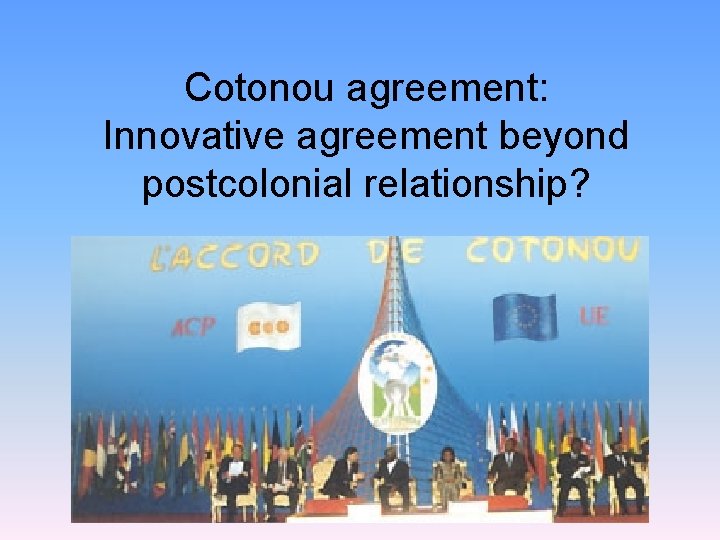
Cotonou agreement: Innovative agreement beyond postcolonial relationship?
EU-ACP relations: Brief History • Rome • Yaoundé • Lomé • Maastricht • Cotonou • Lisbon
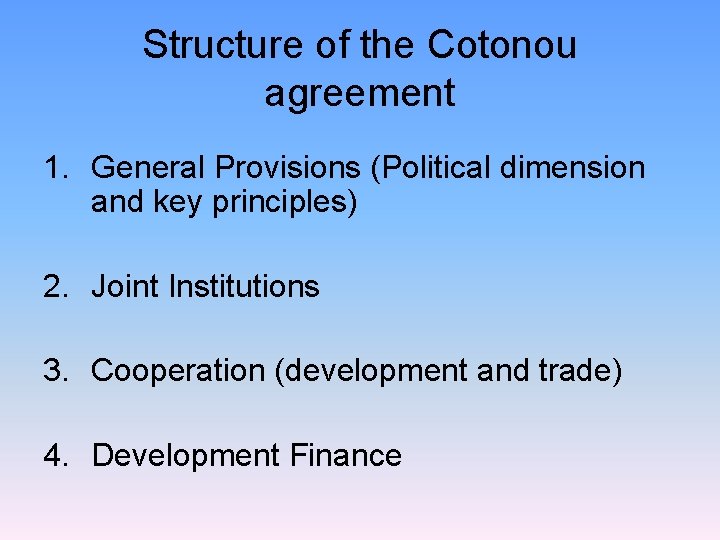
Structure of the Cotonou agreement 1. General Provisions (Political dimension and key principles) 2. Joint Institutions 3. Cooperation (development and trade) 4. Development Finance
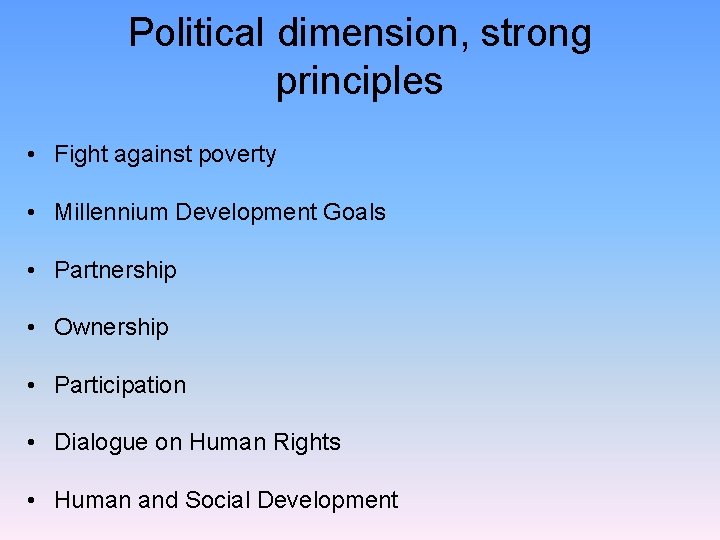
Political dimension, strong principles • Fight against poverty • Millennium Development Goals • Partnership • Ownership • Participation • Dialogue on Human Rights • Human and Social Development
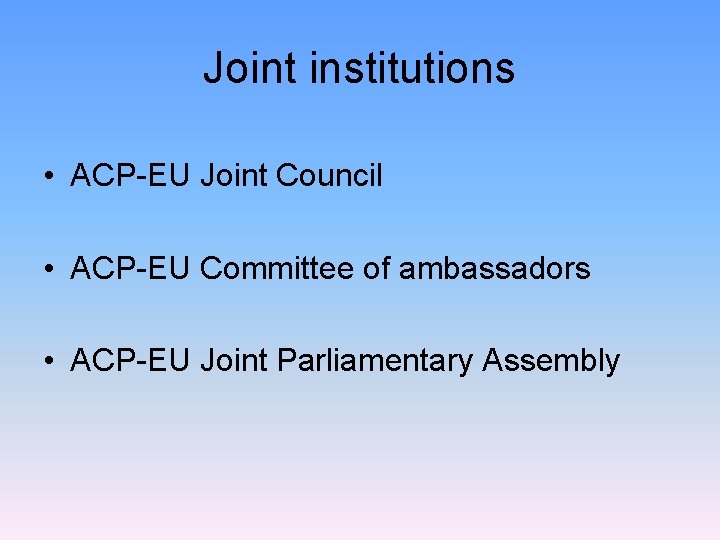
Joint institutions • ACP-EU Joint Council • ACP-EU Committee of ambassadors • ACP-EU Joint Parliamentary Assembly
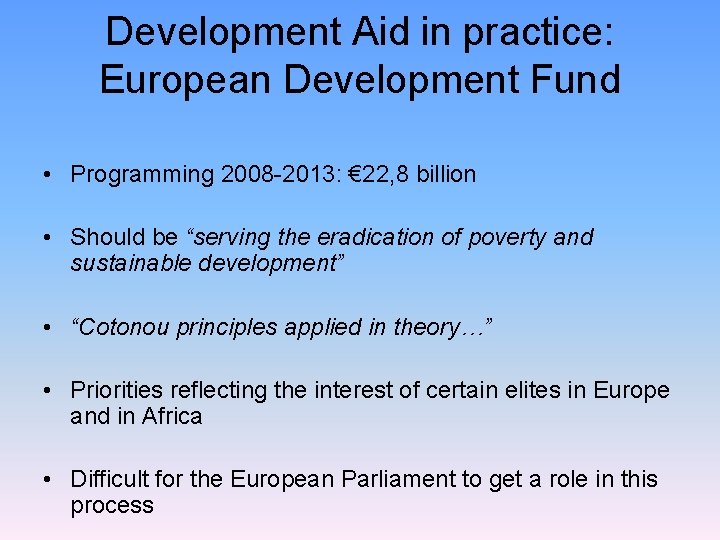
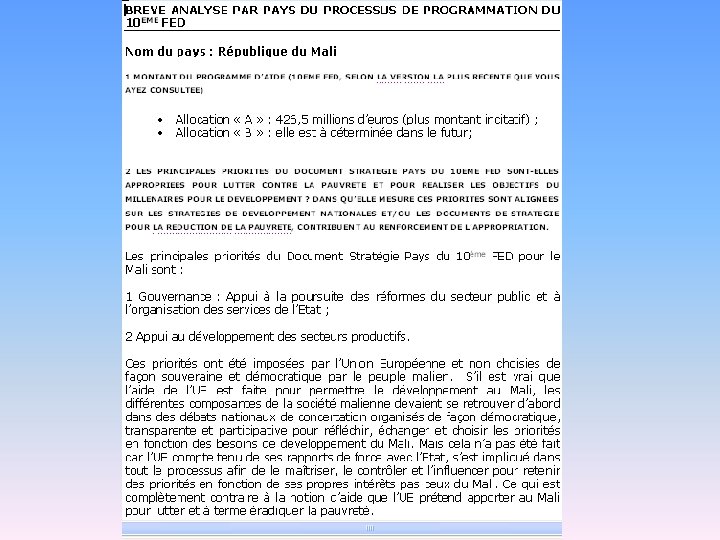
Development Aid in practice: European Development Fund • Programming 2008 -2013: € 22, 8 billion • Should be “serving the eradication of poverty and sustainable development” • “Cotonou principles applied in theory…” • Priorities reflecting the interest of certain elites in Europe and in Africa • Difficult for the European Parliament to get a role in this process
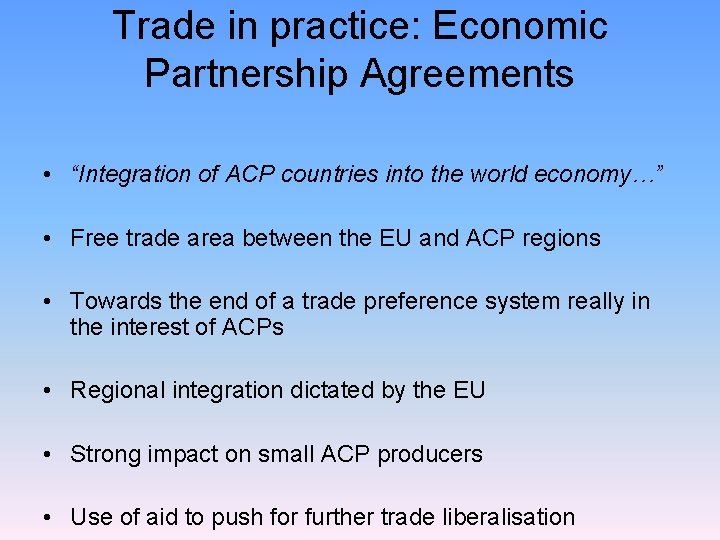
Trade in practice: Economic Partnership Agreements • “Integration of ACP countries into the world economy…” • Free trade area between the EU and ACP regions • Towards the end of a trade preference system really in the interest of ACPs • Regional integration dictated by the EU • Strong impact on small ACP producers • Use of aid to push for further trade liberalisation
Cotonou Agreement: Nice Rhetoric Practice to watch
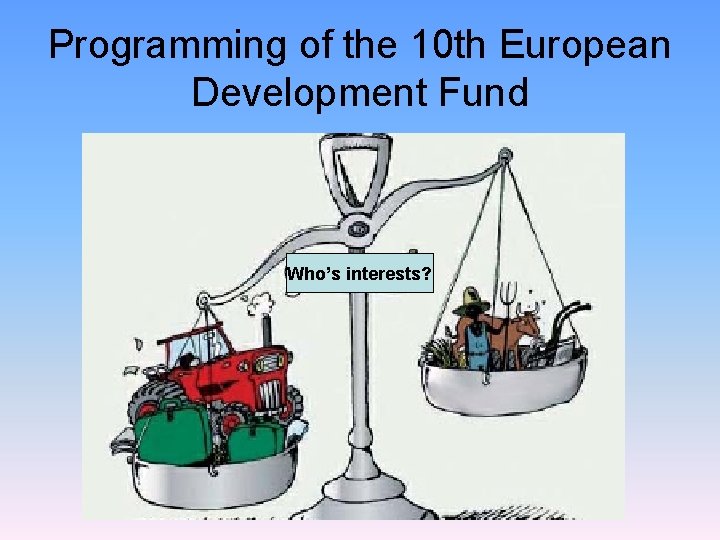
Programming of the 10 th European Development Fund Who’s interests?
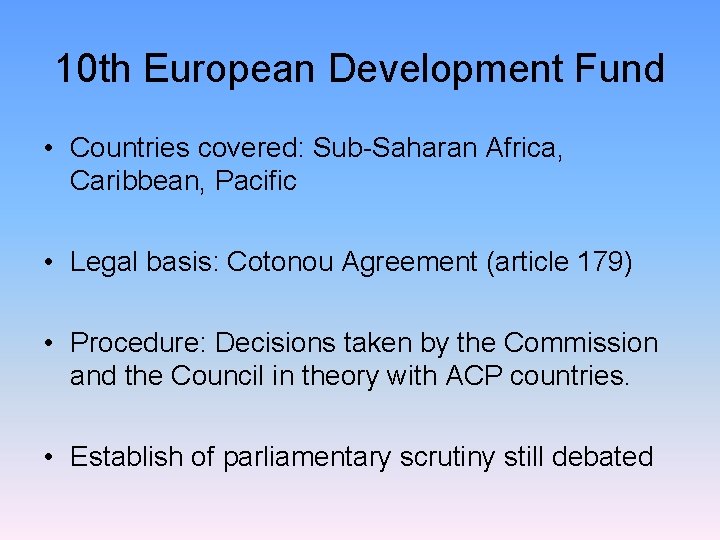
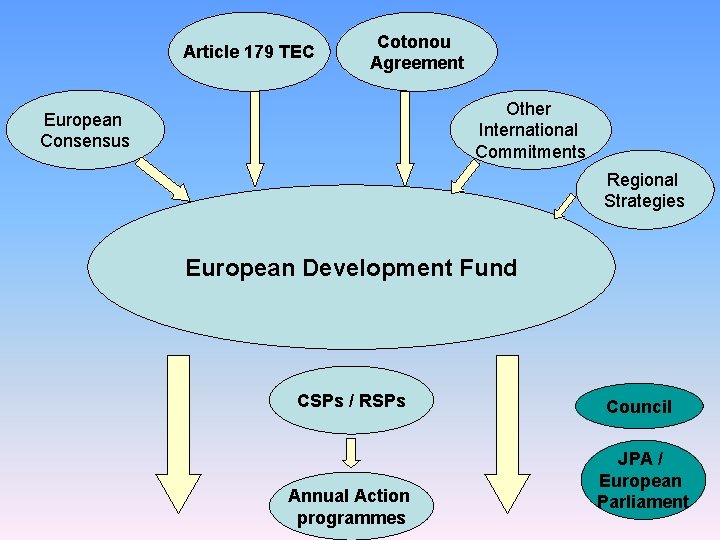
10 th European Development Fund • Countries covered: Sub-Saharan Africa, Caribbean, Pacific • Legal basis: Cotonou Agreement (article 179) • Procedure: Decisions taken by the Commission and the Council in theory with ACP countries. • Establish of parliamentary scrutiny still debated
Article 179 TEC Cotonou Agreement Other International Commitments European Consensus Regional Strategies European Development Fund CSPs / RSPs Annual Action programmes Council JPA / European Parliament
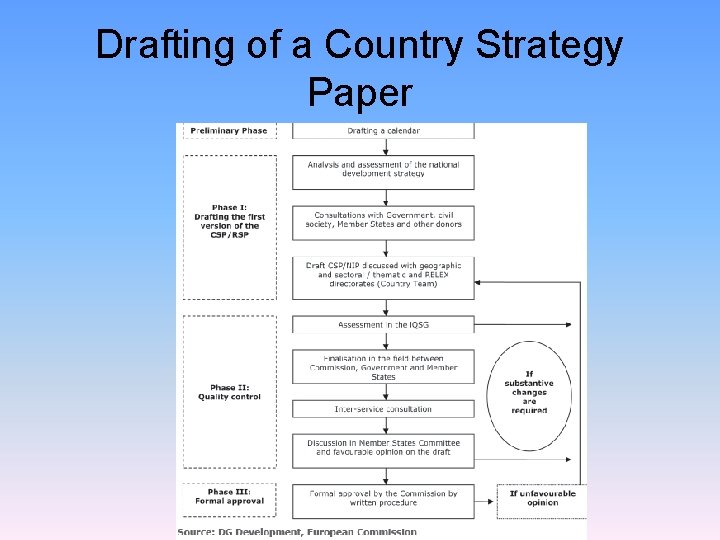
Drafting of a Country Strategy Paper
EDF 10 breakdown 2008 -2013
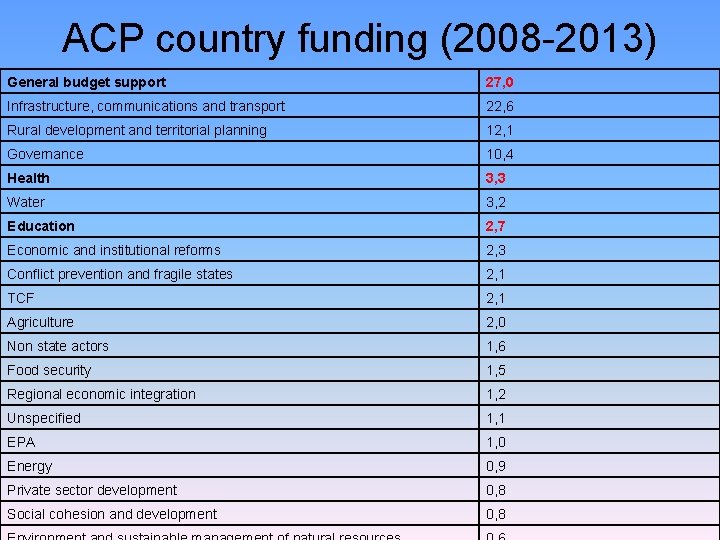
ACP country funding (2008 -2013) General budget support 27, 0 Infrastructure, communications and transport 22, 6 Rural development and territorial planning 12, 1 Governance 10, 4 Health 3, 3 Water 3, 2 Education 2, 7 Economic and institutional reforms 2, 3 Conflict prevention and fragile states 2, 1 TCF 2, 1 Agriculture 2, 0 Non state actors 1, 6 Food security 1, 5 Regional economic integration 1, 2 Unspecified 1, 1 EPA 1, 0 Energy 0, 9 Private sector development 0, 8 Social cohesion and development 0, 8
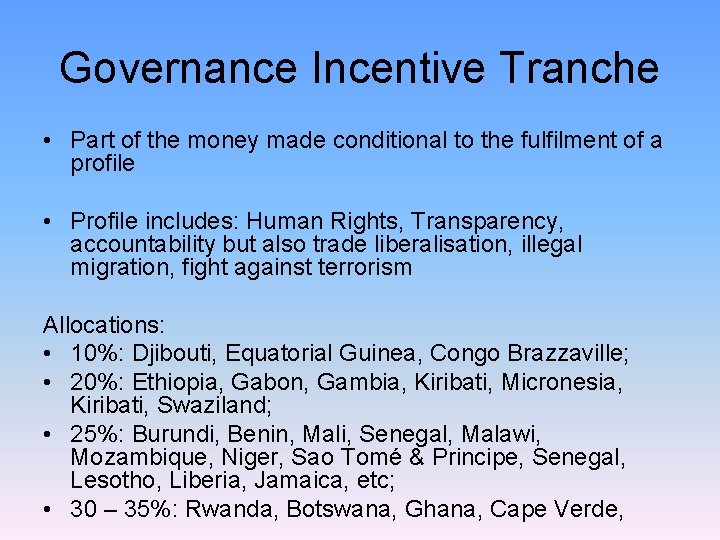
Governance Incentive Tranche • Part of the money made conditional to the fulfilment of a profile • Profile includes: Human Rights, Transparency, accountability but also trade liberalisation, illegal migration, fight against terrorism Allocations: • 10%: Djibouti, Equatorial Guinea, Congo Brazzaville; • 20%: Ethiopia, Gabon, Gambia, Kiribati, Micronesia, Kiribati, Swaziland; • 25%: Burundi, Benin, Mali, Senegal, Malawi, Mozambique, Niger, Sao Tomé & Principe, Senegal, Lesotho, Liberia, Jamaica, etc; • 30 – 35%: Rwanda, Botswana, Ghana, Cape Verde,
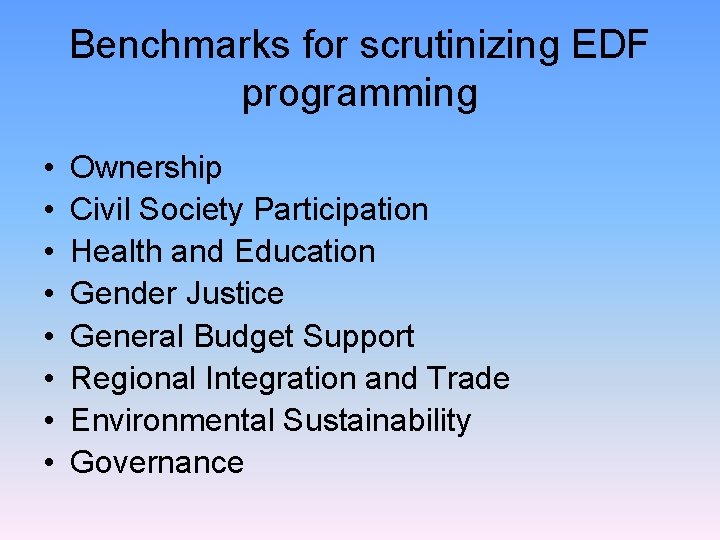
Benchmarks for scrutinizing EDF programming • • Ownership Civil Society Participation Health and Education Gender Justice General Budget Support Regional Integration and Trade Environmental Sustainability Governance
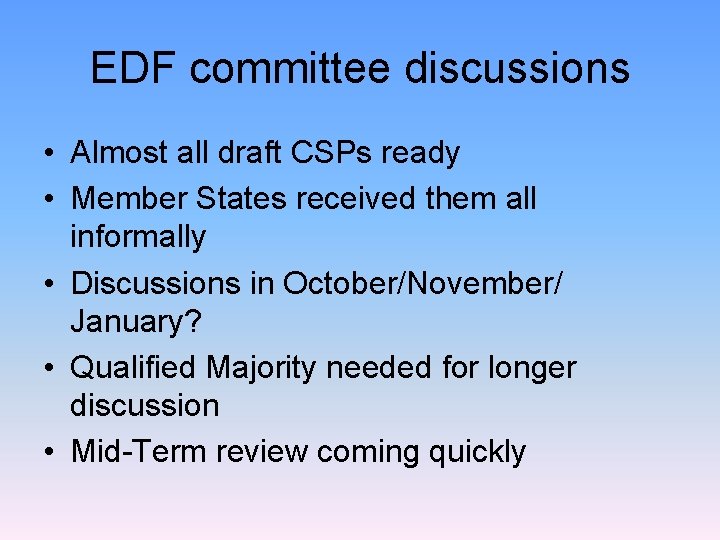
EDF committee discussions • Almost all draft CSPs ready • Member States received them all informally • Discussions in October/November/ January? • Qualified Majority needed for longer discussion • Mid-Term review coming quickly
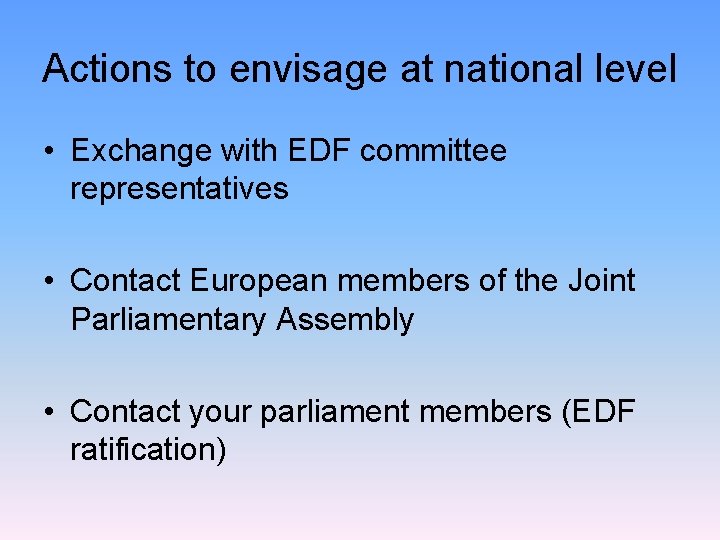
Actions to envisage at national level • Exchange with EDF committee representatives • Contact European members of the Joint Parliamentary Assembly • Contact your parliament members (EDF ratification)
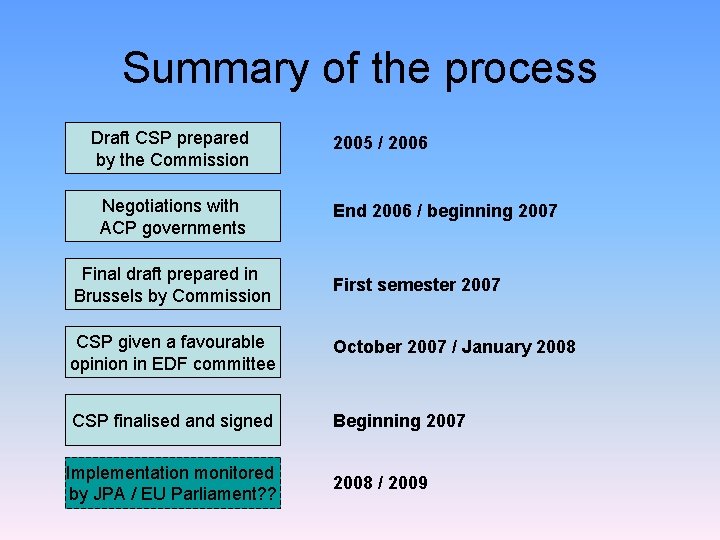
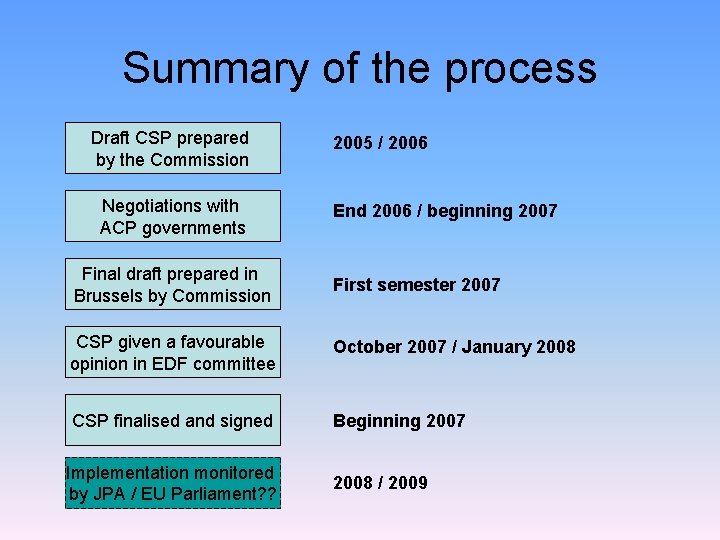
Summary of the process Draft CSP prepared by the Commission Negotiations with ACP governments 2005 / 2006 End 2006 / beginning 2007 Final draft prepared in Brussels by Commission First semester 2007 CSP given a favourable opinion in EDF committee October 2007 / January 2008 CSP finalised and signed Beginning 2007 Implementation monitored by JPA / EU Parliament? ? 2008 / 2009
Principles of the Cotonou Agreement are being violated within the EDF programming We should hold our governments and parliaments to account on European aid to ACP countries
Civil Society and the Cotonou Agreement
Civil Society and the Cotonou Agreement • In the ACPs: – National Cotonou Platform/ Working Groups – No Pan-ACP gathering – Attempts to set up an ACP Civil Society Forum
Civil Society and the Cotonou Agreement • In Europe: – National Africa/Cotonou Working Groups – Concord Cotonou Aid Working Group – Concord Cotonou Trade Working Group
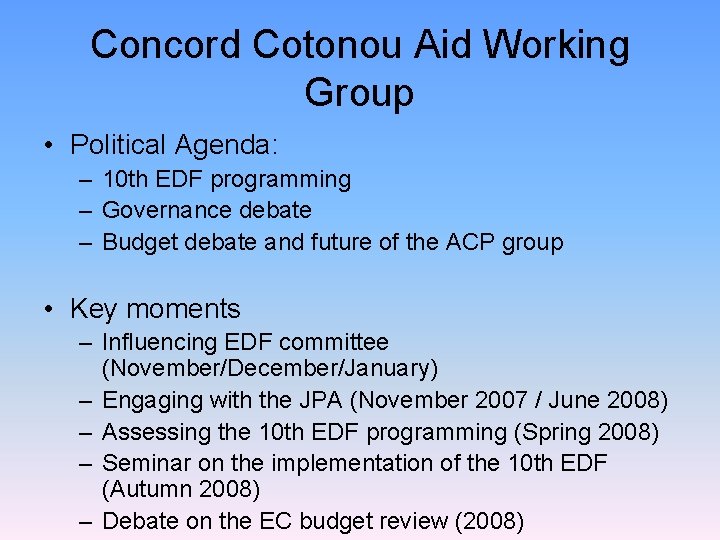
Concord Cotonou Aid Working Group • Political Agenda: – 10 th EDF programming – Governance debate – Budget debate and future of the ACP group • Key moments – Influencing EDF committee (November/December/January) – Engaging with the JPA (November 2007 / June 2008) – Assessing the 10 th EDF programming (Spring 2008) – Seminar on the implementation of the 10 th EDF (Autumn 2008) – Debate on the EC budget review (2008)
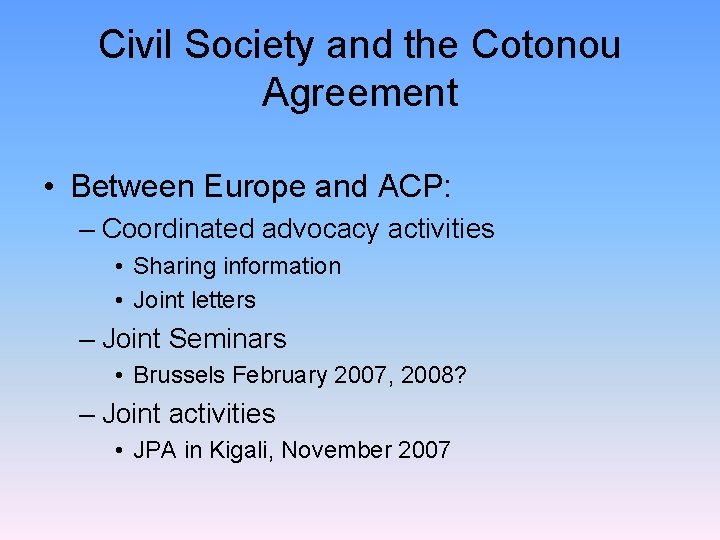
Civil Society and the Cotonou Agreement • Between Europe and ACP: – Coordinated advocacy activities • Sharing information • Joint letters – Joint Seminars • Brussels February 2007, 2008? – Joint activities • JPA in Kigali, November 2007
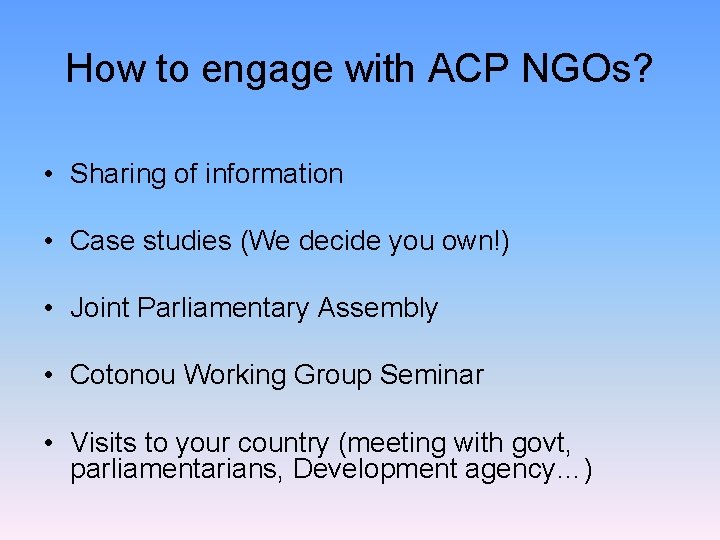
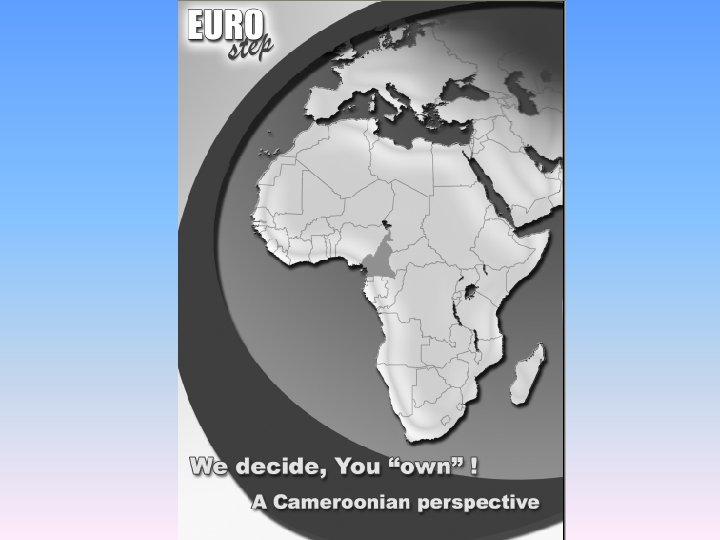
How to engage with ACP NGOs? • Sharing of information • Case studies (We decide you own!) • Joint Parliamentary Assembly • Cotonou Working Group Seminar • Visits to your country (meeting with govt, parliamentarians, Development agency…)
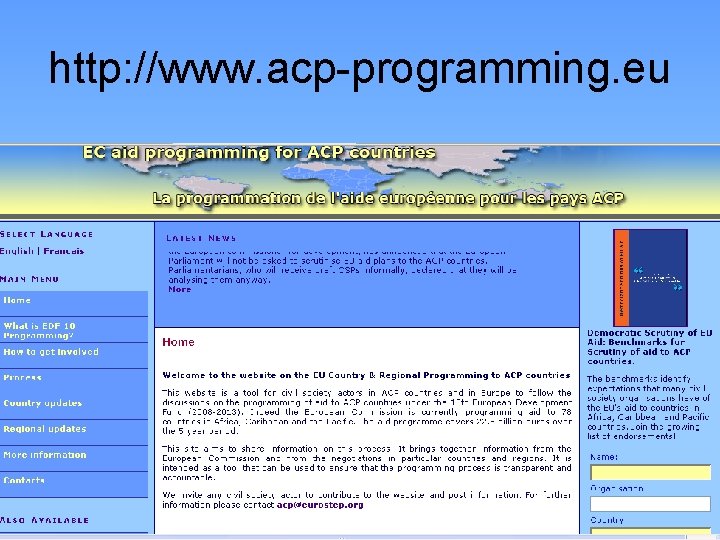
http: //www. acp-programming. eu
- Various channels to engage in EU/ACP discussions. - Need for specific activities towards Hungarian government and parliamentarians. Time to act…
EU/Africa dialogue, an attempt to sideline Cotonou?
EU-Africa Dialogue • Strategic partnership with the whole continent based on shared objectives and common values • Building on values and principles included in: – – – EU treaty Cotonou Agreement Barcelona Process AU constitutive act Nepad Manifesto
Strategies? • Chinese strategy for Africa • EU strategy for Africa • Joint EU-Africa Strategy • Any African Strategy for Africa? • Any African Strategy for Europe?
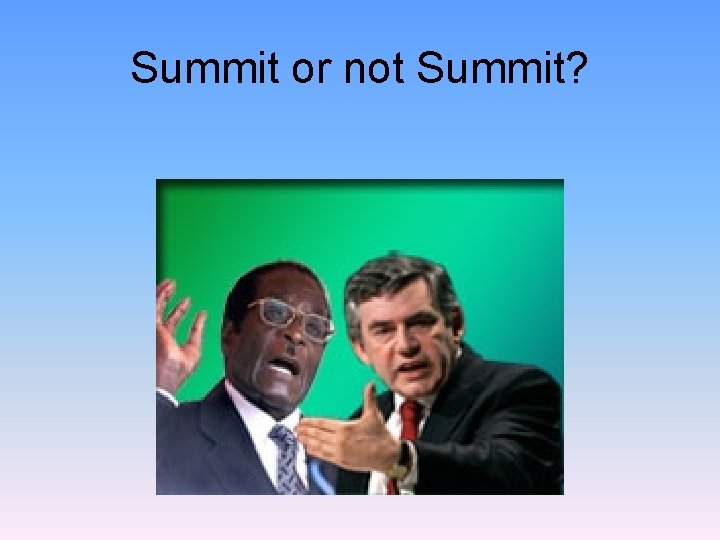
Summit or not Summit?
Joint EU-Africa Strategy… Political Content • Peace and Security • Governance and Human Rights • Trade and Regional Integration • Key Development Issues Institutional Architecture Follow up : Action plan
Joint strategy: impact on Cotonou • Adapting existing instruments to new strategy? • Review of the Cotonou Agreement in 2010 • Real space for civil society?
Renewed EU/Africa dialogue could further diminish ACP’s policy space Cotonou commitments should be at least safeguarded
Workshop Influencing European aid to African Caribbean and Pacific countries
Summary of the process Draft CSP prepared by the Commission Negotiations with ACP governments 2005 / 2006 End 2006 / beginning 2007 Final draft prepared in Brussels by Commission First semester 2007 CSP given a favourable opinion in EDF committee October 2007 / January 2008 CSP finalised and signed Beginning 2007 Implementation monitored by JPA / EU Parliament? ? 2008 / 2009
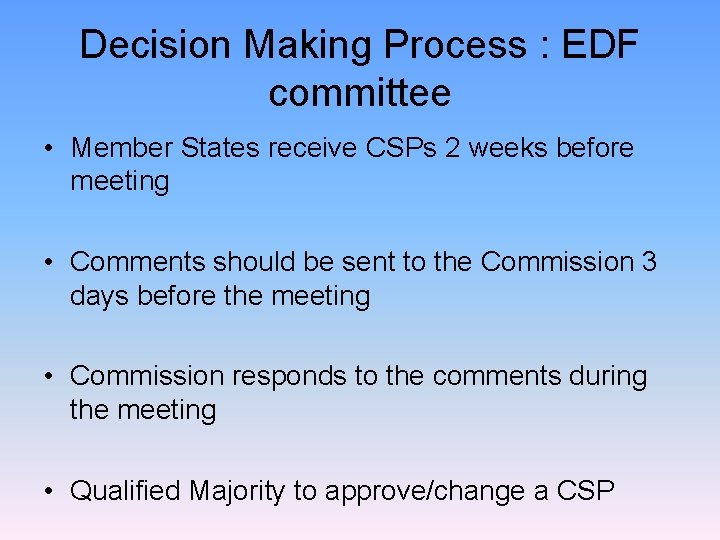
Decision Making Process : EDF committee • Member States receive CSPs 2 weeks before meeting • Comments should be sent to the Commission 3 days before the meeting • Commission responds to the comments during the meeting • Qualified Majority to approve/change a CSP
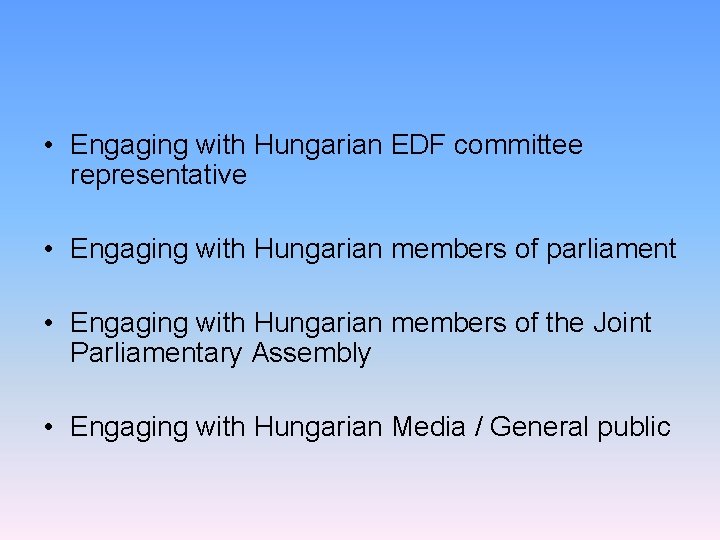
• Engaging with Hungarian EDF committee representative • Engaging with Hungarian members of parliament • Engaging with Hungarian members of the Joint Parliamentary Assembly • Engaging with Hungarian Media / General public