
Europa Lander mission concept and scientific goals L

- Slides: 28
Europa Lander: mission concept and scientific goals L. Zelenyi, O. Korablev, M. Martynov, E. Akim, A. Basilevsky, N. Eismont, A. Fedorova, V. Galchenko, M. Gerasimov, O. Kozlov, L. Ksanfomality, I. Lomakin, G. Managadze, M. Podzolko, G. Popov, A. Simonov, A. Sukhanov, E. Vorobyova, Yu. Agafonov, O. Prieto-Ballesteros, M. Blanc, J. P. Lebreton, R. Pappalardo and the Europa Lander Team IKI, NPOL, Keldysh Inst. , Vernadsky Inst. , Winogradsky Inst. , Skobeltsyn Inst. MSU, NII PME, Soil faculty MSU, Centro Astrobiologica INTA, ESA ESTEC, Ecole Polytechnique, JPL. 1 M-SSS 12 October 2010
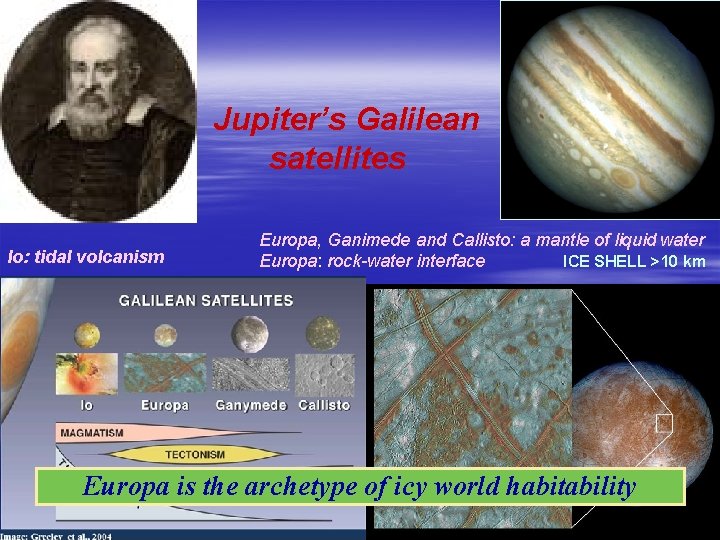
Jupiter’s Galilean satellites Io: tidal volcanism Europa, Ganimede and Callisto: a mantle of liquid water ICE SHELL >10 km Europa: rock-water interface Europa is the archetype of icy world habitability
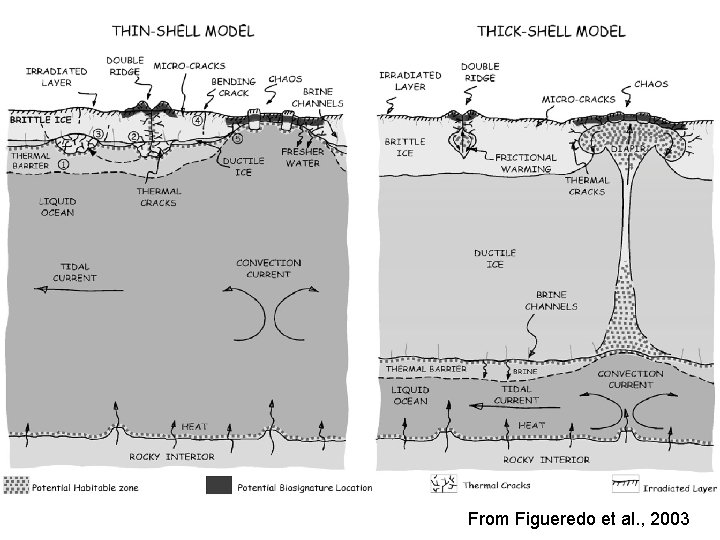
From Figueredo et al. , 2003
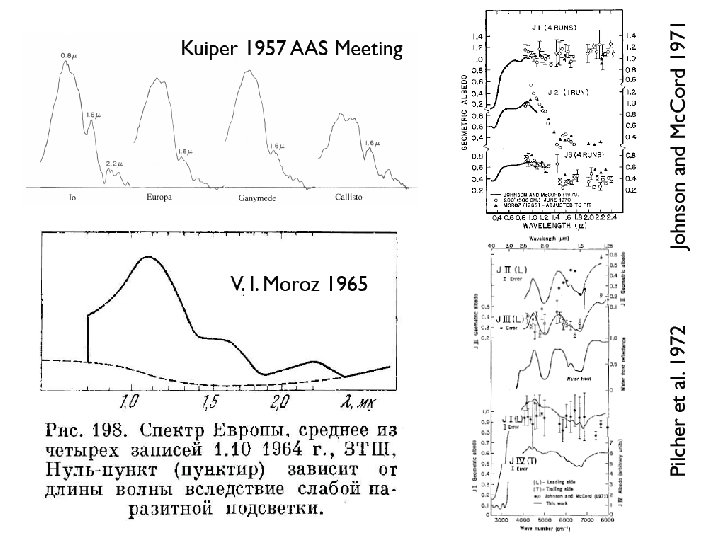
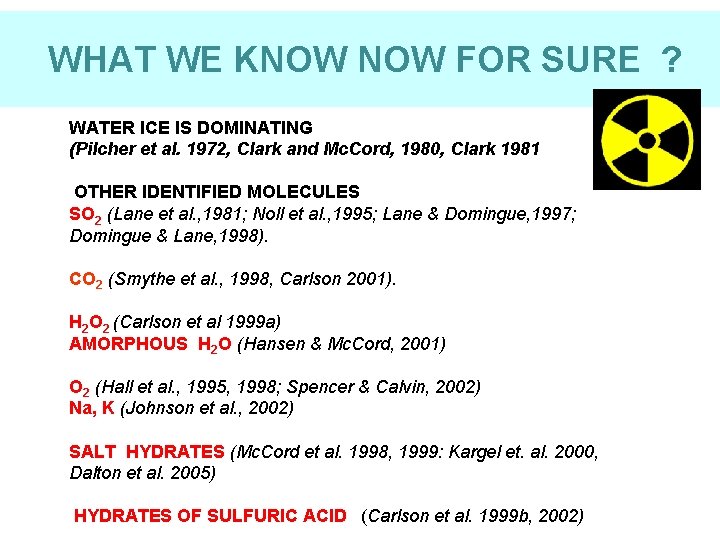
WHAT WE KNOW FOR SURE ? WATER ICE IS DOMINATING (Pilcher et al. 1972, Clark and Mc. Cord, 1980, Clark 1981 OTHER IDENTIFIED MOLECULES SO 2 (Lane et al. , 1981; Noll et al. , 1995; Lane & Domingue, 1997; Domingue & Lane, 1998). CO 2 (Smythe et al. , 1998, Carlson 2001). H 2 O 2 (Carlson et al 1999 a) AMORPHOUS H 2 O (Hansen & Mc. Cord, 2001) O 2 (Hall et al. , 1995, 1998; Spencer & Calvin, 2002) Na, K (Johnson et al. , 2002) SALT HYDRATES (Mc. Cord et al. 1998, 1999: Kargel et. al. 2000, Dalton et al. 2005) HYDRATES OF SULFURIC ACID (Carlson et al. 1999 b, 2002)
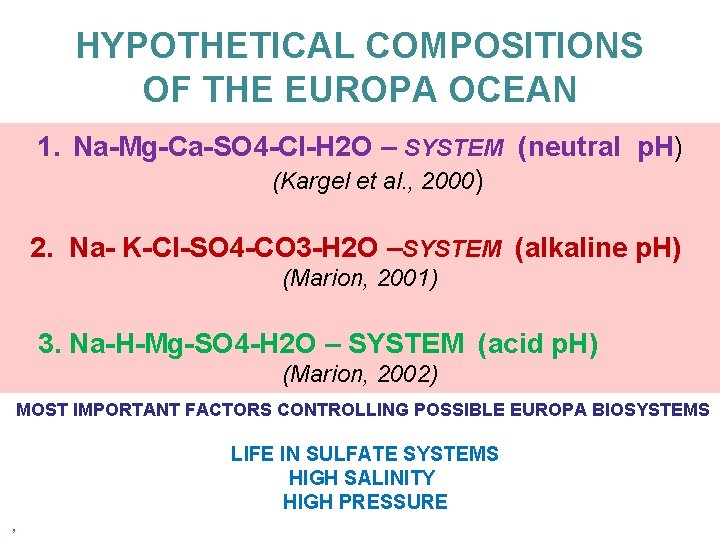
HYPOTHETICAL COMPOSITIONS OF THE EUROPA OCEAN 1. Na-Mg-Ca-SO 4 -Cl-H 2 O – SYSTEM (neutral p. H) (Kargel et al. , 2000) 2. Na- K-Cl-SO 4 -CO 3 -H 2 O –SYSTEM (alkaline p. H) (Marion, 2001) 3. Na-H-Mg-SO 4 -H 2 O – SYSTEM (acid p. H) (Marion, 2002) MOST IMPORTANT FACTORS CONTROLLING POSSIBLE EUROPA BIOSYSTEMS LIFE IN SULFATE SYSTEMS HIGH SALINITY HIGH PRESSURE ,
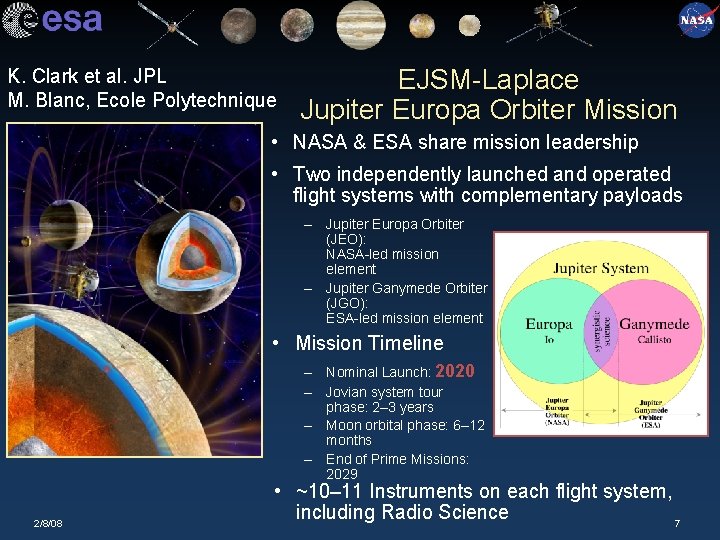
K. Clark et al. JPL M. Blanc, Ecole Polytechnique EJSM-Laplace Jupiter Europa Orbiter Mission • NASA & ESA share mission leadership • Two independently launched and operated flight systems with complementary payloads – Jupiter Europa Orbiter (JEO): NASA-led mission element – Jupiter Ganymede Orbiter (JGO): ESA-led mission element • Mission Timeline – Nominal Launch: 2020 – Jovian system tour phase: 2– 3 years – Moon orbital phase: 6– 12 months – End of Prime Missions: 2029 2/8/08 • ~10– 11 Instruments on each flight system, including Radio Science 7
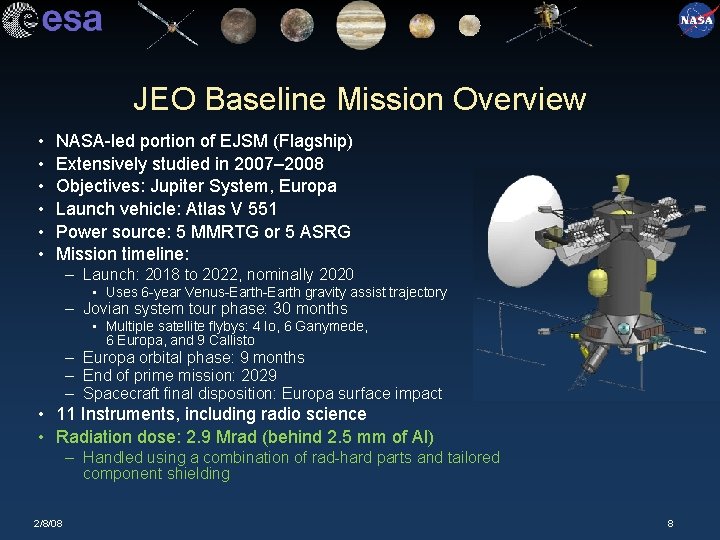
JEO Baseline Mission Overview • • • NASA-led portion of EJSM (Flagship) Extensively studied in 2007– 2008 Objectives: Jupiter System, Europa Launch vehicle: Atlas V 551 Power source: 5 MMRTG or 5 ASRG Mission timeline: – Launch: 2018 to 2022, nominally 2020 • Uses 6 -year Venus-Earth gravity assist trajectory – Jovian system tour phase: 30 months • Multiple satellite flybys: 4 Io, 6 Ganymede, 6 Europa, and 9 Callisto – Europa orbital phase: 9 months – End of prime mission: 2029 – Spacecraft final disposition: Europa surface impact • 11 Instruments, including radio science • Radiation dose: 2. 9 Mrad (behind 2. 5 mm of Al) – Handled using a combination of rad-hard parts and tailored component shielding 2/8/08 8
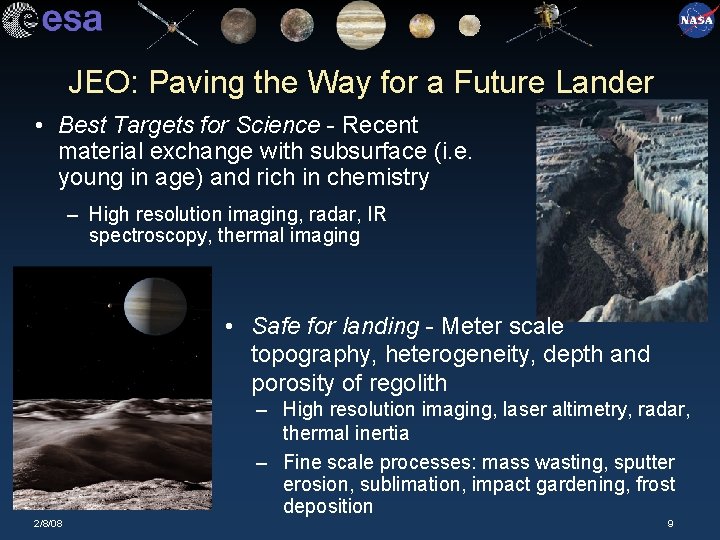
JEO: Paving the Way for a Future Lander • Best Targets for Science - Recent material exchange with subsurface (i. e. young in age) and rich in chemistry – High resolution imaging, radar, IR spectroscopy, thermal imaging • Safe for landing - Meter scale topography, heterogeneity, depth and porosity of regolith – High resolution imaging, laser altimetry, radar, thermal inertia – Fine scale processes: mass wasting, sputter erosion, sublimation, impact gardening, frost deposition 2/8/08 9
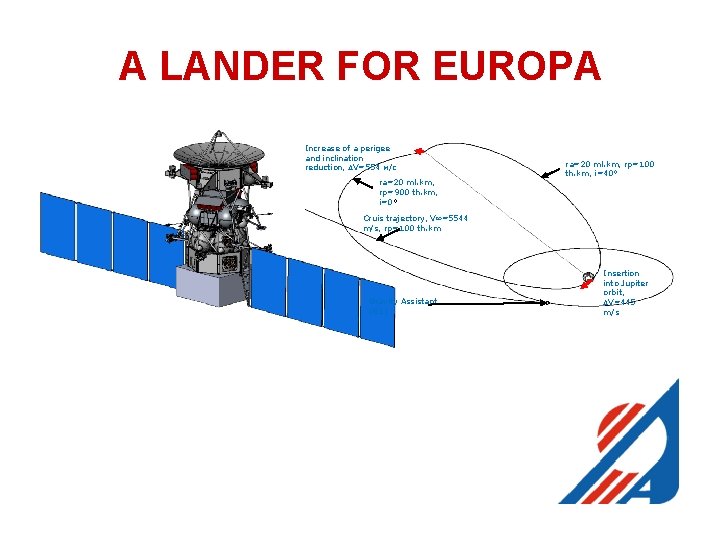
A LANDER FOR EUROPA Increase of a perigee and inclination reduction, V=554 м/с ra=20 ml. km, rp=100 th. km, i=40° ra=20 ml. km, rp=900 th. km, i=0° Cruis trajectory, V =5544 m/s, rp=100 th. km Gravity Assistant (G 1) Insertion into Jupiter orbit, V=445 m/s L. Gurvitz: PRIDE – direct radio link
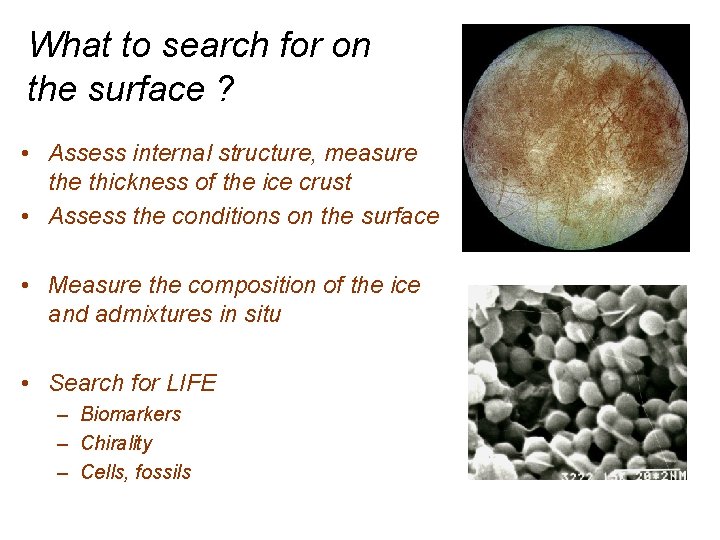
What to search for on the surface ? • Assess internal structure, measure thickness of the ice crust • Assess the conditions on the surface • Measure the composition of the ice and admixtures in situ • Search for LIFE – Biomarkers – Chirality – Cells, fossils
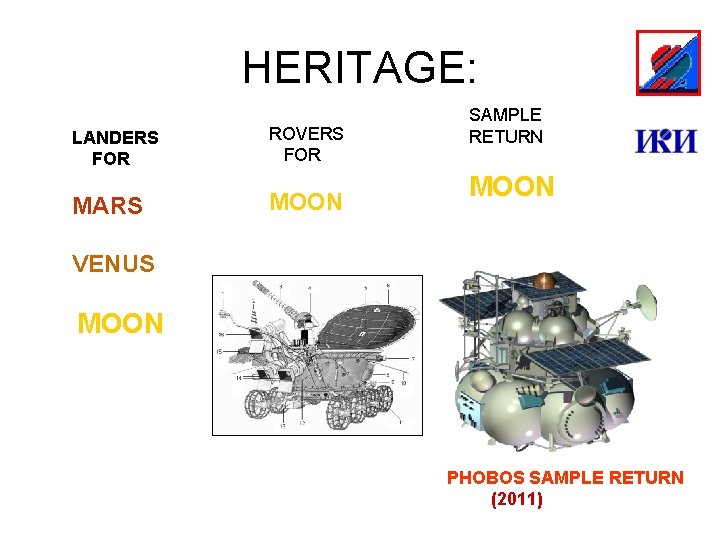
HERITAGE: LANDERS FOR MARS ROVERS FOR MOON SAMPLE RETURN MOON VENUS MOON PHOBOS SAMPLE RETURN (2011)
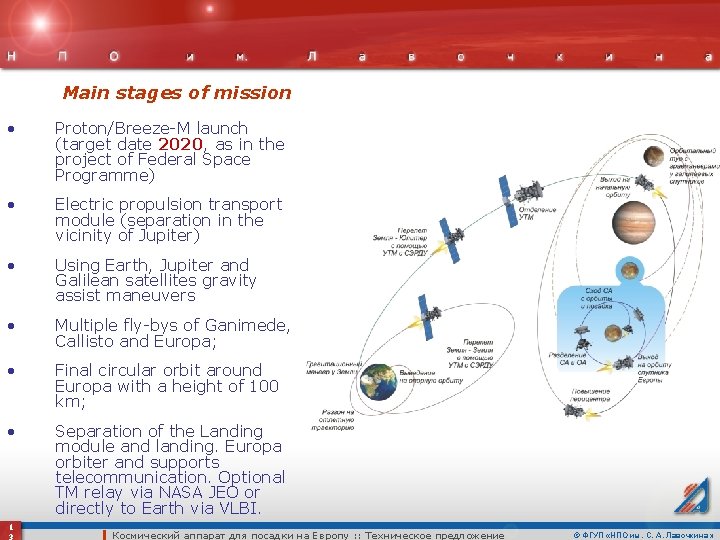
Main stages of mission • Proton/Breeze-M launch (target date 2020, as in the project of Federal Space Programme) • Electric propulsion transport module (separation in the vicinity of Jupiter) • Using Earth, Jupiter and Galilean satellites gravity assist maneuvers • Multiple fly-bys of Ganimede, Callisto and Europa; • Final circular orbit around Europa with a height of 100 km; • Separation of the Landing module and landing. Europa orbiter and supports telecommunication. Optional TM relay via NASA JEO or directly to Earth via VLBI. 1 3 Космический аппарат для посадки на Европу : : Техническое предложение © ФГУП «НПО им. С. А. Лавочкина»
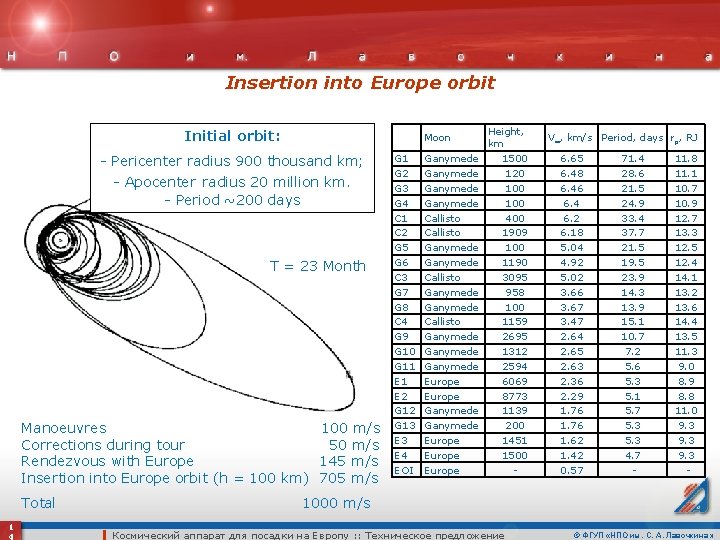
Insertion into Europe orbit Initial orbit: - Pericenter radius 900 thousand km; - Apocenter radius 20 million km. - Period ~200 days T = 23 Month Manoeuvres 100 m/s Corrections during tour 50 m/s Rendezvous with Europe 145 m/s Insertion into Europe orbit (h = 100 km) 705 m/s Moon G 1 G 2 G 3 G 4 C 1 C 2 G 5 G 6 C 3 G 7 G 8 C 4 G 9 G 10 G 11 E 2 G 13 E 4 EOI Ganymede Ganymede Callisto Ganymede Europe Ganymede Europe Height, km 1500 120 100 400 1909 100 1190 3095 958 100 1159 2695 1312 2594 6069 8773 1139 200 1451 1500 - V , km/s Period, days rp, RJ 6. 65 6. 48 6. 46 6. 4 6. 2 6. 18 5. 04 4. 92 5. 02 3. 66 3. 67 3. 47 2. 64 2. 65 2. 63 2. 36 2. 29 1. 76 1. 62 1. 42 0. 57 71. 4 28. 6 21. 5 24. 9 33. 4 37. 7 21. 5 19. 5 23. 9 14. 3 13. 9 15. 1 10. 7 7. 2 5. 6 5. 3 5. 1 5. 7 5. 3 4. 7 - 11. 8 11. 1 10. 7 10. 9 12. 7 13. 3 12. 5 12. 4 14. 1 13. 2 13. 6 14. 4 13. 5 11. 3 9. 0 8. 9 8. 8 11. 0 9. 3 - Total 1000 m/s 1 4 Космический аппарат для посадки на Европу : : Техническое предложение © ФГУП «НПО им. С. А. Лавочкина»
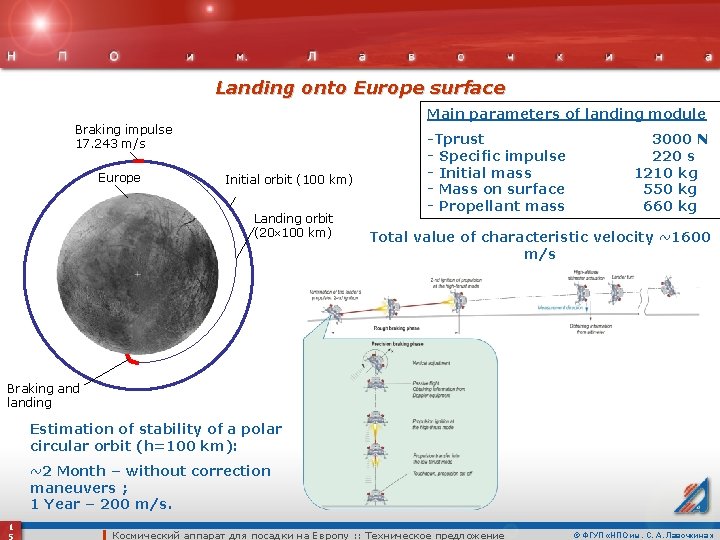
Landing onto Europe surface Main parameters of landing module Braking impulse 17. 243 m/s Europe Initial orbit (100 km) Landing orbit (20 100 km) -Tрrust - Specific impulse - Initial mass - Mass on surface - Propellant mass 3000 N 220 s 1210 kg 550 kg 660 kg Total value of characteristic velocity ~1600 m/s Braking and landing Estimation of stability of a polar circular orbit (h=100 km): ~2 Month – without correction maneuvers ; 1 Year – 200 m/s. 1 5 Космический аппарат для посадки на Европу : : Техническое предложение © ФГУП «НПО им. С. А. Лавочкина»
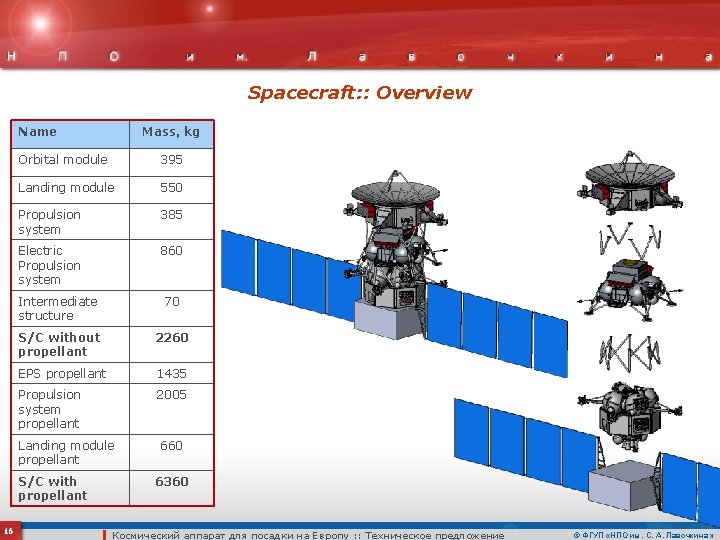
Spacecraft: : Overview Name Mass, kg Orbital module 395 Landing module 550 Propulsion system 385 Electric Propulsion system 860 Intermediate structure 70 S/C without propellant 2260 EPS propellant 1435 Propulsion system propellant 2005 Landing module propellant S/C with propellant 16 660 6360 Космический аппарат для посадки на Европу : : Техническое предложение © ФГУП «НПО им. С. А. Лавочкина»
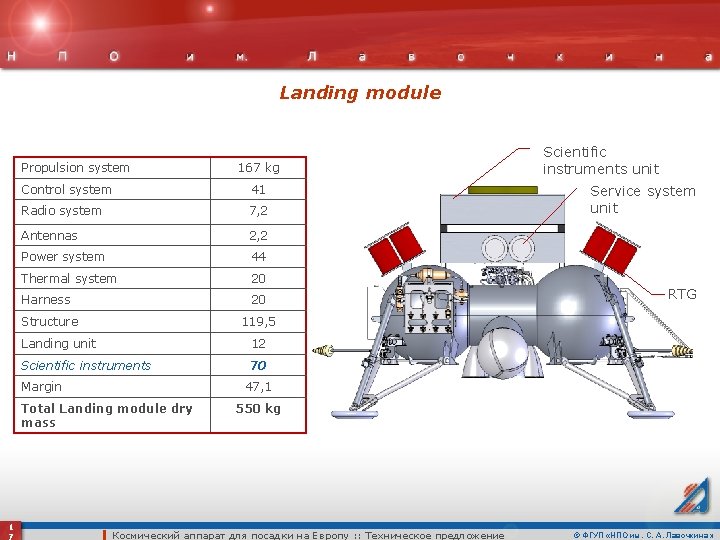
Landing module Propulsion system Control system 41 Radio system 7, 2 Antennas 2, 2 Power system 44 Thermal system 20 Harness 20 Structure Service system unit RTG 119, 5 Landing unit 12 Scientific instruments 70 Margin 47, 1 Total Landing module dry mass 1 7 167 kg Scientific instruments unit 550 kg Космический аппарат для посадки на Европу : : Техническое предложение © ФГУП «НПО им. С. А. Лавочкина»
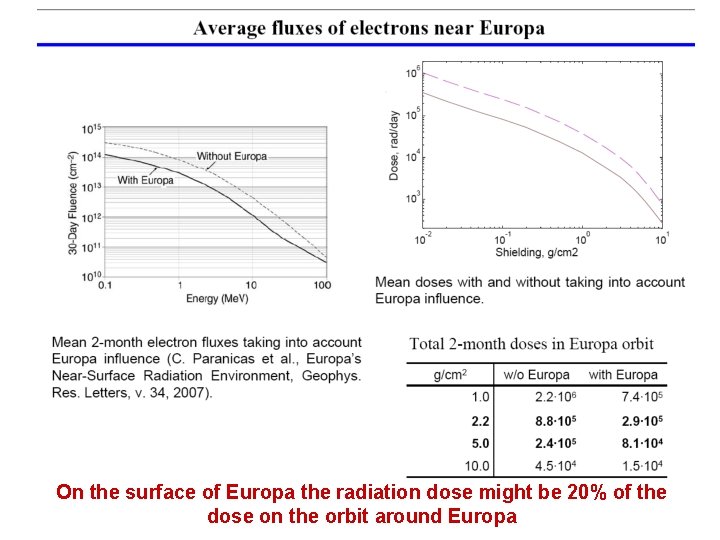
On the surface of Europa the radiation dose might be 20% of the dose on the orbit around Europa
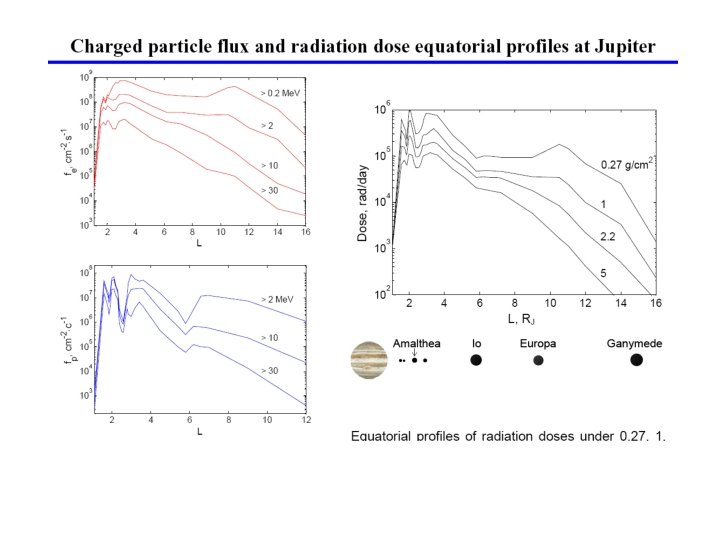
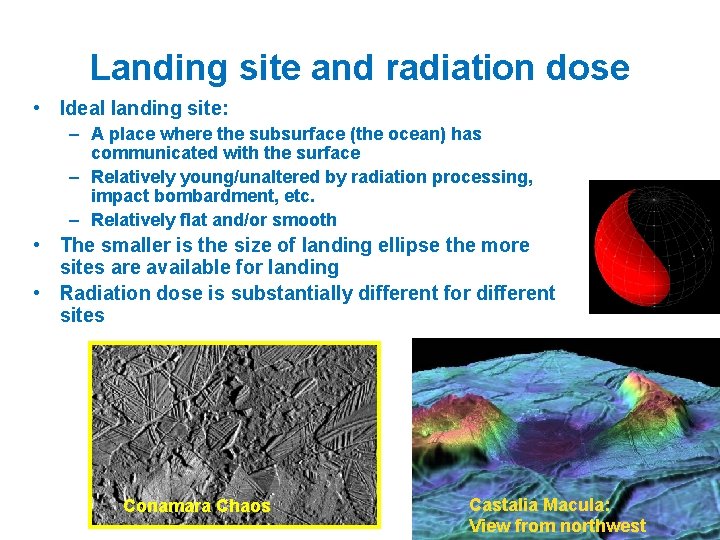
Landing site and radiation dose • Ideal landing site: – A place where the subsurface (the ocean) has communicated with the surface – Relatively young/unaltered by radiation processing, impact bombardment, etc. – Relatively flat and/or smooth • The smaller is the size of landing ellipse the more sites are available for landing • Radiation dose is substantially different for different sites Conamara Chaos Castalia. Geology Macula: View from northwest
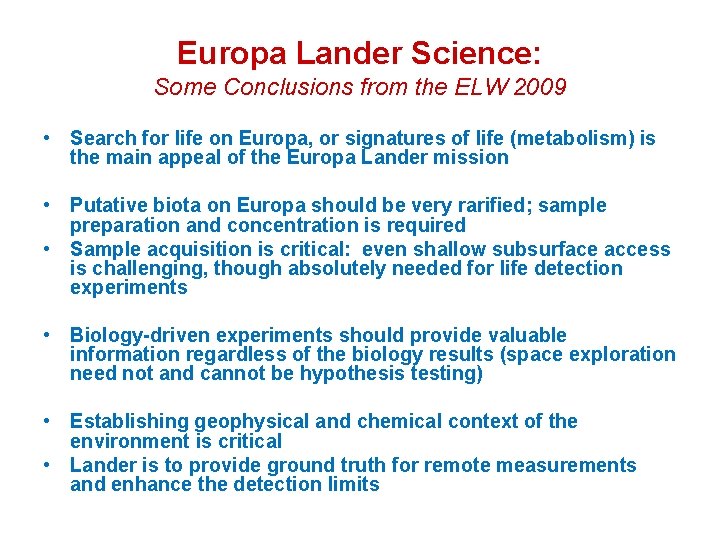
Europa Lander Science: Some Conclusions from the ELW 2009 • Search for life on Europa, or signatures of life (metabolism) is the main appeal of the Europa Lander mission • Putative biota on Europa should be very rarified; sample preparation and concentration is required • Sample acquisition is critical: even shallow subsurface access is challenging, though absolutely needed for life detection experiments • Biology-driven experiments should provide valuable information regardless of the biology results (space exploration need not and cannot be hypothesis testing) • Establishing geophysical and chemical context of the environment is critical • Lander is to provide ground truth for remote measurements and enhance the detection limits
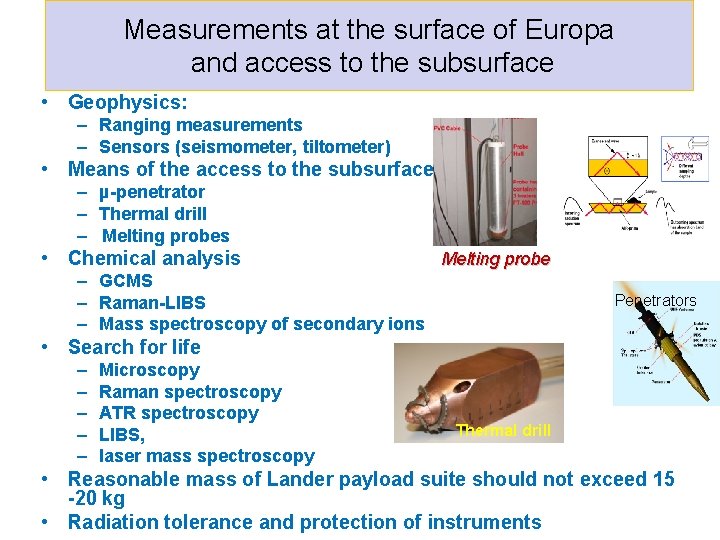
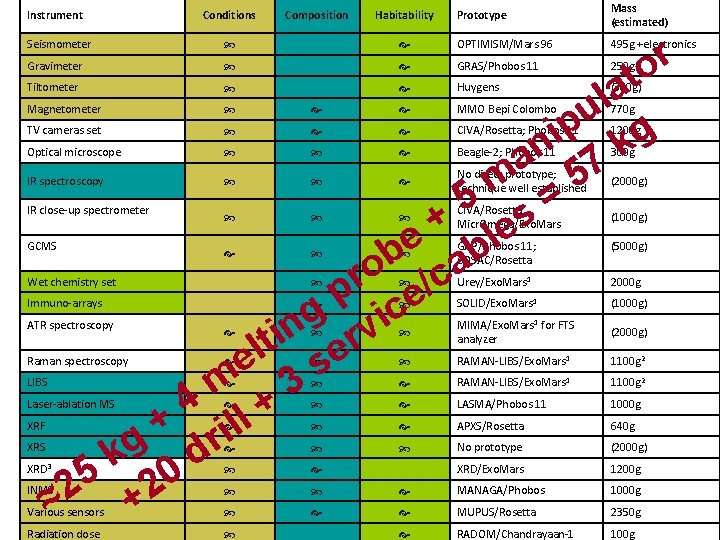
Measurements at the surface of Europa and access to the subsurface • Geophysics: – Ranging measurements – Sensors (seismometer, tiltometer) • Means of the access to the subsurface – µ-penetrator – Thermal drill – Melting probes • Chemical analysis Melting probe – GCMS – Raman-LIBS – Mass spectroscopy of secondary ions Penetrators • Search for life – – – Microscopy Raman spectroscopy ATR spectroscopy LIBS, laser mass spectroscopy Thermal drill • Reasonable mass of Lander payload suite should not exceed 15 -20 kg • Radiation tolerance and protection of instruments
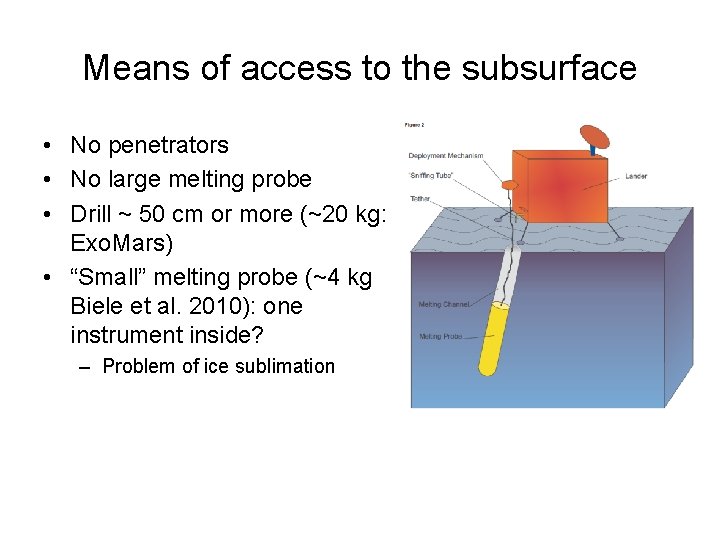
Means of access to the subsurface • No penetrators • No large melting probe • Drill ~ 50 cm or more (~20 kg: Exo. Mars) • “Small” melting probe (~4 kg Biele et al. 2010): one instrument inside? – Problem of ice sublimation
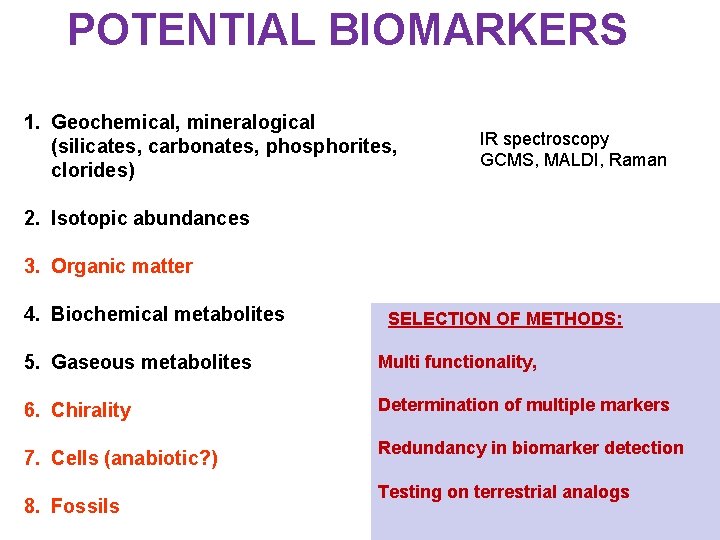
POTENTIAL BIOMARKERS 1. Geochemical, mineralogical (silicates, carbonates, phosphorites, clorides) IR spectroscopy GCMS, MALDI, Raman 2. Isotopic abundances 3. Organic matter 4. Biochemical metabolites SELECTION OF METHODS: 5. Gaseous metabolites Multi functionality, 6. Chirality Determination of multiple markers 7. Cells (anabiotic? ) Redundancy in biomarker detection 8. Fossils Testing on terrestrial analogs
Instrument Conditions Composition Habitability Prototype Mass (estimated) r to Seismometer OPTIMISM/Mars 96 495 g +electronics Gravimeter GRAS/Phobos 11 250 g Tiltometer Huygens (300 g) Magnetometer MMO Bepi Colombo 770 g TV cameras set CIVA/Rosetta; Phobos 11 1200 g Optical microscope Beagle-2; Phobos 11 300 g IR spectroscopy No direct prototype; technique well established (2000 g) CIVA/Rosetta Micr. Omega/Exo. Mars (1000 g) GAP/Phobos 11; COSAC/Rosetta (5000 g) Wet chemistry set Urey/Exo. Mars 1 2000 g Immuno-arrays SOLID/Exo. Mars 1 (1000 g) MIMA/Exo. Mars 1 for FTS analyzer (2000 g) Raman spectroscopy RAMAN-LIBS/Exo. Mars 1 1100 g 2 LIBS RAMAN-LIBS/Exo. Mars 1 1100 g 2 Laser-ablation MS LASMA/Phobos 11 1000 g XRF APXS/Rosetta 640 g No prototype (2000 g) XRD 3 XRD/Exo. Mars 1200 g INMS MANAGA/Phobos 1000 g Various sensors MUPUS/Rosetta 2350 g Radiation dose RADOM/Chandrayaan-1 100 g a l u p kg i n a 57 m 5 s= + e l e b b a o /c r p ce g vi n i r t l e se m 3 4 l+ + ril g d k 0 5 2 ≈2 + IR close-up spectrometer GCMS ATR spectroscopy XRS
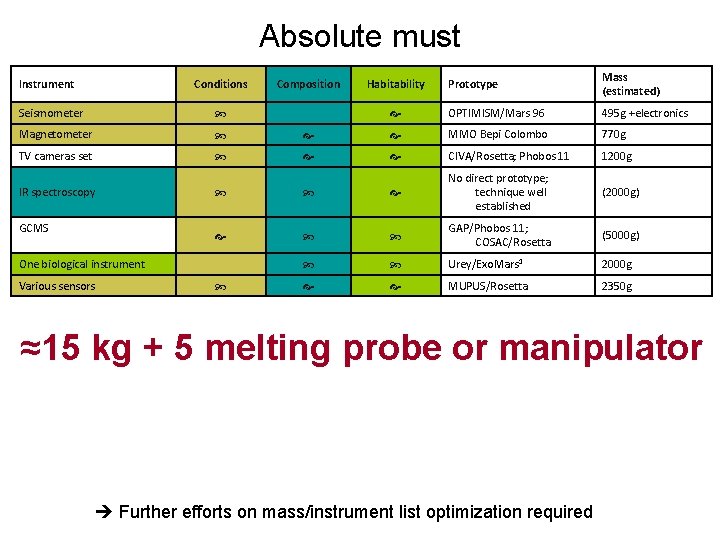
Absolute must Instrument Conditions Composition Prototype Mass (estimated) OPTIMISM/Mars 96 495 g +electronics Habitability Seismometer Magnetometer MMO Bepi Colombo 770 g TV cameras set CIVA/Rosetta; Phobos 11 1200 g (2000 g) IR spectroscopy GCMS No direct prototype; technique well established GAP/Phobos 11; COSAC/Rosetta (5000 g) Urey/Exo. Mars 1 2000 g MUPUS/Rosetta 2350 g One biological instrument Various sensors ≈15 kg + 5 melting probe or manipulator Further efforts on mass/instrument list optimization required
Laplace-Europa Lander mission • Mission included in the project of Federal Space Programme • (Target launch date 2020 -2021) • Launch: Proton + Breese-M, or equivalent heavy launcher (Angara…) • Mission Profile: – Transfer to Jupiter with Earth fly-by – Jupiter maneuver; multiple fly-bys of Ganimede, Callisto and Europa; Orbiting Europa (overall duration of 6. 5 -7 years) – Landing onto Europa surface, analysis of surface, and, possible shell subsurface material. – Data link via orbital spacecraft; limited direct radiolink to the Earth possible using advanced VLBI • Recurrent technical solutions – Orbital module, and Cruise module: Phobos SR (major modifications) – Landing module Luna-Resource (planned launch date 2013 , – major technology developments) • International context: – Europa Lander mission will be parallel to NASA/ESA EJSM-Laplace. NASA – EJSM Europa Orbiter data might be used for the choice of the landing sites
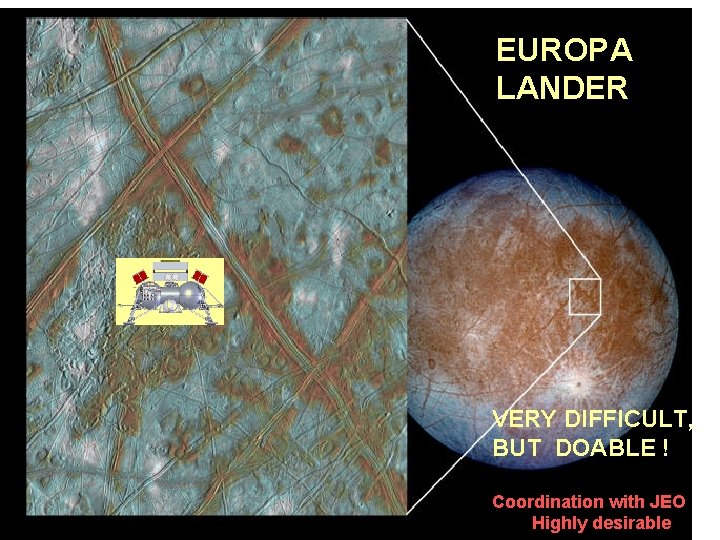
EUROPA LANDER VERY DIFFICULT, BUT DOABLE ! Coordination with JEO Highly desirable