
EUROGRAPHICS 2005 Presenter JongHyun Kim Abstract We present
EUROGRAPHICS 2005 Presenter : Jong-Hyun Kim
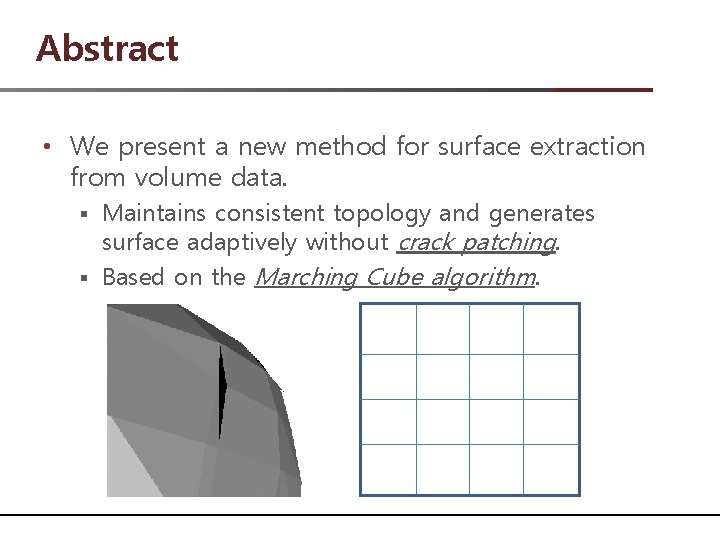
Abstract • We present a new method for surface extraction from volume data. Maintains consistent topology and generates surface adaptively without crack patching. § Based on the Marching Cube algorithm. §
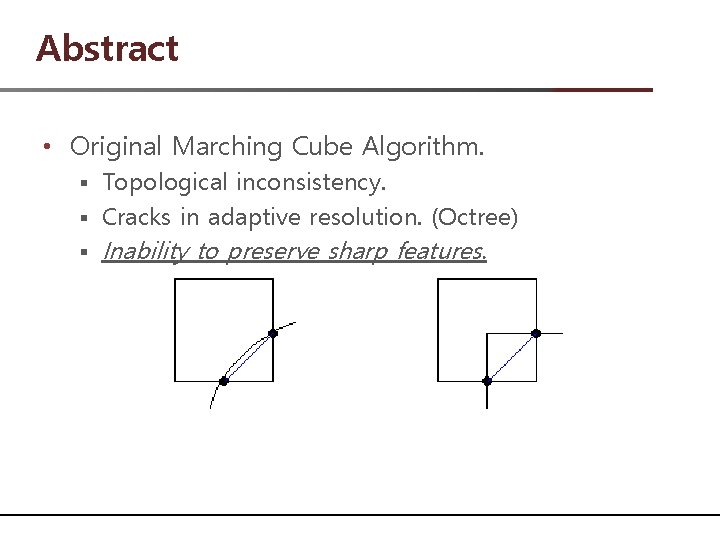
Abstract • Original Marching Cube Algorithm. Topological inconsistency. § Cracks in adaptive resolution. (Octree) § § Inability to preserve sharp features.
Abstract • Our method provides simple and easy to implement solution to all these problems. Converting 3 D marching cubes into 2 D cubical marching squares. § Resolving topology ambiguity with sharp features and eliminating inter-cell dependency by face sharp § features. § We compare our algorithm with other marching cubes variations and demonstrate its effectiveness on various applications.
Introduction • To display the volumetric data efficiently, the wellknown marching cubes algorithm and …. § § § Topological inconsistency. cracks in adaptive resolution. Inability to preserve sharp features.
Introduction • The first problem with the original marching cubes algorithm is topological inconsistency. Because of topology ambiguities. § When there are more than on feasible assignments for a case in the lookup table of marching cubes. § • The second problem is cracks in adaptive resolution. § Cracks at the interfaces of grid cells at different resolution. § Such a problem is often overcome by crack patching.
Introduction While Crack patching is effective, it often stretches the high-resolution edges to match with low resolution edges. § Hence does not take full advantage of the finerresolution data. § • The third problem is the inability to preserve sharp features. § The main idea for solving the problem is to find the exact intersection of the zero-crossing points’ tangent planes.
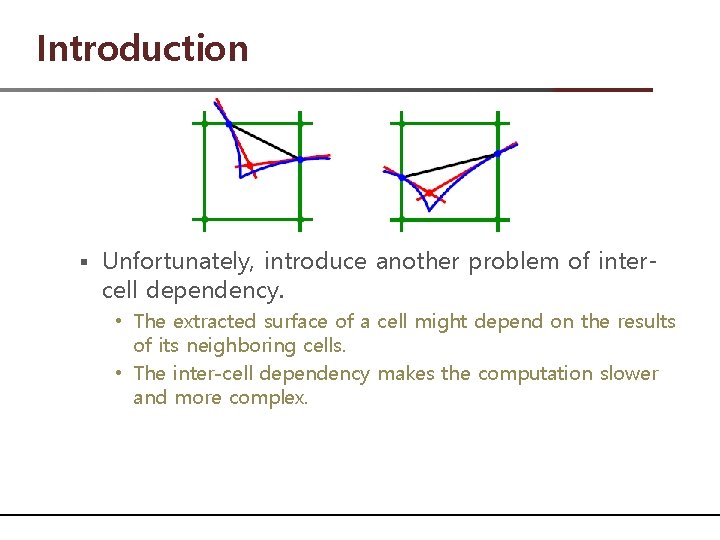
Introduction § Unfortunately, introduce another problem of intercell dependency. • The extracted surface of a cell might depend on the results of its neighboring cells. • The inter-cell dependency makes the computation slower and more complex.
Introduction • To sum up, current marching-cube-style techniques. § Topological inconsistency. § cracks in adaptive resolution. § Sharp feature preservation and inter-cell dependency. • In this paper, we propose a new solution that converts the marching cubes into cubical marching cubes. • We call this method cubical marching squares(CMS)
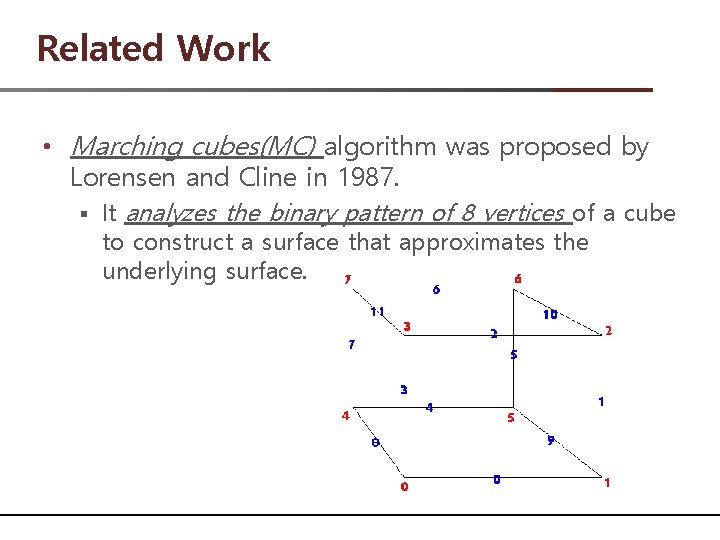
Related Work • Marching cubes(MC) algorithm was proposed by Lorensen and Cline in 1987. § It analyzes the binary pattern of 8 vertices of a cube to construct a surface that approximates the underlying surface.
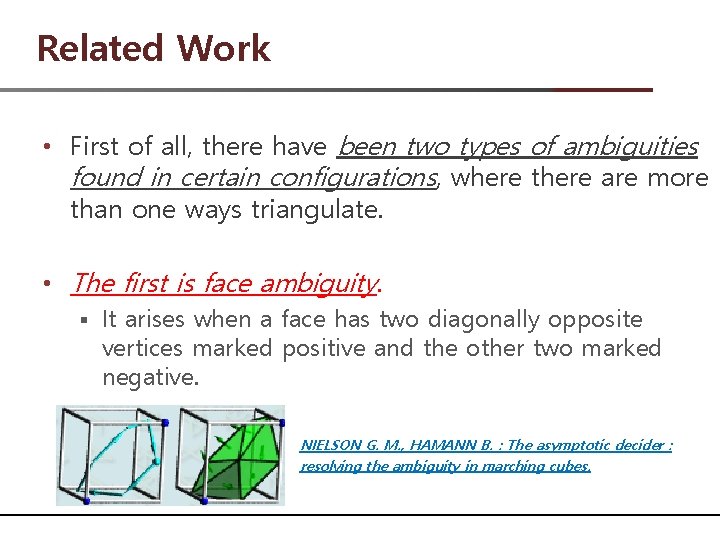
Related Work • First of all, there have been two types of ambiguities found in certain configurations, where there are more than one ways triangulate. • The first is face ambiguity. § It arises when a face has two diagonally opposite vertices marked positive and the other two marked negative. NIELSON G. M. , HAMANN B. : The asymptotic decider : resolving the ambiguity in marching cubes.
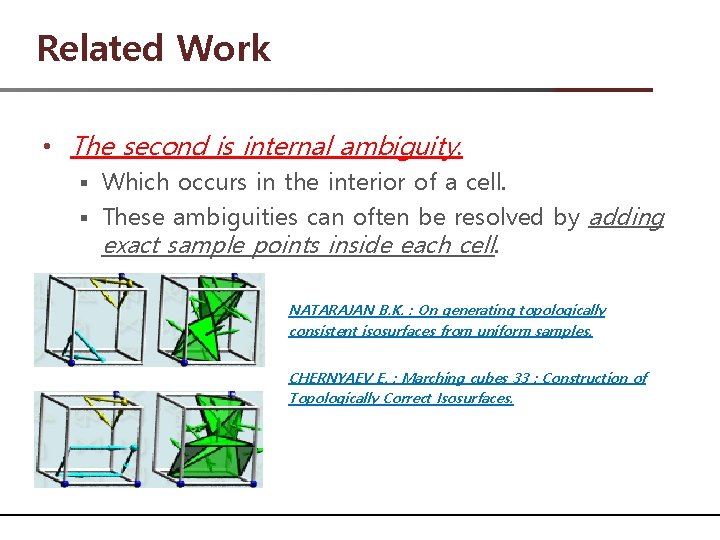
Related Work • The second is internal ambiguity. Which occurs in the interior of a cell. § These ambiguities can often be resolved by adding exact sample points inside each cell. § NATARAJAN B. K. : On generating topologically consistent isosurfaces from uniform samples. CHERNYAEV E. : Marching cubes 33 : Construction of Topologically Correct Isosurfaces.
Related Work § To determine these extra points, many methods assume that “the implicit function of the volumetric data is linear along an edge; bilinear on a face; and trilinear inside a cell. ” § § On face : NIELSON G. M. , HAMANN B. : The asymptotic decider : resolving the ambiguity in marching cubes. Inside the cells : LOPES A. , BRODLIE K. : Improving the robust-ness and accuracy of the marching cubes algorithm for isosurfacing. NIELSON G. M : On marching cubes.
Related Work § More recently, Lewiner et al. provide an efficient and complete implementation of Chernyaev’s method. LEWINER T. , LOPES H. , VIEIRA A. W. , TAVARES G, : Efficient implementation of marching cubes’ case with topological guarantees. § We call these algorithms topology-consistent marching cubes(TMC) in this paper.
Related Work • To reduce the number of triangles, several methods have been developed to apply marching cubes algorithm to an adaptive gird, such as an octree. WILHELMS J. , GELDER A. V. : Octree for faster isosurface generation. SHU R. , CHEN Z. , KANKANHALLI M. S. : Adaptive marching cubes. • Crack patching is performed to fill cracks where two cells of different resolution meet. SHEKHAR R. , FAYYAD E. , YAGEL G. , CORNHILL J. F. : Octree-based decimation of marching cubes surface. • Heidrich et al also propose a real-time adaptive isosurfacing method HEIDRICH W. , SEIDEL R. W. H-P. , ERTL T. : Real-time exploration of regular volume data by adaptive reconstruction of iso-surfaces.
Related Work • The original marching cubes algorithm does not represent sharp features well. • By using extra information of normals. KOBBELT L. P. , BOTSCH M. , SCHWANECKE U. , SEIDEL H. –P. : Feature sensitive surface extraction from volume data. • Ju et al. propose dual contouring(DC). JU T. , LOSASSO F. , SCHAEFER S. , WARREN J. : Doual contouring of hermite data. GIBSON S. F. F. : Using distance maps for accurate surface representation in sampled volumes.
Related Work • Their method preserves sharp features and prevents holes and cracks in adaptive resolution. § These methods do not resolve ambiguous cases and may have holes due to topological error. ZHANG N. , HONG W. , KAUFMAN A. : Dual contouring with tolpologypreserving simplification using enhanced cell representation. SCHAEFER S. , WARREN J. : Dual Marching cubes : Primal contouring of dual grid. VARADHAN G. , KRISHNAN S. , KIM Y. , MANOCHA D. : Feature-sensitive subdivision and isosurface reconstruction. VARADHAN G. , KRISHNAN S. , SRIRAM T. , MANOCHA D. : Topology preserving surface extraction using adaptive subdivision. Feature-sensitive subdivision and isosurface reconstruction.
Related Work • Another related work is the method proposed by Rodehorst and Kimia RODEHORST M. , J. , KIMIA. B : Sub-voxel polygonization of discrete I implicit surfaces using ENO interpolation. • Called ENO anchor point, on an edge of a cell. • They prove that there at most two anchor points on edge and allow an edge have two zero-crossing points. • The surface is reconstructed by triangulating these anchor points. • Triangulation is performed step by step. § Adding one triangle at a time. Until all anchor points are triangulated.
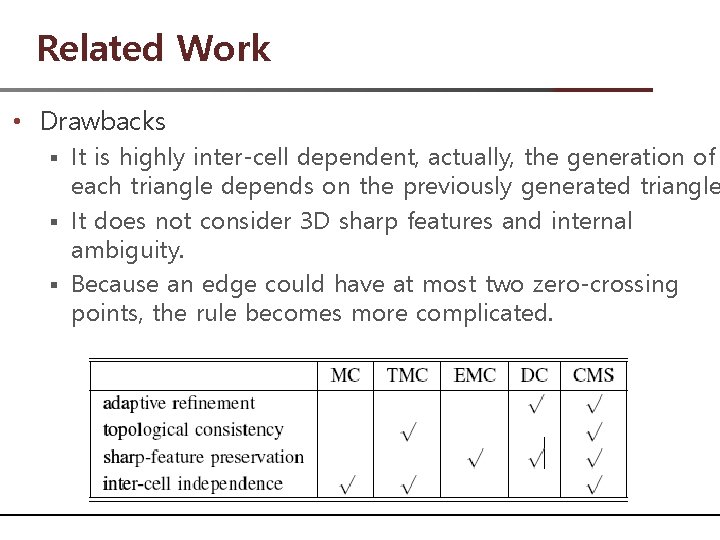
Related Work • Drawbacks It is highly inter-cell dependent, actually, the generation of each triangle depends on the previously generated triangle § It does not consider 3 D sharp features and internal ambiguity. § Because an edge could have at most two zero-crossing points, the rule becomes more complicated. §
Cubical Marching Squares (input) • The first step is to convert different types of geometric representation into a uniformat. (DC) § Hermite Data (intersection point & normal) • The Hermite data is acquired at a very fine resolution. § A uniform gird. • Our algorithm then generates a polygonal approximation for the Hermite data without referring to the original geometric representation.
Cubical Marching Squares (Algorithm overview) • Our algorithm is built on the following ideas Marching cubes can be unfolded as marching squares. § Inter-cell dependency can be eliminated by adding sharp feature on faces § Sample normals can be used not only to sample sharp features but also to solve ambiguities and to maintain consistent topology. § As shown in Figure 1, a cube can be unfolded into six faces. §
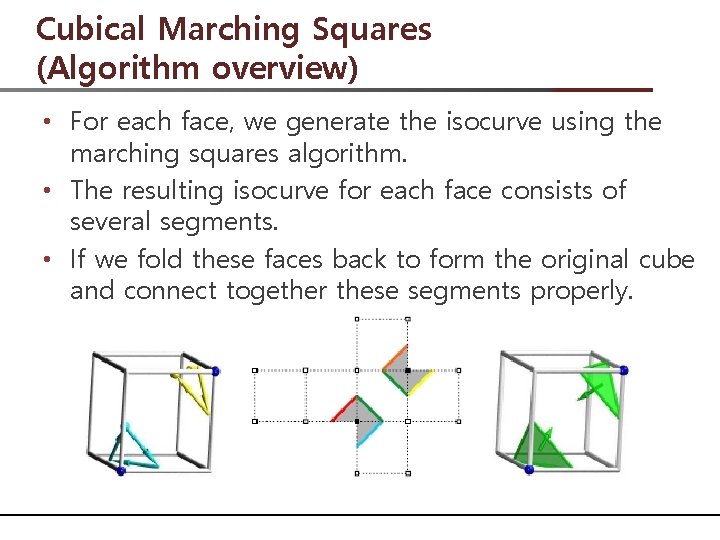
Cubical Marching Squares (Algorithm overview) • For each face, we generate the isocurve using the marching squares algorithm. • The resulting isocurve for each face consists of several segments. • If we fold these faces back to form the original cube and connect together these segments properly.
Cubical Marching Squares (Algorithm overview) • We obtain exactly the same components as marching cube algorithm does. • Finally these components are triangulated to generate the isosurface. • The triangulation can be chosen arbitrarily as long as it is consistent. • Hence a marching cube table lookup can be converted to six marching square table lookups. We call this method cubical marching squares
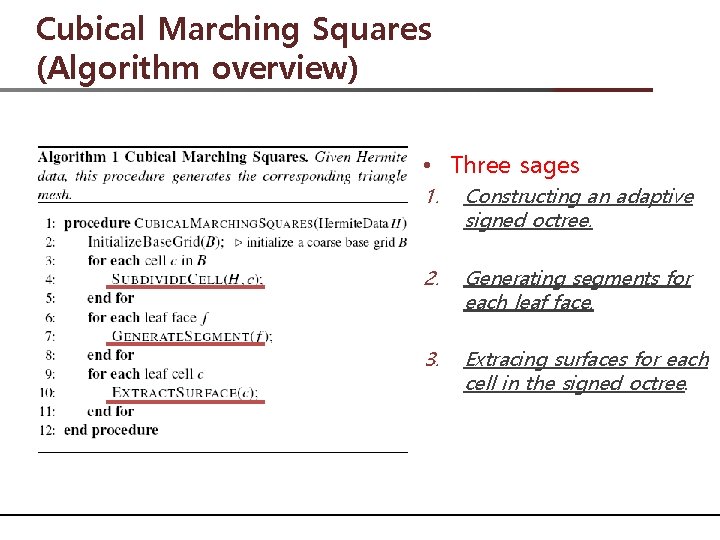
Cubical Marching Squares (Algorithm overview) • Three sages 1. Constructing an adaptive signed octree. 2. Generating segments for each leaf face. 3. Extracing surfaces for each cell in the signed octree.
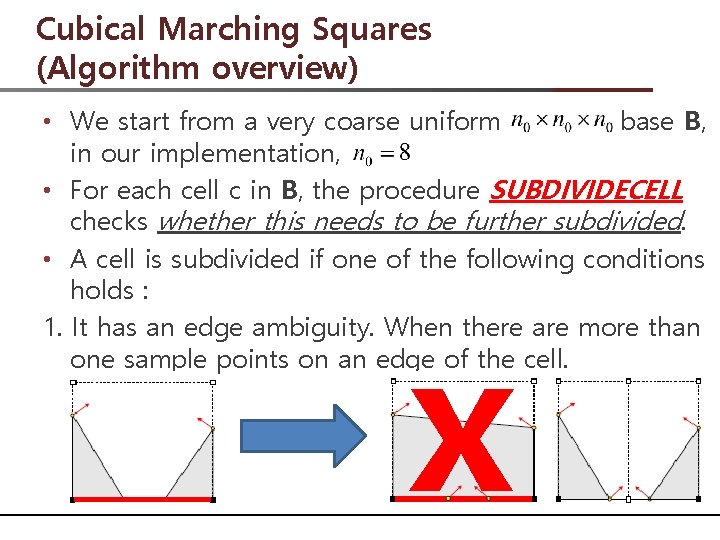
Cubical Marching Squares (Algorithm overview) • We start from a very coarse uniform base B, in our implementation, • For each cell c in B, the procedure SUBDIVIDECELL checks whether this needs to be further subdivided. • A cell is subdivided if one of the following conditions holds : 1. It has an edge ambiguity. When there are more than one sample points on an edge of the cell. x
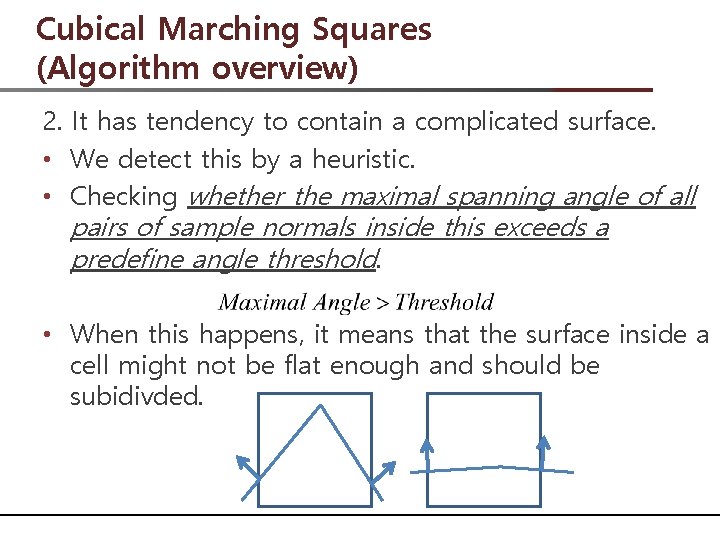
Cubical Marching Squares (Algorithm overview) 2. It has tendency to contain a complicated surface. • We detect this by a heuristic. • Checking whether the maximal spanning angle of all pairs of sample normals inside this exceeds a predefine angle threshold. • When this happens, it means that the surface inside a cell might not be flat enough and should be subidivded.
Cubical Marching Squares (Algorithm overview) • Each face is subdivided into four subfaces and the relationships between subcells and subfaces are recorded. • We stop the subdivision if it exceeds the maximal level of subdivision, k. • Hence, the finest resolution is • The result of this subdivision step is an adaptive signed octree. • A cell in the octree is called a leaf cell if it does not have subfaces. • A face is called a leaf face if it does not have subfaces.
Cubical Marching Squares (Algorithm overview) • The face shared by two cells subdivided at two different levels is called a transition face. • Cracks could happen if the transition faces are not handled properly.
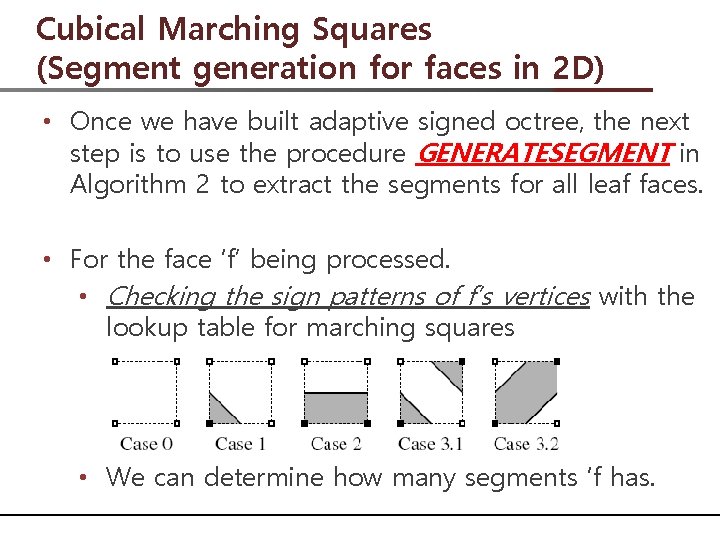
Cubical Marching Squares (Segment generation for faces in 2 D) • Once we have built adaptive signed octree, the next step is to use the procedure GENERATESEGMENT in Algorithm 2 to extract the segments for all leaf faces. • For the face ‘f’ being processed. • Checking the sign patterns of f’s vertices with the lookup table for marching squares • We can determine how many segments ‘f has.
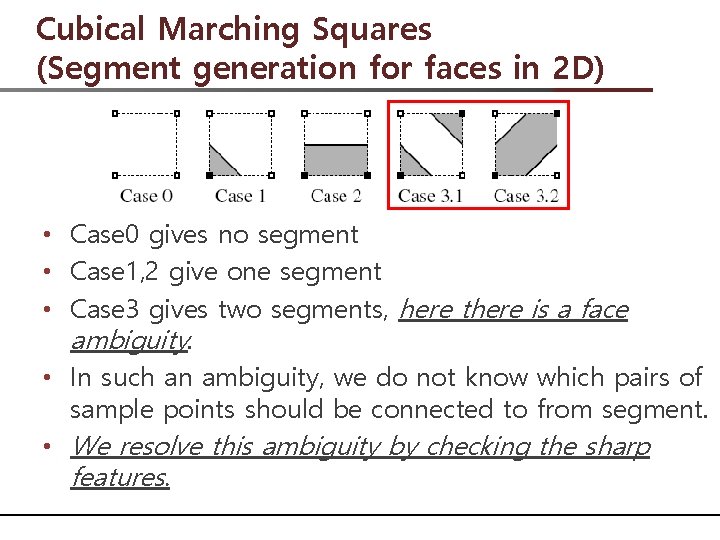
Cubical Marching Squares (Segment generation for faces in 2 D) • Case 0 gives no segment • Case 1, 2 give one segment • Case 3 gives two segments, here there is a face ambiguity. • In such an ambiguity, we do not know which pairs of sample points should be connected to from segment. • We resolve this ambiguity by checking the sharp features.
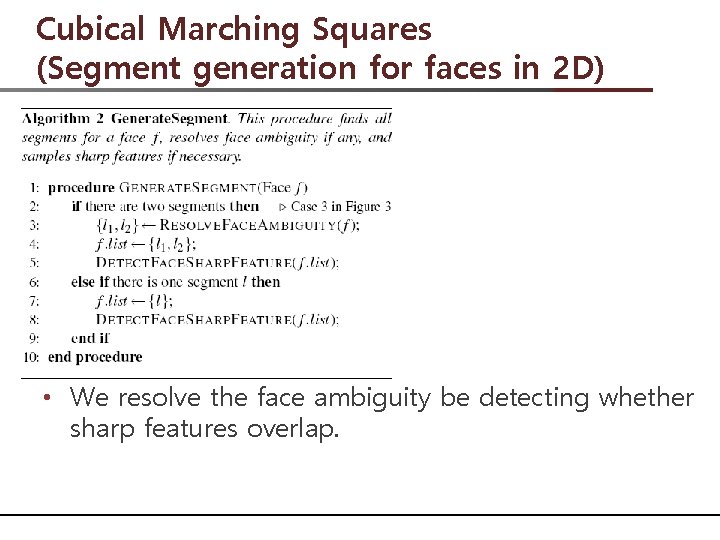
Cubical Marching Squares (Segment generation for faces in 2 D) • We resolve the face ambiguity be detecting whether sharp features overlap.
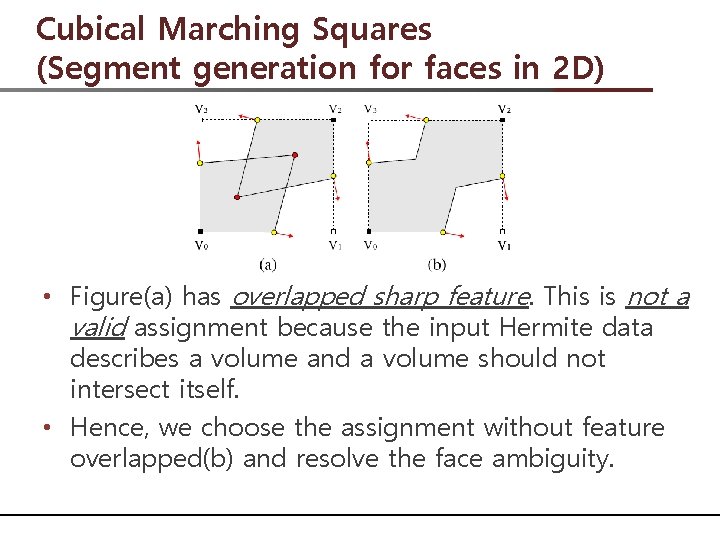
Cubical Marching Squares (Segment generation for faces in 2 D) • Figure(a) has overlapped sharp feature. This is not a valid assignment because the input Hermite data describes a volume and a volume should not intersect itself. • Hence, we choose the assignment without feature overlapped(b) and resolve the face ambiguity.
Cubical Marching Squares (Segment generation for faces in 2 D) • Finally, for each segment, we detect if there is a face sharp feature on the segment by testing whether the angle between two normals are large enough. • If there is a sharp feature, we tag the segment and store the position. • This face sharp feature is used to remove the intercell dependency.
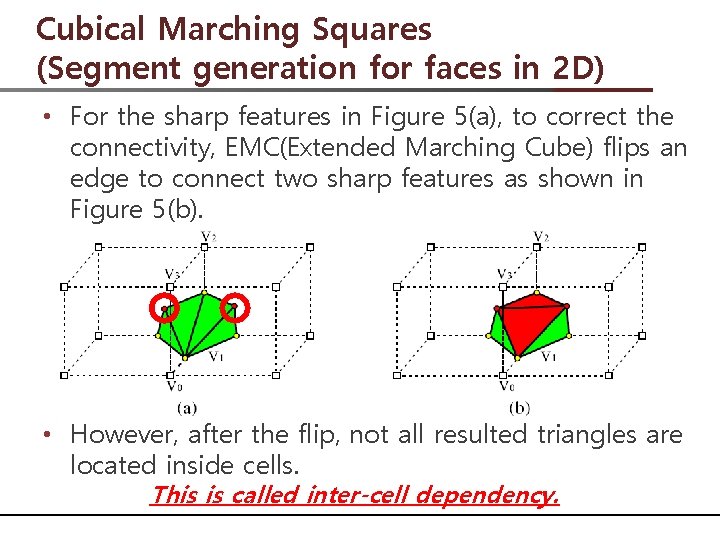
Cubical Marching Squares (Segment generation for faces in 2 D) • For the sharp features in Figure 5(a), to correct the connectivity, EMC(Extended Marching Cube) flips an edge to connect two sharp features as shown in Figure 5(b). • However, after the flip, not all resulted triangles are located inside cells. This is called inter-cell dependency.
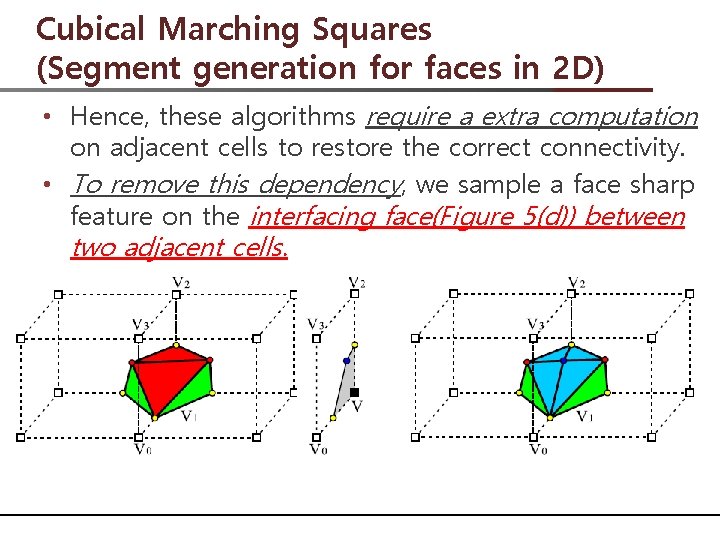
Cubical Marching Squares (Segment generation for faces in 2 D) • Hence, these algorithms require a extra computation on adjacent cells to restore the correct connectivity. • To remove this dependency, we sample a face sharp feature on the interfacing face(Figure 5(d)) between two adjacent cells.
Cubical Marching Squares (Segment generation for faces in 2 D) • After this stage, for each leaf face, we find all segments of this face. • A leaf face could have at most four line segments if it has two sharp features. • However, a non-leaf face could have a set of segments representing very complicated piecewise linear curves.
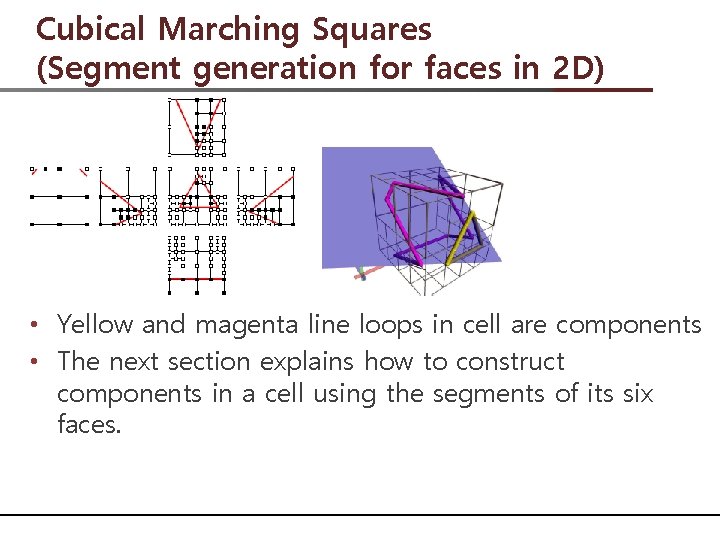
Cubical Marching Squares (Segment generation for faces in 2 D) • Yellow and magenta line loops in cell are components • The next section explains how to construct components in a cell using the segments of its six faces.
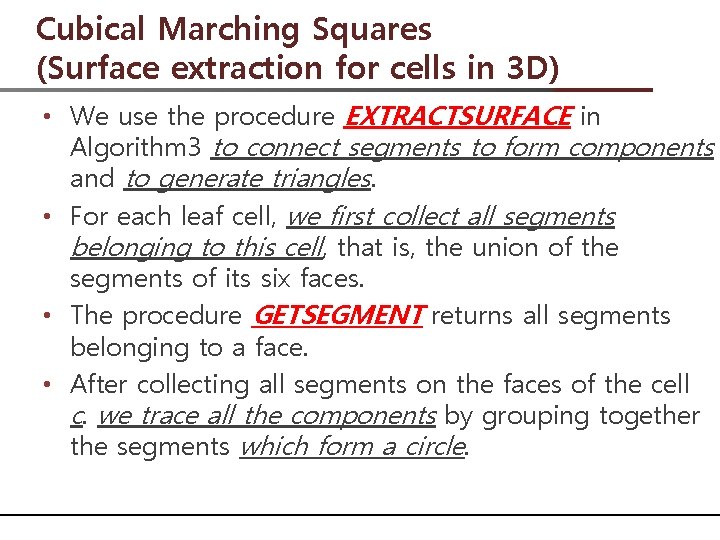
Cubical Marching Squares (Surface extraction for cells in 3 D) • We use the procedure EXTRACTSURFACE in Algorithm 3 to connect segments to form components and to generate triangles. • For each leaf cell, we first collect all segments belonging to this cell, that is, the union of the segments of its six faces. • The procedure GETSEGMENT returns all segments belonging to a face. • After collecting all segments on the faces of the cell c. we trace all the components by grouping together the segments which form a circle.
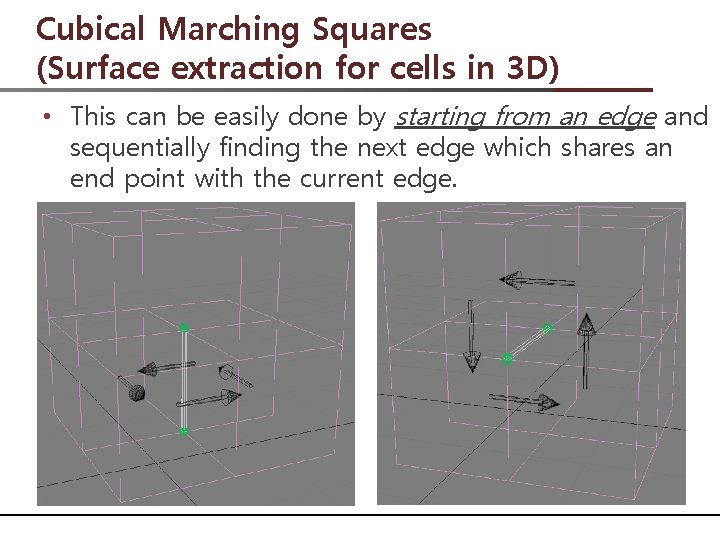
Cubical Marching Squares (Surface extraction for cells in 3 D) • This can be easily done by starting from an edge and sequentially finding the next edge which shares an end point with the current edge.
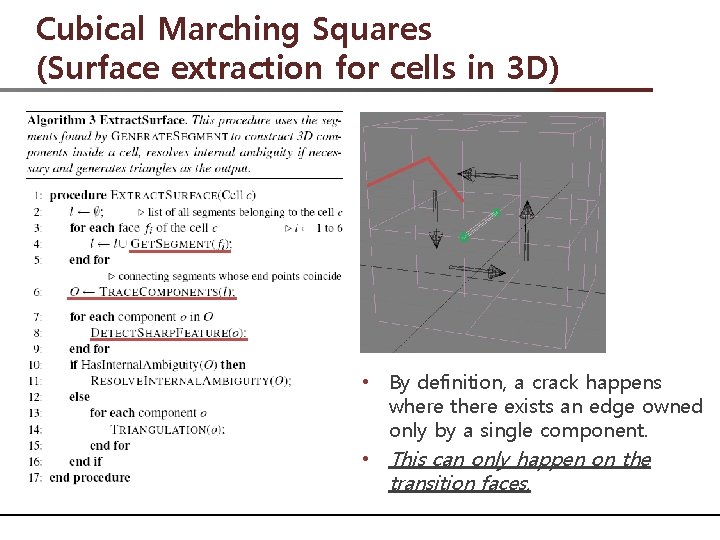
Cubical Marching Squares (Surface extraction for cells in 3 D) • By definition, a crack happens where there exists an edge owned only by a single component. • This can only happen on the transition faces.
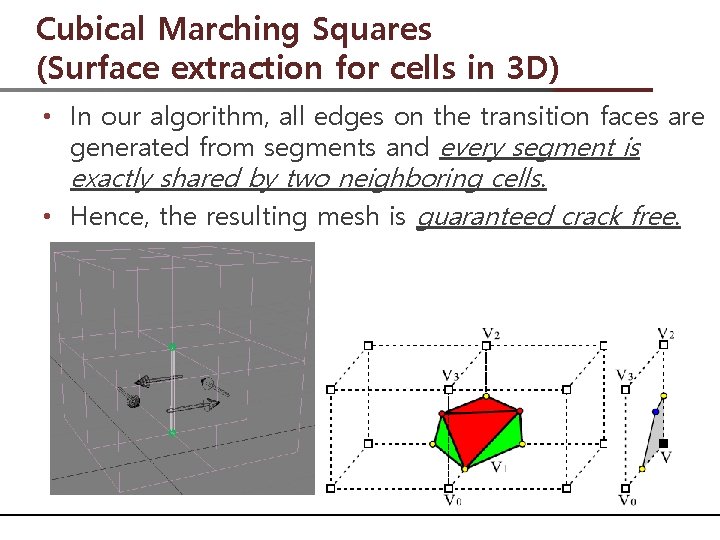
Cubical Marching Squares (Surface extraction for cells in 3 D) • In our algorithm, all edges on the transition faces are generated from segments and every segment is exactly shared by two neighboring cells. • Hence, the resulting mesh is guaranteed crack free.
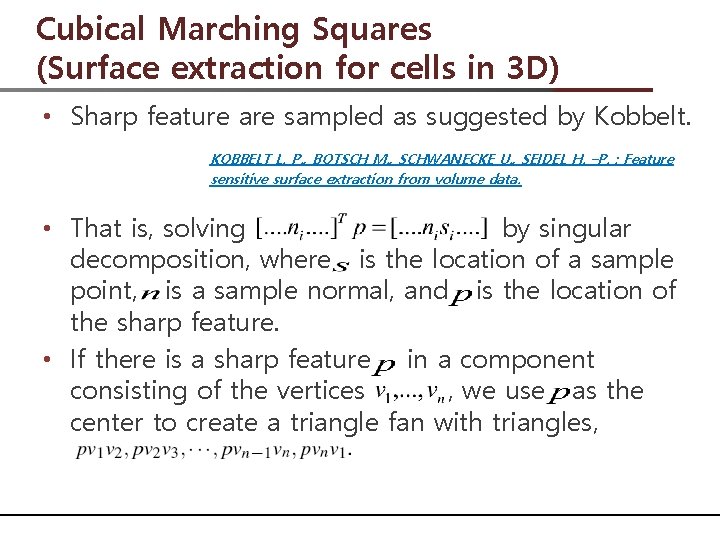
Cubical Marching Squares (Surface extraction for cells in 3 D) • Sharp feature are sampled as suggested by Kobbelt. KOBBELT L. P. , BOTSCH M. , SCHWANECKE U. , SEIDEL H. –P. : Feature sensitive surface extraction from volume data. • That is, solving by singular decomposition, where is the location of a sample point, is a sample normal, and is the location of the sharp feature. • If there is a sharp feature in a component consisting of the vertices , we use as the center to create a triangle fan with triangles,
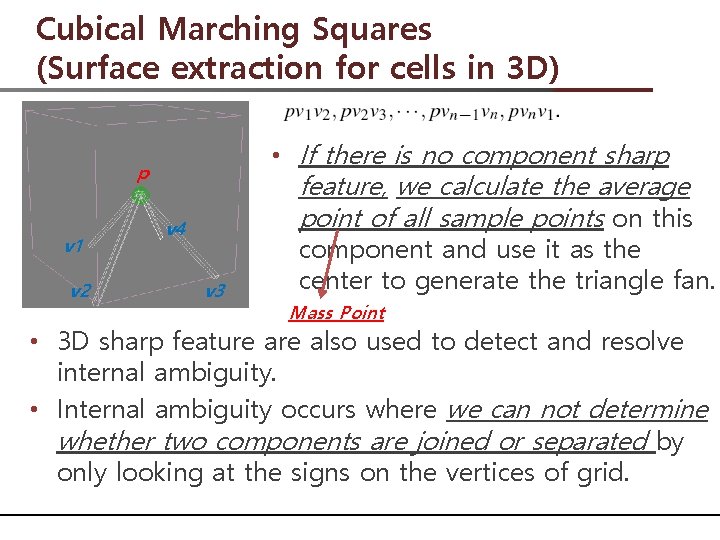
Cubical Marching Squares (Surface extraction for cells in 3 D) p v 1 v 2 v 4 v 3 • If there is no component sharp feature, we calculate the average point of all sample points on this component and use it as the center to generate the triangle fan. Mass Point • 3 D sharp feature also used to detect and resolve internal ambiguity. • Internal ambiguity occurs where we can not determine whether two components are joined or separated by only looking at the signs on the vertices of grid.
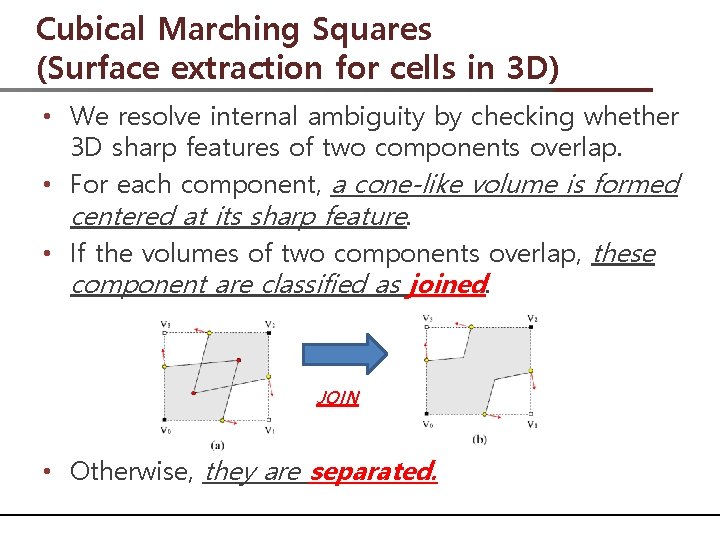
Cubical Marching Squares (Surface extraction for cells in 3 D) • We resolve internal ambiguity by checking whether 3 D sharp features of two components overlap. • For each component, a cone-like volume is formed centered at its sharp feature. • If the volumes of two components overlap, these component are classified as joined. JOIN • Otherwise, they are separated.
Cubical Marching Squares (Surface extraction for cells in 3 D) • If two components are joined, the resulting surface is topologically equivalent to cylinder. • We use a dynamic programming algorithm to connect and triangulate these two components to form the surface.
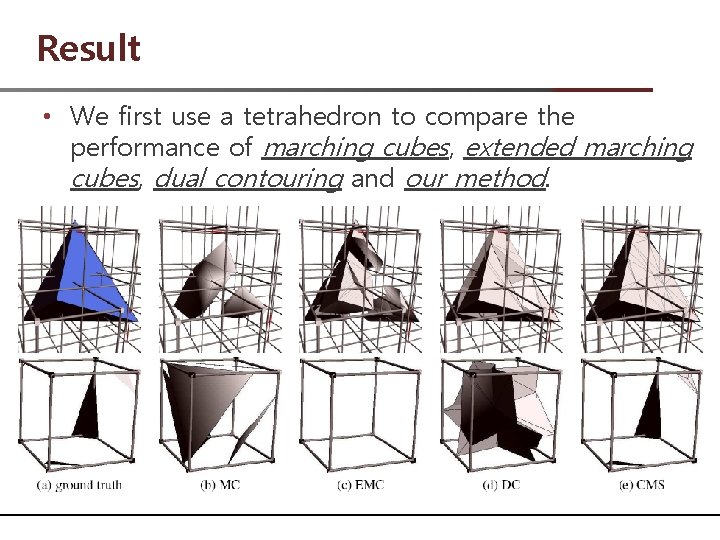
Result • We first use a tetrahedron to compare the performance of marching cubes, extended marching cubes, dual contouring and our method.
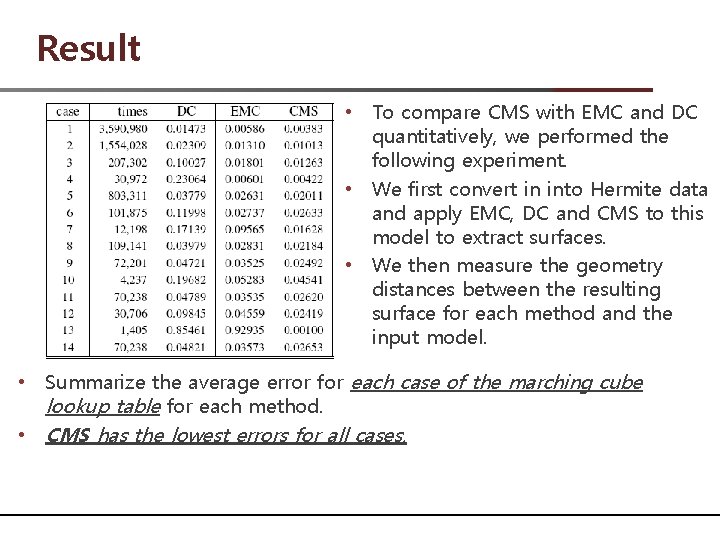
Result • To compare CMS with EMC and DC quantitatively, we performed the following experiment. • We first convert in into Hermite data and apply EMC, DC and CMS to this model to extract surfaces. • We then measure the geometry distances between the resulting surface for each method and the input model. • Summarize the average error for each case of the marching cube lookup table for each method. • CMS has the lowest errors for all cases.
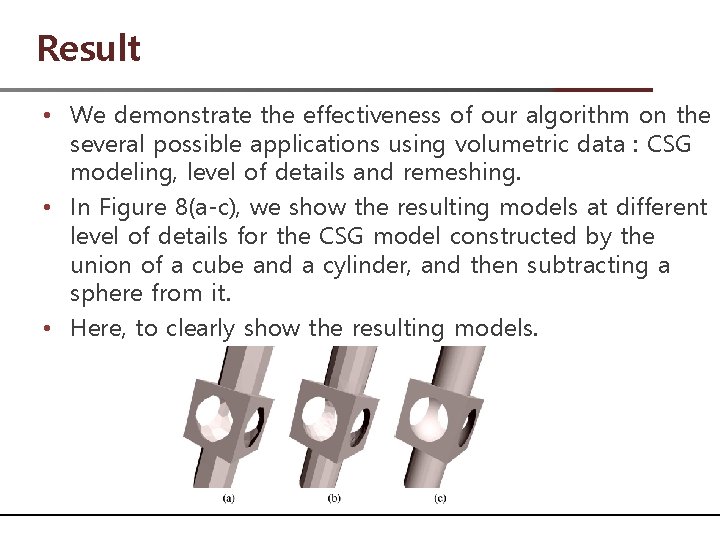
Result • We demonstrate the effectiveness of our algorithm on the several possible applications using volumetric data : CSG modeling, level of details and remeshing. • In Figure 8(a-c), we show the resulting models at different level of details for the CSG model constructed by the union of a cube and a cylinder, and then subtracting a sphere from it. • Here, to clearly show the resulting models.
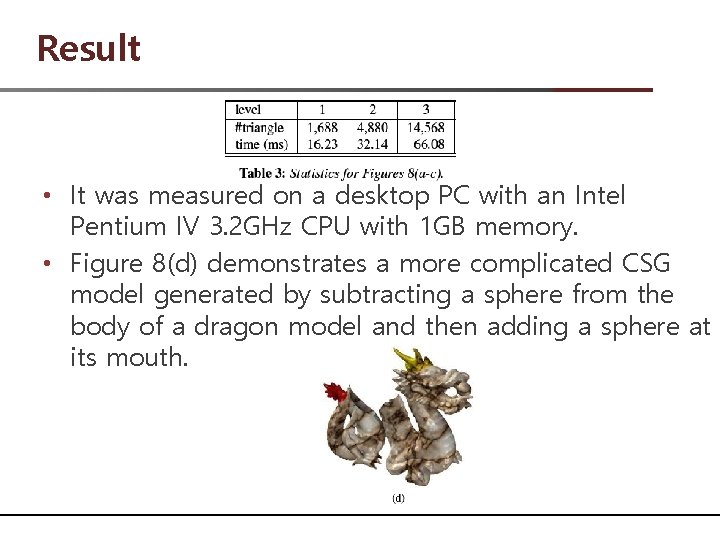
Result • It was measured on a desktop PC with an Intel Pentium IV 3. 2 GHz CPU with 1 GB memory. • Figure 8(d) demonstrates a more complicated CSG model generated by subtracting a sphere from the body of a dragon model and then adding a sphere at its mouth.
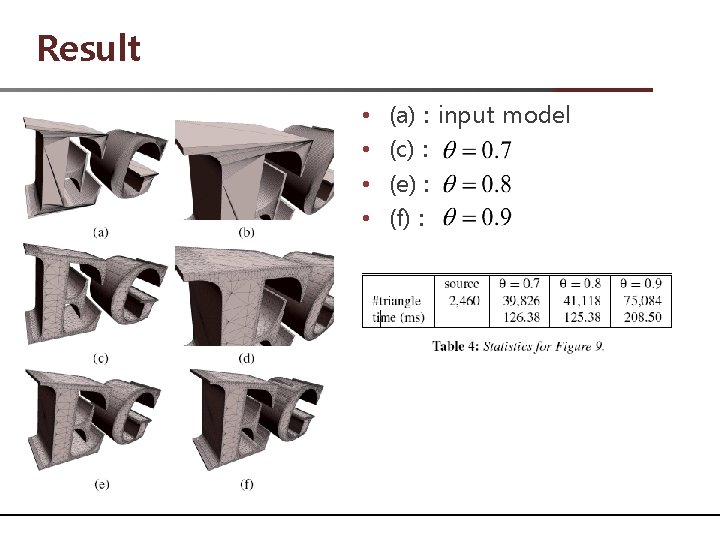
Result • • (a) : input model (c) : (e) : (f) :
Conclusion • This method has the following unique features • 1. Hermite data is used to solve the problem of topological ambiguity. • 2. the problem of cracks between adjacent cells when using a multi-resolution representation for the data is solved without crack patching because the shared geometric component is common. • 3. 3 D features can be reconstructed starting from the 2 D features located on the faces of the cells • This avoids inter-cell dependencies These features make our method quite simple, relatively easy to implement and, at the same time, effective.

Conclusion • We have partially implemented our algorithm on GPU. However, the resulting speed only comparable to our CPU implementation. • As many other GPU algorithms, the bottleneck is the data transfer between CPU and GPU. • In the future, we plan to fully implement our algorithm on GPU. We believe that our algorithm will benefit from the improvement on the bus bandwidth between CPU and GPU.
- Slides: 52