
EUROGRAPHICS 2003 On Visual Similarity Based 3 D

EUROGRAPHICS 2003 On Visual Similarity Based 3 D Model Retrieval Ding-Yun Chen | Xiao-Pei Tian | Yu-Te Shen | Ming Ouhyoung Department of Computer Science and Information Engineering, National Taiwan University 2021/3/9
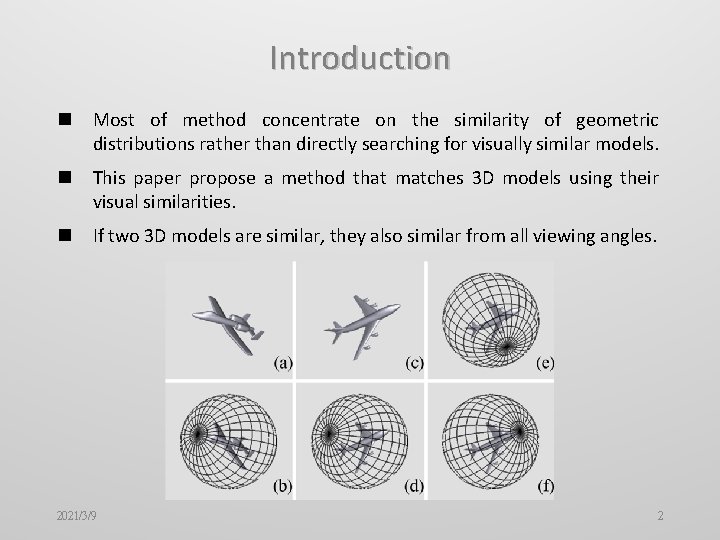
Introduction n Most of method concentrate on the similarity of geometric distributions rather than directly searching for visually similar models. n This paper propose a method that matches 3 D models using their visual similarities. n If two 3 D models are similar, they also similar from all viewing angles. 2021/3/9 2
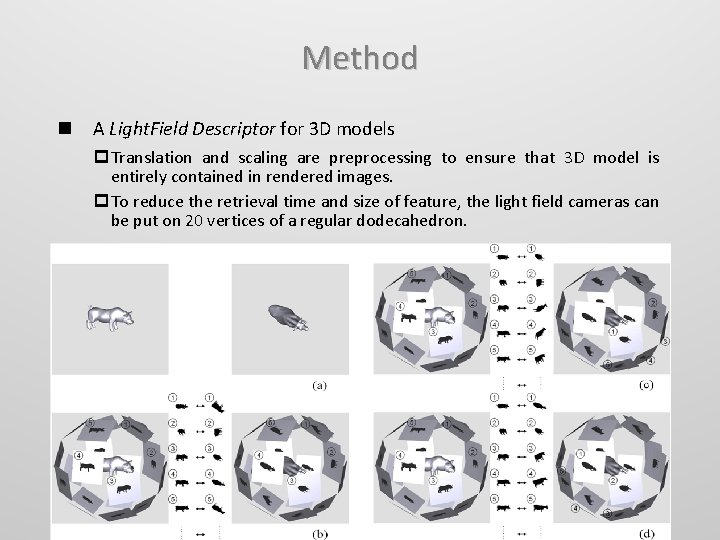
Method n A Light. Field Descriptor for 3 D models p Translation and scaling are preprocessing to ensure that 3 D model is entirely contained in rendered images. p To reduce the retrieval time and size of feature, the light field cameras can be put on 20 vertices of a regular dodecahedron. 2021/3/9 3
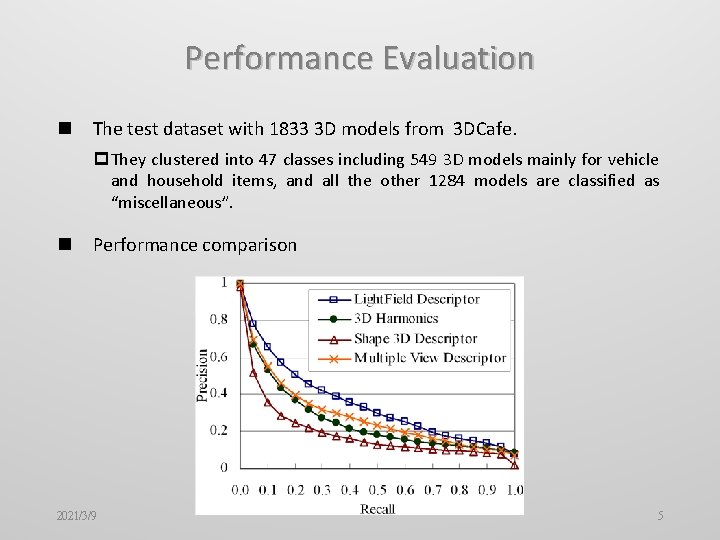
Performance Evaluation n The test dataset with 1833 3 D models from 3 DCafe. p They clustered into 47 classes including 549 3 D models mainly for vehicle and household items, and all the other 1284 models are classified as “miscellaneous”. n Performance comparison 2021/3/9 5
Results 2021/3/9 6

Shape Modeling International (SMI) 2008 A 3 D Model Alignment and Retrieval System Ding-Yun Chen | Ming Ouhyoung Department of Computer Science and Information Engineering, National Taiwan University 2021/3/9
Introduction n This paper propose an algorithm for 3 D model alignment, which gets the affine transformation between two 3 D models. n The main idea of algorithm in rotation is to search the similarity of projected 2 D shapes from each viewing angle between two models. 2021/3/9 8

Method n 3 D model alignment p TS denotes the translation and scaling p Rc denote the coarser rotation alignment p Rr denote the refined rotation alignment 2021/3/9 9
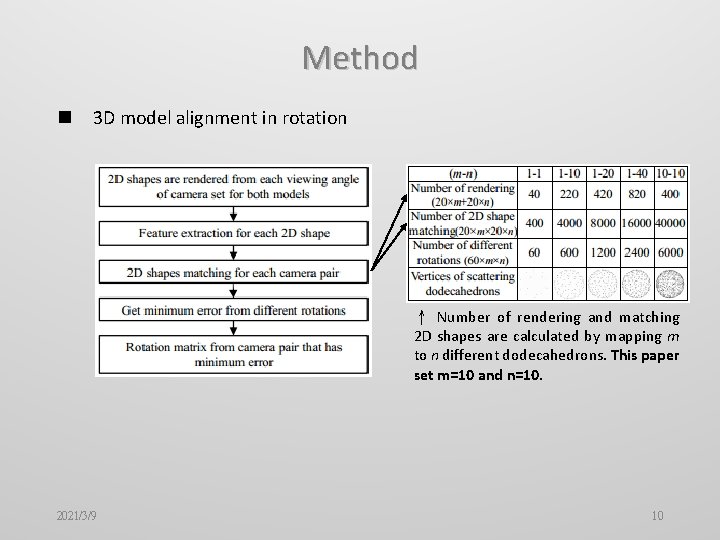
Method n 3 D model alignment in rotation ↑ Number of rendering and matching 2 D shapes are calculated by mapping m to n different dodecahedrons. This paper set m=10 and n=10. 2021/3/9 10
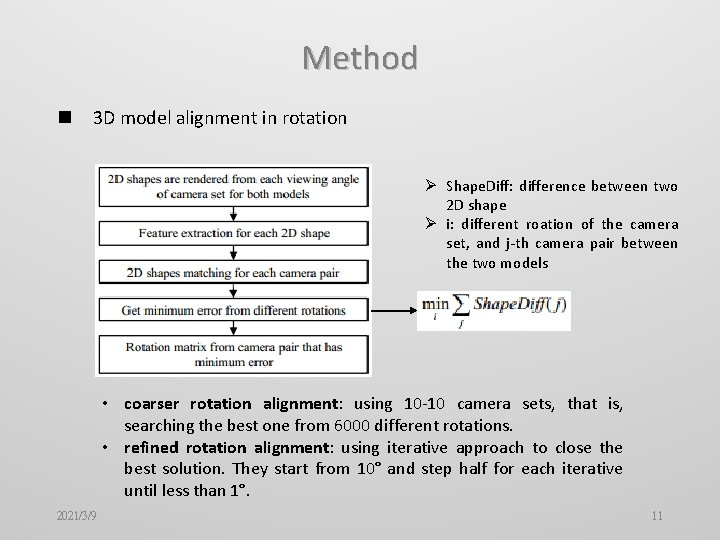
Method n 3 D model alignment in rotation Ø Shape. Diff: difference between two 2 D shape Ø i: different roation of the camera set, and j-th camera pair between the two models • coarser rotation alignment: using 10 -10 camera sets, that is, searching the best one from 6000 different rotations. • refined rotation alignment: using iterative approach to close the best solution. They start from 10° and step half for each iterative until less than 1°. 2021/3/9 11
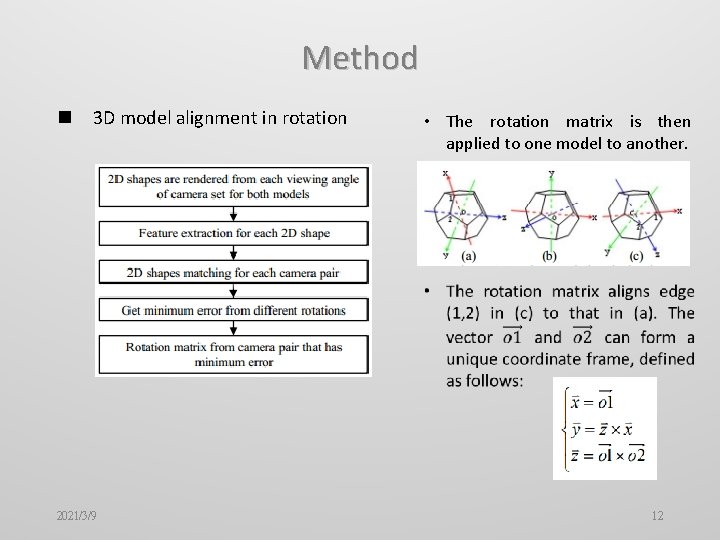
Method n 3 D model alignment in rotation 2021/3/9 • The rotation matrix is then applied to one model to another. 12
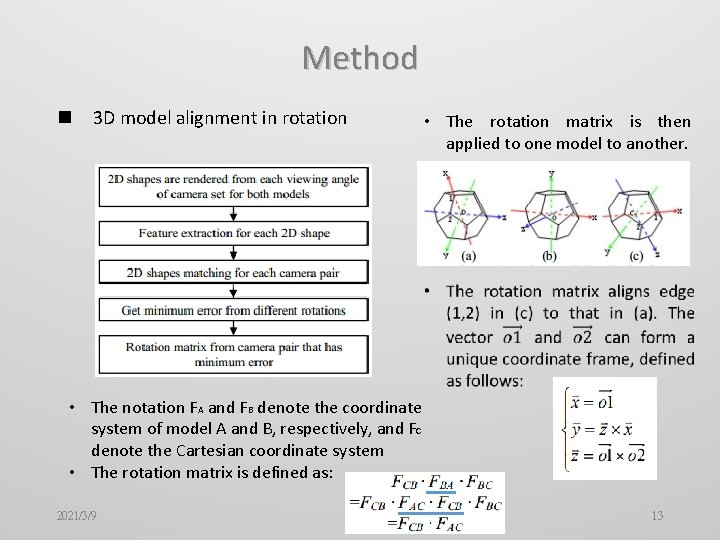
Method n 3 D model alignment in rotation • The rotation matrix is then applied to one model to another. • The notation FA and FB denote the coordinate system of model A and B, respectively, and FC denote the Cartesian coordinate system • The rotation matrix is defined as: 2021/3/9 13
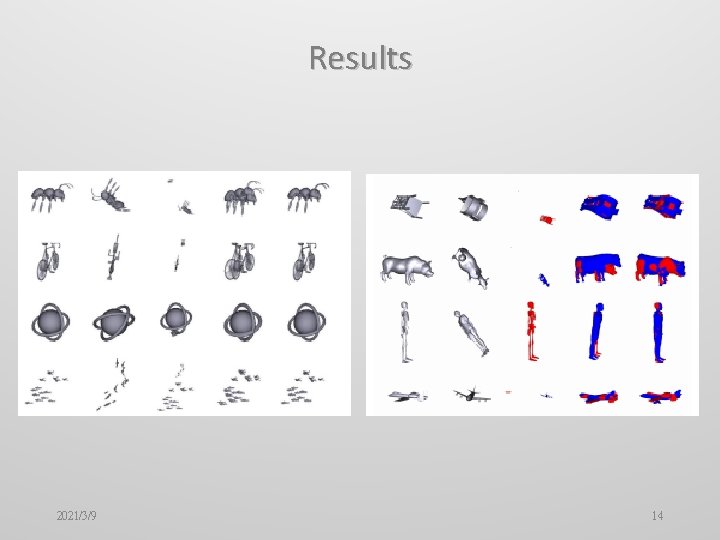
Results 2021/3/9 14
Content-Based Multimedia Indexing (CBMI) 2014 Symmetry-Based Alignment for 3 D Model Retrieval Quoc-Viet Dang | Sandrine Mouysset | Geraldine Morin University of Toulouse, France 2021/3/9
Introduction n Many objects are composed by similar parts up to a rotation, a translation or a symmetry. n Therefore, the canonical frame of a 3 D model can be extracted from its partial symmetry information. n This paper present a method for aligning 3 D shapes modeled as Non. Uniform Rational B-Spline (NURBS) based Boundary Representations(B-Rep) models, exploiting partial symmetries of the shape. Ø NURBS is a mathematical model commonly used in computer graphics for generating and representing curves and surfaces. Ø B-Rep is a method for representing shapes using the limits. A solid is represented as a collection of connected surface elements, the boundary between solid and non-solid. 2021/3/9 16
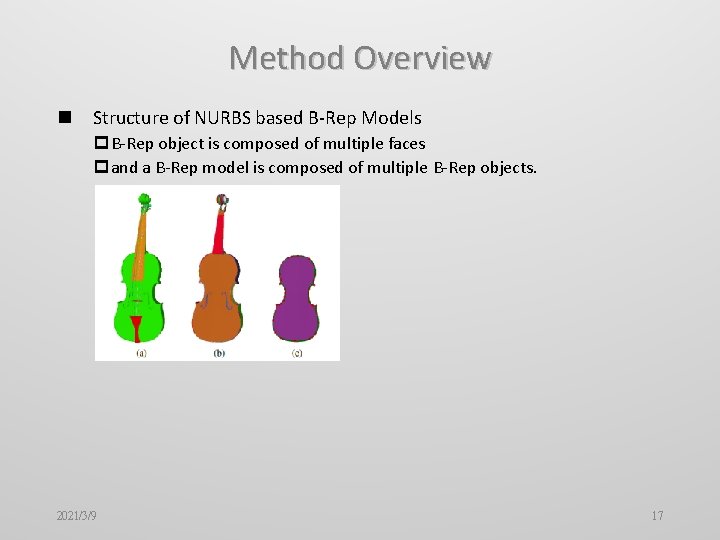
Method Overview n Structure of NURBS based B-Rep Models p B-Rep object is composed of multiple faces p and a B-Rep model is composed of multiple B-Rep objects. 2021/3/9 17
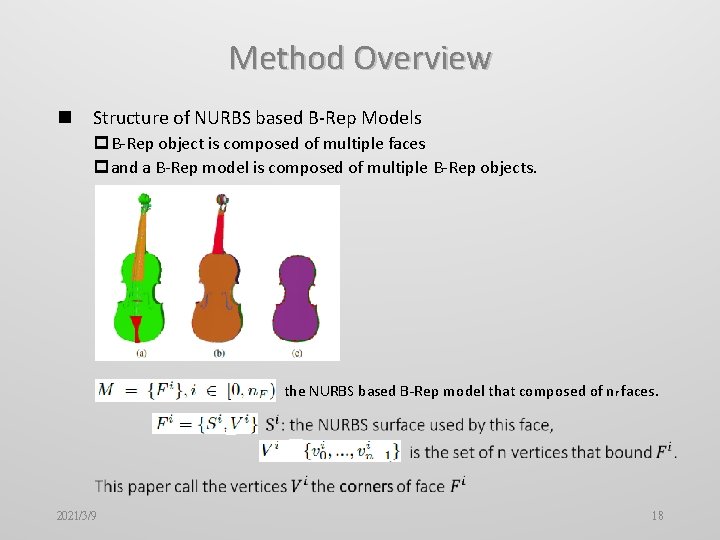
Method Overview n Structure of NURBS based B-Rep Models p B-Rep object is composed of multiple faces p and a B-Rep model is composed of multiple B-Rep objects. the NURBS based B-Rep model that composed of n. F faces. 2021/3/9 18
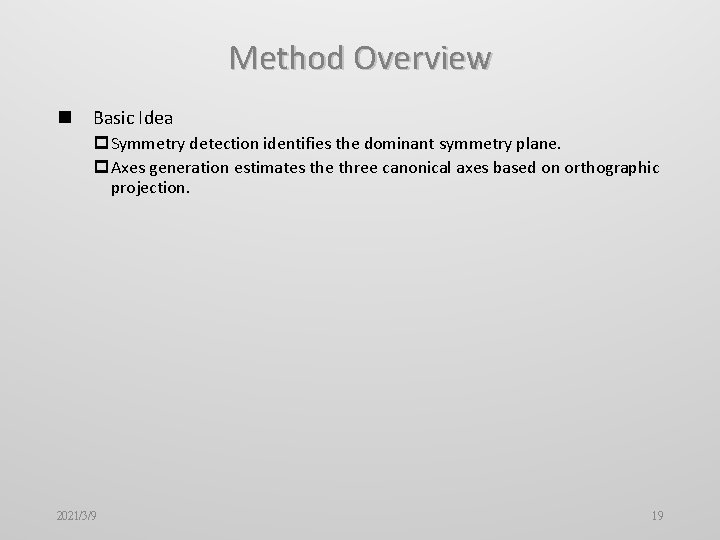
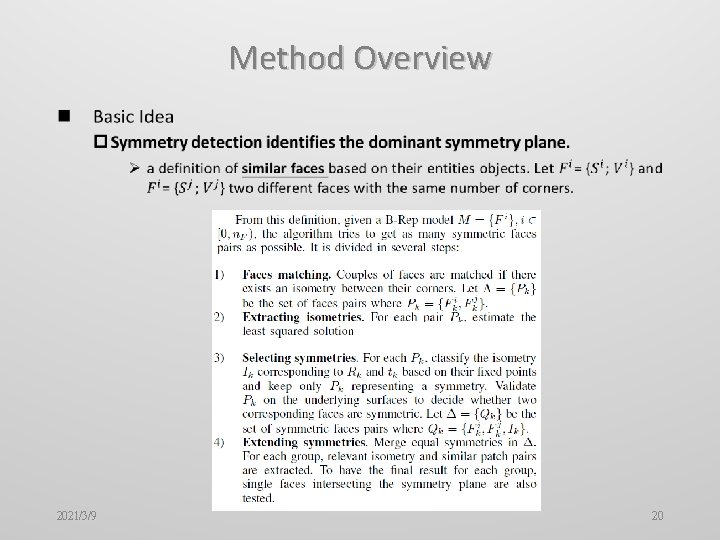
Method Overview n Basic Idea p Symmetry detection identifies the dominant symmetry plane. p Axes generation estimates the three canonical axes based on orthographic projection. 2021/3/9 19
Method Overview n 2021/3/9 20
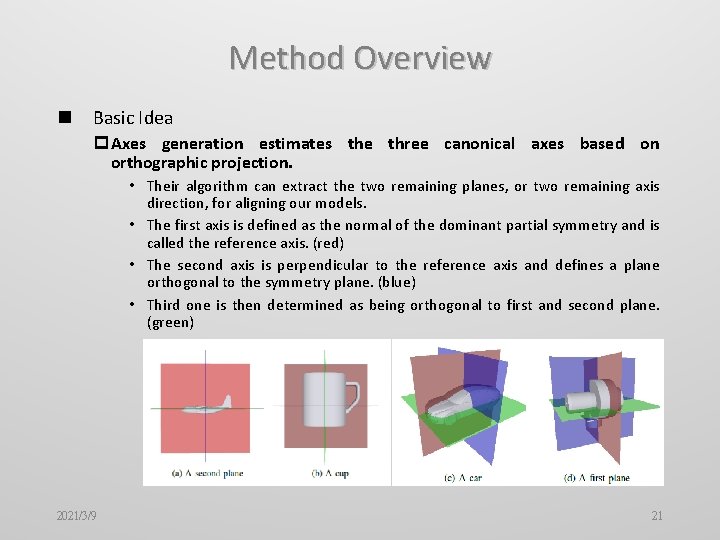
Method Overview n Basic Idea p Axes generation estimates the three canonical axes based on orthographic projection. • Their algorithm can extract the two remaining planes, or two remaining axis direction, for aligning our models. • The first axis is defined as the normal of the dominant partial symmetry and is called the reference axis. (red) • The second axis is perpendicular to the reference axis and defines a plane orthogonal to the symmetry plane. (blue) • Third one is then determined as being orthogonal to first and second plane. (green) 2021/3/9 21
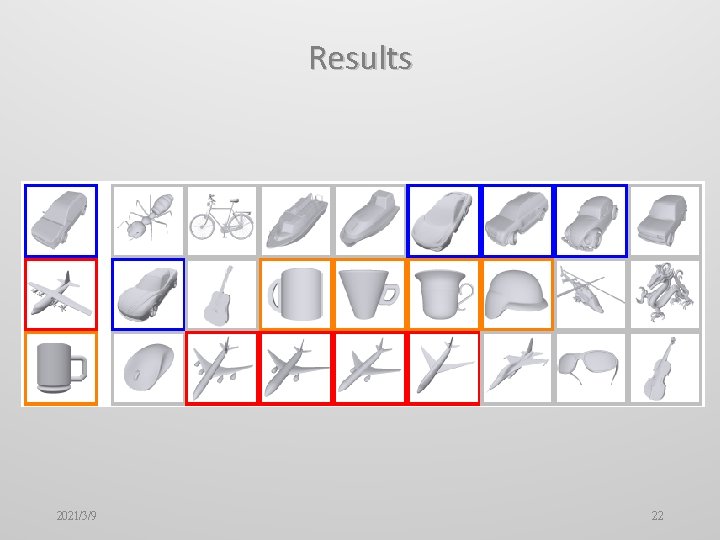
Results 2021/3/9 22

Journal of Computer Graphics Techniques 2014 A Simple Method for Correcting Facet Orientations in Polygon Meshes Based on Ray Casting 1 Kenshi Takayama | 2 Alec Jacobson | 3 Ladislav Kavan | 1 Olga Sorkine-Hornung 1. Department of Computer Science ETH Zurich 2. Department of Computer Science Columbia University 3. Department of Computer and Information Science University of Pennsylvania 2021/3/9
Introduction n The polygon meshes with incorrect facet orientations when working from Internet repositories. n A polygon mesh generally consist of a set of 3 D vertex positions and a set of polygon facets each defined by an ordered list of vertex index. n The ordering of vertices determines facet orientation. n The “correctness” of facet orientations is defined as a facet’s orientation is correct if its front side corresponds to the “outside”. n This paper present a method for fixing incorrect orientations of facets in input polygon mesh. n The method is easier than previously methods, only requiring sampling visibilities by shooting many rays. 2021/3/9 24
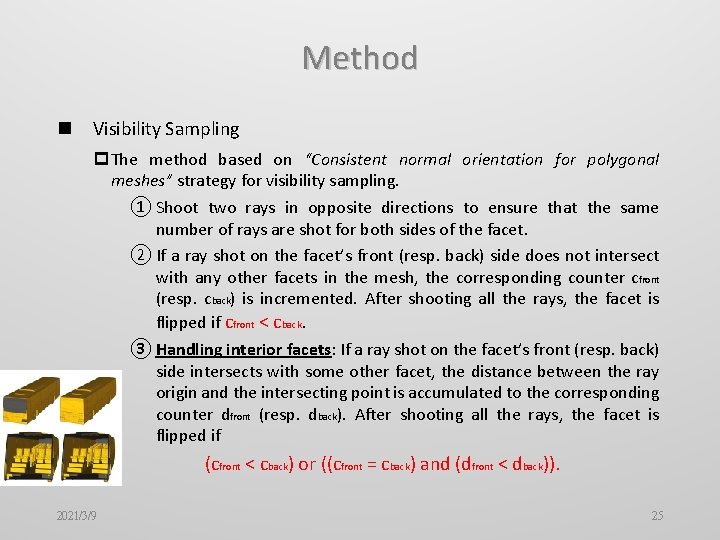
Method n Visibility Sampling p The method based on “Consistent normal orientation for polygonal meshes” strategy for visibility sampling. ① Shoot two rays in opposite directions to ensure that the same number of rays are shot for both sides of the facet. ② If a ray shot on the facet’s front (resp. back) side does not intersect with any other facets in the mesh, the corresponding counter cfront (resp. cback) is incremented. After shooting all the rays, the facet is flipped if cfront < cback. ③ Handling interior facets: If a ray shot on the facet’s front (resp. back) side intersects with some other facet, the distance between the ray origin and the intersecting point is accumulated to the corresponding counter dfront (resp. dback). After shooting all the rays, the facet is flipped if (cfront < cback) or ((cfront = cback) and (dfront < dback)). 2021/3/9 25
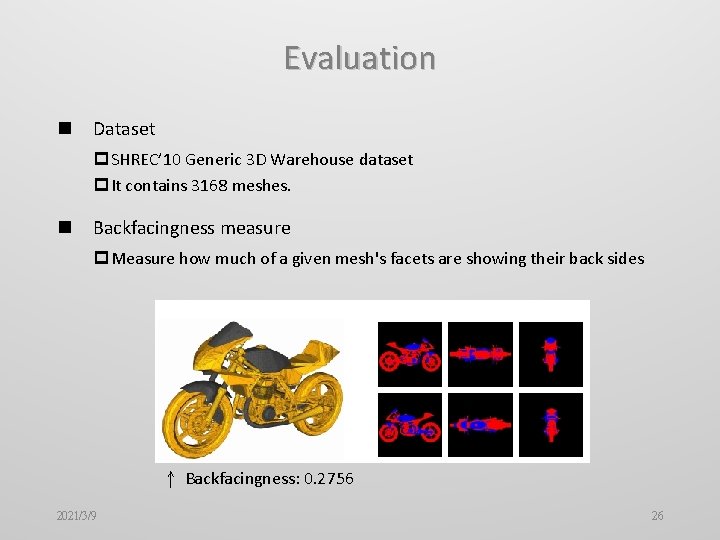
Evaluation n Dataset p SHREC’ 10 Generic 3 D Warehouse dataset p It contains 3168 meshes. n Backfacingness measure p Measure how much of a given mesh's facets are showing their back sides ↑ Backfacingness: 0. 2756 2021/3/9 26
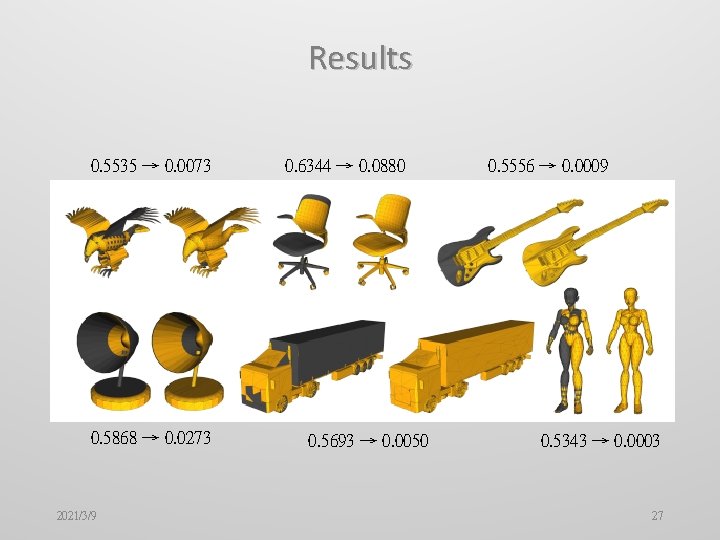
Results 0. 5535 → 0. 0073 0. 5868 → 0. 0273 2021/3/9 0. 6344 → 0. 0880 0. 5693 → 0. 0050 0. 5556 → 0. 0009 0. 5343 → 0. 0003 27

SIGGRAPH Asia 2010 Style-Content Separation by Anisotropic Part Scales 1, 2 Kai Xu | 1, 2 Honghua Li | 1 Hao Zhang | 3 Daniel Cohen-Or | 2 Yueshan Xiong | 1. Simon Fraser University 2. National University of Defense Technology 3. Tel-Aviv University 2021/3/9 2 Zhi-Quan Cheng
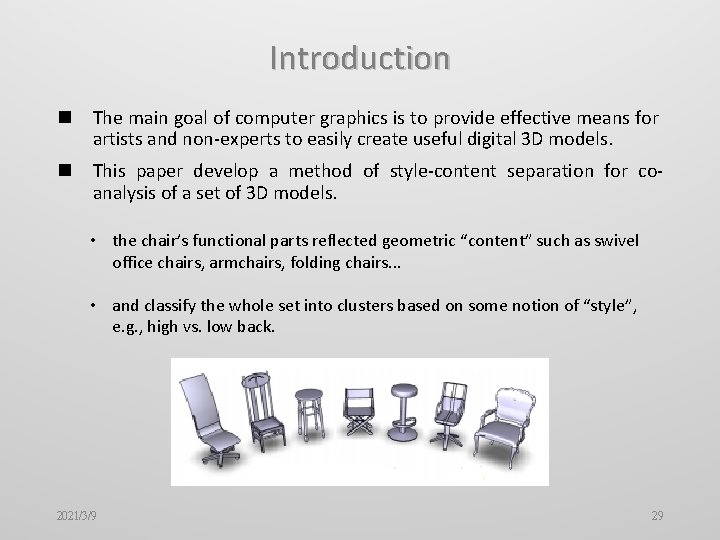
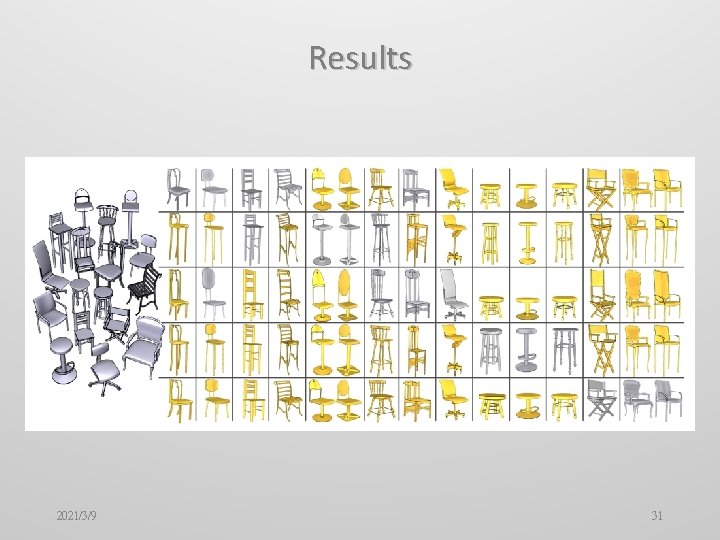
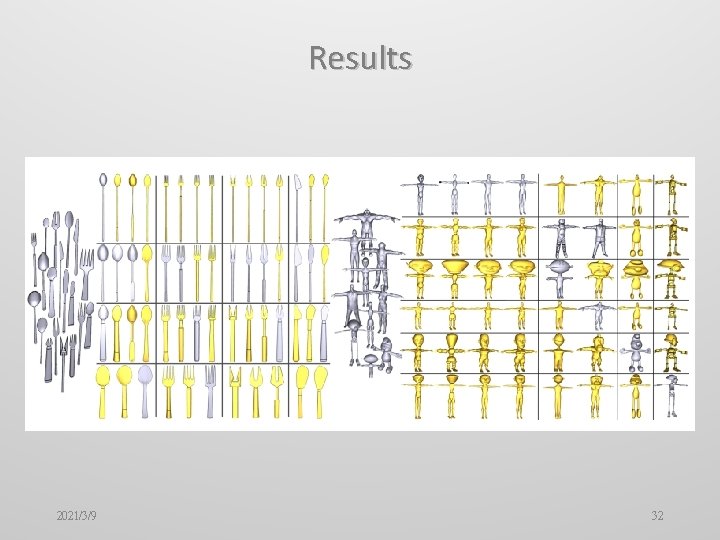
Introduction n The main goal of computer graphics is to provide effective means for artists and non-experts to easily create useful digital 3 D models. n This paper develop a method of style-content separation for coanalysis of a set of 3 D models. • the chair’s functional parts reflected geometric “content” such as swivel office chairs, armchairs, folding chairs. . . • and classify the whole set into clusters based on some notion of “style”, e. g. , high vs. low back. 2021/3/9 29
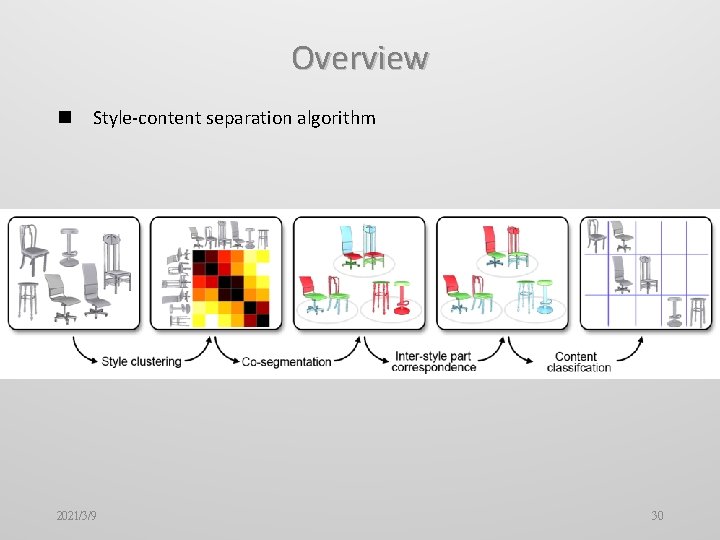
Overview n Style-content separation algorithm 2021/3/9 30
Results 2021/3/9 31
Results 2021/3/9 32
- Slides: 31