
Eureka Math A Story of Units K5 Focus



- Slides: 75
Eureka Math: A Story of Units K-5 Focus on Fluency
This Power. Point presentation is provided to individuals who participated in a live training by professional developers certified by, or affiliated with, the copyright holder, Common Core, Inc. It may be not be altered in any way. The presentation may be shared for noncommercial purposes only. However, Common Core makes no representations or warranties about the effectiveness of training provided by non-certified/non-affiliated presenters of the material. Any commercial use of this presentation is illegal and violates the copyrights of Common Core, Inc.
Focus on Fluency Session Objectives: • Understand the fluency component of rigor called for in the Standards, as defined by guiding documents • Examine Sprints, counting exercises, choral and whiteboard exchanges, and other fluency activities • Analyze the implementation considerations and differentiation abilities of each fluency activity • Recognize and appreciate the coherence of K-5 fluency
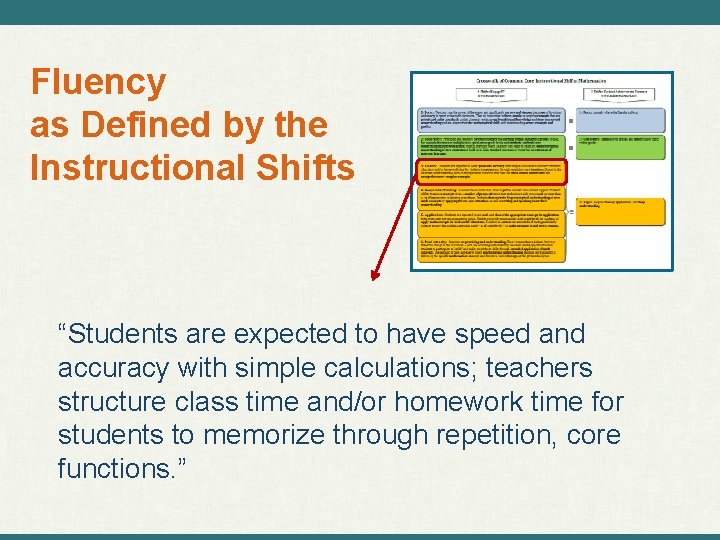
Fluency as Defined by the Instructional Shifts “Students are expected to have speed and accuracy with simple calculations; teachers structure class time and/or homework time for students to memorize through repetition, core functions. ”
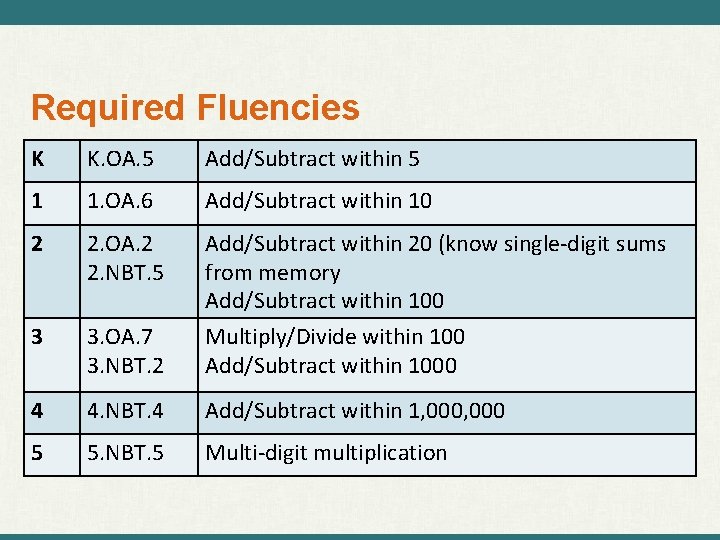
Required Fluencies K K. OA. 5 Add/Subtract within 5 1 1. OA. 6 Add/Subtract within 10 2 2. OA. 2 2. NBT. 5 Add/Subtract within 20 (know single-digit sums from memory Add/Subtract within 100 3 3. OA. 7 3. NBT. 2 Multiply/Divide within 100 Add/Subtract within 1000 4 4. NBT. 4 Add/Subtract within 1, 000 5 5. NBT. 5 Multi-digit multiplication
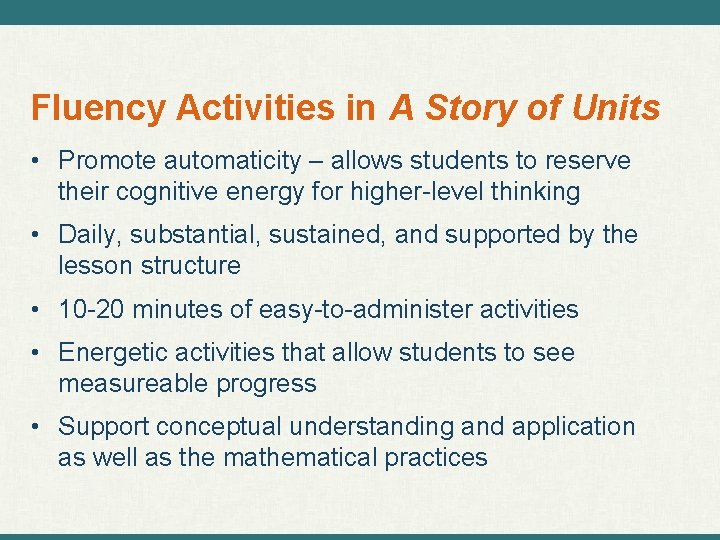
Fluency Activities in A Story of Units • Promote automaticity – allows students to reserve their cognitive energy for higher-level thinking • Daily, substantial, sustained, and supported by the lesson structure • 10 -20 minutes of easy-to-administer activities • Energetic activities that allow students to see measureable progress • Support conceptual understanding and application as well as the mathematical practices
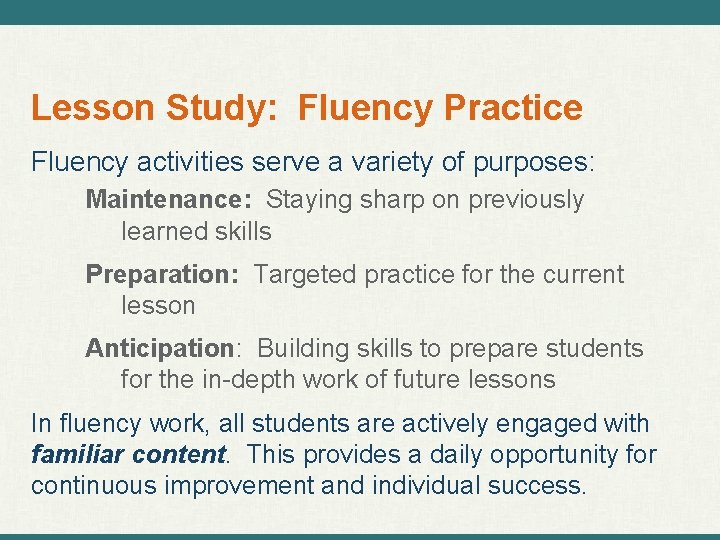
Lesson Study: Fluency Practice Fluency activities serve a variety of purposes: Maintenance: Staying sharp on previously learned skills Preparation: Targeted practice for the current lesson Anticipation: Building skills to prepare students for the in-depth work of future lessons In fluency work, all students are actively engaged with familiar content. This provides a daily opportunity for continuous improvement and individual success.
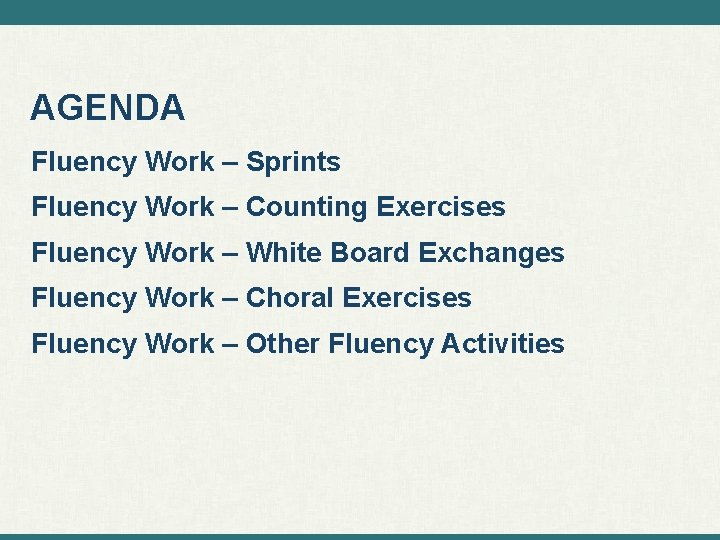
AGENDA Fluency Work – Sprints Fluency Work – Counting Exercises Fluency Work – White Board Exchanges Fluency Work – Choral Exercises Fluency Work – Other Fluency Activities
Sprint: Take the Challenge!! Grade 5 Sprint Write the Missing Factor You try!
Sprint Directions Read through the Directions for Administration of Sprints • Located in the overview of first module of every grade, 1 st through 5 th
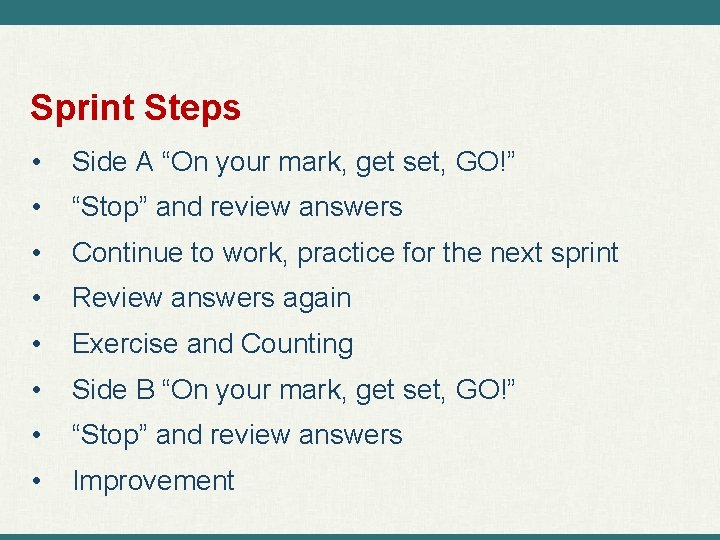
Sprint Steps • Side A “On your mark, get set, GO!” • “Stop” and review answers • Continue to work, practice for the next sprint • Review answers again • Exercise and Counting • Side B “On your mark, get set, GO!” • “Stop” and review answers • Improvement
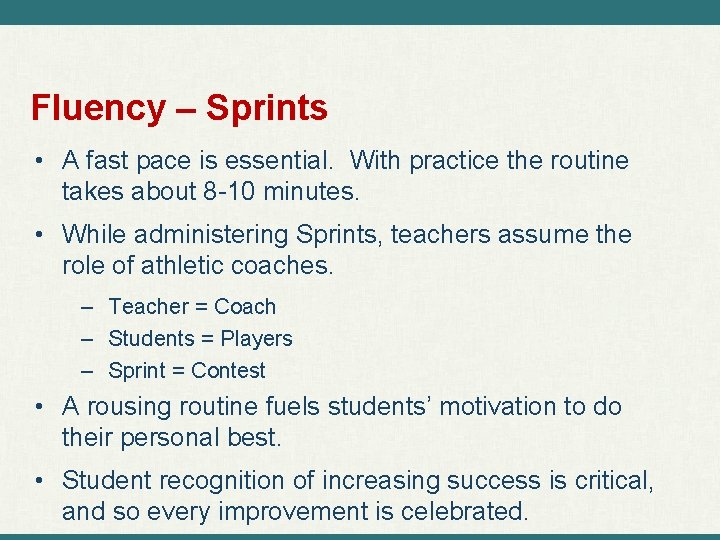
Fluency – Sprints • A fast pace is essential. With practice the routine takes about 8 -10 minutes. • While administering Sprints, teachers assume the role of athletic coaches. ‒ Teacher = Coach ‒ Students = Players ‒ Sprint = Contest • A rousing routine fuels students’ motivation to do their personal best. • Student recognition of increasing success is critical, and so every improvement is celebrated.
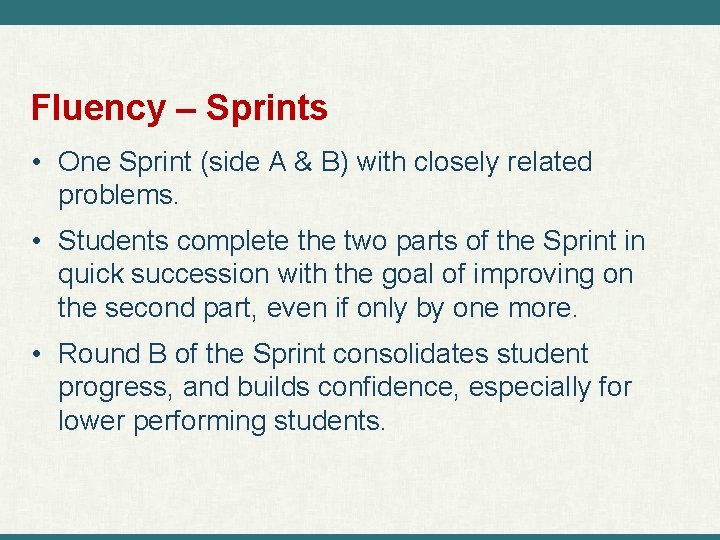
Fluency – Sprints • One Sprint (side A & B) with closely related problems. • Students complete the two parts of the Sprint in quick succession with the goal of improving on the second part, even if only by one more. • Round B of the Sprint consolidates student progress, and builds confidence, especially for lower performing students.
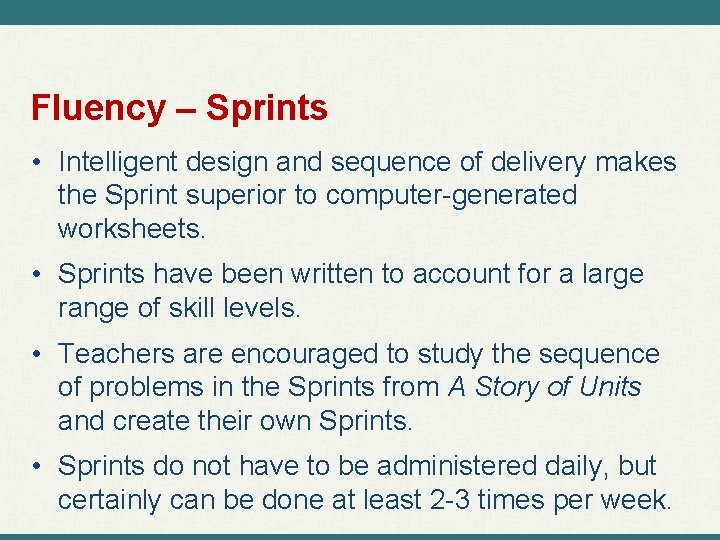
Fluency – Sprints • Intelligent design and sequence of delivery makes the Sprint superior to computer-generated worksheets. • Sprints have been written to account for a large range of skill levels. • Teachers are encouraged to study the sequence of problems in the Sprints from A Story of Units and create their own Sprints. • Sprints do not have to be administered daily, but certainly can be done at least 2 -3 times per week.
Sprints - Fluency in Action:
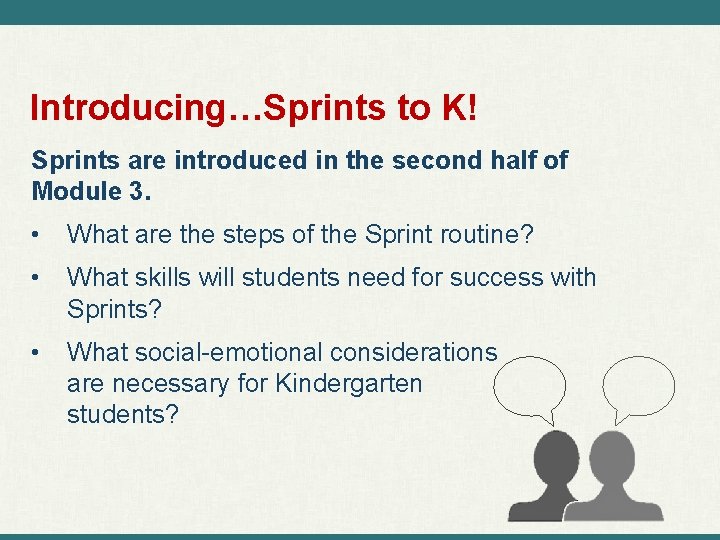
Introducing…Sprints to K! Sprints are introduced in the second half of Module 3. • What are the steps of the Sprint routine? • What skills will students need for success with Sprints? • What social-emotional considerations are necessary for Kindergarten students?
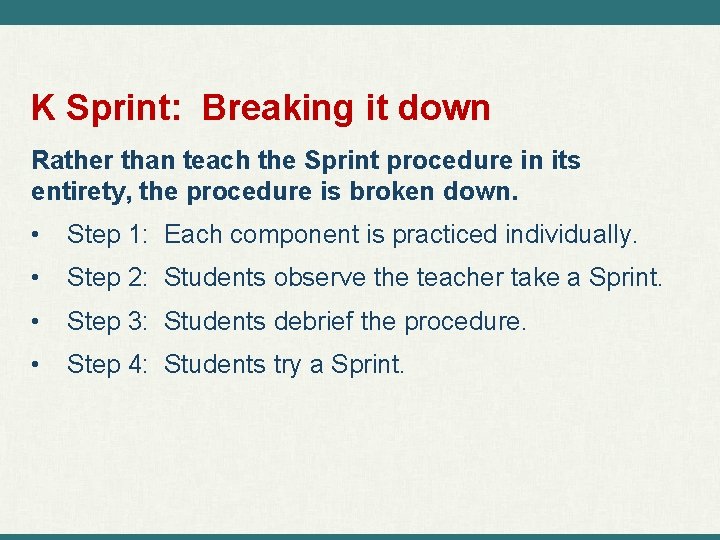
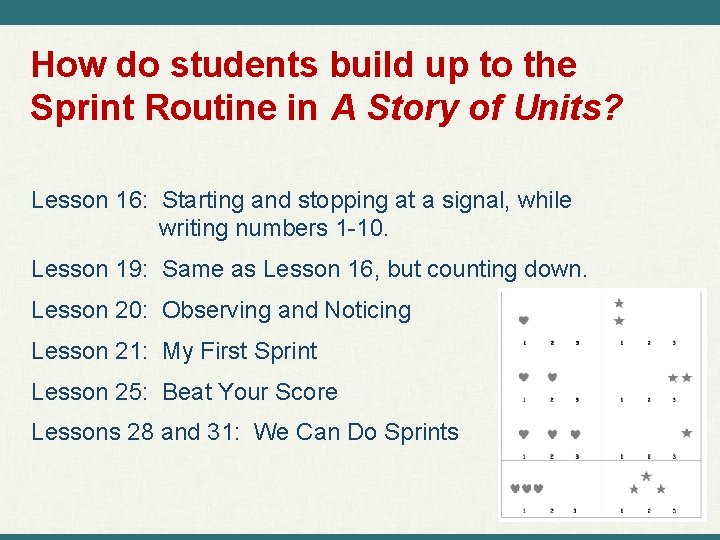
K Sprint: Breaking it down Rather than teach the Sprint procedure in its entirety, the procedure is broken down. • Step 1: Each component is practiced individually. • Step 2: Students observe the teacher take a Sprint. • Step 3: Students debrief the procedure. • Step 4: Students try a Sprint.
How do students build up to the Sprint Routine in A Story of Units? Lesson 16: Starting and stopping at a signal, while writing numbers 1 -10. Lesson 19: Same as Lesson 16, but counting down. Lesson 20: Observing and Noticing Lesson 21: My First Sprint Lesson 25: Beat Your Score Lessons 28 and 31: We Can Do Sprints
Variations for Kindergarten • Complete example problem(s) on the board. • If usingle sided Sprints, have students write numbers to 10 on the back while they wait, so that no time is wasted. • Warm up: Have students “finger-write” the answers, so that they can practice before the real race. • Instead of teacher role play, take students to observe a 1 st grade class taking a Sprint, or watch a video, pausing periodically to ask questions about what students noticed.
Troubleshooting in Kindergarten • If motor skills haven’t caught up to cognitive ability… try having the student use a highlighter to “swipe” the correct answer, rather than write it. • If the student is still working across the columns, instead of down… try making a green stripe along the left side, and a red stripe down the right to lead the eye down the columns.
Troubleshooting in Kindergarten • If a student is slow to get started… Check to see that they are holding the pencil “ready to write” , that is, in the writing grip position, not by the eraser, or in the middle. Fumbling to orient the pencil when the signal is given leads to valuable seconds lost!
Sprints in Action – 2 nd Grade
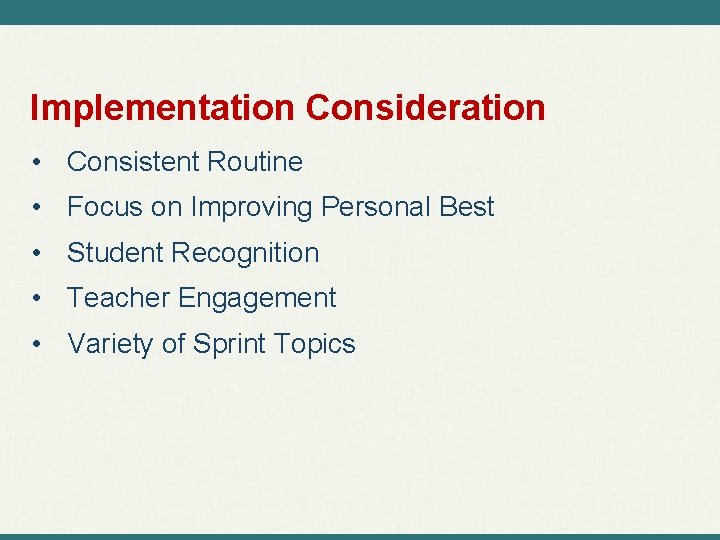
Implementation Consideration • Consistent Routine • Focus on Improving Personal Best • Student Recognition • Teacher Engagement • Variety of Sprint Topics
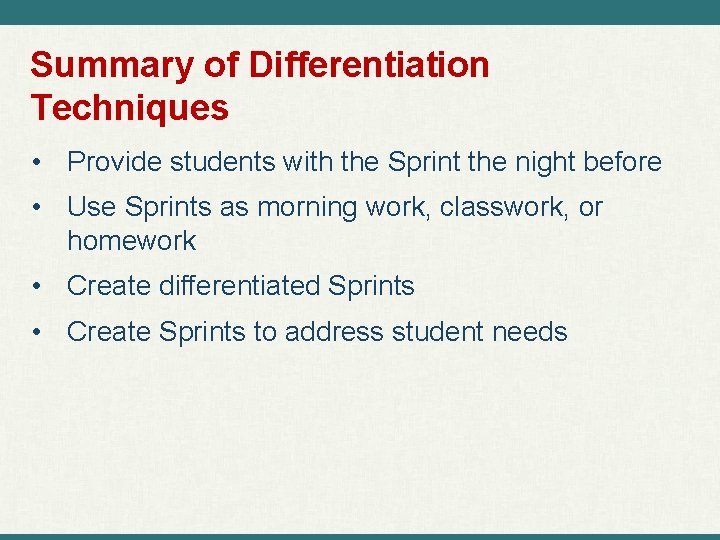
Summary of Differentiation Techniques • Provide students with the Sprint the night before • Use Sprints as morning work, classwork, or homework • Create differentiated Sprints • Create Sprints to address student needs
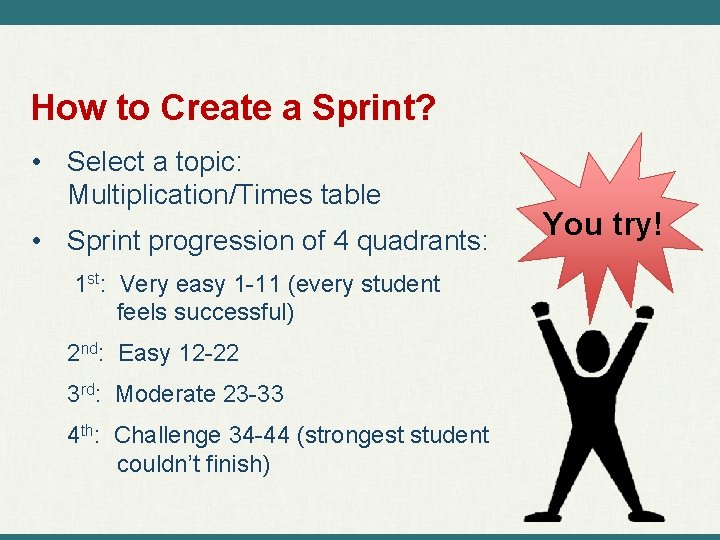
How to Create a Sprint? • Select a topic: Multiplication/Times table • Sprint progression of 4 quadrants: 1 st: Very easy 1 -11 (every student feels successful) 2 nd: Easy 12 -22 3 rd: Moderate 23 -33 4 th: Challenge 34 -44 (strongest student couldn’t finish) You try!
Sprints: Reflections • In what ways are Sprints advantageous in meeting the demands of fluency?
Sprints: Key Points • Sprints allow for rapid completion of multiple practice problems. • Sprints create intensity in student practice. • Sprints give students quick feedback. • Sprints motivate students with a near-term goal for improvement.
AGENDA Fluency Work – Sprints Fluency Work – Counting Exercises Fluency Work – White Board Exchanges Fluency Work – Choral Exercises Fluency Work – Other Fluency Activities
Counting Exercises • Appropriate for all grade levels, K-5 • Counting forward and backwards allows students to develop a mental number line • Counting forward and backwards supports addition and subtraction • Skip-counting supports multiplication
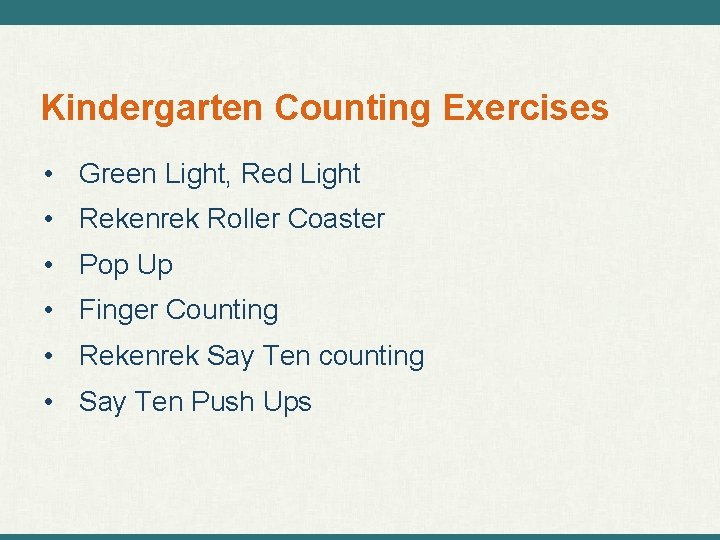
Kindergarten Counting Exercises • Green Light, Red Light • Rekenrek Roller Coaster • Pop Up • Finger Counting • Rekenrek Say Ten counting • Say Ten Push Ups
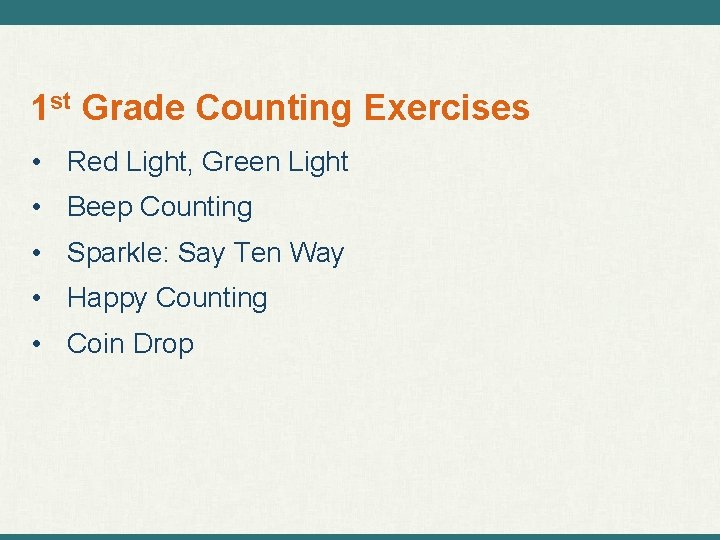
1 st Grade Counting Exercises • Red Light, Green Light • Beep Counting • Sparkle: Say Ten Way • Happy Counting • Coin Drop
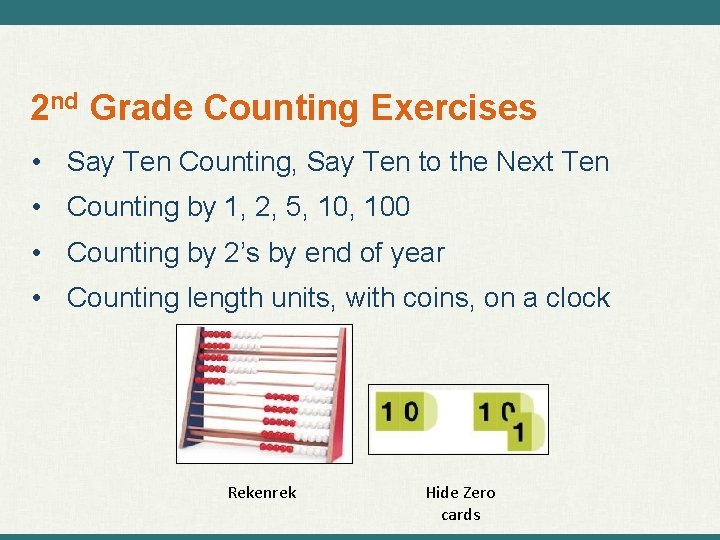
2 nd Grade Counting Exercises • Say Ten Counting, Say Ten to the Next Ten • Counting by 1, 2, 5, 100 • Counting by 2’s by end of year • Counting length units, with coins, on a clock Rekenrek Hide Zero cards
Counting Exercises in Action: K-2
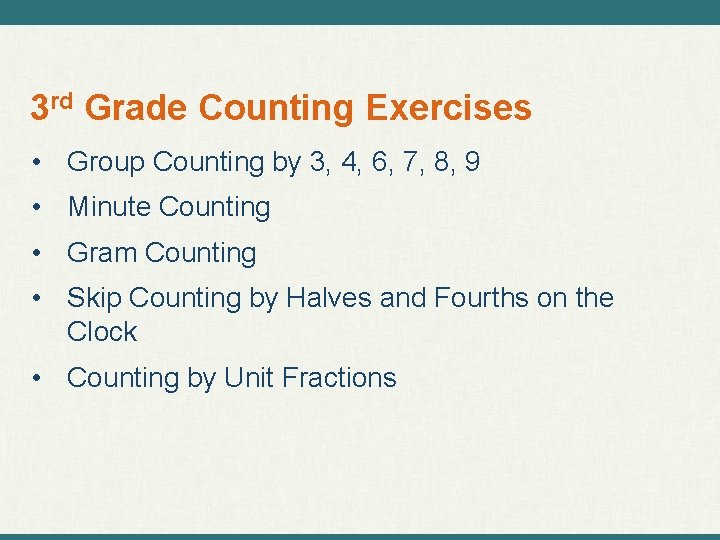
3 rd Grade Counting Exercises • Group Counting by 3, 4, 6, 7, 8, 9 • Minute Counting • Gram Counting • Skip Counting by Halves and Fourths on the Clock • Counting by Unit Fractions
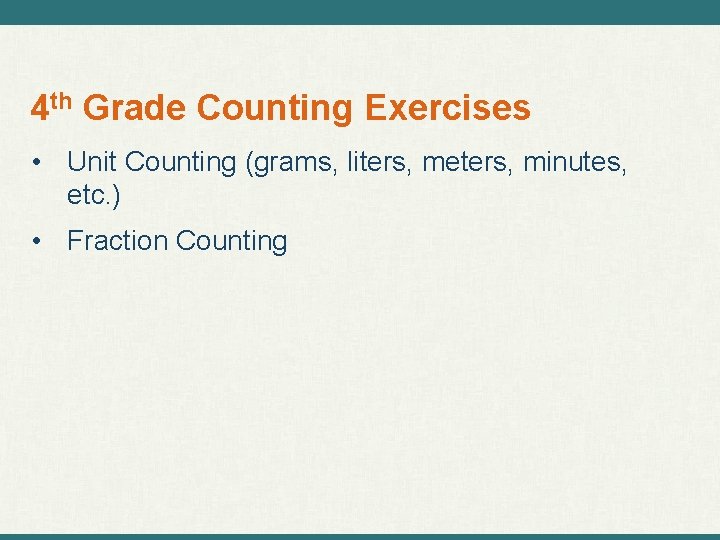
4 th Grade Counting Exercises • Unit Counting (grams, liters, meters, minutes, etc. ) • Fraction Counting
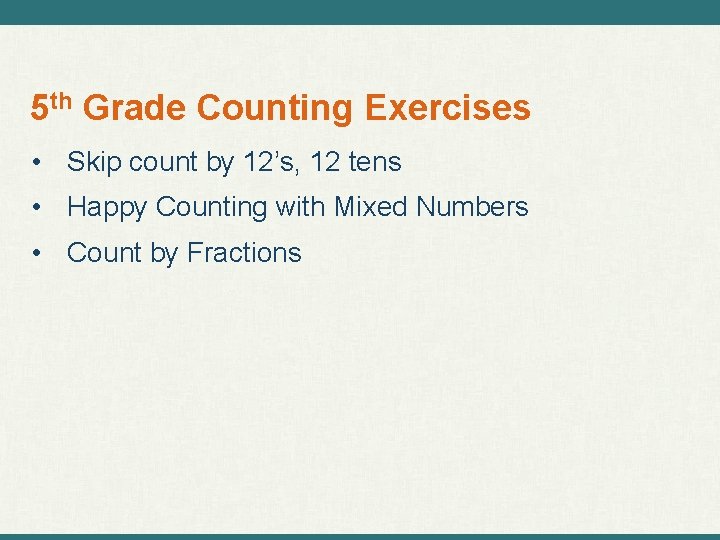
5 th Grade Counting Exercises • Skip count by 12’s, 12 tens • Happy Counting with Mixed Numbers • Count by Fractions
Implementation Considerations • Consistent routine • Engagement and Pacing • Varied student ability levels
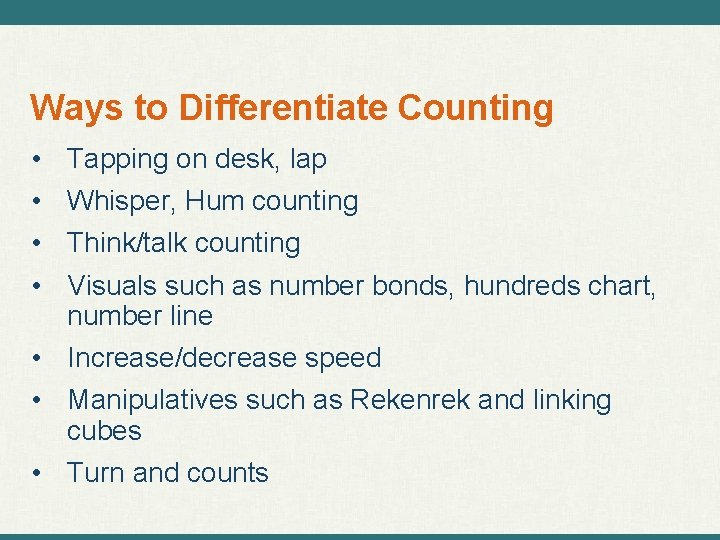
Ways to Differentiate Counting • • Tapping on desk, lap Whisper, Hum counting Think/talk counting Visuals such as number bonds, hundreds chart, number line • Increase/decrease speed • Manipulatives such as Rekenrek and linking cubes • Turn and counts
Counting Exercises in Action: 3 -5
Let’s Practice! 1. Study the progression of counting exercises in grades K-5. 2. Select a few exercises and practice with a partner. You try!
Counting Exercises: Reflections • How could counting exercises have an impact or a benefit in your classes, school or district? • How might counting exercises address trouble areas that your students experience?
Counting Exercises: Key Points • Appropriate for all grade levels, K-5 • Counting forward and backwards allows students to develop a mental number line • Counting forward and backwards supports addition and subtraction • Skip-counting supports multiplication
AGENDA Fluency Work – Sprints Fluency Work – Counting Exercises Fluency Work – White Board Exchanges Fluency Work – Choral Exercises Fluency Work – Other Fluency Activities
Fluency – White Board Exchanges • Quick, efficient interactive drills and games • Applies to a wide range of skills
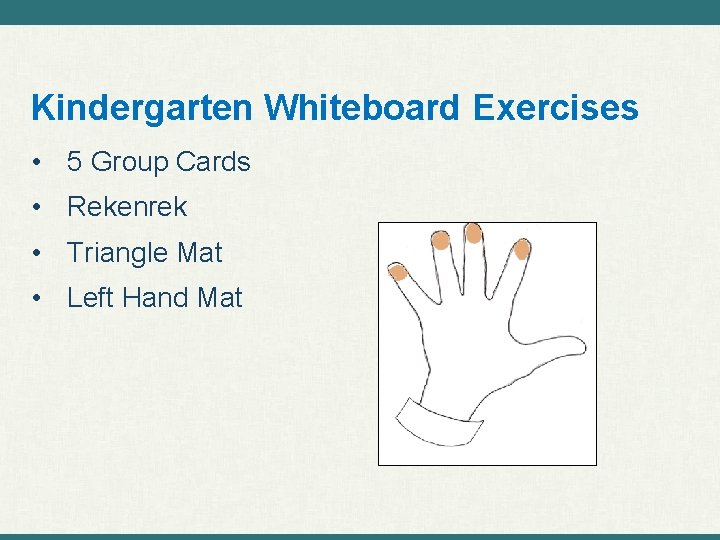
Kindergarten Whiteboard Exercises • 5 Group Cards • Rekenrek • Triangle Mat • Left Hand Mat
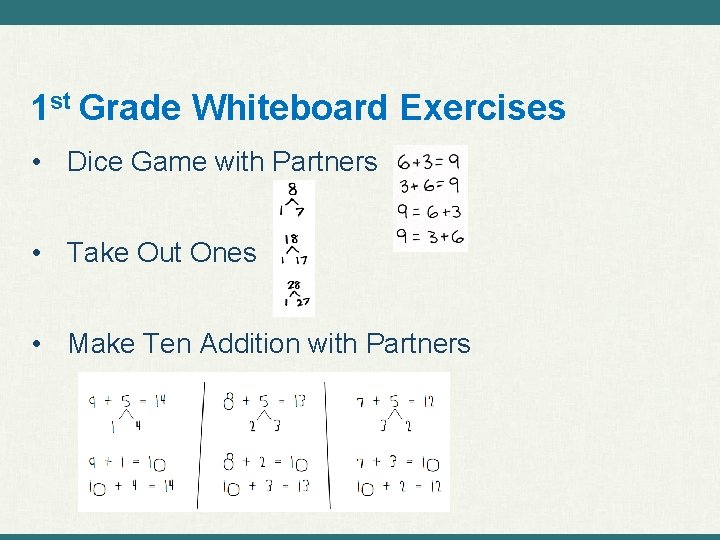
1 st Grade Whiteboard Exercises • Dice Game with Partners • Take Out Ones • Make Ten Addition with Partners
2 nd Grade Whiteboard Exercises • Take From 10, Take From 20 • 10 More/Less, 100 More/Less • Rename the Units • Compensation
3 rd Grade Whiteboard Exercises • Rekenrek: Multiplication and Division • Rename Tens • Halfway on the Number Line • Number Bonds: Decompose 60 minutes • Unit and Non-Unit Fractions of 1 Whole
4 th Grade Whiteboard Exercises • Place Value • Rename the Units • Find the Missing Part • Find Equivalent Fractions
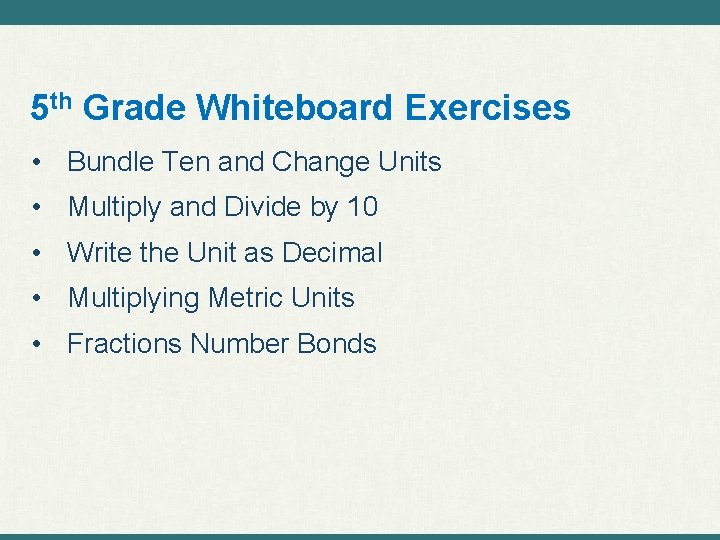
5 th Grade Whiteboard Exercises • Bundle Ten and Change Units • Multiply and Divide by 10 • Write the Unit as Decimal • Multiplying Metric Units • Fractions Number Bonds
Whiteboard Exercises in Action: 3 -5
Scaffolding Exercise Create a sequence to rename 3, 426 * Reminder: simple to complex You try!
Whiteboard Exercises: Reflections • What are the benefits of using personal whiteboards?
Whiteboard Exercises: Key Points • Quick, efficient interactive drills and games • Applies to a wide range of skills
AGENDA Fluency Work – Sprints Fluency Work – Counting Exercises Fluency Work – White Board Exchanges Fluency Work – Choral Exercises Fluency Work – Other Fluency Activities
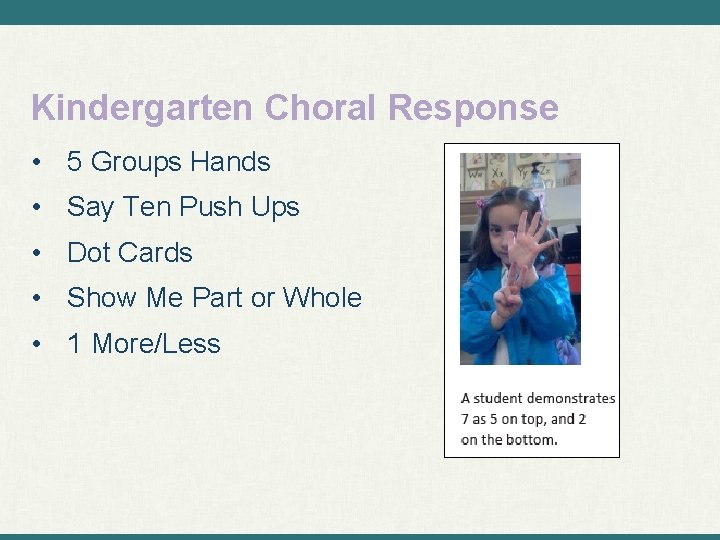
Kindergarten Choral Response • 5 Groups Hands • Say Ten Push Ups • Dot Cards • Show Me Part or Whole • 1 More/Less
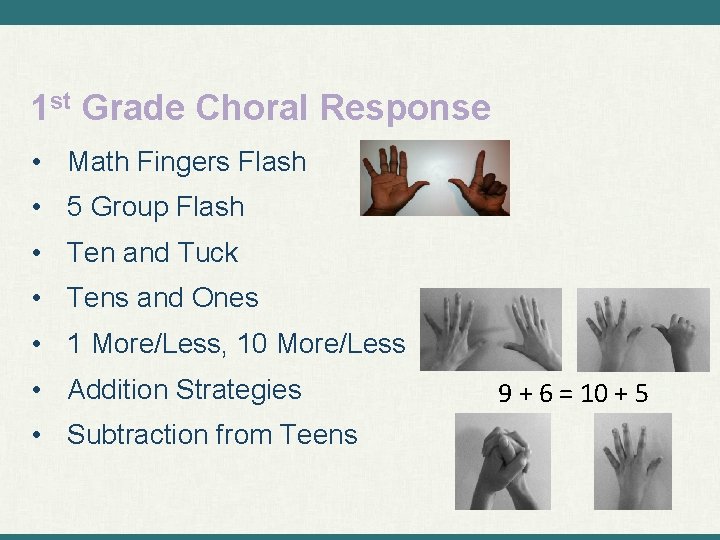
1 st Grade Choral Response • Math Fingers Flash • 5 Group Flash • Ten and Tuck • Tens and Ones • 1 More/Less, 10 More/Less • Addition Strategies • Subtraction from Teens 9 + 6 = 10 + 5
2 nd Grade Choral Response • Make Ten/ Take From Ten • Make Ten to Add • Place Value/Renaming Units • Zap to Zero • Take From Tens or Ones • Related Facts within 20
Choral Response in Action: K-2
3 rd Grade Choral Response • Add to Multiply • Commutative Multiplying • Rename Tens • Rounding Three- and Four-Digit Numbers • Find the Area • Find the Whole/Missing Part
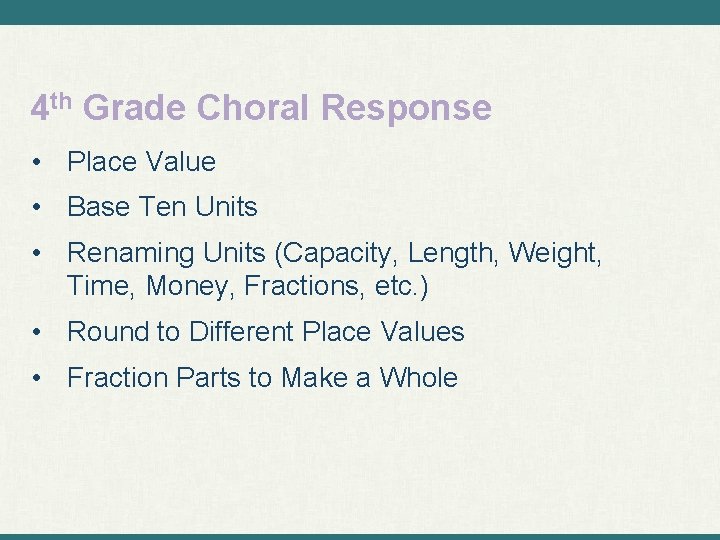
4 th Grade Choral Response • Place Value • Base Ten Units • Renaming Units (Capacity, Length, Weight, Time, Money, Fractions, etc. ) • Round to Different Place Values • Fraction Parts to Make a Whole
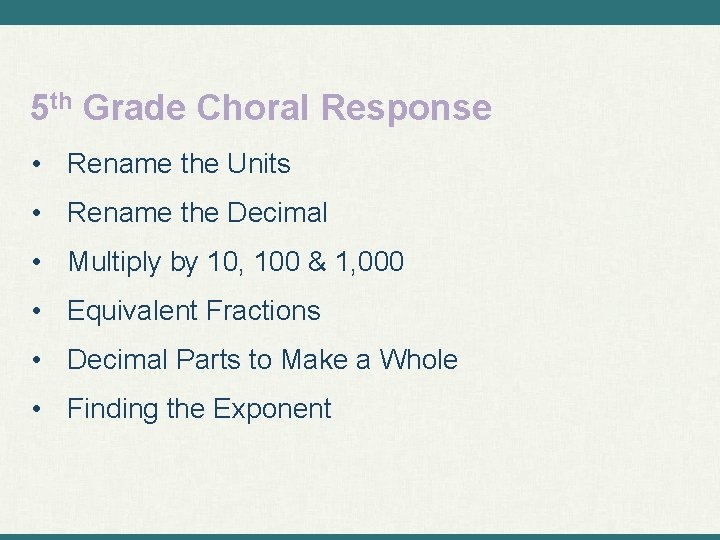
5 th Grade Choral Response • Rename the Units • Rename the Decimal • Multiply by 10, 100 & 1, 000 • Equivalent Fractions • Decimal Parts to Make a Whole • Finding the Exponent
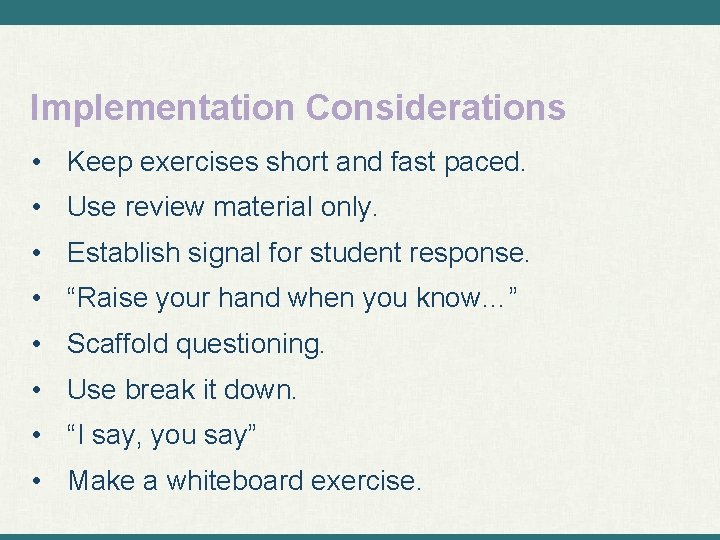
Implementation Considerations • Keep exercises short and fast paced. • Use review material only. • Establish signal for student response. • “Raise your hand when you know…” • Scaffold questioning. • Use break it down. • “I say, you say” • Make a whiteboard exercise.
Choral Response in Action: 3 -5
Let’s Practice! 1. Study the progression of choral response exercises for grades 35. 2. Select a few exercises and practice with a partner. You try!
Choral Response: Reflections • What are some benefits of using a choral response in a classroom?
Choral Response: Key Points • Exchanges can be used as a quick form of assessment. • Exchanges allow for rapid completion of multiple practice problems. • Exchanges create intensity in student practice. • Exchanges give students immediate feedback.
AGENDA Fluency Work – Sprints Fluency Work – Counting Exercises Fluency Work – White Board Exchanges Fluency Work – Choral Exercises Fluency Work – Other Fluency Activities
Kindergarten Fluency Activities • Tower Flip • 1, 2, 3 Sit on 10 • Make 10 Memory Game • 5 Group Fill Up • Core Fluency Differentiated Practice Sets
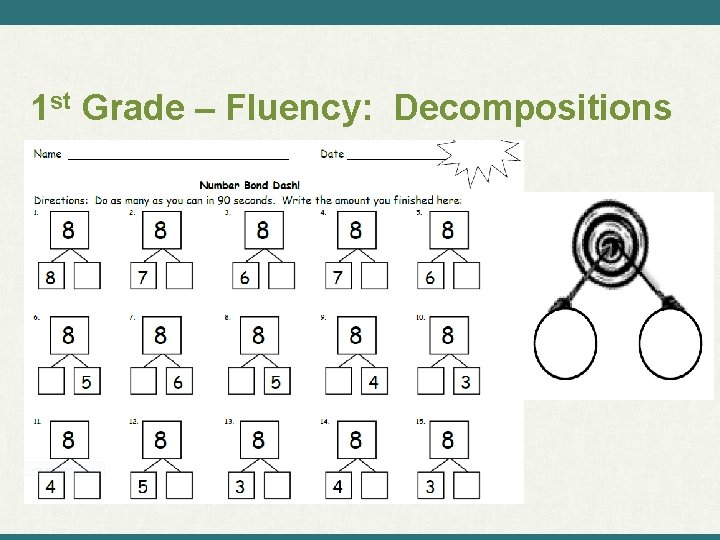
1 st Grade – Fluency: Decompositions
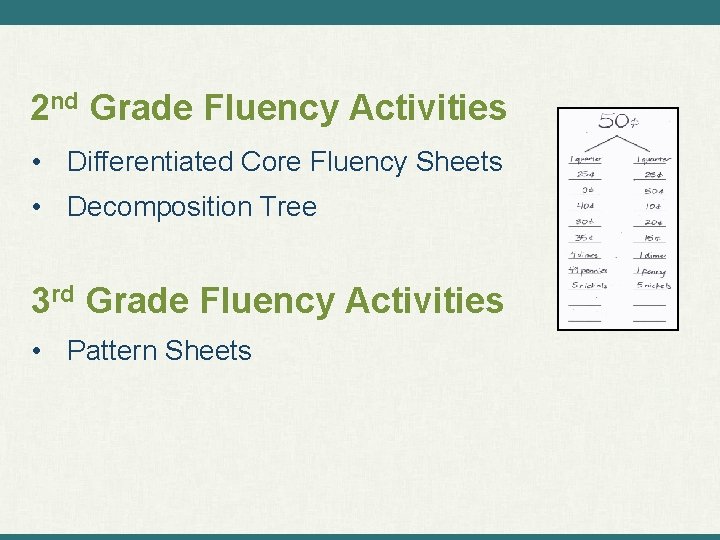
2 nd Grade Fluency Activities • Differentiated Core Fluency Sheets • Decomposition Tree 3 rd Grade Fluency Activities • Pattern Sheets
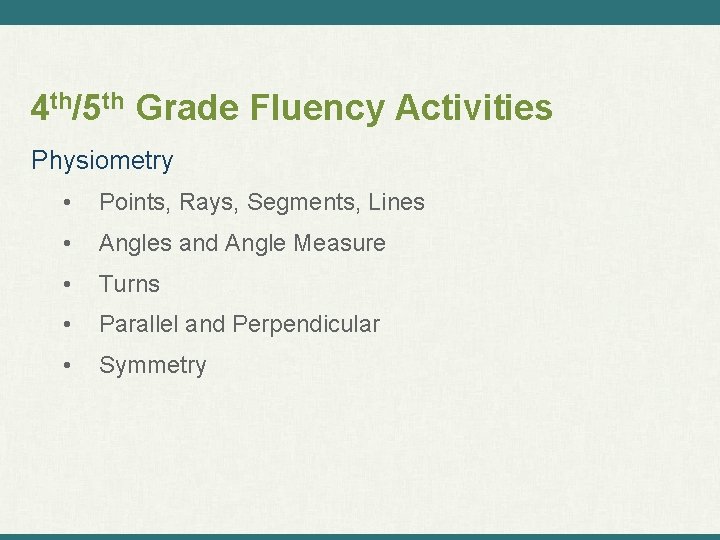
4 th/5 th Grade Fluency Activities Physiometry • Points, Rays, Segments, Lines • Angles and Angle Measure • Turns • Parallel and Perpendicular • Symmetry
Gallery Walk • Sprints • Counting • Whiteboard Exercises • Choral Response • Other Fluency Activities
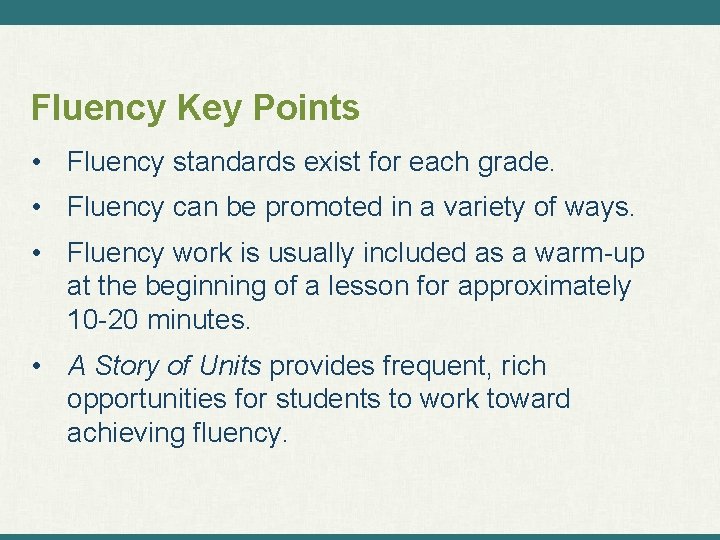
Fluency Key Points • Fluency standards exist for each grade. • Fluency can be promoted in a variety of ways. • Fluency work is usually included as a warm-up at the beginning of a lesson for approximately 10 -20 minutes. • A Story of Units provides frequent, rich opportunities for students to work toward achieving fluency.
Next Steps • What type of fluency activity are you most eager to incorporate into your current teaching? • How can you help your colleagues implement the fluency component of rigor?