
Eukaryotic Microbial Diversity Early attempts at taxonomy all

Eukaryotic Microbial Diversity • Early attempts at taxonomy: all plants and animals • Whitaker scheme (late 20 th century) – Five kingdoms – Modified by Woese’s work on r. RNA • Three Domains, one of which is Eukaryotes • Next two lectures on two eukaryotic kingdoms – Fungi – Protists www. kc-mtm. com http: //www. xtec. cat/~jfarre 13/hotpotatoes/imatges-hotpot/Euglena. jpg 1
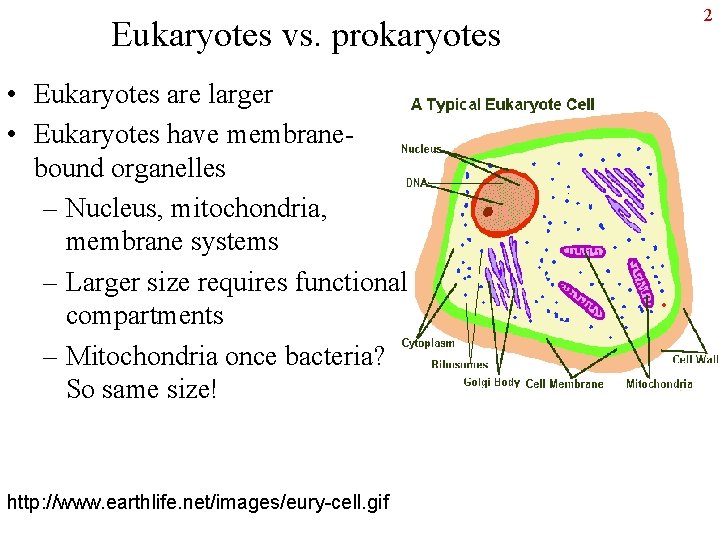
Eukaryotes vs. prokaryotes • Eukaryotes are larger • Eukaryotes have membranebound organelles – Nucleus, mitochondria, membrane systems – Larger size requires functional compartments – Mitochondria once bacteria? So same size! http: //www. earthlife. net/images/eury-cell. gif 2
Microbial eukaryotes • Animals – Parasitic worms; studied by Parasitologists • Fungi – Yeasts and molds, studied by Mycologists – Several types can cause human disease • Protists – Unicellular eukaryotes with many different characteristics. Also studied by Parasitologists. – Some cause human disease • Plants: not of particular interest other than hosts 3
Fungi 4 • Mycology: the study of fungi • Fungi are mostly saprophytes, all heterotrophs – Saprophytes: decay non-living organic matter • Fungi are the kings of decomposition – Heterotrophs: use pre-formed organic matter • Not autotrophs, not photosynthetic • Fungi grow into, through their food – Release extracellular enzymes, break down polymers into LMW compounds for transport
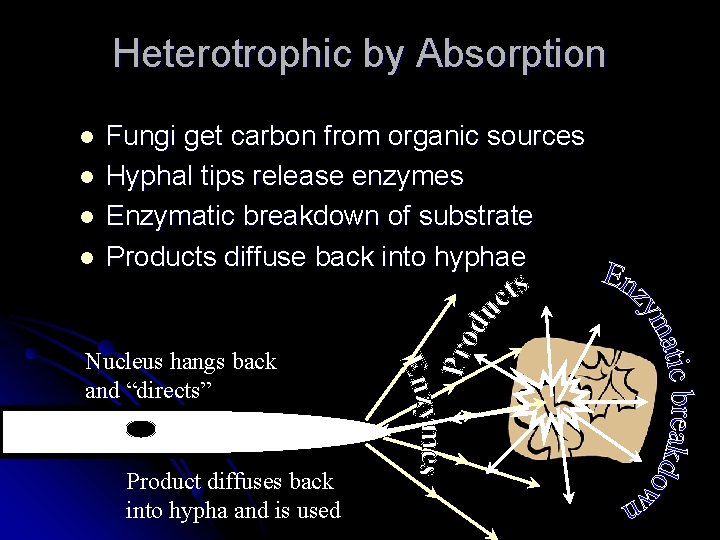
Heterotrophic by Absorption l l Fungi get carbon from organic sources Hyphal tips release enzymes Enzymatic breakdown of substrate Products diffuse back into hyphae Nucleus hangs back and “directs” Product diffuses back into hypha and is used
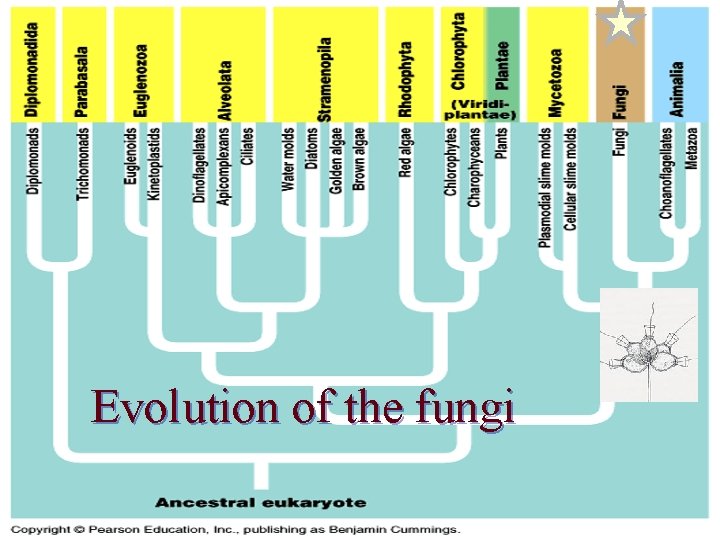
Evolution of the fungi
Classification of fungi 7 • By sexual reproductive structures • Fungi reproduce both asexually and sexually • Deuteromycota = Fungi Imperfecti – No longer a valid classification – Contained fungi that couldn’t be coaxed into having sex – Through morphological and molecular means (e. g. DNA analysis), being distributed into the other 3 phyla of fungi.
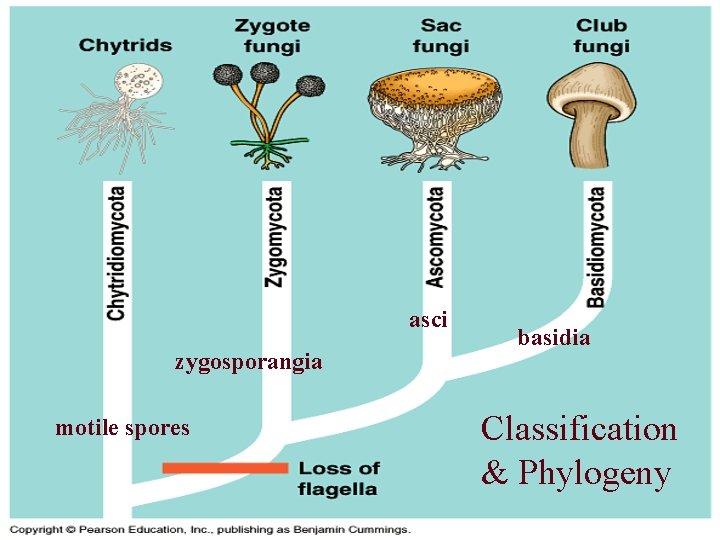
asci zygosporangia motile spores basidia Classification & Phylogeny
Fungi terminology and structure • Hypha (singular) hyphae (plural): thread – Hyphae may be partially separated into cells or not at all (ceonocytic). • Cytoplasm is continuous throughout hypha • Mycelium (plural mycelia): a mass of hyphae – Like a bacterial colony except really all one organism. • Some fungi are molds, some are yeasts – Yeasts are oval, unicellular – Dimorphic: able to grow as either form. • Typical of some disease-causing fungi 9
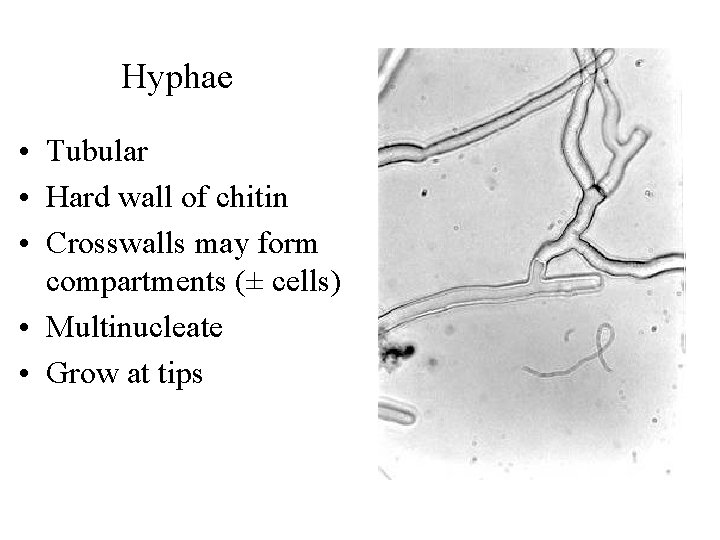
Hyphae • Tubular • Hard wall of chitin • Crosswalls may form compartments (± cells) • Multinucleate • Grow at tips
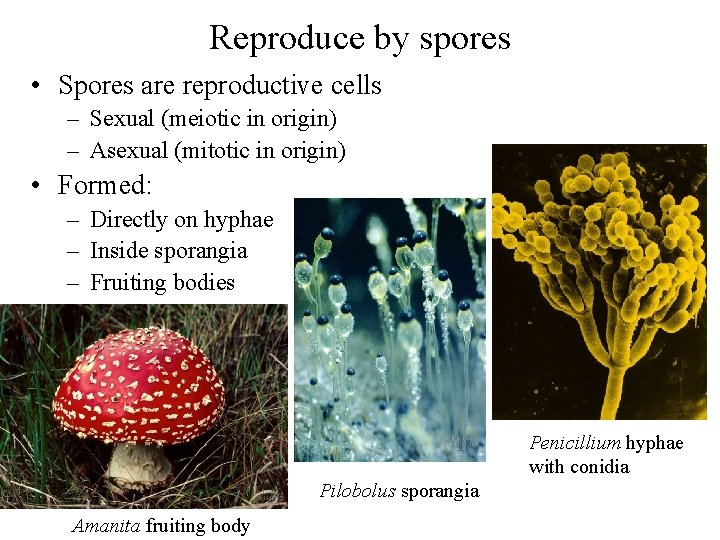
Reproduce by spores • Spores are reproductive cells – Sexual (meiotic in origin) – Asexual (mitotic in origin) • Formed: – Directly on hyphae – Inside sporangia – Fruiting bodies Penicillium hyphae with conidia Pilobolus sporangia Amanita fruiting body
Impacts of Fungi • Disease: mycosis (plural mycoses) – Most are saprobes, but some cause disease • Antibiotic production – Penicillium, Cephalosporium • Food industry – Soy sauce, cheeses • Decomposition – Cellulose and other plant polymers, wood – stone, paintings, paint, plastic • Plant pathogens – Rice, fruit, etc. 12
Mycorrhizae l l “Fungus roots” Mutualism between: l l l Several kinds l l l Fungus (nutrient & water uptake for plant) Plant (carbohydrate for fungus) Zygomycota – hyphae invade root cells Ascomycota & Basidiomycota – hyphae invade root but don’t penetrate cells Extremely important ecological role of fungi!
Fungi and Disease Classification of fungal diseases l Superficial, cutaneous, subcutaneous l Systemic and opportunistic l Poisoning and allergies l Treatment l Azole drugs, amphotericin B, others
Opportunistic infections l l Aspergillus (aspergillosis) l Variety of species, very common in soil, plant materials l Serious infections in immunocompromised l Allergies to A. fumigatus l Poisoning from aflatoxin from A. flavus Candida (candidiasis)- normal microbiota l Cause of vaginal infections, diaper rash, thrush l Capable of infecting any part of the body l Dangerous in cancer patients, HIV infections, etc.
Opportunists-2 l Cryptococcus neoformans l Inhalation of spores l Can infect many parts, but has predilection for CNS l Particularly serious in AIDS l Pneumocystis carinii l Very protozoan like, but is a fungus l Most cases associated with AIDS l Serious lung infections: PCP (P. carinii pneumonia)
- Slides: 16