
Eugene Bergman The Deaf Survivor By Megan Buckalew

Eugene Bergman The Deaf Survivor By, Megan Buckalew NTID/RIT Fall 2006 Holocaust Studies and Deaf People
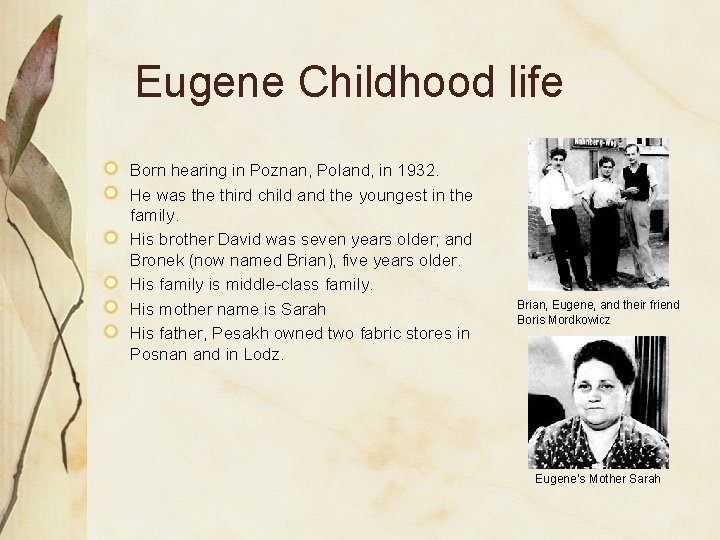
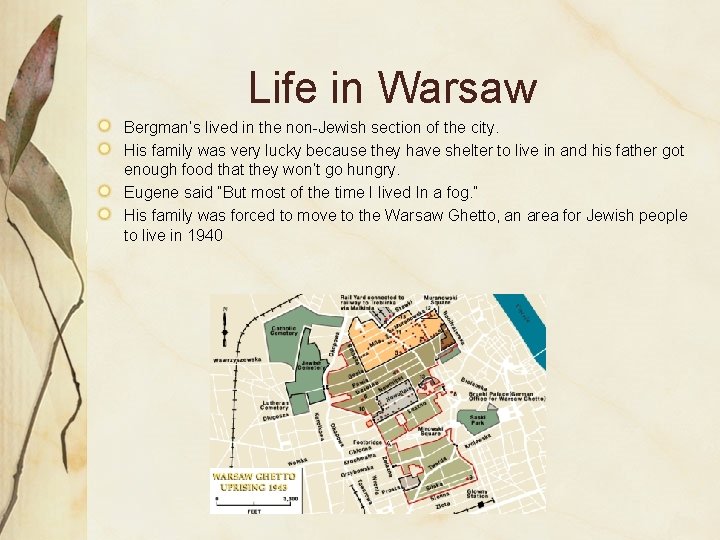
Eugene Childhood life Born hearing in Poznan, Poland, in 1932. He was the third child and the youngest in the family. His brother David was seven years older; and Bronek (now named Brian), five years older. His family is middle-class family. His mother name is Sarah His father, Pesakh owned two fabric stores in Posnan and in Lodz. Brian, Eugene, and their friend Boris Mordkowicz Eugene’s Mother Sarah
Eugene Became Deaf When Eugene was seven years old, one of the German hit him in the head with a rifle. That was the end of his childhood memories. He was in a coma for awhile and he woke up at the hospital. He said “It was a strange experience. I saw a doctor and nurse moving their mouths, but I could not hear anything. ” That the time when he became deaf.

Leaving Poznan On September 1, 1939 German invaded Poland. Most of the Jews were order to leave Poznan. After he recovered at the hospital, his family moved to Lodz to stay with relatives.
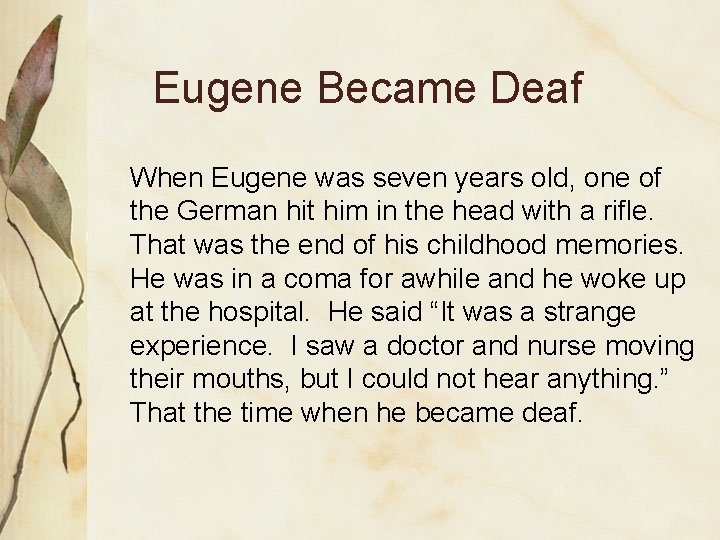
Bergman Moved Again… In the Spring of 1940 after they have been living in Lodz, they have to move again to Warsaw. Eugene said “I remember that we traveled in a horse-drawn cart to get there. ” Jewish people can’t own a car to get to places that they want to get to. Those are example of a Jewish family using horse-drawn car to move places to places.
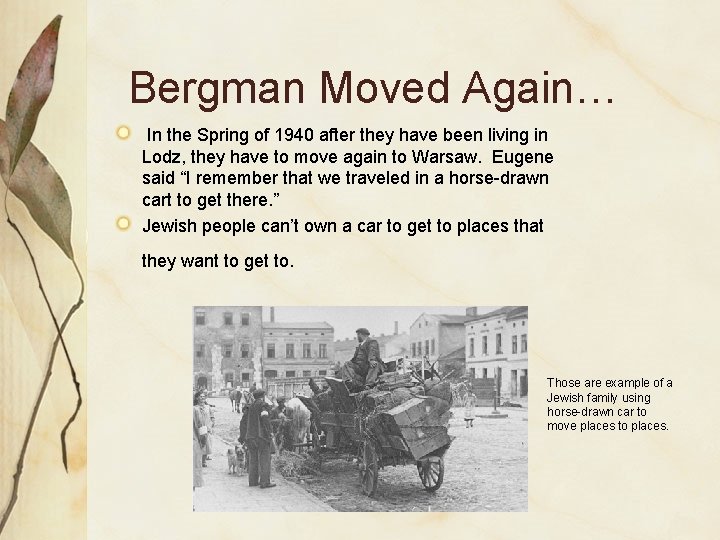
Life in Warsaw Bergman’s lived in the non-Jewish section of the city. His family was very lucky because they have shelter to live in and his father got enough food that they won’t go hungry. Eugene said “But most of the time I lived In a fog. ” His family was forced to move to the Warsaw Ghetto, an area for Jewish people to live in 1940
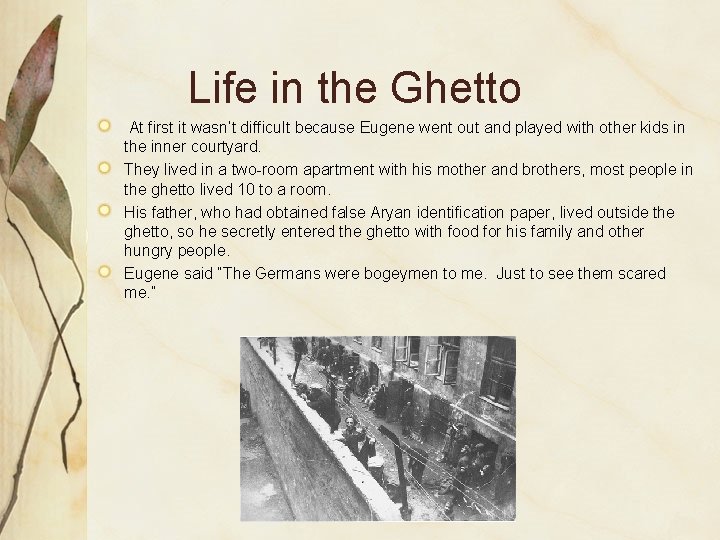
Life in the Ghetto At first it wasn’t difficult because Eugene went out and played with other kids in the inner courtyard. They lived in a two-room apartment with his mother and brothers, most people in the ghetto lived 10 to a room. His father, who had obtained false Aryan identification paper, lived outside the ghetto, so he secretly entered the ghetto with food for his family and other hungry people. Eugene said “The Germans were bogeymen to me. Just to see them scared me. ”
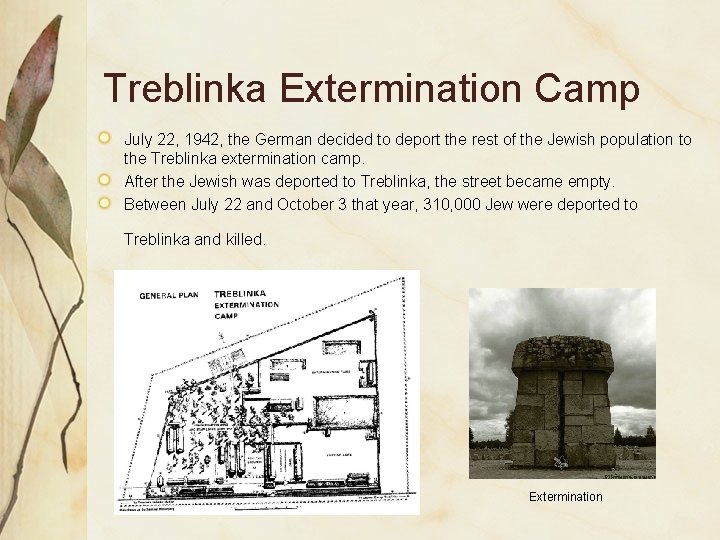
Treblinka Extermination Camp July 22, 1942, the German decided to deport the rest of the Jewish population to the Treblinka extermination camp. After the Jewish was deported to Treblinka, the street became empty. Between July 22 and October 3 that year, 310, 000 Jew were deported to Treblinka and killed. Extermination

Terror in the Ghetto Five days of terror, Eugene and his family hid in a secret cellar in their apartment building. People in their apartment were dragged out of their homes and carried away. “The Germans and the Askaris surrounded individual houses and dragged everyone out to deport them, ” as he remembers. “They broke open doors of apartment and shot everyone who would not go down to the courtyard. Sick people, cripples - they were shot dead in their homes. ” Eugene remembers a German entered the ghetto and he had a beefy, thick face. He took out his pistol and started shooting people. He said everyone fleed into the buildings and he shot people like they were rabbits. He seemed to enjoy it he was smiling. Eugene has never forgotten this.
Hunger Eugene, for the first time he became hungry. Guards around the ghetto increased so no one could get in, including his father. During the morning Germans takes people away, so Bergmans hid. So, in the afternoon they could go out into the street. A lot of time people have no idea that their friends and relatives were taken to camp to be gassed. In Treblinka, they forced the Jewish people to write a postcard to let them know that they are okay and got jobs to do. After they wrote that, they were gassed.
Message in the Bread After five days when all this happening, Eugene’s father smuggle in a loaf of bread with a message telling his family to get out of the ghetto. Eugene’s brother Bronek had already fled a couple of days earlier. Eugene’s other brother David approached a Jewish policeman and bribed him. His mother, brother and Eugene approached the German guard with papers, and they let them out of the ghetto. When they left the ghetto, they walk to a one -room apartment where his father stayed. He said “We opened the door. Father was inside. His hair in those five days had turned completely white. He was only 37 years old at the time. I was 10. ”
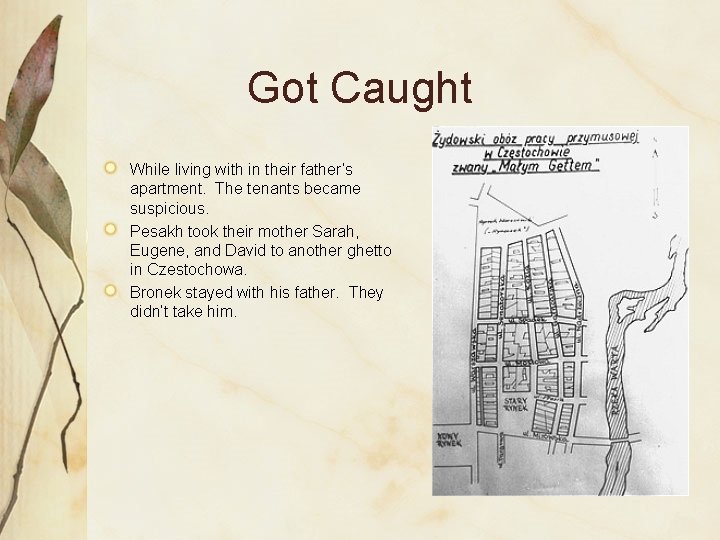
Got Caught While living with in their father’s apartment. The tenants became suspicious. Pesakh took their mother Sarah, Eugene, and David to another ghetto in Czestochowa. Bronek stayed with his father. They didn’t take him.
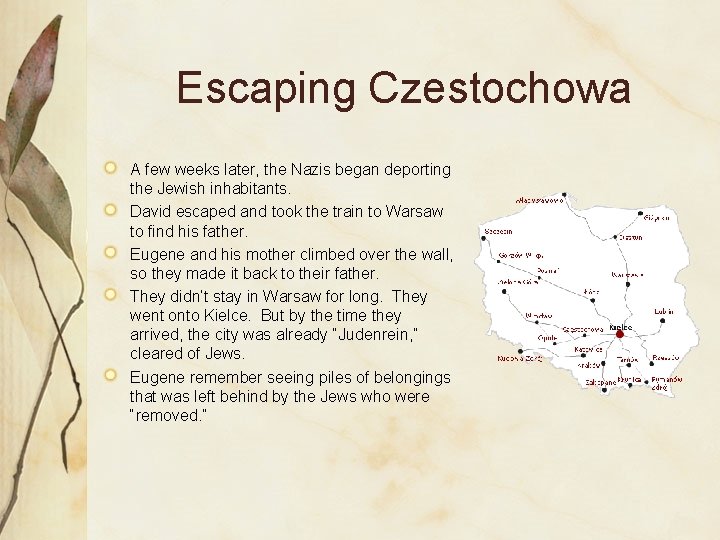
Escaping Czestochowa A few weeks later, the Nazis began deporting the Jewish inhabitants. David escaped and took the train to Warsaw to find his father. Eugene and his mother climbed over the wall, so they made it back to their father. They didn’t stay in Warsaw for long. They went onto Kielce. But by the time they arrived, the city was already “Judenrein, ” cleared of Jews. Eugene remember seeing piles of belongings that was left behind by the Jews who were “removed. ”
Return to Warsaw After a few months, they move back to Warsaw in the winter of 1942 -43. Eugene’s father had obtained false papers which allowed his family to stay outside of the ghetto. But David needed to remain hidden because he looked too Jewish. Eugene said “Some evenings when it was dark, David and my father would go out for walks, he would wear a scarf that hid half his face. ”
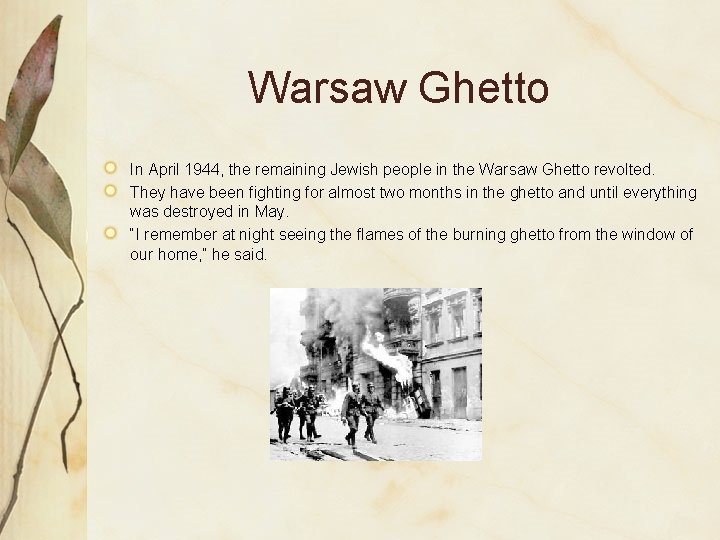
Warsaw Ghetto In April 1944, the remaining Jewish people in the Warsaw Ghetto revolted. They have been fighting for almost two months in the ghetto and until everything was destroyed in May. “I remember at night seeing the flames of the burning ghetto from the window of our home, ” he said.
Being Deaf – Saved and Risked His Life Eugene was swimming at the Vistula River on August 1, 1944. The Polish uprising against the Nazi began. Eugene was seized with leg cramps and almost drown but the Polish who was boatman saved him. They suspected that he was Jewish so they ordered him to take off his pants to see if he was circumcised. So Eugene point his hear to tell them that he is deaf. So they let him go. He thinks his deafness may have saved his life. He never made it home so he walk that day. As he was walking, he noticed dust rising around his feet so he continued walking and soon was confronted by members of the Polish resistance who had been shooting at him. He couldn’t hear the guns shooting. They ask him for papers but they found out that he was deaf and they let him stay with them. He carried equipment, searching for food and sharing little food. He couldn’t go home because they were shooting everywhere.
POW One day Eugene and the others became prisoner of war for being with the resistance – they did not know he was Jewish. Taken to the Lamsdorf POW camp in Silesia. “We were always hungry, They gave us one-eighth of a loaf of black bread apiece each day. ” he remembered. The memorable day is that he received a whole loaf of bread. The 50 youngest prisoners between the age of 10 -16 were separated from others. Other side is the group of French prisoners. Eugene wrote a note in fracture French and threw it over the fence. It said “Je suis faim. Donnez-moi pain - I am hungry, give me bread. ” So the French prisoners threw a loaf of bread over the fence to give it to him. He learned french at the Warsaw Ghetto. He was at this camp less than a month. The 50 youngster were transferred to a secret German aircraft factory in Saxony, near Meissen. They drove from 6 am to 6 pm. He lived in the factory in a barracks guarded by the German for about six months until the Russians came on May 2, 1945.
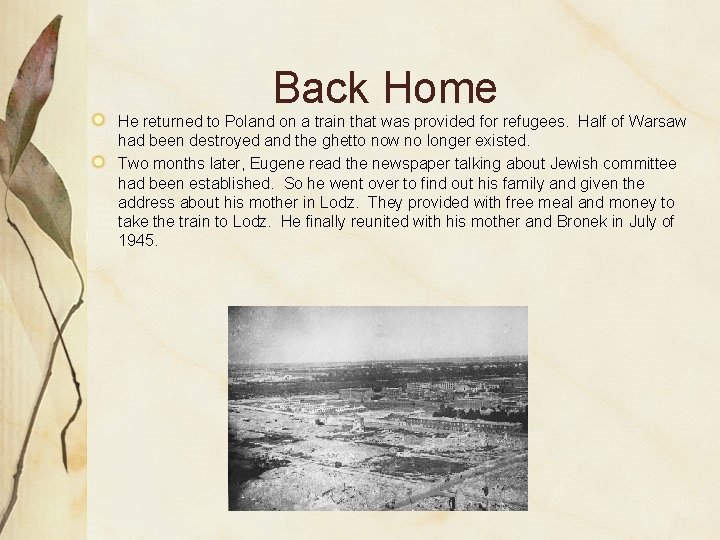
Back Home He returned to Poland on a train that was provided for refugees. Half of Warsaw had been destroyed and the ghetto now no longer existed. Two months later, Eugene read the newspaper talking about Jewish committee had been established. So he went over to find out his family and given the address about his mother in Lodz. They provided with free meal and money to take the train to Lodz. He finally reunited with his mother and Bronek in July of 1945.
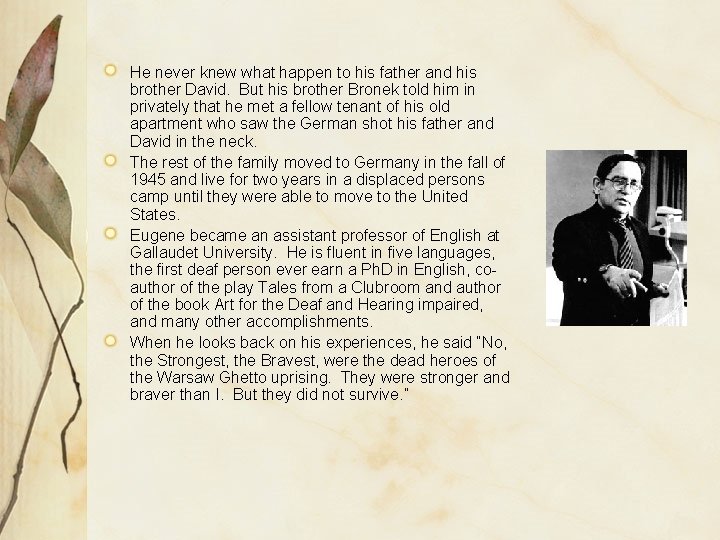
He never knew what happen to his father and his brother David. But his brother Bronek told him in privately that he met a fellow tenant of his old apartment who saw the German shot his father and David in the neck. The rest of the family moved to Germany in the fall of 1945 and live for two years in a displaced persons camp until they were able to move to the United States. Eugene became an assistant professor of English at Gallaudet University. He is fluent in five languages, the first deaf person ever earn a Ph. D in English, coauthor of the play Tales from a Clubroom and author of the book Art for the Deaf and Hearing impaired, and many other accomplishments. When he looks back on his experiences, he said “No, the Strongest, the Bravest, were the dead heroes of the Warsaw Ghetto uprising. They were stronger and braver than I. But they did not survive. ”

The End
Information Gallaudet Today, Inside the Madness A Deaf Survivor Remembers the Holocaust http: //clerccenter. gallaudet. edu/World. Around. You/holocaust/bergman. html United State Holocaust Memorial Museum http: //www. ushmm. org/ Google for the image http: //www. google. com By, Megan Buckalew November 12, 2006
- Slides: 21