
Euclids Elements Book VI Definitions VI 1 2
Euclid’s Elements Book VI
Definitions VI. 1, 2 Definition 1. Similar rectilinear figures are such as have their angles severally equal and the sides about the equal angles proportional. Definition 2. Two figures are reciprocally related when the sides about corresponding angles are reciprocally proportional.
Definitions VI. 3, 4 Definition 3. A straight line is said to have been cut in extreme and mean ratio when, as the whole line is to the greater segment, so is the greater to the less. Definition 4. The height of any figure is the perpendicular drawn from the vertex to the base.
Euclid VI. 1. Triangles and parallelograms which are under the same height are to one another as their bases.
Euclid VI. 2. If a straight line is drawn parallel to one of the sides of a triangle, then it cuts the sides of the triangle proportionally; and, if the sides of the triangle are cut proportionally, then the line joining the points of section is parallel to the remaining side of the triangle.
Euclid VI. 3. If an angle of a triangle is bisected by a straight line cutting the base, then the segments of the base have the same ratio as the remaining sides of the triangle; and, if segments of the base have the same ratio as the remaining sides of the triangle, then the straight line joining the vertex to the point of section bisects the angle of the triangle.
Euclid VI. 3. If an angle of a triangle is bisected by a straight line cutting the base, then the segments of the base have the same ratio as the remaining sides of the triangle; and, if segments of the base have the same ratio as the remaining sides of the triangle, then the straight line joining the vertex to the point of section bisects the angle of the triangle.
Euclid VI. 4. In equiangular triangles the sides about the equal angles are proportional where the corresponding sides are opposite the equal angles.
Euclid VI. 5. If two triangles have their sides proportional, then the triangles are equiangular with the equal angles opposite the corresponding sides.
Euclid VI. 6. If two triangles have one angle equal to one angle and the sides about the equal angles proportional, then the triangles are equiangular and have those angles equal opposite the corresponding sides.
Euclid VI. 7. If two triangles have one angle equal to one angle, the sides about other angles proportional, and the remaining angles either both less or both not less than a right angle, then the triangles are equiangular and have those angles equal the sides about which are proportional.

Euclid VI. 8. If in a right-angled triangle a perpendicular is drawn from the right angle to the base, then the triangles adjoining the perpendicular are similar both to the whole and to one another. Corollary. If in a right-angled triangle a perpendicular is drawn from the right angle to the base, then the straight line so drawn is a mean proportional between the segments of the base.
Euclid VI. 9. To cut off a prescribed part from a given straight line.
Euclid VI. 10. To cut a given uncut straight line similarly to a given cut straight line.
Euclid VI. 11. To find a third proportional to two given straight lines.
Euclid VI. 12. To find a fourth proportional to three given straight lines.
Euclid VI. 13. To find a mean proportional to two given straight lines.
Euclid VI. 14. In equal and equiangular parallelograms the sides about the equal angles are reciprocally proportional; and equiangular parallelograms in which the sides about the equal angles are reciprocally proportional are equal.
Euclid VI. 15. In equal triangles which have one angle equal to one angle the sides about the equal angles are reciprocally proportional; and those triangles which have one angle equal to one angle, and in which the sides about the equal angles are reciprocally proportional, are equal.
Euclid VI. 16. If four straight lines are proportional, then the rectangle contained by the extremes equals the rectangle contained by the means; and, if the rectangle contained by the extremes equals the rectangle contained by the means, then the four straight lines are proportional.
Euclid VI. 17. If three straight lines are proportional, then the rectangle contained by the extremes equals the square on the mean; and, if the rectangle contained by the extremes equals the square on the mean, then the three straight lines are proportional.
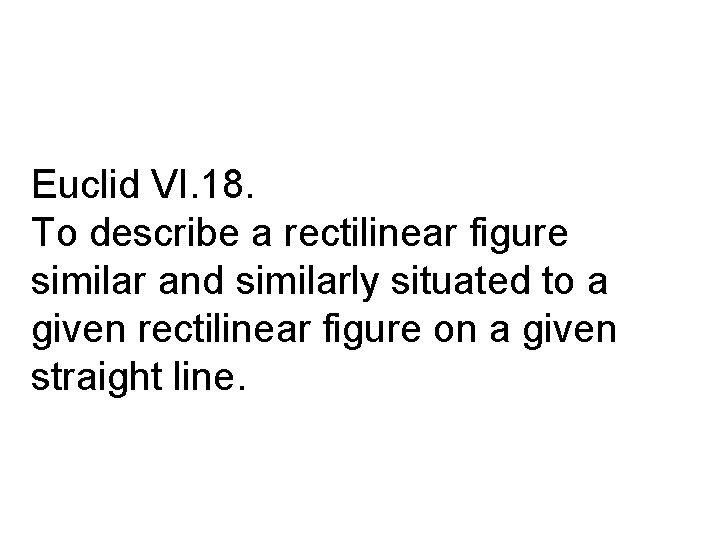
Euclid VI. 18. To describe a rectilinear figure similar and similarly situated to a given rectilinear figure on a given straight line.
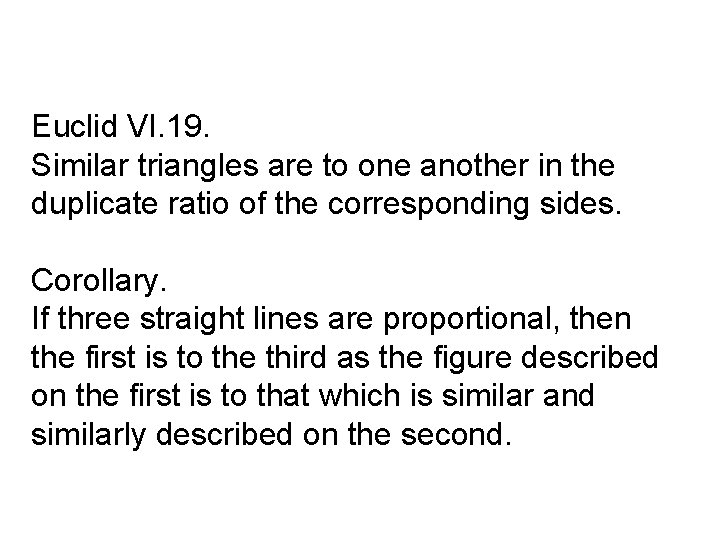
Euclid VI. 19. Similar triangles are to one another in the duplicate ratio of the corresponding sides. Corollary. If three straight lines are proportional, then the first is to the third as the figure described on the first is to that which is similar and similarly described on the second.
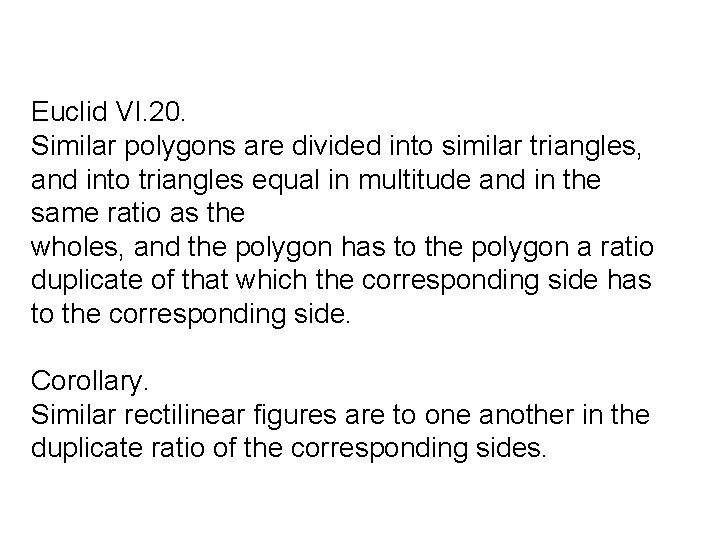
Euclid VI. 20. Similar polygons are divided into similar triangles, and into triangles equal in multitude and in the same ratio as the wholes, and the polygon has to the polygon a ratio duplicate of that which the corresponding side has to the corresponding side. Corollary. Similar rectilinear figures are to one another in the duplicate ratio of the corresponding sides.
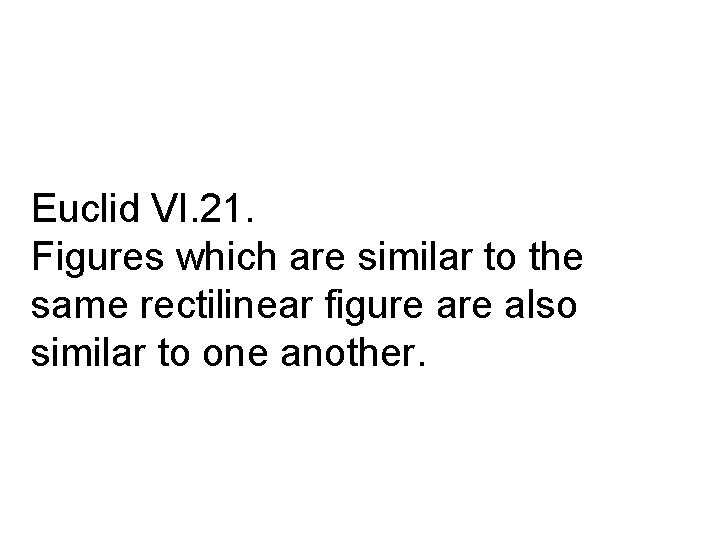
Euclid VI. 21. Figures which are similar to the same rectilinear figure also similar to one another.
Euclid VI. 22. If four straight lines are proportional, then the rectilinear figures similar and similarly described upon them are also proportional; and, if the rectilinear figures similar and similarly described upon them are proportional, then the straight lines are themselves also proportional.
Euclid VI. 23. Equiangular parallelograms have to one another the ratio compounded of the ratios of their sides.
Euclid VI. 24. In any parallelogram the parallelograms about the diameter are similar both to the whole and to one another.
Euclid VI. 25. To construct a figure similar to one given rectilinear figure and equal to another.
Euclid VI. 26. If from a parallelogram there is taken away a parallelogram similar and similarly situated to the whole and having a common angle with it, then it is about the same diameter with the whole.
Euclid VI. 27. Of all the parallelograms applied to the same straight line falling short by parallelogrammic figures similar and similarly situated to that described on the half of the straight line, that parallelogram is greatest which is applied to the half of the straight line and is similar to the difference.
Euclid VI. 28. To apply a parallelogram equal to a given rectilinear figure to a given straight line but falling short by a parallelogram similar to a given one; thus the given rectilinear figure must not be greater than the parallelogram described on the half of the straight line and similar to the given parallelogram.
Euclid VI. 29. To apply a parallelogram equal to a given rectilinear figure to a given straight line but exceeding it by a parallelogram similar to a given one.
Euclid VI. 30. To cut a given finite straight line in extreme and mean ratio.
Euclid VI. 31. In right-angled triangles the figure on the side opposite the right angle equals the sum of the similar and similarly described figures on the sides containing the right angle.
Euclid VI. 32. If two triangles having two sides proportional to two sides are placed together at one angle so that their corresponding sides are also parallel, then the remaining sides of the triangles are in a straight line.
Euclid VI. 33. Angles in equal circles have the same ratio as the circumferences on which they stand whether they stand at the centers or at the circumferences.
- Slides: 37