
EU Settlement Scheme EU Settlement Applying to Scheme

- Slides: 18
EU Settlement Scheme
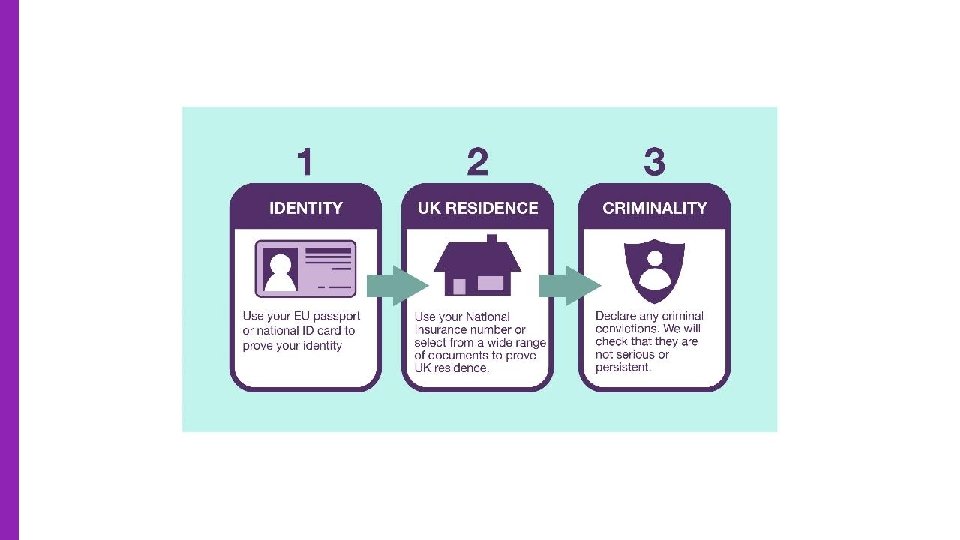
EU Settlement Applying to. Scheme the Settlement Scheme v On 29 March 2019, the EU Settlement Scheme opened to all applications. EEA and Swiss citizens, and their family members in the UK, will need to apply to secure their rights through a free, simple, digital system. This will give them a status in UK law, once we leave the EU. v There is plenty of time to apply and the application process is quick and user-friendly. The Home Office worked closely with representatives of EU citizens on its design and development. v It is a three-step process, assessing applicants on identity, residence, and criminality. v We are looking for reasons to grant, not to refuse.
What does the Scheme mean? Applying to EU the. Settlement Scheme v Eligible applicants to the EU Settlement Scheme will be given either pre-settled status, or settled status. The status given generally depends on how long you have lived in the UK when you apply. v To obtain settled status EEA and Swiss citizens, and their family members will generally need simply to have lived continuously in the UK for five years. Those with less than five years’ residence will be granted pre-settled status until they accumulate five years’ continuous residence. v With pre-settled status and settled status, applicants can; v v v Work in the UK Use the NHS Enrol in education or continue studying Access public funds such as benefits and pensions, if eligible for them Travel in and out of the UK
What does the Scheme mean? Applying to EU the. Settlement Scheme v Once an applicant has settled status, they are able to stay in the UK for as long as they wish. They can also leave the UK for up to five years without their settled status lapsing. Swiss citizens and their family members can spend up to four years outside the UK without their settled status lapsing. Those with pre-settled status will be given five years’ leave to accumulate the five years’ continuous residence generally required for settled status. They will then be able to swap this for settled status. v Those who hold Permanent Residence will need to convert this to settled status, by applying to the EU Settlement Scheme. Those who hold existing indefinite leave to remain do not need to apply to the EU Settlement Scheme, but may do so if they wish, to swap this for settled status – as this indefinite leave to remain granted under the scheme has additional benefits, like the period which can be spent outside the UK before it lapses. v Irish citizens do not need to apply to the EU Settlement Scheme to protect their status and rights. They are covered by Common Travel Area (CTA) arrangements.
Identity Applying to the Settlement Scheme v There are three ways for applicants to verify their identity; v Using the ‘EU Exit ID Document Check app’: This option is currently available on android devices and available to resident EU citizens (and their EU citizen family members) with a valid biometric passport, and to their non-EU citizen family members holding a valid biometric residence card, so that they can prove their identity remotely. There also local hubs with android devices where applicants can go to have their identity checked remotely. The Home Office is in discussions with Apple on opening functionality of their devices, and we expect this to happen by the end of the year. v Send an identity document in the post: This will allow caseworkers to check applicants identity as part of the application process. v Face to face: Applicants can have their identity verified face to face, in one of the passport offices across the UK.
Residence to the Settlement Scheme Applying v To obtain settled status EU citizens and their family members will generally need simply to have lived continuously in the UK for five years. Those with less than five years’ residence will be granted pre-settled status until they accumulate their five years. For a year to qualify as being resident in the UK, we need six months of evidence from that 12 month period. v To lessen the burden on applicants, we check the employment and benefits records the Government holds to establish the period of residence, meaning most applicants won’t need to do anything to prove their residence. Where there are gaps, a wide variety of documents can be photographed and uploaded as evidence. Applicants can upload different types of evidence to demonstrate different periods of residence. v Caseworkers will work proactively with applicants to help them evidence their qualifying period of residence in the UK by the best means available to the applicant.
Criminality to the Settlement Scheme Applying v The application form will ask if an applicant has any criminal convictions, both in the UK and overseas. Applicants will be checked against the UK’s crime databases. v This is to determine an applicant is not a serious or persistent criminal, and that the applicant doesn’t pose a security threat. If an applicant has been convicted of a minor crime, they will still be eligible for either pre-settled status or settled status. v An applicant may still get pre-settled status or settled status even if they have other convictions. All of these applications will be assessed on a case-by-case basis. v If an applicant has been to prison, that time does not count as residence in the UK but they are still able to apply to the EU Settlement Scheme where they are released before the ‘specified date’.
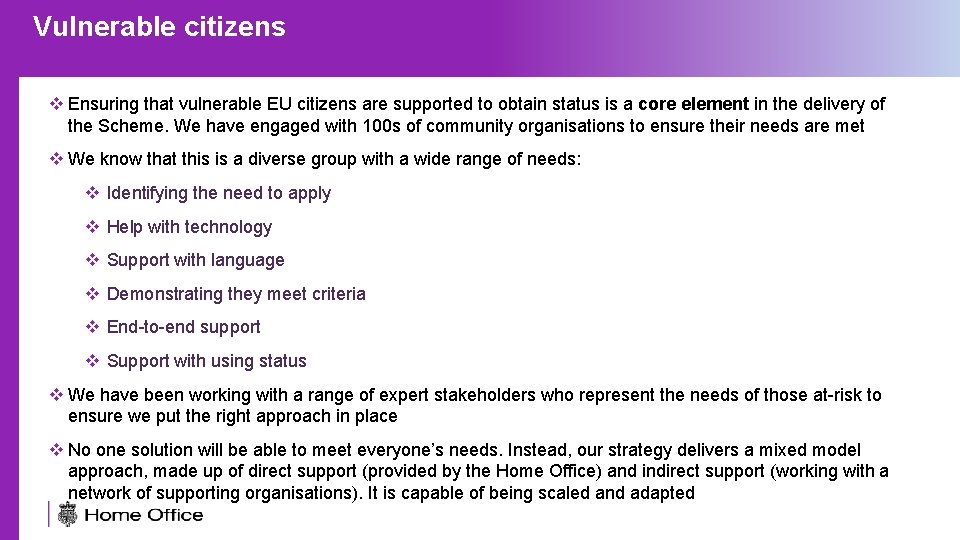
Vulnerable citizens Applying to the Settlement Scheme v Ensuring that vulnerable EU citizens are supported to obtain status is a core element in the delivery of the Scheme. We have engaged with 100 s of community organisations to ensure their needs are met v We know that this is a diverse group with a wide range of needs: v Identifying the need to apply v Help with technology v Support with language v Demonstrating they meet criteria v End-to-end support v Support with using status v We have been working with a range of expert stakeholders who represent the needs of those at-risk to ensure we put the right approach in place v No one solution will be able to meet everyone’s needs. Instead, our strategy delivers a mixed model approach, made up of direct support (provided by the Home Office) and indirect support (working with a network of supporting organisations). It is capable of being scaled and adapted
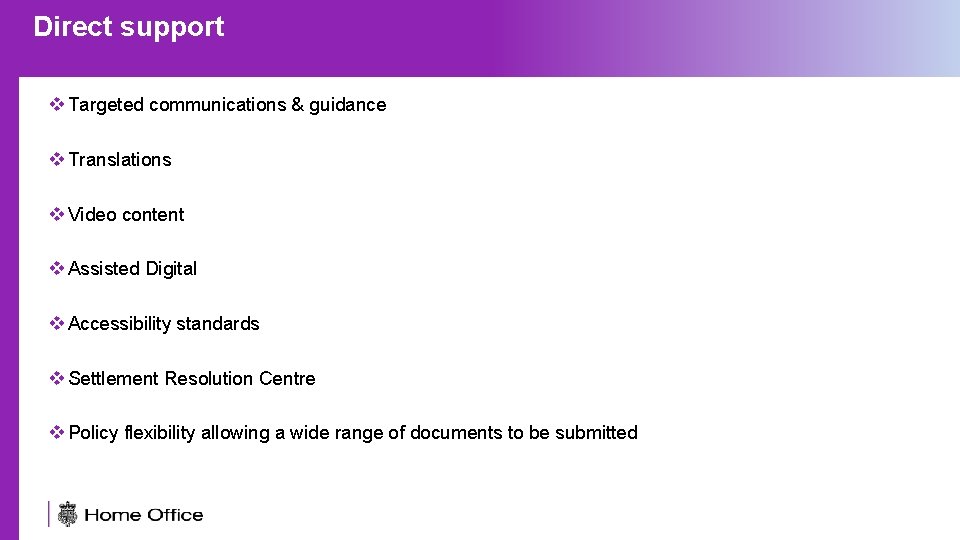
Direct support Applying to the Settlement Scheme v Targeted communications & guidance v Translations v Video content v Assisted Digital v Accessibility standards v Settlement Resolution Centre v Policy flexibility allowing a wide range of documents to be submitted
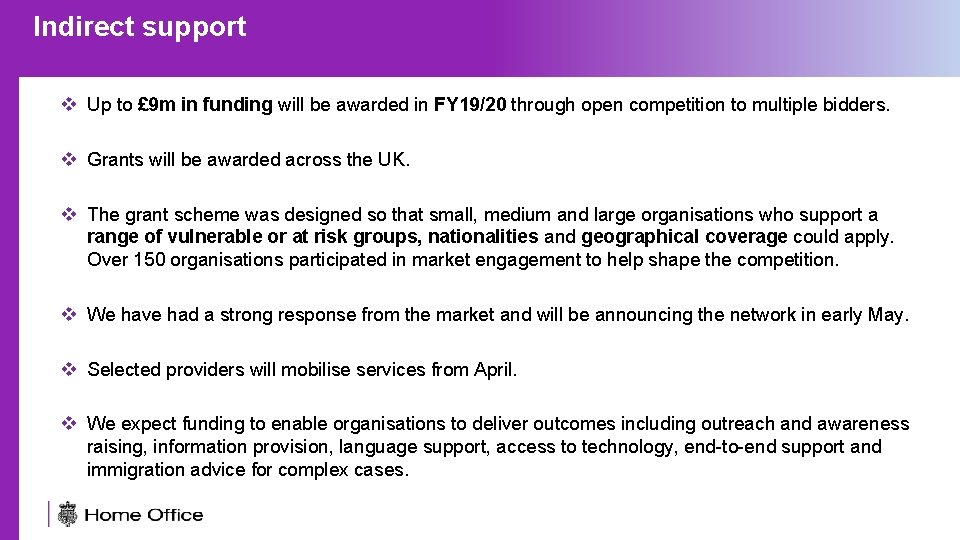
Indirect support Applying to the Settlement Scheme v Up to £ 9 m in funding will be awarded in FY 19/20 through open competition to multiple bidders. v Grants will be awarded across the UK. v The grant scheme was designed so that small, medium and large organisations who support a range of vulnerable or at risk groups, nationalities and geographical coverage could apply. Over 150 organisations participated in market engagement to help shape the competition. v We have had a strong response from the market and will be announcing the network in early May. v Selected providers will mobilise services from April. v We expect funding to enable organisations to deliver outcomes including outreach and awareness raising, information provision, language support, access to technology, end-to-end support and immigration advice for complex cases.
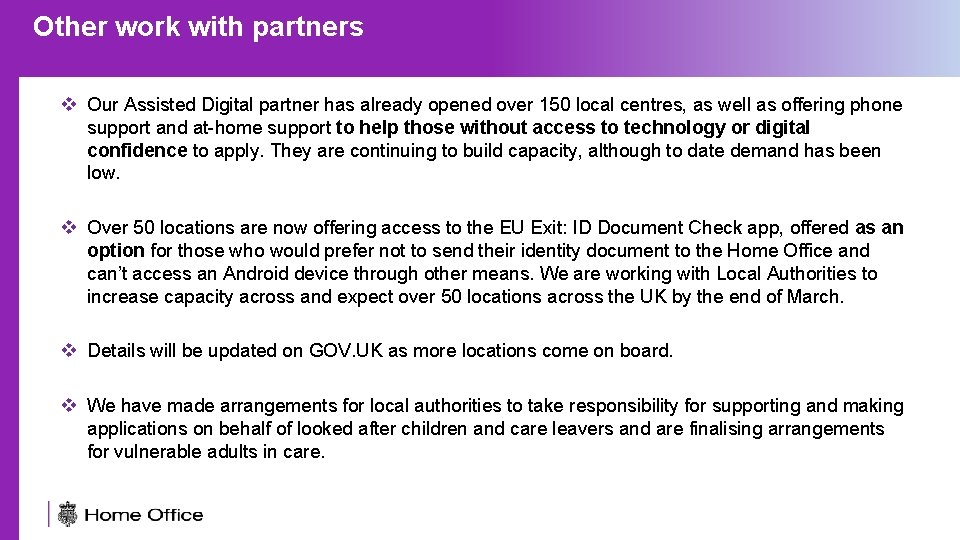
Other work with partners Applying to the Settlement Scheme v Our Assisted Digital partner has already opened over 150 local centres, as well as offering phone support and at-home support to help those without access to technology or digital confidence to apply. They are continuing to build capacity, although to date demand has been low. v Over 50 locations are now offering access to the EU Exit: ID Document Check app, offered as an option for those who would prefer not to send their identity document to the Home Office and can’t access an Android device through other means. We are working with Local Authorities to increase capacity across and expect over 50 locations across the UK by the end of March. v Details will be updated on GOV. UK as more locations come on board. v We have made arrangements for local authorities to take responsibility for supporting and making applications on behalf of looked after children and care leavers and are finalising arrangements for vulnerable adults in care.
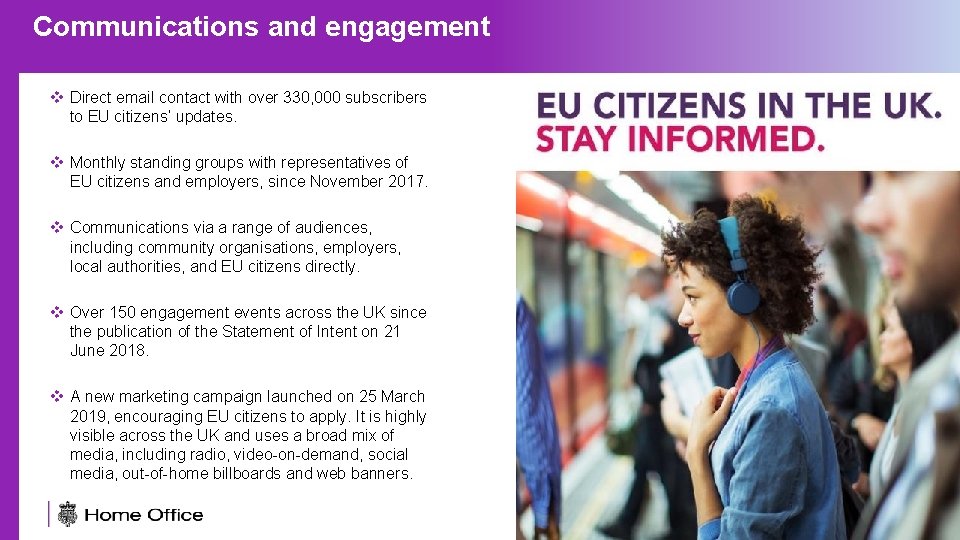
Communications and engagement v Direct email contact with over 330, 000 subscribers to EU citizens’ updates. v Monthly standing groups with representatives of EU citizens and employers, since November 2017. v Communications via a range of audiences, including community organisations, employers, local authorities, and EU citizens directly. v Over 150 engagement events across the UK since the publication of the Statement of Intent on 21 June 2018. v A new marketing campaign launched on 25 March 2019, encouraging EU citizens to apply. It is highly visible across the UK and uses a broad mix of media, including radio, video-on-demand, social media, out-of-home billboards and web banners. 13
ONLINE APPLICATION (DRAFT / INDICATIVE – still in development)
Online status checking v During the Implementation Period, EU citizens will continue to be able to use their passports or ID cards to evidence their rights and entitlements. These online services provide them with an alternative way to demonstrate this v The Home Office is developing a range of online services, enabling migrants to access their immigration status, and prove their entitlement to a range of public and private services – such as work, rental accommodation, healthcare and benefits v An online Right to Work service – enabling holders of Biometric Residence Permits (BRP) and Biometric Residence Cards (BRC) to check their own right to work status and share this securely with employers went live in April 2018. This was extended in November to include individuals granted status under the EU Settlement Scheme v An online status service has been developed for those granted status under the EU Settlement Scheme – ‘view and prove your rights in the UK’. This has been in beta testing along with the rest of the EU Settlement Scheme, and allows users to view their status information, update their details and prove their right to work to an employer v This service will be further developed as the scheme launches, enabling users to share their rights with other service providers, such as landlords, and will continue to iterate and improve these services based on user feedback
No deal - European Leave to Remain Applying to the Temporary Settlement Scheme v After exit, once free movement has ended, EEA citizens newly arriving in the UK can visit for three months visa-free. They can continue to enter the UK using a valid passport or identity card. After free movement ends, those EEA citizens who wish to stay in the UK for longer than three months will need to make an application for European Temporary Leave to Remain. Irish citizens an continue to live, work and study in the UK just as before. v Subject to identity, criminality and security checks, European Temporary Leave to Remain will be granted for 36 months. This permission to stay for 36 months cannot be extended. Those who wish to stay for longer will need to apply and qualify under the terms of the new skillsbased immigration system, which will begin from 1 January 2021 v Employers already conduct Right to Work checks on EEA citizens and that will not change. They do not have to differentiate between those who are resident in the UK before exit and those who arrive afterwards. Until the new skills-based immigration system is introduced, EEA citizens will be able to evidence their right to work in the UK by using a passport or national identity card, as now
Useful links v EU Settlement Scheme: www. gov. uk/eusettledstatus v Employers toolkit: https: //www. gov. uk/government/publications/eu-settlement-scheme-employer-toolkit v Community Leaders toolkit: https: //www. gov. uk/government/publications/eu-settlement-scheme-communityleaders-toolkit v ID document scanner locations: www. gov. uk/government/publications/eu-settlement-scheme-id-documentscanner-locations v Assisted Digital Service: www. gov. uk/government/publications/eu-settlement-scheme-assisted-digital-service v Citizens’ Rights in a no deal: www. gov. uk/government/publications/policy-paper-on-citizens-rights-in-theevent-of-a-no-deal-Brexit v Sign up for EUSS updates: https: //gov. smartwebportal. co. uk/homeoffice/public/webform. asp? id=67&id 2=627 DF 7
QUESTIONS