
EU Lawmaking process presented by Alexander Taibi Irene
EU Law-making process presented by Alexander Taibi Irene Prota
AGENDA • Competence to act. • The Legislative process: the ordinary legislative process. • Crisis-era Reform Agenda. • Administrative rule-making. • The role of Esma.
COMPETENCE TO ACT • The law-making process for EU securities and market regulation is based on the institutional framework and processes set out in the Treaties and which govern law making in EU generally. • Art. 5, 2 TUE: Under the principle of conferral, the Union shall act only within the limits of the competences conferred upon it by the Member States in the Treaties to attain the objectives set out therein. Competences not conferred upon the Union in the Treaties remain with the Member States.
The Legislative process: the Ordinary Legislative Process • Legislative rules in the securities and market sphere adopted under the Article 294 TFEU ‘ ordinary legislative procedure’; • It is based on ’the principle of parity between the European Parliament and Council. ’ • The ordinary legislative procedure is multistaged and based on multiple readings by the European Parliament, prior to the adoption of an agreed text by the Council and Parliament.

ORDINARY LEGISLATIVE PROCESS COMMISSION Members nominated by Eu states Proposes legislation COUNCIL Governments of the 25 states CODECISION PARLIAMENT Directly elected

The Legislative Process and the Crisis-era Reform Agenda • The Legislative process was generally regarded as having worked reasonably effectively over the FSPA/Lamfalussy era, and as having benefits from the Lamfalussy process. • The Crisis Era saw this complex and multistage procedure being ’eschewed’ in favour of the ’FAST-TRACKING’ LEGISLATION. HOW DOES IT WORK ? • The process is based on the conclusion of an agreement at the 1° reading stage, which is preceded by an informal tripartite meetings attended by the Parliament, the Council and the Commission. • During the trilogues, agreement is sought on the Parliament amandments, such that they can be adopted in a plenary Parliament session and accepted by the Council.
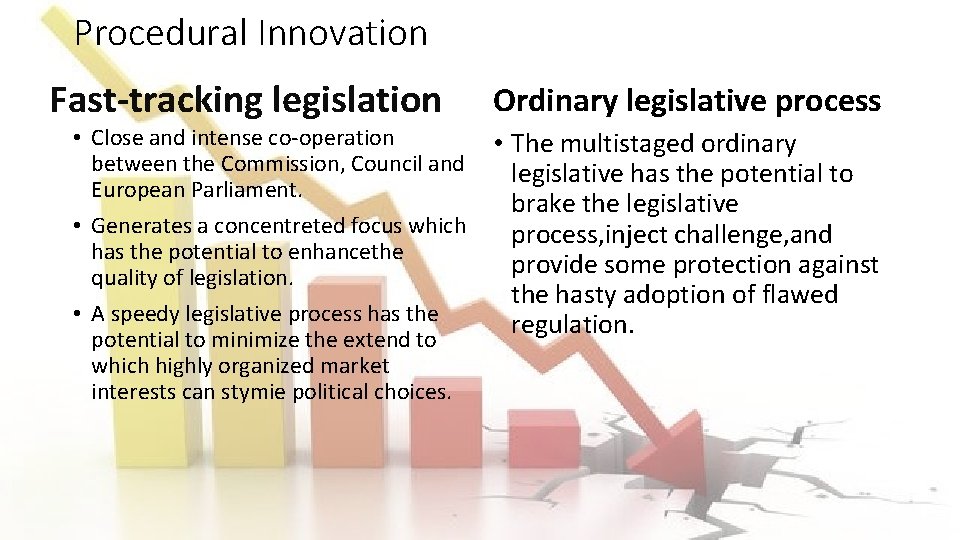
Procedural Innovation Fast-tracking legislation • Close and intense co-operation between the Commission, Council and European Parliament. • Generates a concentreted focus which has the potential to enhancethe quality of legislation. • A speedy legislative process has the potential to minimize the extend to which highly organized market interests can stymie political choices. Ordinary legislative process • The multistaged ordinary legislative has the potential to brake the legislative process, inject challenge, and provide some protection against the hasty adoption of flawed regulation.
ADMINISTRATIVE RULE-MAKING ADMINISTRATIVE AGENCIES What are they for? • Technical expertise. • Freedom from bias. • Long-term perspective. Which are the benefits they produce? • Technical and expert capacity. • Ability to engage stakeholders. • These benefits are reflected in the rule-making mandates conferred on regulatory authorities worldwide.
‘AGENCIFICATION’ of EU Governance What does it mean? • A multiplicity of agencies now exercise quasi-rule-making powers of varying degrees. …But under EU Treaties: the Commission is the constitutional location for Administrative Law-Making.
…This means that European Agencies cannot adopt administrative rules. «Regulatory Agencies without Regulatory Powers» • Sui generis EU constitutional framework
The role of the Commission in the Administrative rule-making Two Forms of Administrative rule-making are supported by the Treaties: 1) Art. 290 -291 TFEU Article 290 TFEU: • Delegation of rule-making power from Co-legislators (Parliment and/or Counsil) to the Commission. Article 291 TFEU: • Addresses Executive powers and related Implemented rules 2) Adoption by the Commission of BTSs (Binding Technical Standards) More power to ESMA
ESMA and Administrative Rule-Making (European Securities and Market Authority) - What is ESMA? - ESMA and Meroni Ruling (1958). - ESMA’s objective: «to protect the public interest by contributing to the short, medium, and long-term stability and effectiveness of the financial system, for the Union economy, its citizens and businesses» (ESMA Regulation Article 1 (5)). - BTS (Binding Technical Standards).

Thanks for your attention…
- Slides: 13