
EU Korea FTA EUs response and preparation for
- Slides: 18
EU Korea FTA EU’s response and preparation for the EU-Korea FTA Xavier Coget Head of Trade section EU Delegation to the Republic of Korea June 2011
EU Korea FTA 1. What is in this FTA?
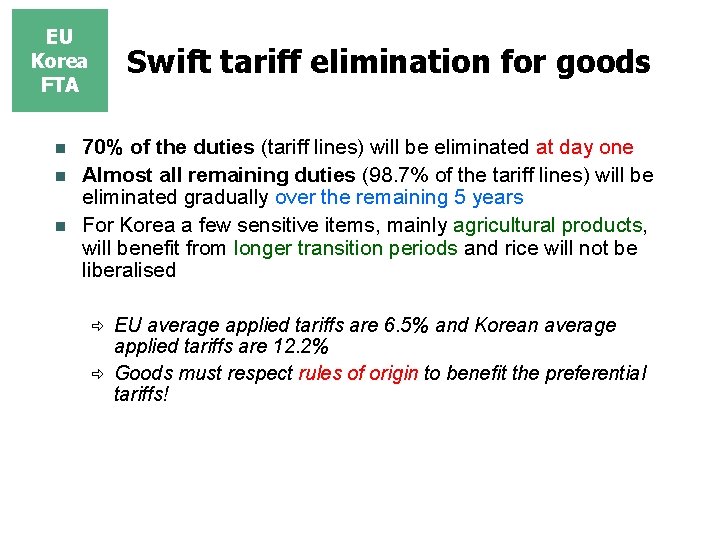
EU Korea FTA n n n Swift tariff elimination for goods 70% of the duties (tariff lines) will be eliminated at day one Almost all remaining duties (98. 7% of the tariff lines) will be eliminated gradually over the remaining 5 years For Korea a few sensitive items, mainly agricultural products, will benefit from longer transition periods and rice will not be liberalised ð ð EU average applied tariffs are 6. 5% and Korean average applied tariffs are 12. 2% Goods must respect rules of origin to benefit the preferential tariffs!
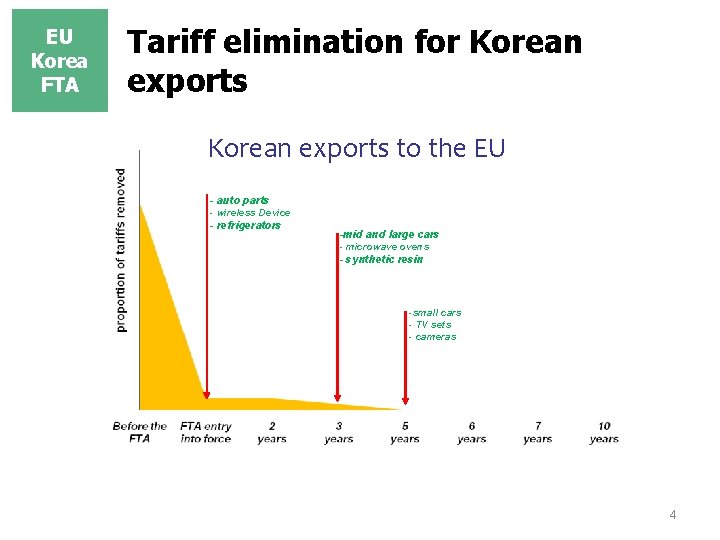
EU Korea FTA Tariff elimination for Korean exports to the EU - auto parts - wireless Device - refrigerators -mid and large cars - microwave ovens - synthetic resin -small cars - TV sets - cameras 4
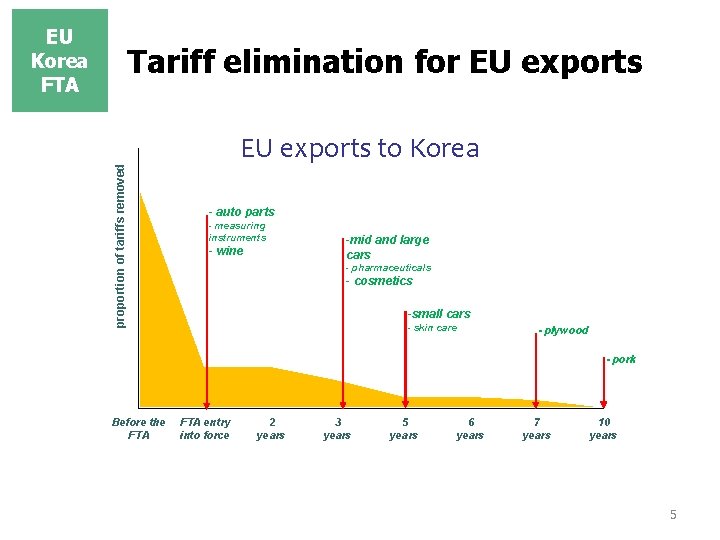
EU Korea FTA proportion of tariffs removed Tariff elimination for EU exports to Korea - auto parts - measuring instruments - wine -mid and large cars - pharmaceuticals - cosmetics -small cars - skin care - plywood - pork Before the FTA entry into force 2 years 3 years 5 years 6 years 7 years 10 years 5
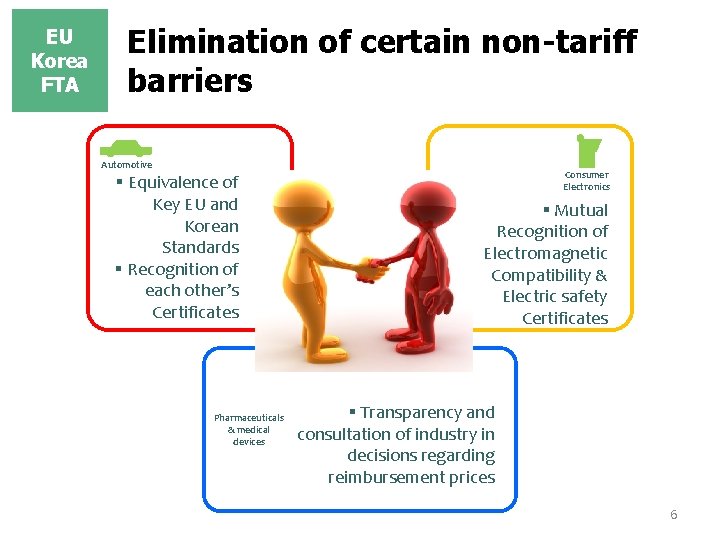
EU Korea FTA Elimination of certain non-tariff barriers Automotive § Equivalence of Key EU and Korean Standards § Recognition of each other’s Certificates Pharmaceuticals & medical devices Consumer Electronics § Mutual Recognition of Electromagnetic Compatibility & Electric safety Certificates § Transparency and consultation of industry in decisions regarding reimbursement prices 6
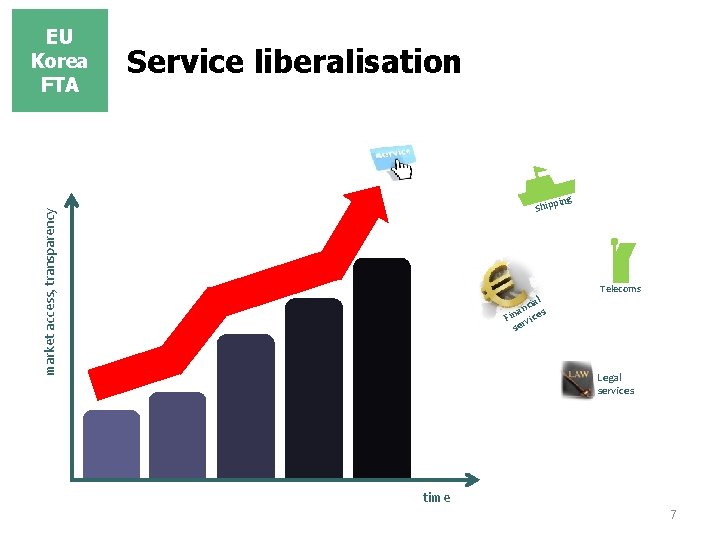
EU Korea FTA Service liberalisation ing market access, transparency Shipp al nci s a Fin rvice se Telecoms Legal services time 7
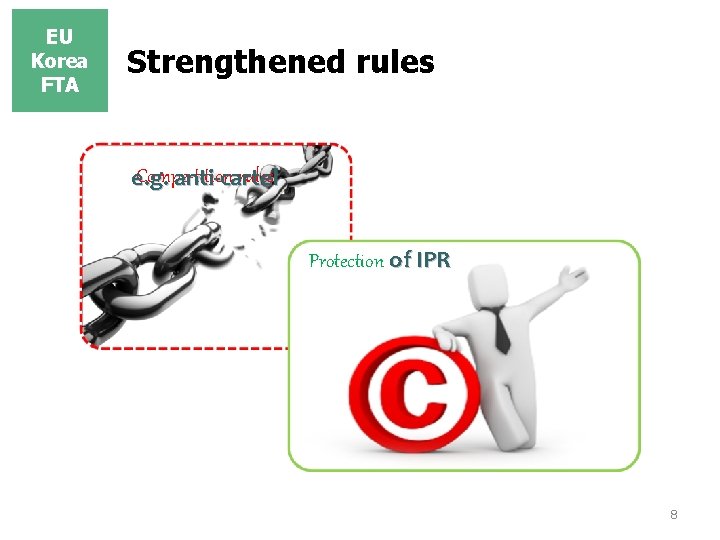
EU Korea FTA Strengthened rules Compe-tition rules e. g. anti-cartel Protection of IPR 8
EU Korea FTA Other elements n Efficient dispute settlement rules n Protocol on cultural co-operation n General safeguard clause n Efficient institutions 9
EU Korea FTA 2. Expected impact
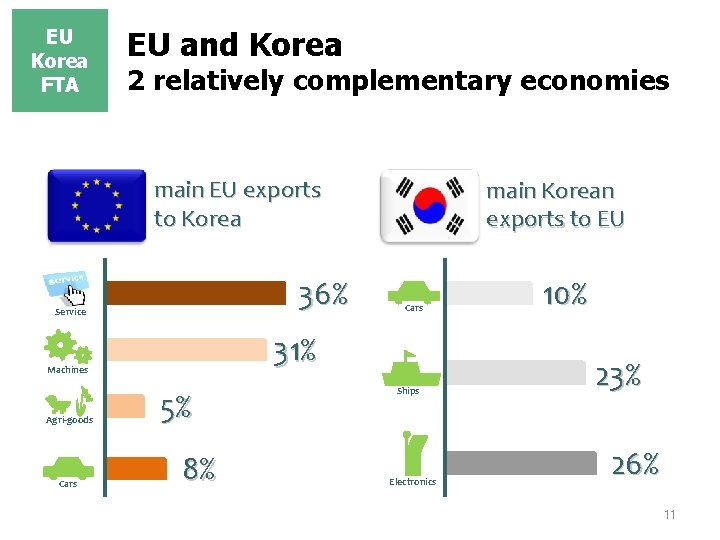
EU Korea FTA EU and Korea 2 relatively complementary economies main EU exports to Korea 36% Service Cars 31% Machines Agri-goods main Korean exports to EU 5% 8% Ships Electronics 10% 23% 26% 11
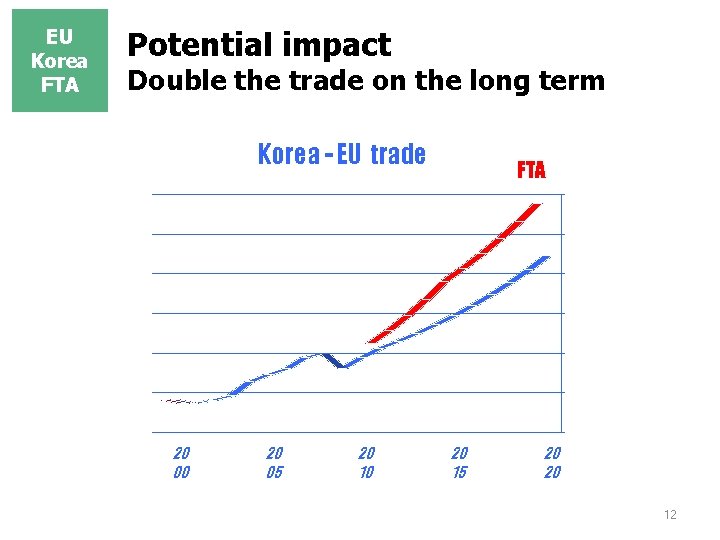
EU Korea FTA Potential impact Double the trade on the long term Korea - EU trade 20 00 20 05 20 10 FTA 20 15 20 20 12
EU Korea FTA Economic growth, job creation, consumer benefits, competition, investment GDP Income Fair Competition 13
EU Korea FTA n n n Summary Most important FTA negotiated by EU or Korea. Bilateral trade and growth will be boosted ð One study estimates that the FTA will increase bilateral trade by more than € Bn 30 On the short term: - Most competitive sectors of each side will immediately boost their exports while weaker ones will face tougher competition (adjustment cost) - Costs for consumers and users will decrease, boosting competitiveness of the 2 economies On the longer term: - Increase of investment - Economies of scale / more efficient resource allocation - Opportunities for strategic partnerships - Emulation, innovation, technology transfer
EU Korea FTA 3. EU’s response and preparation
EU Korea FTA n n n Adoption of FTA implementing legislation in the EU Council Decision approving the provisional application of the FTA Amendment of the TARIC database (EU custom duties database) to implement the liberalisation schedule EU Safeguard Regulation (internal EU rules on how to operate the bilateral FTA safeguard) Commission Regulation/Decision with specific rules to implement the Rules of Origin derogations Protection of Korean Geographical Indications Several other EU legislation are implementing commitments in the service sector of IPR
EU Korea FTA n n Communication and pedagogic efforts towards businesses and governments Organization of / participation to several information seminars for businesses and EU Governments Publication of several pedagogic materials (text of the FTA, summary, reading guide, Powerpoint presentations) Specific targeted pedagogic and communication efforts by EU Member States administrations (e. g. National customs for the approved exporters’ status and rules of origin) Press activity and celebration events end June / early July
EU Korea FTA Institutional set-up / relations with the Korean Government n Reinforcement of EU officials operating trade relation with Korea n Intensification of contacts and cooperation with Korean Government / monitoring of Korea’s FTA implementation n New institutional set-up for FTA implementation (13 EUKorea Committees and Working Groups will meet at least once a year to operate the FTA) n More contacts with EU industry through the usual channels