
ETSI STANDARDS FOR INFORMATION AND COMMUNICATION TECHNOLOGIES Dirk












- Slides: 41
ETSI – STANDARDS FOR INFORMATION AND COMMUNICATION TECHNOLOGIES Dirk Weiler, Chairman of the Board and IPR Special Committee, ETSI Head of Standards Policy, Nokia Vortrag in der Reihe „Datenschutz und IT-Sicherheit“ , Hochschule München, 21. Dezember 2016
ETSI – STANDARDS FOR INFORMATION AND COMMUNICATION TECHNOLOGIES Standardization Overview of ETSI Security in ETSI 2 © ETSI 2016. All rights reserved
Business considerations For-profit organizations prefer monopoly over standard Proprietary solution – no need for consensus building Economies of scale More brain power Customer pressure for competition Government pressure against lock-in 3 © ETSI 2016. All rights reserved
Some reasons to participate Ensure interoperability Drive your technology of choice into the standard Access to leading-edge ICT knowledge Opportunities to meet and influence your customers & competitors Direct insight into critical issues, including regulatory & spectrum matters, and the ability to influence them Contribute the views of your constituency (e. g. environment, users, social interests, SMEs) 4 © ETSI 2016. All rights reserved
Interests of standard contributors and standard users 5 Standard contributors Standard users Develop the most suitable standard Have the most suitable standard available Fair and reasonable access to the standard for all interested users Reward for the investments into developing the standard Minimum constraints for using the standard Optimum reward Minimum costs © ETSI 2016. All rights reserved
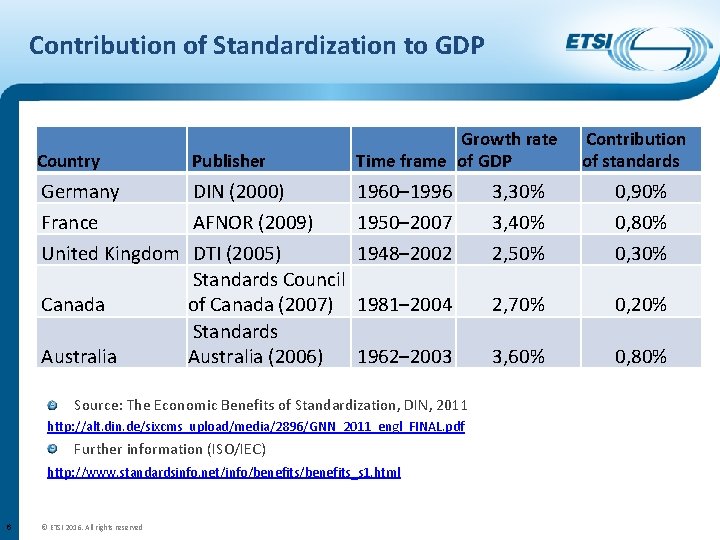
Contribution of Standardization to GDP Country Publisher Germany DIN (2000) France AFNOR (2009) United Kingdom DTI (2005) Standards Council Canada of Canada (2007) Standards Australia (2006) Growth rate Time frame of GDP 1960– 1996 1950– 2007 1948– 2002 3, 30% 3, 40% 2, 50% 0, 90% 0, 80% 0, 30% 1981– 2004 2, 70% 0, 20% 1962– 2003 3, 60% 0, 80% Source: The Economic Benefits of Standardization, DIN, 2011 http: //alt. din. de/sixcms_upload/media/2896/GNN_2011_engl_FINAL. pdf Further information (ISO/IEC) http: //www. standardsinfo. net/info/benefits_s 1. html 6 © ETSI 2016. All rights reserved Contribution of standards
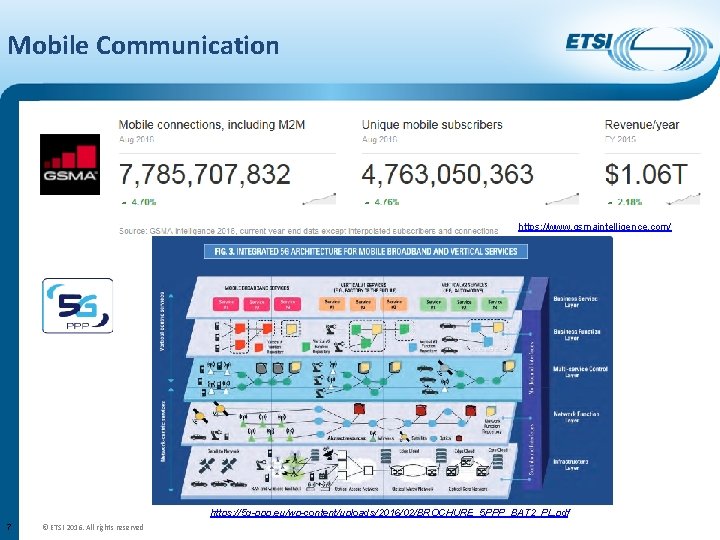
Mobile Communication https: //www. gsmaintelligence. com/ https: //5 g-ppp. eu/wp-content/uploads/2016/02/BROCHURE_5 PPP_BAT 2_PL. pdf 7 © ETSI 2016. All rights reserved
ETSI – STANDARDS FOR INFORMATION AND COMMUNICATION TECHNOLOGIES Standardization Overview of ETSI Security in ETSI 8 © ETSI 2016. All rights reserved
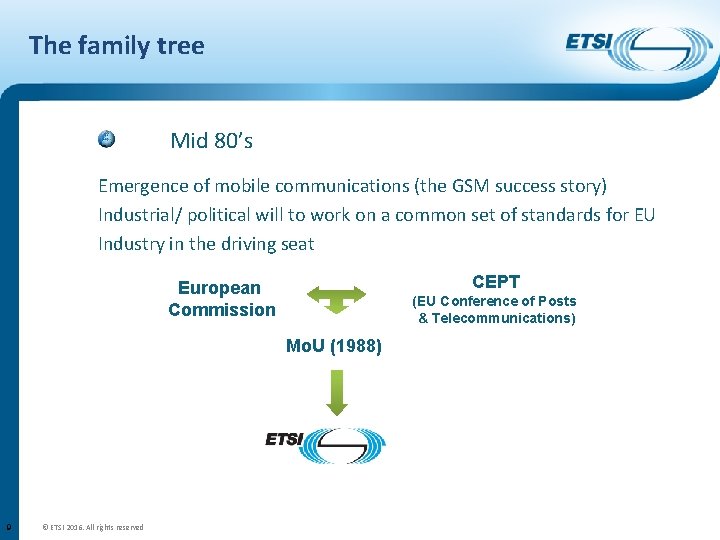
The family tree Mid 80’s Emergence of mobile communications (the GSM success story) Industrial/ political will to work on a common set of standards for EU Industry in the driving seat CEPT European Commission (EU Conference of Posts & Telecommunications) Mo. U (1988) 9 © ETSI 2016. All rights reserved
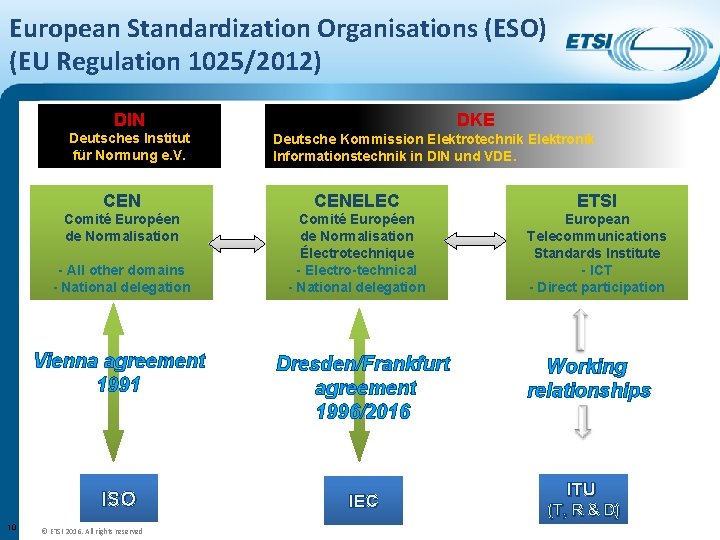
European Standardization Organisations (ESO) (EU Regulation 1025/2012) DIN Deutsches Institut für Normung e. V. Deutsche Kommission Elektrotechnik Elektronik Informationstechnik in DIN und VDE. CENELEC ETSI Comité Européen de Normalisation Électrotechnique - Electro-technical - National delegation European Telecommunications Standards Institute - ICT - Direct participation - All other domains - National delegation 10 DKE Vienna agreement 1991 Dresden/Frankfurt agreement 1996/2016 ISO IEC © ETSI 2016. All rights reserved Working relationships ITU (T, R & D)
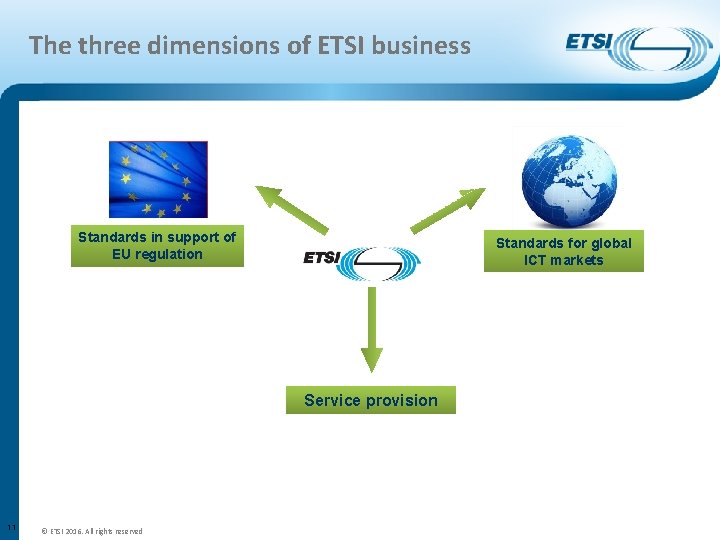
The three dimensions of ETSI business Standards in support of EU regulation Standards for global ICT markets Service provision 11 © ETSI 2016. All rights reserved
ETSI’s Basic Principles ETSI's fundamental values with regard to the work it undertakes are timeliness, quality and responsiveness to market needs ETSI is inclusive with a global membership representing a wide range of stakeholders, a global network of partnerships and a consensus approach in its working methods ETSI is fully compliant with WTO/TBT provisions and EU Regulation (EU) 1025/2012 ETSI works across all sectors of industry and society that make, use or rely on ICT technology ETSI works at the forefront of developing and emerging technologies ETSI produces technical standards aimed at being adopted by the most competitive markets ETSI promotes the adoption of its technical standards worldwide for the benefit of its members' competitiveness ETSI, in its role as an ESO, provides technical standards supporting EU regulatory requirements and policy ETSI produces technical standards that use spectrum effectively, minimise interference and avoid undesirable effects, in accord with appropriate regulatory frameworks 12 © ETSI 2016. All rights reserved
ETSI’s Vison, Mission and Strategic Objectives VISION ETSI is a leading standardization organization for Information and Communication Technology (ICT) standards fulfilling European and global market needs MISSION To provide the platforms where interested parties come together and collaborate on the production of standards for Information and Communication Technology (ICT) systems and services that are used globally Strategic Objectives Being at the Heart of Digital Being an Enabler of Standards Being Global Being Versatile Being Inclusive 13 © ETSI 2016. All rights reserved ETSI LTS 2016 -2021
ETSI’s Product, services and collaboration Technical specifications and standards with global application Support to industry and European regulation Specification & testing methodologies Interoperability testing 112 Partnership agreements 14 © ETSI 2016. All rights reserved
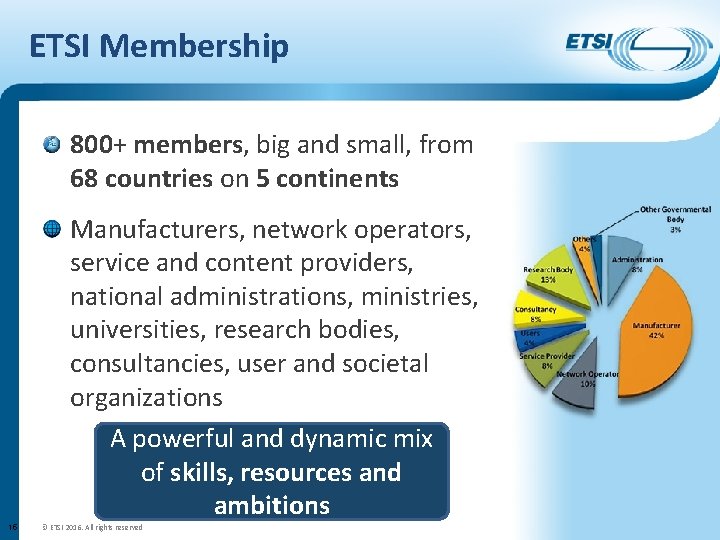
ETSI Membership 800+ members, big and small, from 68 countries on 5 continents Manufacturers, network operators, service and content providers, national administrations, ministries, universities, research bodies, consultancies, user and societal organizations A powerful and dynamic mix of skills, resources and ambitions 15 © ETSI 2016. All rights reserved
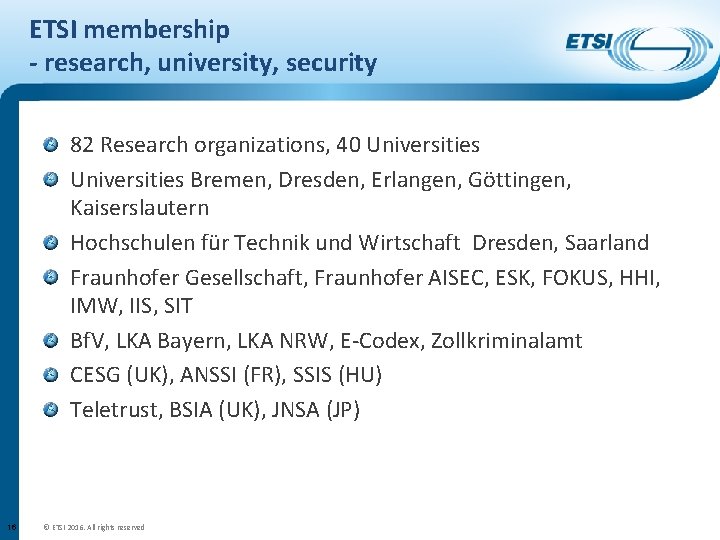
ETSI membership - research, university, security 82 Research organizations, 40 Universities Bremen, Dresden, Erlangen, Göttingen, Kaiserslautern Hochschulen für Technik und Wirtschaft Dresden, Saarland Fraunhofer Gesellschaft, Fraunhofer AISEC, ESK, FOKUS, HHI, IMW, IIS, SIT Bf. V, LKA Bayern, LKA NRW, E-Codex, Zollkriminalamt CESG (UK), ANSSI (FR), SSIS (HU) Teletrust, BSIA (UK), JNSA (JP) 16 © ETSI 2016. All rights reserved
The ETSI structure General Assembly ETSI Board l ica n” hn tio ec za “T ani g Or 17 Special Committees ETSI Projects Technical Committees ETSI Partnership Projects Industry Specification Groups Working Groups The ETSI Secretariat gives support to all the different entities in the Organization © ETSI 2016. All rights reserved
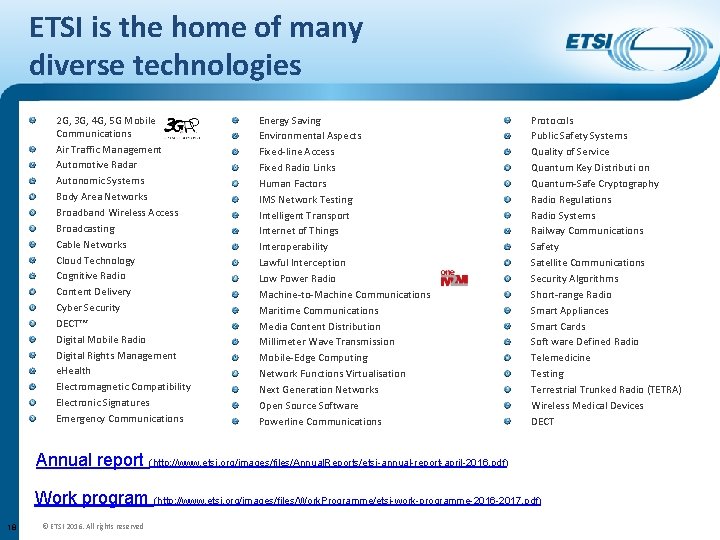
ETSI is the home of many diverse technologies 2 G, 3 G, 4 G, 5 G Mobile Communications Air Traffic Management Automotive Radar Autonomic Systems Body Area Networks Broadband Wireless Access Broadcasting Cable Networks Cloud Technology Cognitive Radio Content Delivery Cyber Security DECT™ Digital Mobile Radio Digital Rights Management e. Health Electromagnetic Compatibility Electronic Signatures Emergency Communications Energy Saving Environmental Aspects Fixed-line Access Fixed Radio Links Human Factors IMS Network Testing Intelligent Transport Internet of Things Interoperability Lawful Interception Low Power Radio Machine-to-Machine Communications Maritime Communications Media Content Distribution Millimeter Wave Transmission Mobile-Edge Computing Network Functions Virtualisation Next Generation Networks Open Source Software Powerline Communications Protocols Public Safety Systems Quality of Service Quantum Key Distributi on Quantum-Safe Cryptography Radio Regulations Radio Systems Railway Communications Safety Satellite Communications Security Algorithms Short-range Radio Smart Appliances Smart Cards Soft ware Defined Radio Telemedicine Testing Terrestrial Trunked Radio (TETRA) Wireless Medical Devices DECT Annual report (http: //www. etsi. org/images/files/Annual. Reports/etsi-annual-report-april-2016. pdf) Work program (http: //www. etsi. org/images/files/Work. Programme/etsi-work-programme-2016 -2017. pdf) 18 © ETSI 2016. All rights reserved
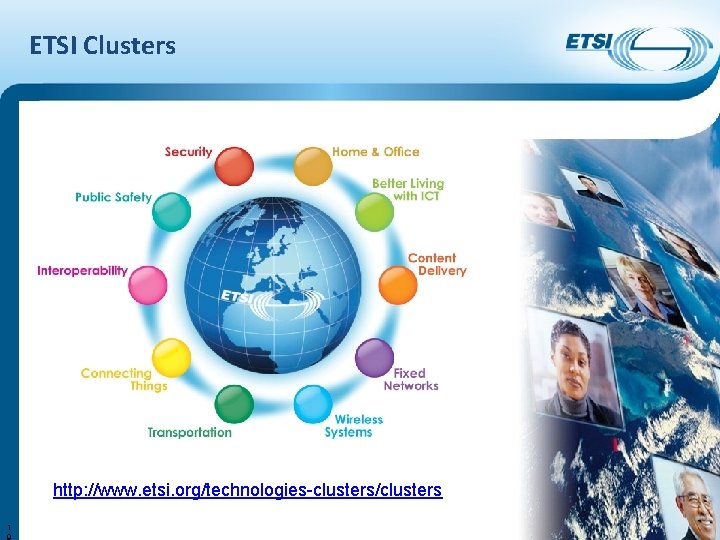
ETSI Clusters http: //www. etsi. org/technologies-clusters/clusters 1 9
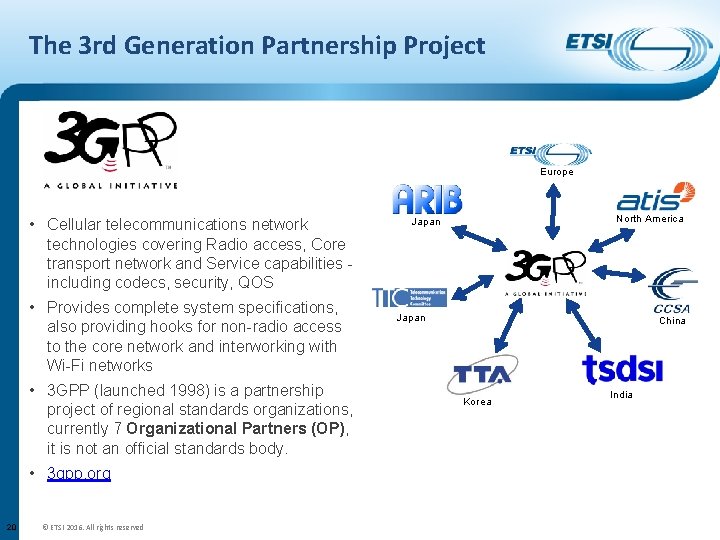
The 3 rd Generation Partnership Project Europe • Cellular telecommunications network technologies covering Radio access, Core transport network and Service capabilities including codecs, security, QOS • Provides complete system specifications, also providing hooks for non-radio access to the core network and interworking with Wi-Fi networks • 3 GPP (launched 1998) is a partnership project of regional standards organizations, currently 7 Organizational Partners (OP), it is not an official standards body. • 3 gpp. org 20 © ETSI 2016. All rights reserved North America Japan China Korea India
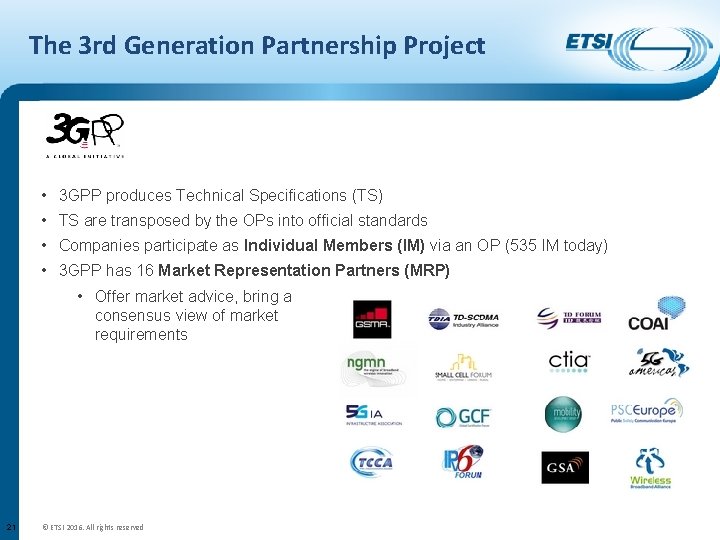
The 3 rd Generation Partnership Project • 3 GPP produces Technical Specifications (TS) • TS are transposed by the OPs into official standards • Companies participate as Individual Members (IM) via an OP (535 IM today) • 3 GPP has 16 Market Representation Partners (MRP) • Offer market advice, bring a consensus view of market requirements 21 © ETSI 2016. All rights reserved
one. M 2 M was launched in 2012 as a global initiative to ensure the most efficient deployment of Machine-to-Machine (M 2 M) communications systems and the Internet of Things (Io. T). Its aim is to develop technical specifications for a common M 2 M Service Layer that can be embedded within various hardware and software to connect the wide range of devices worldwide with M 2 M application servers. onem 2 m. org 22 © ETSI 2016. All rights reserved
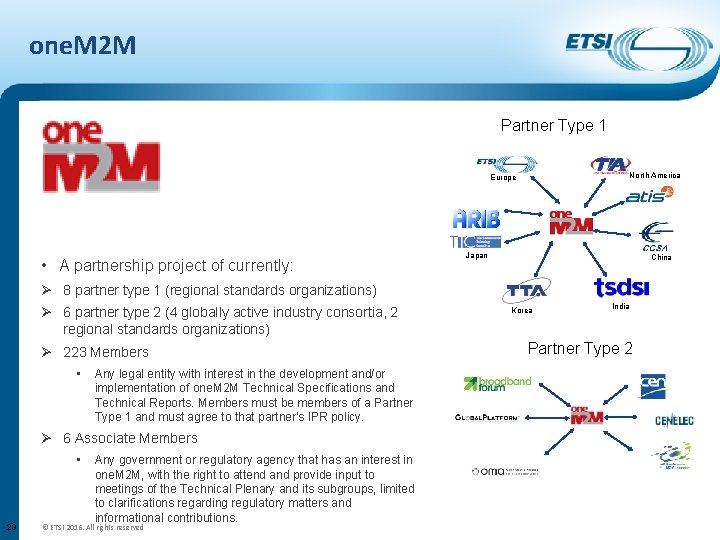
one. M 2 M Partner Type 1 North America Europe • A partnership project of currently: Japan China Ø 8 partner type 1 (regional standards organizations) Ø 6 partner type 2 (4 globally active industry consortia, 2 regional standards organizations) Ø 223 Members • Any legal entity with interest in the development and/or implementation of one. M 2 M Technical Specifications and Technical Reports. Members must be members of a Partner Type 1 and must agree to that partner's IPR policy. Ø 6 Associate Members • 23 Any government or regulatory agency that has an interest in one. M 2 M, with the right to attend and provide input to meetings of the Technical Plenary and its subgroups, limited to clarifications regarding regulatory matters and informational contributions. © ETSI 2016. All rights reserved Korea India Partner Type 2
Workshops and events since last GA (i) ETSI branded events organized by the Secretariat: ETSI Summit on 5 G: From Myth to Reality, 21 April in ETSI Workshop “From Research to Standardization”, 10 -11 May in ETSI Security Week, 13 -17 June in ETSI Workshop on Open Source and Standardization: Legal Interactions, 16 September in ETSI 4 th ETSI/IQC Workshop on Quantum-Safe Cryptography, 19 – 21 September in Toronto, Canada ETSI Workshop on “Public Protection and Disaster Relief: Regulatory changes and new opportunities for Broadband PPDR”, 29 September in ETSI UCAAT 2016 - ETSI User Conference on Advanced Automated Testing, 26 -28 October in Budapest, Hungary ETSI Workshop on “Managing Rail Mobile Communications Evolution. On Track for Future Challenges", 2 -3 November in ETSI 24 © ETSI 2016. All rights reserved
Workshops and events since last GA (ii) Non ETSI branded events where ETSI has been represented through speaker, stand or just endorsed by ETSI: MEC DAY @ SCWS – 9 May, London, UK Network Virtualization & SDN MENA, 10 -11 May, Dubai, UAE DECT World Conference 2016 – 31(st) May – 1(st) June, Barcelona, ES Critical Communications World, 31 May - 2 June, Amsterdam, NL (jointly with 3 GPP) Network Virtualization & SDN World, 31 May - 2 June, Madrid, ES Network Edge Europe 2016 – 6 -7 June, London, UK 5 G World, 28 -30 June, London, UK (jointly with 3 GPP) Connected Cars, 28 -30 June, London, UK MEC Congress + 1 st ETSI MEC Po. C ZONE, 20 -22 September, Munich, DE Network Virtualization & SDN Asia, 27 -28 September, Singapore, SG SDN & Open. Flow World Congress – 11 -14 October, The Hague, NL Broadband World Forum – 18 -20 October, London, UK (jointly with 3 GPP) IEEE Conference on NFV – SDN – 9 November, Palo Alto, US 25 © ETSI 2016. All rights reserved
ETSI – STANDARDS FOR INFORMATION AND COMMUNICATION TECHNOLOGIES Standardization Overview of ETSI Security in ETSI 26 © ETSI 2016. All rights reserved
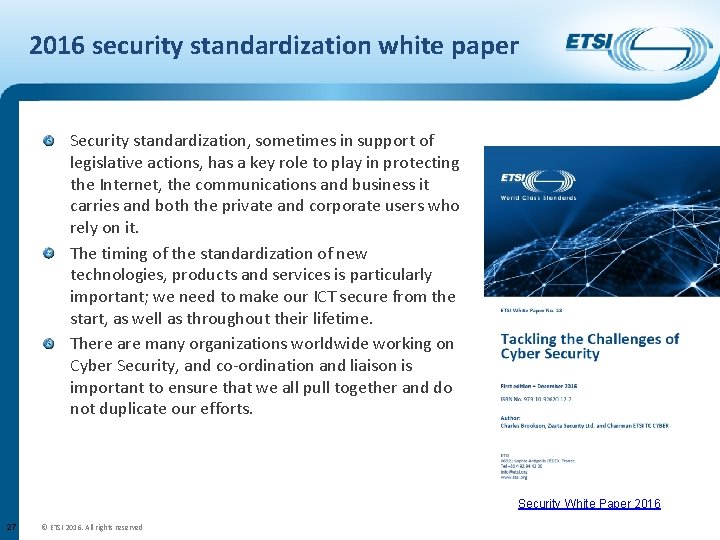
2016 security standardization white paper Security standardization, sometimes in support of legislative actions, has a key role to play in protecting the Internet, the communications and business it carries and both the private and corporate users who rely on it. The timing of the standardization of new technologies, products and services is particularly important; we need to make our ICT secure from the start, as well as throughout their lifetime. There are many organizations worldwide working on Cyber Security, and co-ordination and liaison is important to ensure that we all pull together and do not duplicate our efforts. Security White Paper 2016 27 © ETSI 2016. All rights reserved
Areas of security standardization (I) Privacy by Design - protecting privacy by building protection in up front rather than trying to ‘bolt it on’ as an afterthought. ETSI (together with CEN and CENELEC) is responding to the European Commission (EC) Mandate on Privacy by Design (M/530). Up to 11 standards are expected , e. g. TC CYBER works on a practical introductory guide to privacy and a Technical Report (TR) outlining a high-level structured ecosystem of security design requirements for communication and IT networks and attached devices. TC CYBER is working on • Protection and retention of Personally Identifiable Information (PII) • Defining the technical means to enable the assurance of privacy and • 28 the verification of that assurance Addressing identity management and naming schema protection mechanisms to prevent identity theft and resultant crime. © ETSI 2016. All rights reserved
Areas of security standardization (II) The Sharing of Cyber Threat Intelligence The sharing of information is a crucial weapon in our armoury against cyber-attack. TC CYBER is preparing a TR on the means for describing and exchanging cyber threat information in a standardized and structured manner. TC CYBER also provides and regularly maintains a global overview of Cyber Security activities in technical fora. Securing Technologies and Systems One of ETSI’s key strengths is in the securing of overall systems and technologies such as mobile communications, NFV, Future Networks, Intelligent Transport Systems, Digital Enhanced Cordless Telecommunications (DECT™), M 2 M communications and emergency telecommunications (including Terrestrial Trunked Radio (TETRA)). The security standards required by these technologies are dealt with primarily within dedicated technology-focused technical committees. 29 © ETSI 2016. All rights reserved
Areas of security standardization (III) TC DECT is implementing security architecture enhancements in the core technology to better protect end-user privacy and the confidentiality of communications. Reconfigurable Radio Systems (TC RRS) is protecting the integrity of reconfigurable radio communications. It is important to guarantee the integrity of radio applications and prevent their use as attack vectors against either individual devices or the network itself TC CYBER embarks on new work to support the Network and Information Security Directive, intended to increase consumer confidence and maintain the smooth functioning of the European internal market. TC CYBER started new work on network gateway cyber defence, aimed at improving Cyber Security by identifying and then advancing changes to technology standards. 30 © ETSI 2016. All rights reserved
Areas of security standardization (IV) The Internet of Things The Io. T is at the edge of cyber-space. As such, Cyber Security must be embedded and ready-to-use by the consumer without any previous specialist technical knowledge. In order to achieve this, we need greater co-operation between producers and operators of technical systems, as well as society and service providers. Work in one. M 2 M is focused on three aspects of security: protecting the one. M 2 M service layer; providing security as a service to Io. T applications, and leveraging communication network security services, where available. e. Health Our e. Health Project (EP e. HEALTH ) is looking at e. Health in general and in particular its relation to the Io. T and M 2 M, including concerns surrounding security and privacy. From a Cyber Security viewpoint, requirements for the protection of privacy make e. Health a particularly difficult M 2 M/Io. T use case. 31 © ETSI 2016. All rights reserved
Areas of security standardization (V) Trust Service Providers We support EU Regulation N° 910/2014 on electronic identification and trust services for electronic transactions in the internal market (the ‘e. IDAS Regulation’), and are developing standards to meet the needs of the international community for trust and confidence in electronic transactions. Our Electronic Signatures and Infrastructures committee (TC ESI) is building on its standards for trust services providers (TSPs), electronic signatures, electronic seals and electronic time-stamps, including the definition of security and policy requirements for TSPs providing public key certificates and electronic time-stamps. We are now defining the security and policy requirements for TSPs providing registered e. Delivery services, remote signature creation and remote signature validation. 32 © ETSI 2016. All rights reserved
Areas of security standardization (VI) Secure Cards and Elements Work is underway to address the embedded UICC (e. UICC) and the definition of test cases related to the support of multiple secure elements for mobile contactless communication over the Near Field Communication interface. As the convergence of different market segments such as banking, identity services and fixed line communication with the mobile market is leading to new requirements, we are also considering the future of the secure element. We are looking at improving the existing physical/electrical interface and/or logical interface or defining new ones for removable and non-removable secure elements. Cryptography Strong (and efficient) cryptography is a central building block for security in a huge range of products and systems. 33 © ETSI 2016. All rights reserved
Areas of security standardization (VII) Security Algorithms ETSI’s Security Algorithms Group of Experts (SAGE) provides both ETSI and 3 GPP with cryptographic algorithms and protocols specific to fraud prevention, unauthorized access to public and private telecommunications networks and user data privacy. Principle in 3 GPP security is nowadays that systems should support two different algorithms from day one, providing ‘belt and braces’ security against the possibility that either algorithm may be broken in the future. Currently working on new algorithms for GPRS, 128 -bit encryption algorithm (GEA 5) and new 128 -bit integrity algorithms (GIA 4 and GIA 5). These are being developed primarily for EC-GSM-Io. T, a radio interface solution for use in the Io. T. 34 © ETSI 2016. All rights reserved
Areas of security standardization (VIII) The Impact of the Quantum Computer TC CYBER has published an ETSI Guide (EG 203 310) on the impact of quantum computing on ICT security that reinforces the notion of having cryptographic agility as a root capability of products and services, and also advises that business management, including business continuity, takes due account of the role of cryptography in the business process. Quantum-Safe Cryptographic Algorithms TC CYBER started identifying cryptographic primitives that are resistant to both conventional and quantum-computing attacks. Six specifications including a quantum-safe algorithmic framework and a threat and risk assessment for real-world use cases soon to be completed. Further work concern the characterization of cryptographic primitives, benchmarking their performance and their suitability to a variety of applications. 35 © ETSI 2016. All rights reserved
Areas of security standardization (VIII) 36 Quantum Cryptography Quantum cryptography provides primitives that are intrinsically quantum-safe, as they are based on the laws of nature rather than computation complexity. It allows keys and digital signatures to be shared over optical fibre or free space links and can be used in a general Cyber Security framework, and to complement algorithmic methods for specific applications. Apart from resilience from every possible attack on a quantum computer, quantum cryptography also provides forward secrecy in that recorded communications cannot be decrypted in future when more powerful supercomputers will be available. Our ISG on Quantum Key Distribution (QKD) is developing specifications that will allow this radically new technology to be adopted in communication networks. We are addressing best-practice security guidance for implementation security. We are also specifying measurement protocols for characterising optical components and complete QKD transmitter modules. © ETSI 2016. All rights reserved
Areas of security standardization (IX) Network Functions Virtualisation Detailed specifications are being developed in support of trusted platforms, remote attestation, public key infrastructure in the NFV environment and others. Lawful Interception and Data Retention TC LI develops Lawful Interception and Retained Data (RD) capability, these standards are being adopted around the world. LI implementation is required by the EU which allows for LI to prevent crime, including fraud and terrorism. Current work: Dynamic triggering of interception, security for LI and RD systems as those are increasingly IP service-centric, globally distributed and, frequently, software-based. Guidance on LI and RD standards and concepts, and on LI for LTE™. Further aspects: Assurance of the integrity and originator of approvals/authorisations, the security aspects of internal interfaces for LI, and security issues around global, trustedthird-party components of law enforcement equipment 37 © ETSI 2016. All rights reserved
3 GPP / GSMA work on security assurance for network equipment Joint 3 GPP and GSMA activity to create a security assurance scheme for network equipment Processes and requirements defined for security accreditation of: • • • Product development lifecycles of equipment vendors Product lifecycles of equipment vendors Test activities for network equipment of test labs Conflict resolution Technical security requirements for particular classes of network equipment (MME, HSS, PCRF, e. Node. B, …) Benefits • • 38 Raised security quality of network equipment (standard products) Standardised set of minimum security requirements for network equipment Simplified quotation/contract negotiation process Liaison with regulators of local governments to unify legislation © ETSI 2016. All rights reserved
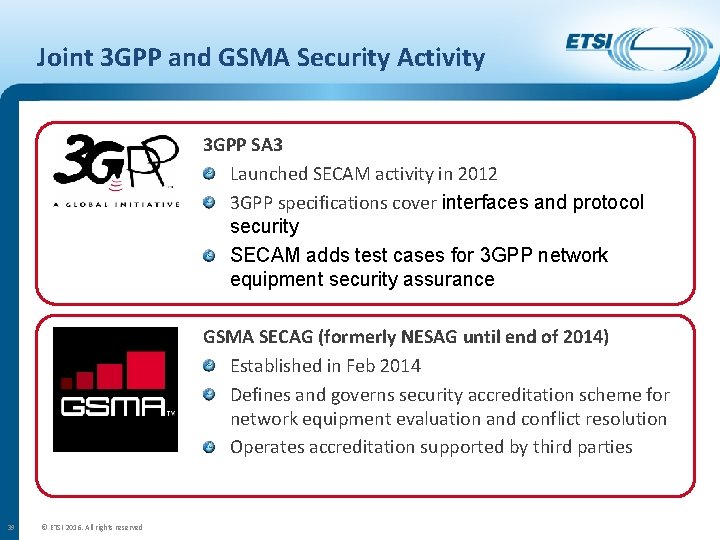
Joint 3 GPP and GSMA Security Activity 3 GPP SA 3 Launched SECAM activity in 2012 3 GPP specifications cover interfaces and protocol security SECAM adds test cases for 3 GPP network equipment security assurance GSMA SECAG (formerly NESAG until end of 2014) Established in Feb 2014 Defines and governs security accreditation scheme for network equipment evaluation and conflict resolution Operates accreditation supported by third parties 39 © ETSI 2016. All rights reserved
Contact Dirk. weiler@nokia. com ETSI: info@etsi. org Discussion 40 © ETSI 2016. All rights reserved
Contact Dirk. weiler@nokia. com ETSI: info@etsi. org Thank you! 41 © ETSI 2016. All rights reserved