
ETSI INDUSTRY SPECIFICATION GROUPS A comprehensive guide Patrick
- Slides: 24
ETSI INDUSTRY SPECIFICATION GROUPS A comprehensive guide Patrick Guillemin © ETSI 2012. All rights reserved 4 February 2014
About Standardization Details of ISGs Establishing the ISG Contact Questions
“Hidden” Benefits of Standardization contributes to consumer confidence Products are commercialized faster Products reach global markets Standardization does not require full manufacturing Standardization does not distribute forces at the expense of SMEs or research centers Standardization exploits research results Standardization ensures interoperability Standardization lowers the burden of evolution and maintenance, supported by industry Standardization improves technologies and products through multiple feed-back 3
Research Input to Standards ICT markets are shaped by standards • de facto, industry, fora, SDOs European strength in collaborative R&D European R&D in ICT must lead to standards activity • Developing new products, new services, new markets • Driving, not disseminating Input is not enough – longer term participation is required 4
About Standardization Details of ISGs Establishing the ISG Contact Questions
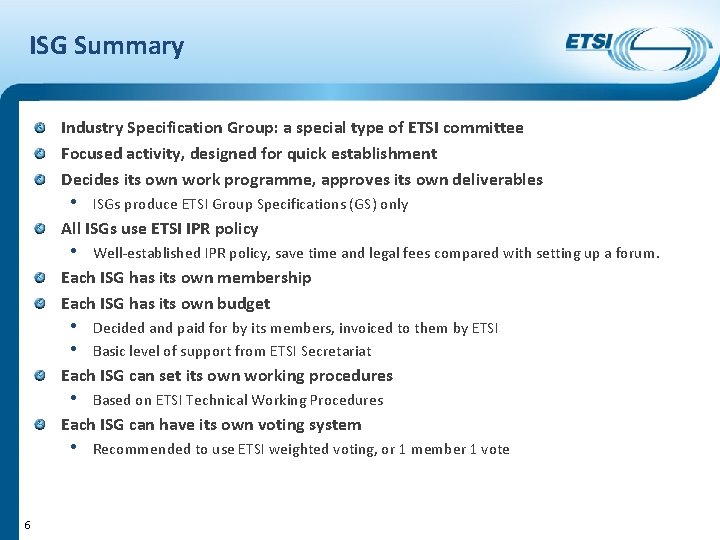
ISG Summary Industry Specification Group: a special type of ETSI committee Focused activity, designed for quick establishment Decides its own work programme, approves its own deliverables • ISGs produce ETSI Group Specifications (GS) only All ISGs use ETSI IPR policy • Well-established IPR policy, save time and legal fees compared with setting up a forum. Each ISG has its own membership Each ISG has its own budget • Decided and paid for by its members, invoiced to them by ETSI • Basic level of support from ETSI Secretariat Each ISG can set its own working procedures • Based on ETSI Technical Working Procedures Each ISG can have its own voting system • Recommended to use ETSI weighted voting, or 1 member 1 vote 6
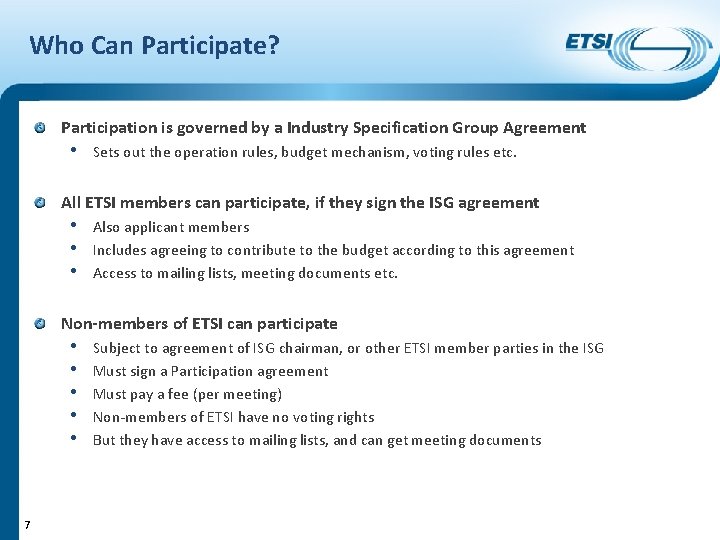
Who Can Participate? Participation is governed by a Industry Specification Group Agreement • Sets out the operation rules, budget mechanism, voting rules etc. All ETSI members can participate, if they sign the ISG agreement • Also applicant members • Includes agreeing to contribute to the budget according to this agreement • Access to mailing lists, meeting documents etc. Non-members of ETSI can participate • • • 7 Subject to agreement of ISG chairman, or other ETSI member parties in the ISG Must sign a Participation agreement Must pay a fee (per meeting) Non-members of ETSI have no voting rights But they have access to mailing lists, and can get meeting documents
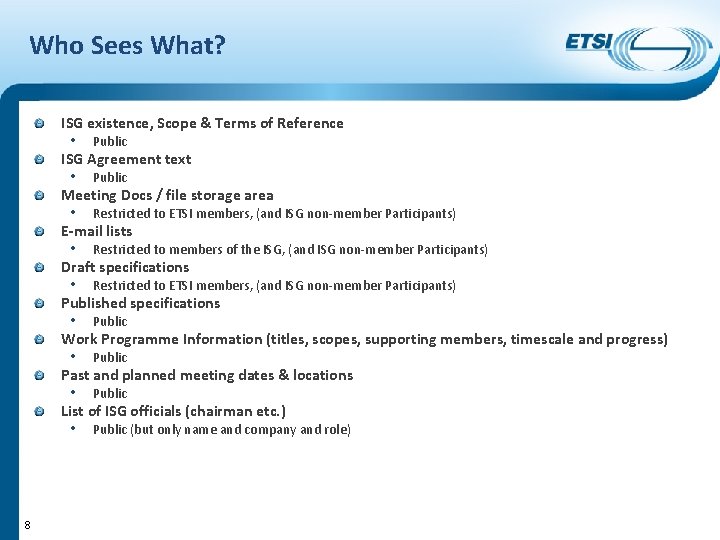
Who Sees What? ISG existence, Scope & Terms of Reference • Public ISG Agreement text • Public Meeting Docs / file storage area • Restricted to ETSI members, (and ISG non-member Participants) E-mail lists • Restricted to members of the ISG, (and ISG non-member Participants) Draft specifications • Restricted to ETSI members, (and ISG non-member Participants) Published specifications • Public Work Programme Information (titles, scopes, supporting members, timescale and progress) • Public Past and planned meeting dates & locations • Public List of ISG officials (chairman etc. ) • Public (but only name and company and role) 8
Essential IPR Conditions for essential IPR in ETSI: Fair Reasonable And Non. Discriminatory 9
Operation of an ISG Scope of activities defined by Terms of Reference ISG Rules of Procedure based on ETSI Technical Working Procedures • Appointment of chair and officials • Participation rights • IPR Policy • Work Programme Management and document approval • Reporting • Convening a meeting, meeting procedures (changes permitted) • Decision Making: voting rules & procedures (changes permitted) • E. g. weighted or non-weighted voting • Liaison handling (changes permitted) All available ‘off the shelf’ from ETSI 10
Organisation of Work Internal structure: freedom to establish working groups All ETSI specification work based on Work Item concept • The description of a task defined in terms of the: • • • title intended deliverable type (GS only) technical scope, including field of application schedule of tasks for its production identities of the supporting members identity of the rapporteur • Detailed on New Work Item Form • WIs tracked in ETSI Work Programme Management application (public) Work Item must be supported by at least four ETSI members Separate Work Item for each deliverable Work Item need not result in an ETSI deliverable ISG may request creation of a Specialist Task Force if the need is urgent and if they fund it ISG approves its own output for publication • Must comply with ETSI Drafting Rules: http: //portal. etsi. org/edithelp/home. asp 11
ETSI Secretariat Support ETSI provides ‘basic support’ to ISGs • meeting rooms with Wi. Fi in ETSI premises • meeting support for invitations, badges, etc. (meetings at ETSI) • online meeting registration & meeting document handling • tea/coffee in ETSI premises • ISG info/meeting/document handling area on the ETSI Portal • document storage area on the ETSI DOCBOX server (FTP & HTML access) • one or more e-mail lists • maintenance of the ISGs Work Items in the WPM database • processing/publication of GSs (providing they have respected the ETSI Drafting Rules) 12
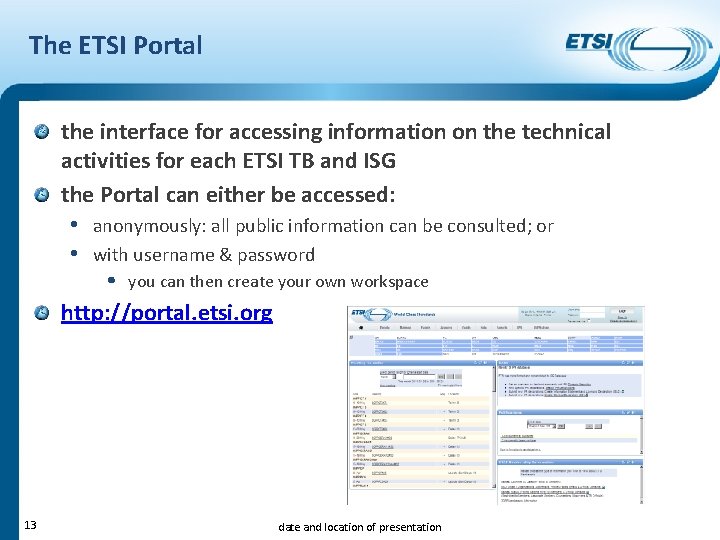
The ETSI Portal the interface for accessing information on the technical activities for each ETSI TB and ISG the Portal can either be accessed: • anonymously: all public information can be consulted; or • with username & password • you can then create your own workspace http: //portal. etsi. org 13 date and location of presentation
ISG Budget ISG can maintain its own budget • Cost allocation between members detailed in ISG Agreement • Annual budget report & plan supplied to Secretariat • All expenditure performed by ETSI, invoiced to members according to ISG Agreement Typical items an ISG could choose to pay for • Full time support, Technical Officer support at meetings • Conferences or workshop or publicity event • Dedicated Website/domain or Wiki hosting and development • Technical support to committee, Technical Editor • ETSI Special Task Force • Expert development of specifications • Development of test specifications 14
Legal ISG Agreement • • Must be signed by ETSI Members who wish to participate in the ISG Between ETSI and each member of ISG Identical agreement for all members Binding on all members of the ISG Agree to adhere to ETSI IPR Policy Distribution of costs among members Voting and decision making rules Details specific operational rules of ISG (beyond ETSI TWP) ISG Participant Agreement • • Must be signed by non-members of ETSI who wish to participate in ISG Binding on all non-member participants to the ISG Agree to adhere to ETSI IPR Policy Confidentiality requirement Templates of both agreements available Signatories to the agreements are effectively ‘ISG Members’ 15
Limitations of an ISGs only produce ETSI Group Specifications (GS) • Specifically identified as coming from an ISGs cannot handle activities Mandated by EC/EFTA ISGs should not handle the following • health • safety • environment • public interest • basic legal/economic interests of consumer related issues 16
About Standardization Details of ISGs Establishing the ISG Contact Questions
How to Set One up? Minimum 4 ETSI members or applicant members are required Quick Operational Pack available • (draft To. R, Members Agreements, Working Procedures) Propose a scope for Terms of Reference, and basic workplan • 2 -3 paragraphs describing what the group will do • Need to choose a 3 -letter acronym for the ISG! ETSI Director General decides to establish ISG, based on documentation presented • rapid decision and implementation • using off the shelf ETSI Portal components 18 date and location of presentation
How to End it? ISG becomes an ETSI Technical Body • Not an end – a new beginning! • Pre-standardisation is over • Requires agreement of ETSI Board • Greater authority, visibility • Can produce TS, EN specifications • Greater access to support and funding • Open to all ETSI Members ISG becomes working group of existing ETSI TB ISG members choose to close group • Should identify which ETSI TB/ISG handles maintenance 19 date and location of presentation
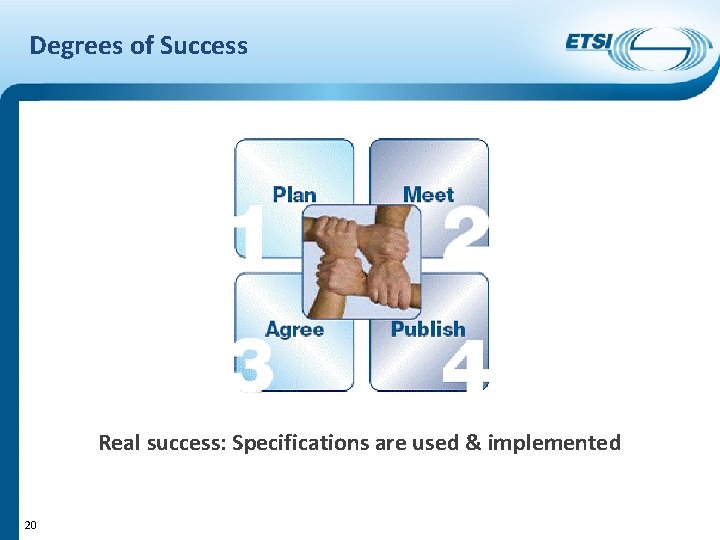
Degrees of Success Real success: Specifications are used & implemented 20
About Standardization Details of ISGs Establishing the ISG Contact Questions
Contact Patrick Guillemin Innovation • patrick. guillemin@etsi. org; +33 6 87 74 52 09 • isg@etsi. org 22
Contact Gaby Lenhart Innovation • gaby. lenhart@etsi. org; +33 6 74 40 83 76 • isg@etsi. org 23
Contact Hermann Brand, Director Innovation • hermann. brand@etsi. org; +33 6 08 77 22 05 • isg@etsi. org 24