
Etruscan Culture Influence on the Romans Origins Contributions
Etruscan Culture & Influence on the Romans Origins, Contributions, and Culture
Origins n Somewhere between 900 and 500 BC, the Italian peninsula was settled by a group of people we call the Etruscans. n The name they had for themselves was Rasenna, and the Greeks called them Tyrrhenioi, from which we get our present name for the Tyrrhenian Sea. Romans named them Etruscans. n Archaeologists suspect that they came from the eastern Mediterranean, possibly Asia Minor, though there are several different theories. http: //mushecht. haifa. ac. il/Etruscan_Culture. html
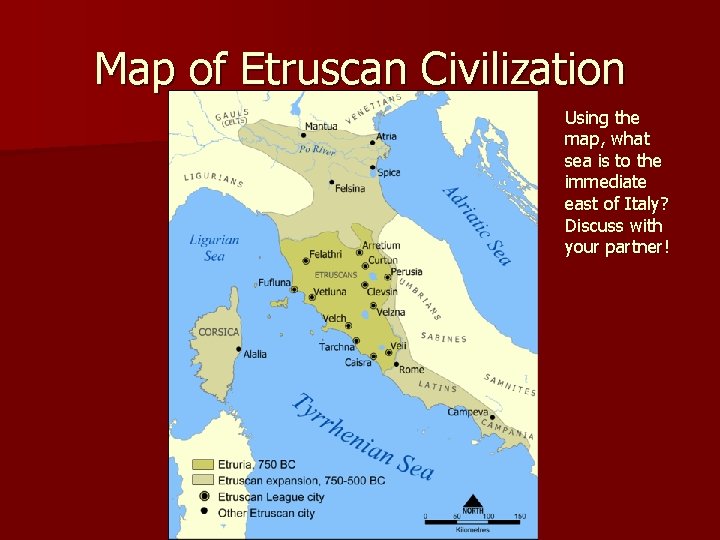
Map of Etruscan Civilization Using the map, what sea is to the immediate east of Italy? Discuss with your partner!
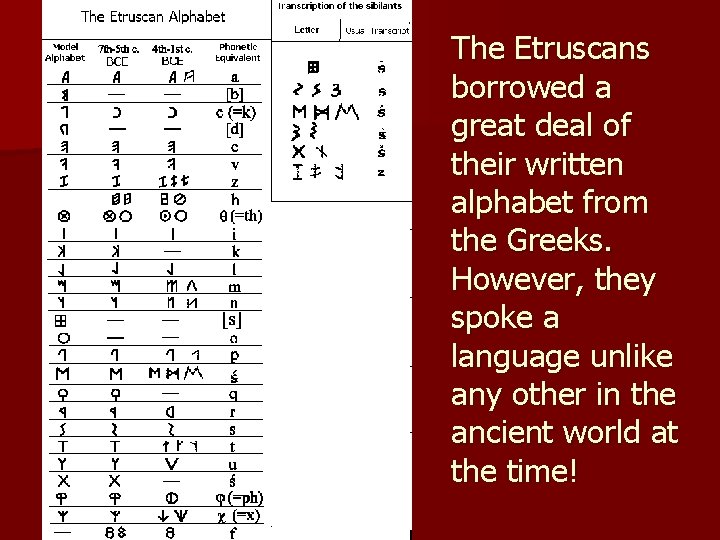
The Etruscans borrowed a great deal of their written alphabet from the Greeks. However, they spoke a language unlike any other in the ancient world at the time!
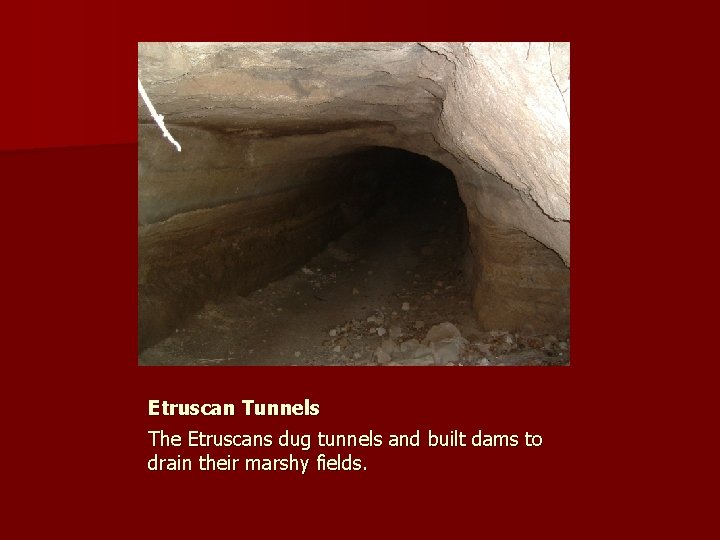
Etruscan Tunnels The Etruscans dug tunnels and built dams to drain their marshy fields.
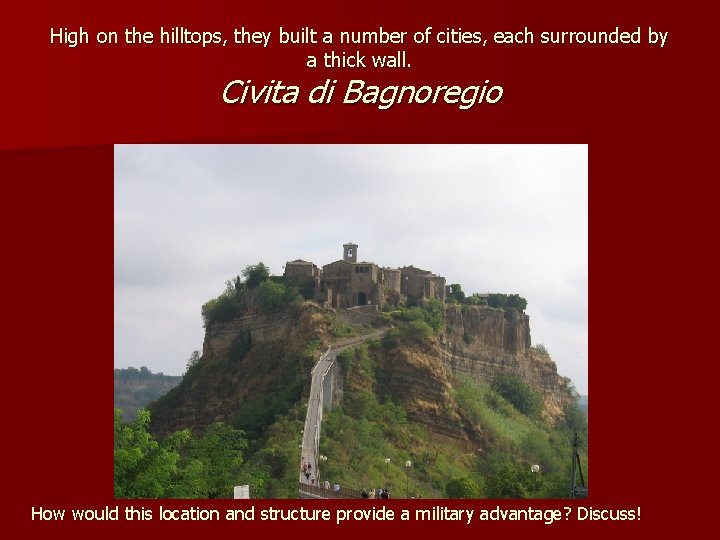
High on the hilltops, they built a number of cities, each surrounded by a thick wall. Civita di Bagnoregio How would this location and structure provide a military advantage? Discuss!
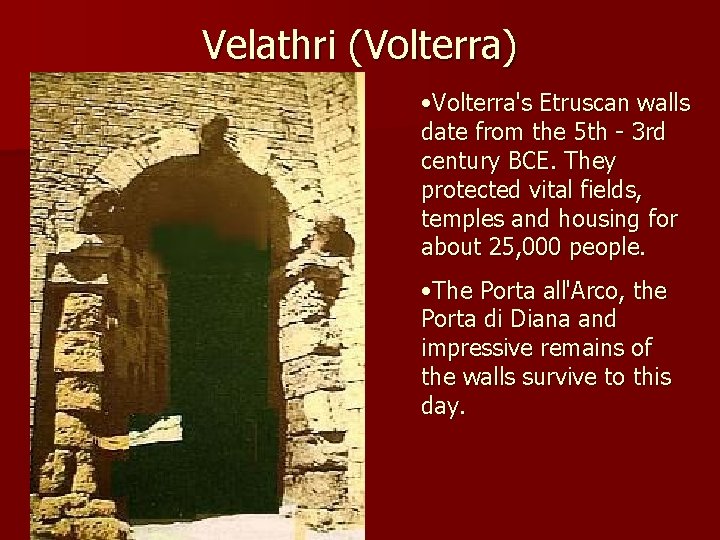
Velathri (Volterra) • Volterra's Etruscan walls date from the 5 th - 3 rd century BCE. They protected vital fields, temples and housing for about 25, 000 people. • The Porta all'Arco, the Porta di Diana and impressive remains of the walls survive to this day.
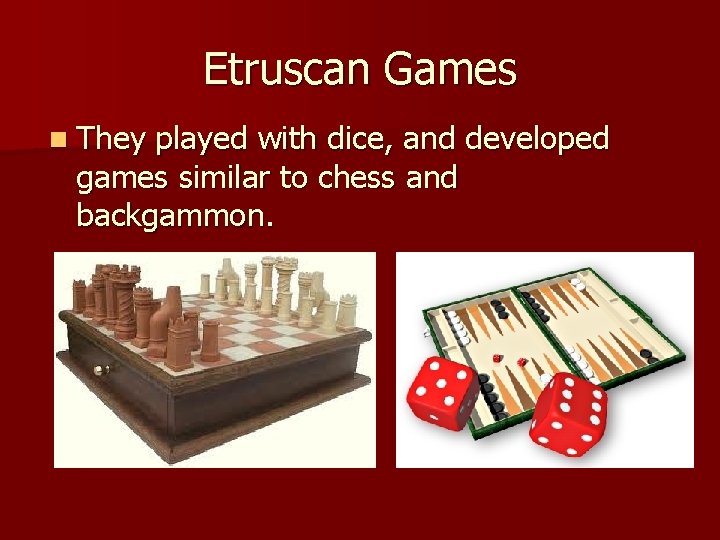
Etruscan Games n They played with dice, and developed games similar to chess and backgammon.
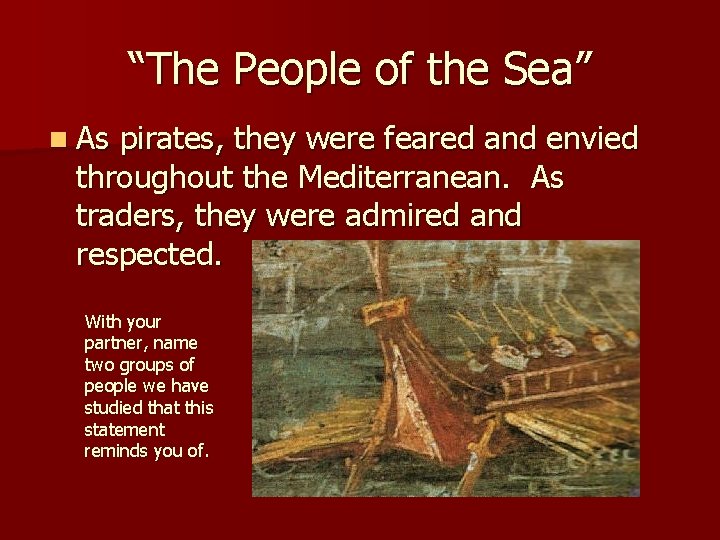
“The People of the Sea” n As pirates, they were feared and envied throughout the Mediterranean. As traders, they were admired and respected. With your partner, name two groups of people we have studied that this statement reminds you of.
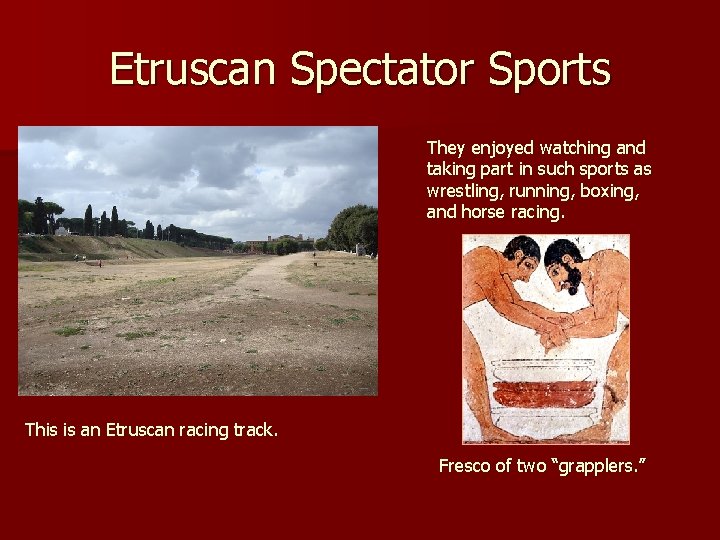
Etruscan Spectator Sports They enjoyed watching and taking part in such sports as wrestling, running, boxing, and horse racing. This is an Etruscan racing track. Fresco of two “grapplers. ”
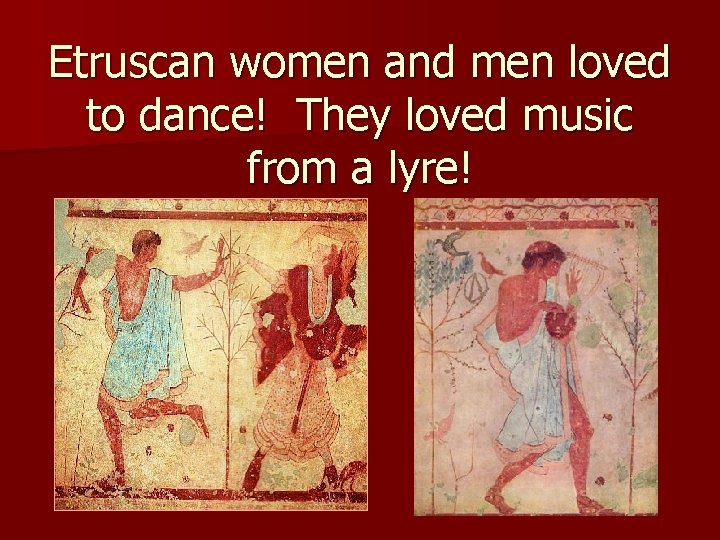
Etruscan women and men loved to dance! They loved music from a lyre!
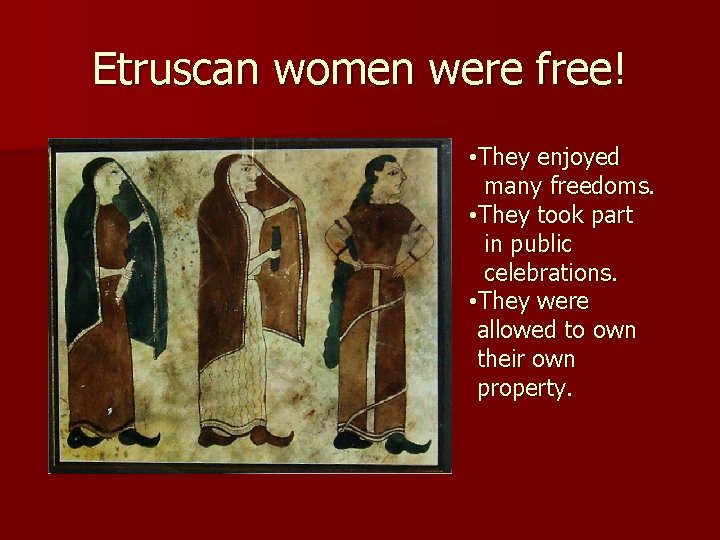
Etruscan women were free! • They enjoyed many freedoms. • They took part in public celebrations. • They were allowed to own their own property.

Etruscan Military The Etruscans had a strong army, using weapons and battle techniques from the Greeks. In addition to the phalanx, they had a secret weaponheavy leather sandals! Discuss with your partner: Why would these be considered a military advantage? Bronze helmet, 7 th century BCE and chariot, 6 th century BCE.
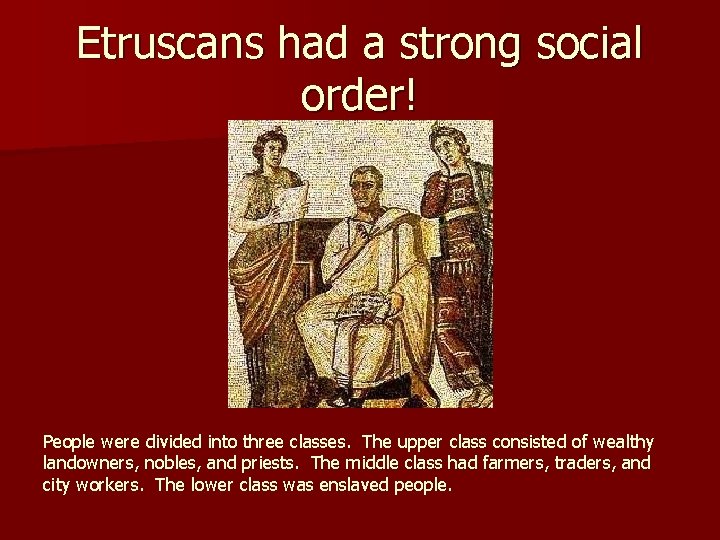
Etruscans had a strong social order! People were divided into three classes. The upper class consisted of wealthy landowners, nobles, and priests. The middle class had farmers, traders, and city workers. The lower class was enslaved people.
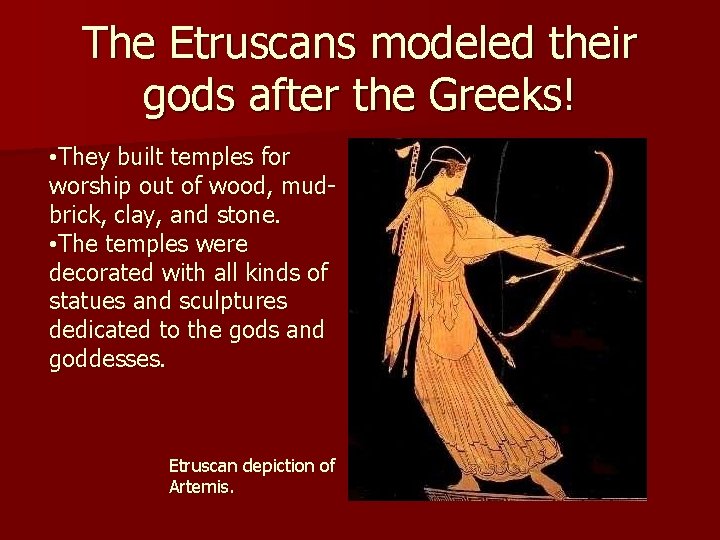
The Etruscans modeled their gods after the Greeks! • They built temples for worship out of wood, mudbrick, clay, and stone. • The temples were decorated with all kinds of statues and sculptures dedicated to the gods and goddesses. Etruscan depiction of Artemis.
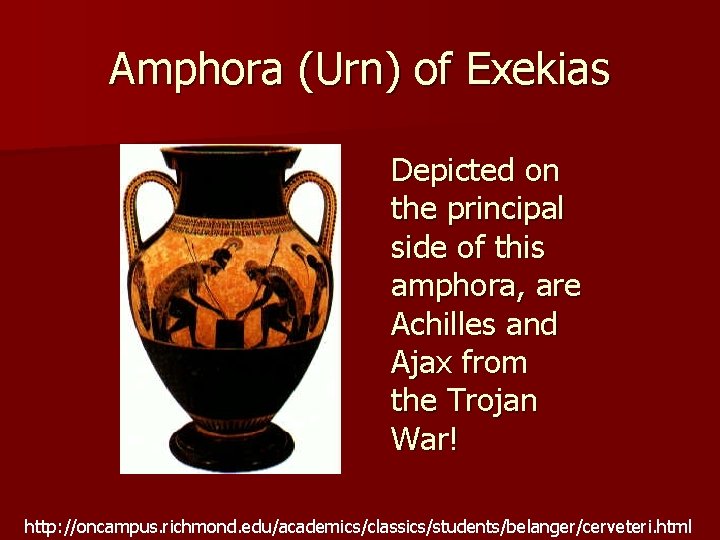
Amphora (Urn) of Exekias Depicted on the principal side of this amphora, are Achilles and Ajax from the Trojan War! http: //oncampus. richmond. edu/academics/classics/students/belanger/cerveteri. html
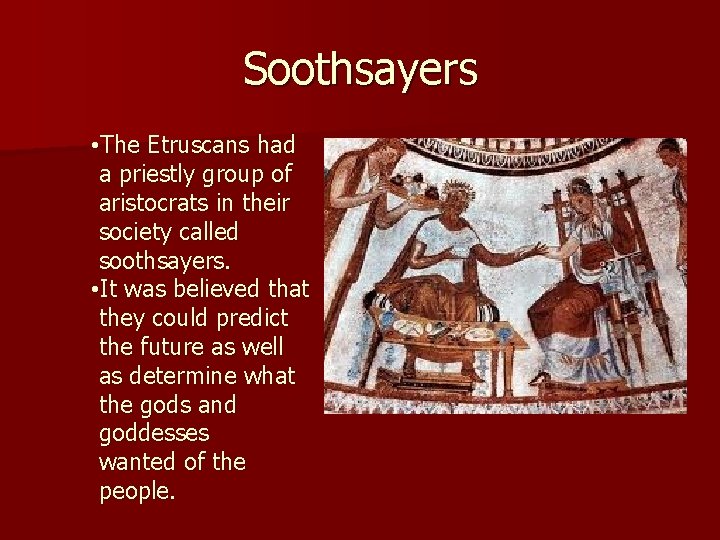
Soothsayers • The Etruscans had a priestly group of aristocrats in their society called soothsayers. • It was believed that they could predict the future as well as determine what the gods and goddesses wanted of the people.
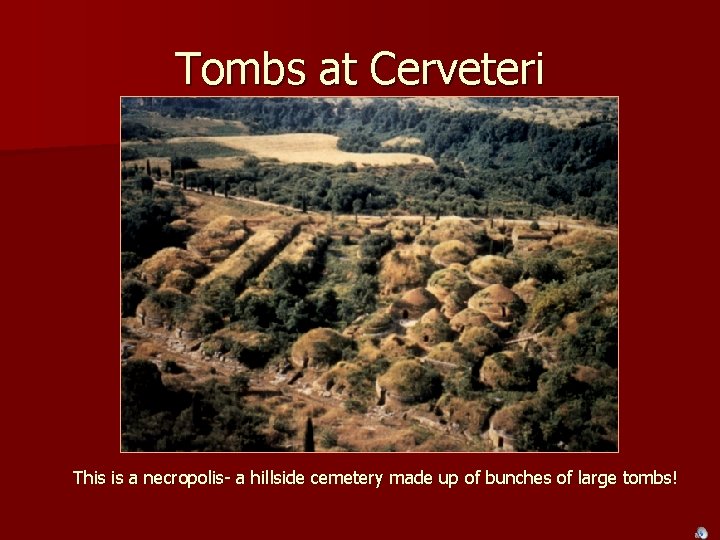
Tombs at Cerveteri This is a necropolis- a hillside cemetery made up of bunches of large tombs!
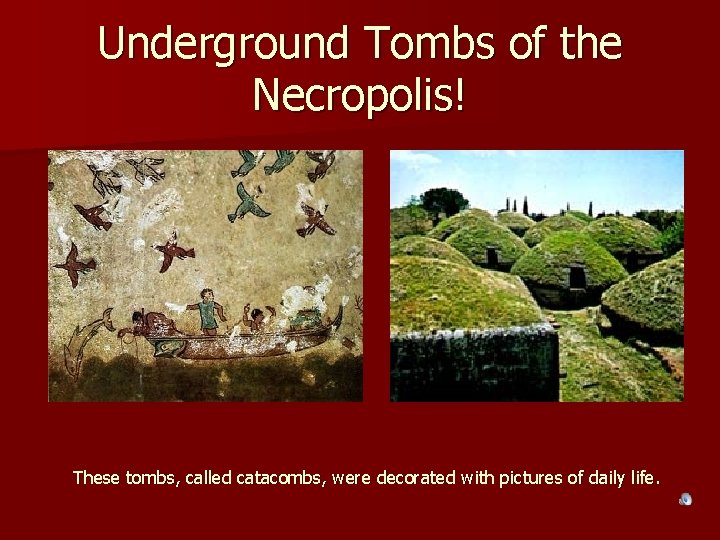
Underground Tombs of the Necropolis! These tombs, called catacombs, were decorated with pictures of daily life.
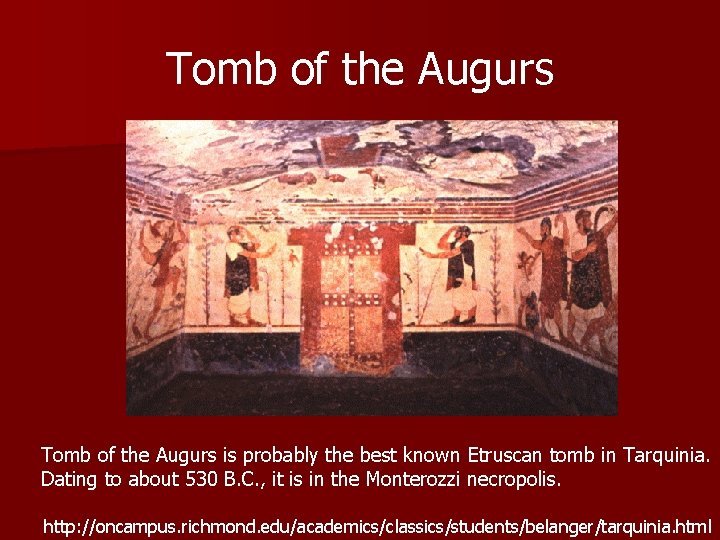
Tomb of the Augurs is probably the best known Etruscan tomb in Tarquinia. Dating to about 530 B. C. , it is in the Monterozzi necropolis. http: //oncampus. richmond. edu/academics/classics/students/belanger/tarquinia. html
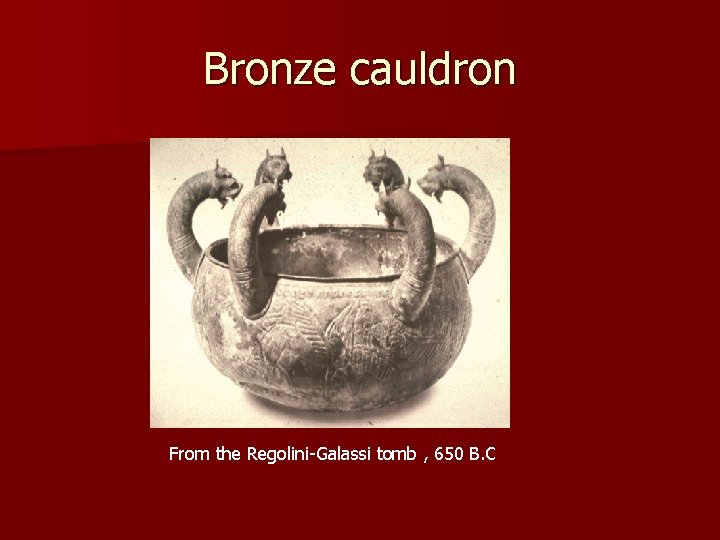
Bronze cauldron From the Regolini-Galassi tomb , 650 B. C
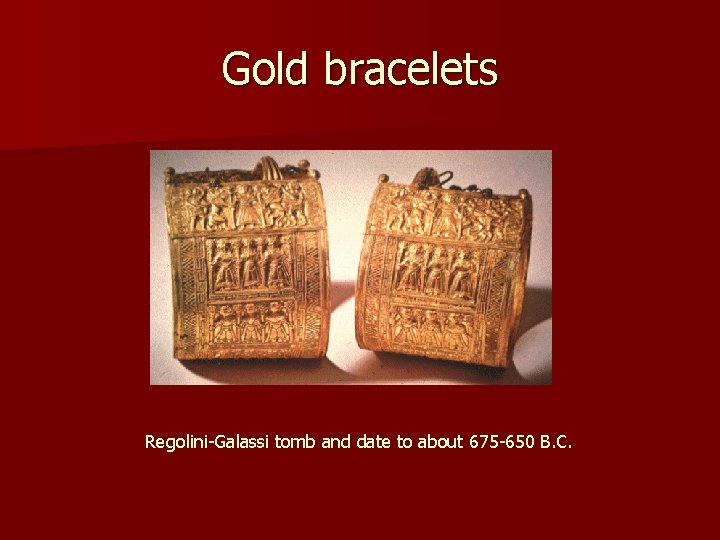
Gold bracelets Regolini-Galassi tomb and date to about 675 -650 B. C.
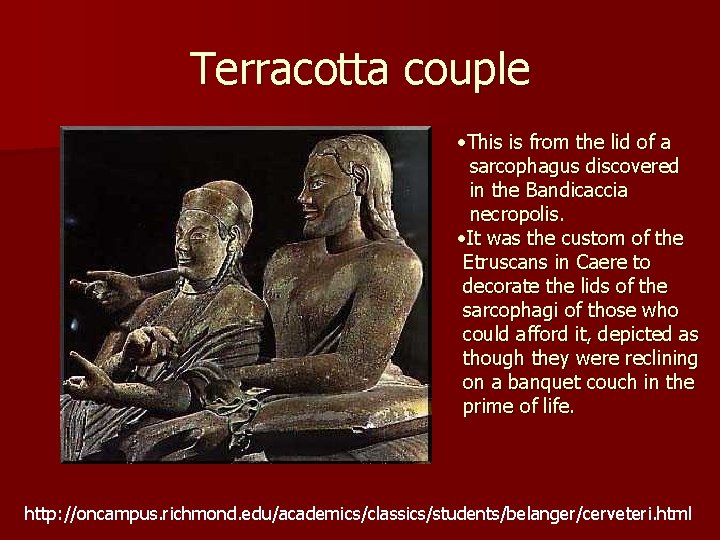
Terracotta couple • This is from the lid of a sarcophagus discovered in the Bandicaccia necropolis. • It was the custom of the Etruscans in Caere to decorate the lids of the sarcophagi of those who could afford it, depicted as though they were reclining on a banquet couch in the prime of life. http: //oncampus. richmond. edu/academics/classics/students/belanger/cerveteri. html
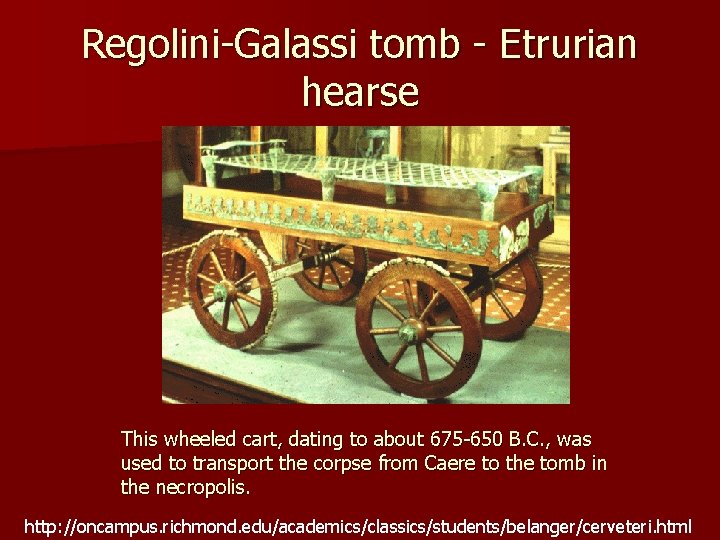
Regolini-Galassi tomb - Etrurian hearse This wheeled cart, dating to about 675 -650 B. C. , was used to transport the corpse from Caere to the tomb in the necropolis. http: //oncampus. richmond. edu/academics/classics/students/belanger/cerveteri. html
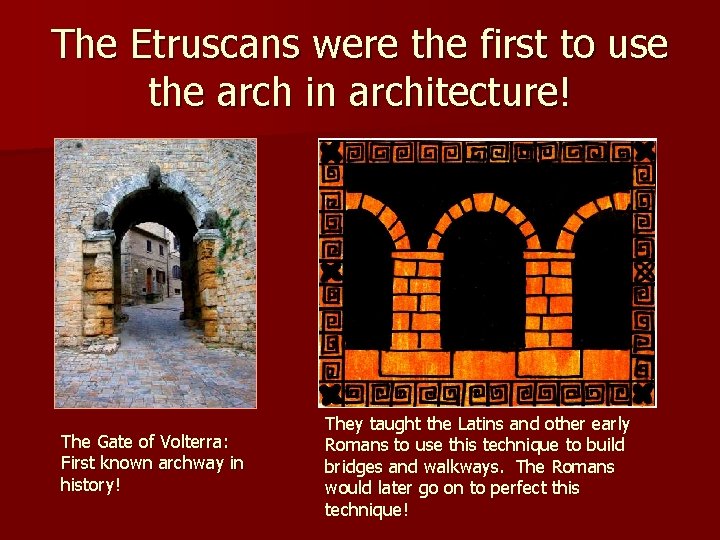
The Etruscans were the first to use the arch in architecture! The Gate of Volterra: First known archway in history! They taught the Latins and other early Romans to use this technique to build bridges and walkways. The Romans would later go on to perfect this technique!
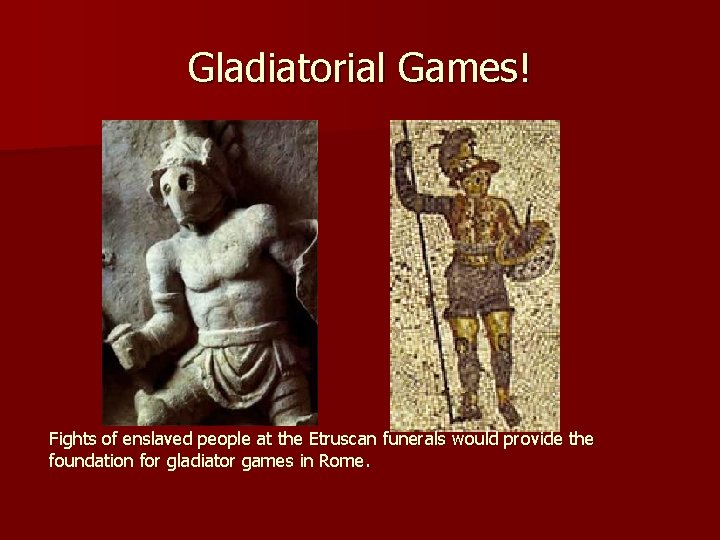
Gladiatorial Games! Fights of enslaved people at the Etruscan funerals would provide the foundation for gladiator games in Rome.
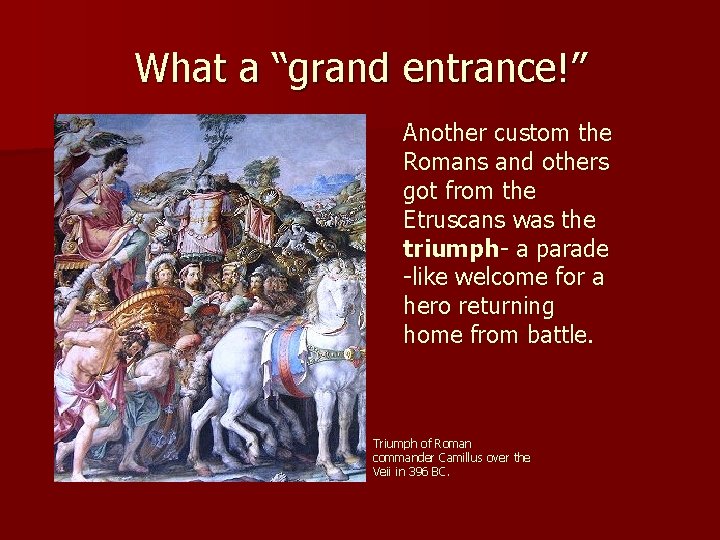
What a “grand entrance!” Another custom the Romans and others got from the Etruscans was the triumph- a parade -like welcome for a hero returning home from battle. Triumph of Roman commander Camillus over the Veii in 396 BC.
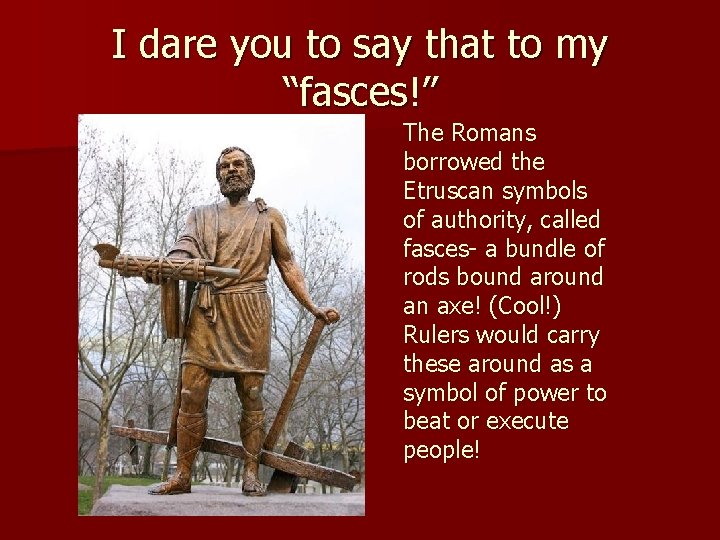
I dare you to say that to my “fasces!” The Romans borrowed the Etruscan symbols of authority, called fasces- a bundle of rods bound around an axe! (Cool!) Rulers would carry these around as a symbol of power to beat or execute people!
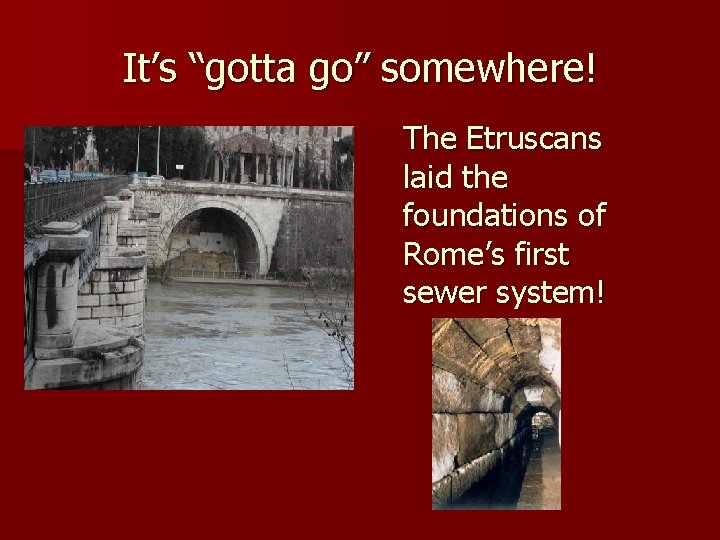
It’s “gotta go” somewhere! The Etruscans laid the foundations of Rome’s first sewer system!
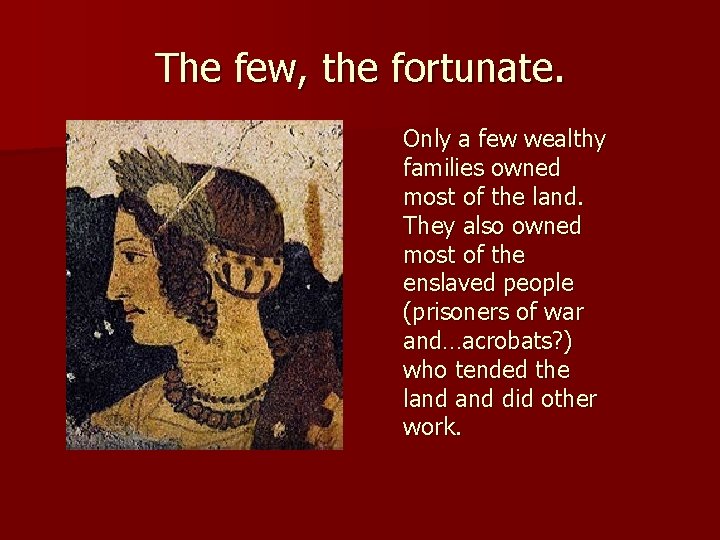
The few, the fortunate. Only a few wealthy families owned most of the land. They also owned most of the enslaved people (prisoners of war and…acrobats? ) who tended the land did other work.
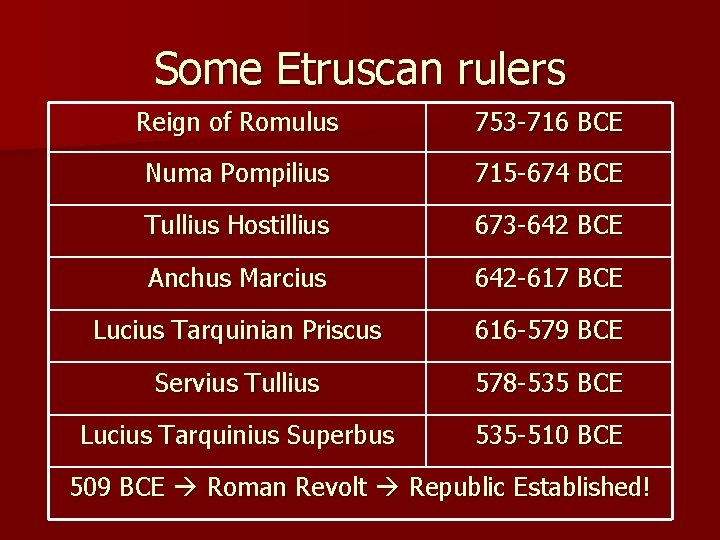
Some Etruscan rulers Reign of Romulus 753 -716 BCE Numa Pompilius 715 -674 BCE Tullius Hostillius 673 -642 BCE Anchus Marcius 642 -617 BCE Lucius Tarquinian Priscus 616 -579 BCE Servius Tullius 578 -535 BCE Lucius Tarquinius Superbus 535 -510 BCE 509 BCE Roman Revolt Republic Established!

End of Etruria n In 504 BC, the Etruscans were driven from their territory when their army was defeated. n After this, Tarquinius Superbus, the Etruscan king of Rome fell, and the Roman Republic formed.
Apply What You Know! • Read ALL of the directions below before moving forward 1. ) Create a Venn Diagram on packet page 16 (Greeks vs Etruscans) Greeks Etruscans 2. ) Use your notes from pp. 15 and the link below to complete the Venn diagram on pp. 16 http: //www. mysteriousetruscans. com/ -Include 5 similarities between Etruscans & Greeks -Include 5 differences between Etruscans and Greeks (a total of 15 details)
- Slides: 33