
Etiquette Training An Athletes Guide To Proper Social
- Slides: 30
Etiquette Training An Athlete’s Guide To Proper Social Behaviour
Objectives of this workshop By the end of this workshop participants are expected to: • • • Define etiquette and how it can be of value to you and the organization you represent Make a good first impression Minimize nervousness in social situations Build good Social & Communication Skills, Self-esteem & Confidence, Self-respect & Respect for Others Have Effective Conversation & Listening Skills Learn Email and social media etiquette Learn The Etiquette of Public Places and events Understand The Etiquette of Dining Out Learn the Do's & Don'ts of Dining Thank Your Host
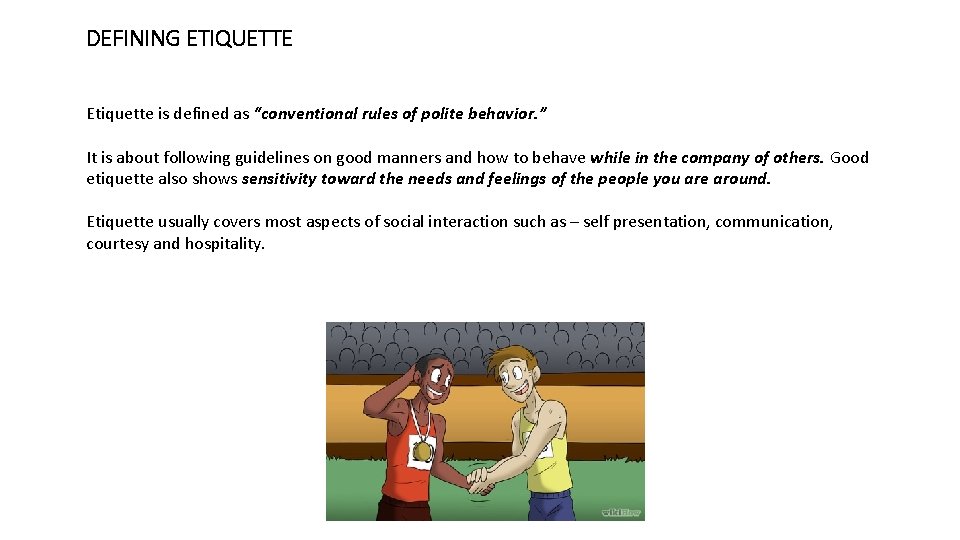
DEFINING ETIQUETTE Etiquette is defined as “conventional rules of polite behavior. ” It is about following guidelines on good manners and how to behave while in the company of others. Good etiquette also shows sensitivity toward the needs and feelings of the people you are around. Etiquette usually covers most aspects of social interaction such as – self presentation, communication, courtesy and hospitality.
WHY IS ETIQUETTE IMPORTANT NOWADAYS? Success in any aspect of life, relies on relationships; whether with team members, coaches, teachers, parents, sponsors or co-workers. When you are well mannered and considerate when dealing with others, you can build long lasting, engaging and productive relationships that will become important to you throughout your career. This is why it is so important to learn to conduct oneself in the company of others.
START FEELING COMFORTABLE AND CONFIDENT IN SOCIAL SETTINGS! EXERCISE: 1 Ask yourselves these questions and let’s work on getting over fears or discomfort in social situations § Do you enjoy cricket events? § How do you feel when the spotlight is on you? § How comfortable are you when being interviewed? § What are some of the things you dislike about these events? § What do you enjoy most about these events? § Who do you ask for help if you are not sure what to say or do at these events? Take a few minutes to think about and write down the answers to these questions
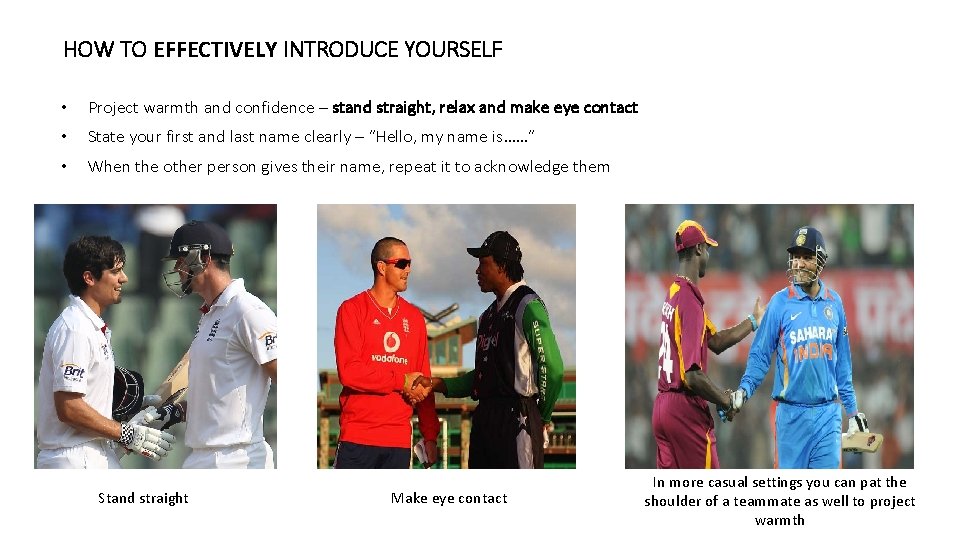
HOW TO EFFECTIVELY INTRODUCE YOURSELF • Project warmth and confidence – stand straight, relax and make eye contact • State your first and last name clearly – “Hello, my name is……” • When the other person gives their name, repeat it to acknowledge them Stand straight Make eye contact In more casual settings you can pat the shoulder of a teammate as well to project warmth
Exercise: 2 Practice standing and giving the persons next to you a proper handshake. Make sure you are using all of the steps below: • Project warmth and confidence – stand straight, relax and make eye contact • State your first and last name clearly – “Hello, my name is……” • When the other person gives their name, repeat it to acknowledge them DO NOT: • Squeeze the other person’s hand to hurt them but be firm • Shake hands if your palm is sweating – use a handkerchief to wipe hands if they are sweating • Extend a limp hand – it makes people feel as though you do not want to interact with them • Look away when shaking someone’s hand
SOCIAL BEHAVIOUR AND COMMUNICATION FOR YOUTHS self–es·teem noun -ə-ˈstēm: a feeling of having respect for yourself and your abilities; a confidence and satisfaction in oneself: self-respect This is an easily understood definition. Now, let’s apply this term, as it stands, to the youth athlete. The athlete has self-respect for him- or herself, not only as an athlete, but as a person, and the athlete has respect for his or her athletic skills and abilities. The athlete’s self-esteem is an internal measure of self worth, as an athlete and as a person.
FIRST IMPRESSIONS • It takes 30 seconds for a person meeting you for the first time to form impressions about you, your character, and abilities. You never get a second chance to make a first impression! • You’re always ―onstage. Always be prepared to look and sound your best • Good grooming is essential • Smile and make eye contact
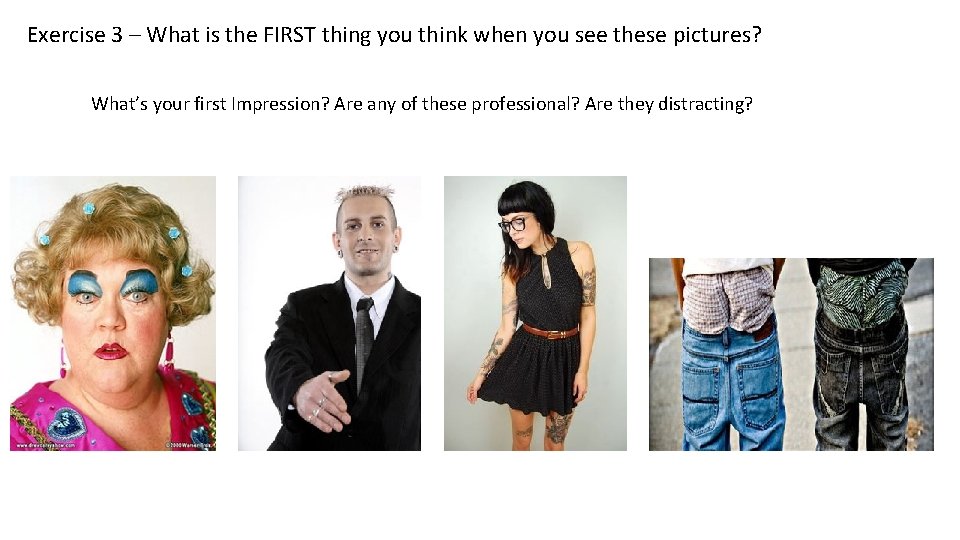
Exercise 3 – What is the FIRST thing you think when you see these pictures? What’s your first Impression? Are any of these professional? Are they distracting?
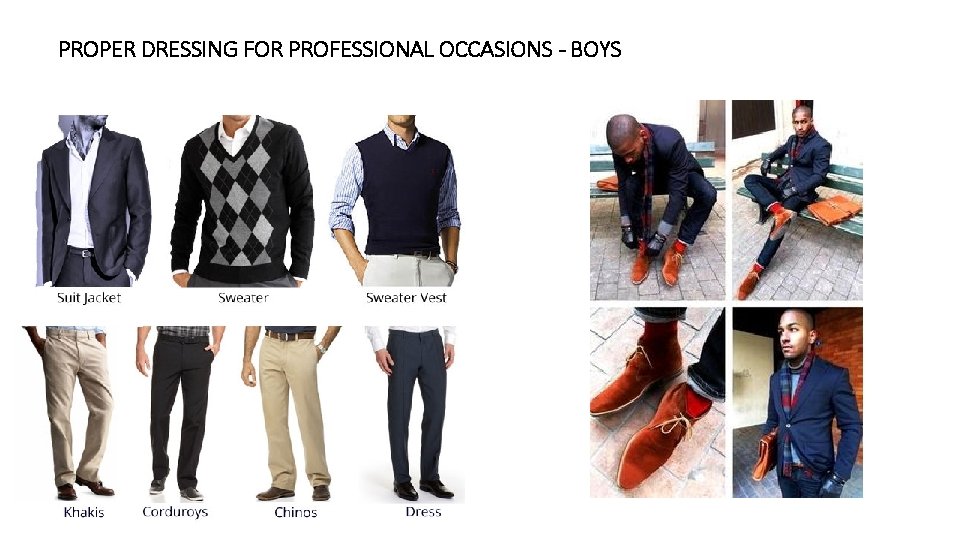
PROPER DRESSING FOR PROFESSIONAL OCCASIONS - BOYS
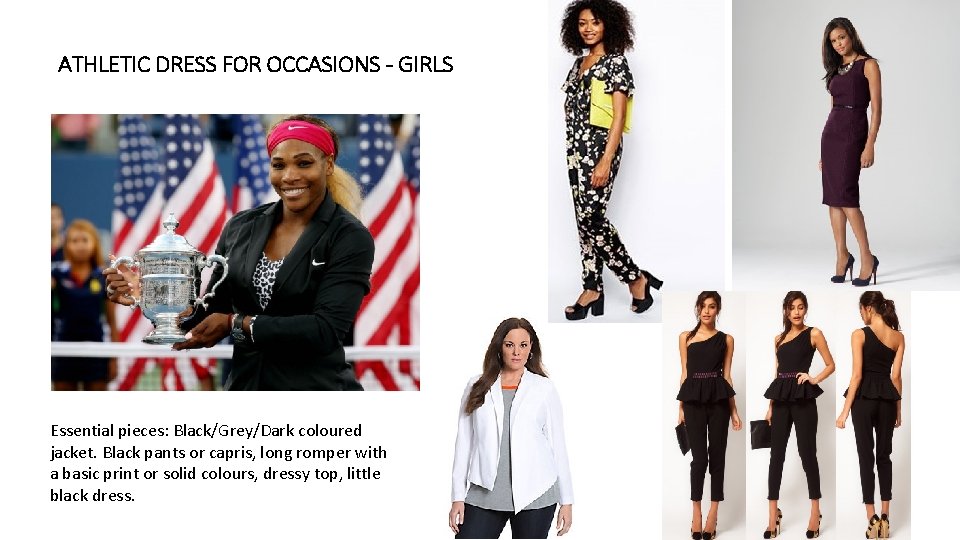
ATHLETIC DRESS FOR OCCASIONS - GIRLS Essential pieces: Black/Grey/Dark coloured jacket. Black pants or capris, long romper with a basic print or solid colours, dressy top, little black dress.
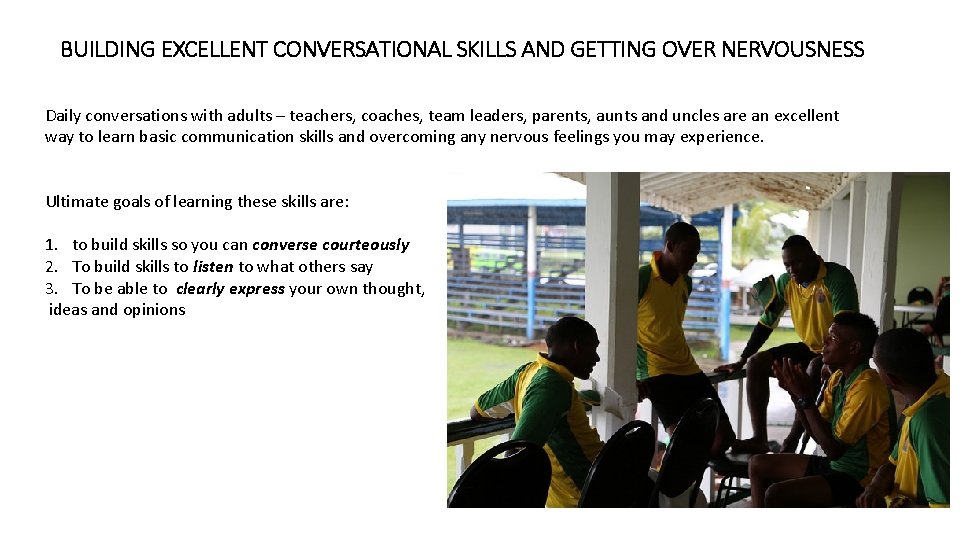
BUILDING EXCELLENT CONVERSATIONAL SKILLS AND GETTING OVER NERVOUSNESS Daily conversations with adults – teachers, coaches, team leaders, parents, aunts and uncles are an excellent way to learn basic communication skills and overcoming any nervous feelings you may experience. Ultimate goals of learning these skills are: 1. to build skills so you can converse courteously 2. To build skills to listen to what others say 3. To be able to clearly express your own thought, ideas and opinions
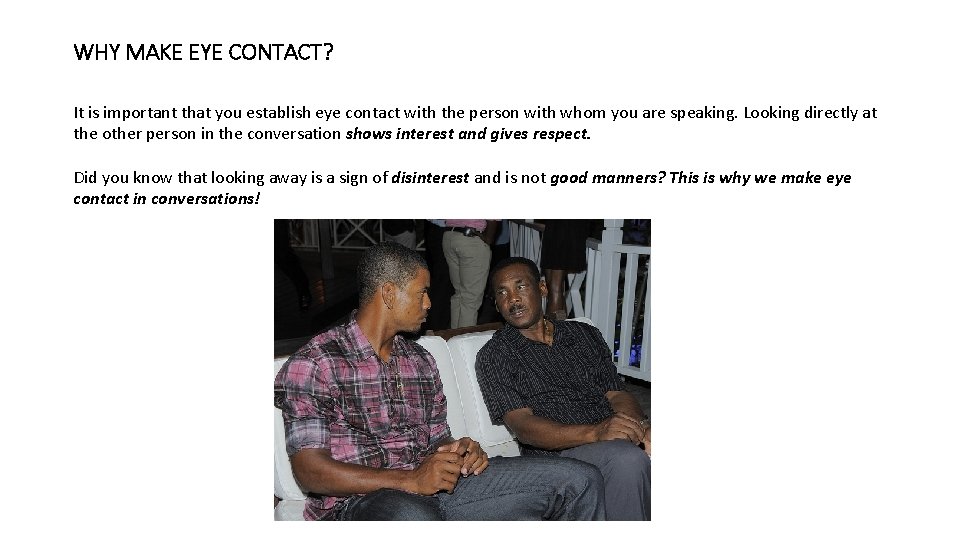
WHY MAKE EYE CONTACT? It is important that you establish eye contact with the person with whom you are speaking. Looking directly at the other person in the conversation shows interest and gives respect. Did you know that looking away is a sign of disinterest and is not good manners? This is why we make eye contact in conversations!
SPEAK CLEARLY AND CORRECTLY • Use good pronunciation –if you are not sure you can always ask a teacher • Don’t speak too quickly – sometimes when we are excited we can speak too quickly and others don’t understand, so take your time! • Use good grammar – don’t try to impress by using “big” words. Keep it simple and straightforward
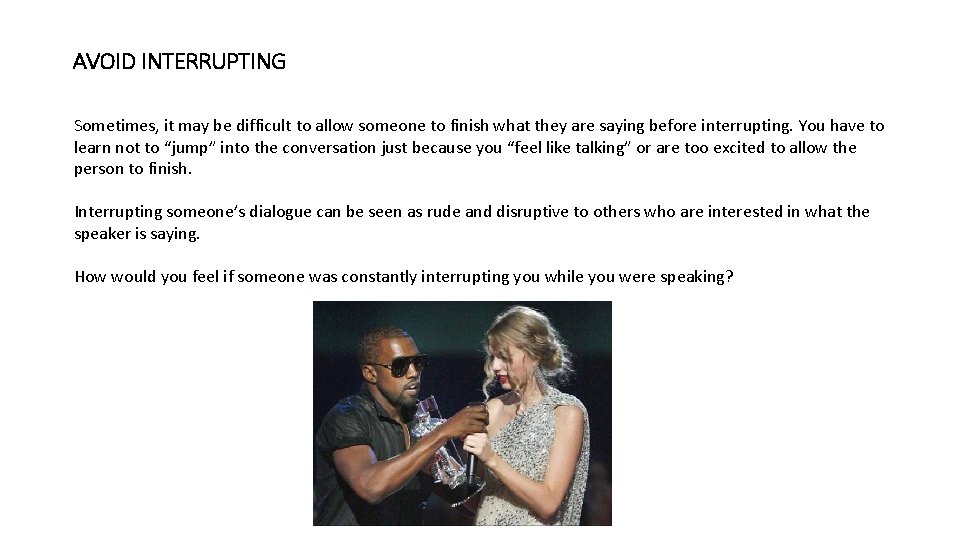
AVOID INTERRUPTING Sometimes, it may be difficult to allow someone to finish what they are saying before interrupting. You have to learn not to “jump” into the conversation just because you “feel like talking” or are too excited to allow the person to finish. Interrupting someone’s dialogue can be seen as rude and disruptive to others who are interested in what the speaker is saying. How would you feel if someone was constantly interrupting you while you were speaking?
PAY CLOSE ATTENTION AND RESPOND Good listening skills are developed by getting involved in what the speaker is saying and being interested. Always listen attentively to your speaker and if it is one on one, you can also ask questions showing that you are interested. The best conversationalists are those who listen well. For example: you can nod your head in agreement with a statement or even share a small laugh at funny stories or jokes. You can say, “That’s very interesting, ” “That sounds great!” “Thanks for sharing” “That’s a great achievement” Practice your listening skills with your friends and teammates. Tell them a story and test your conversational and listening skills
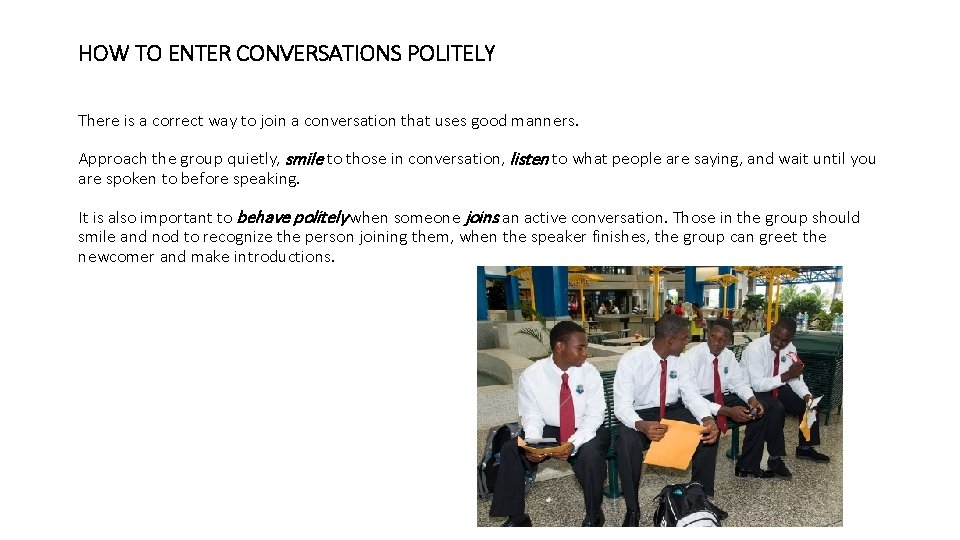
HOW TO ENTER CONVERSATIONS POLITELY There is a correct way to join a conversation that uses good manners. Approach the group quietly, smile to those in conversation, listen to what people are saying, and wait until you are spoken to before speaking. It is also important to behave politely when someone joins an active conversation. Those in the group should smile and nod to recognize the person joining them, when the speaker finishes, the group can greet the newcomer and make introductions.
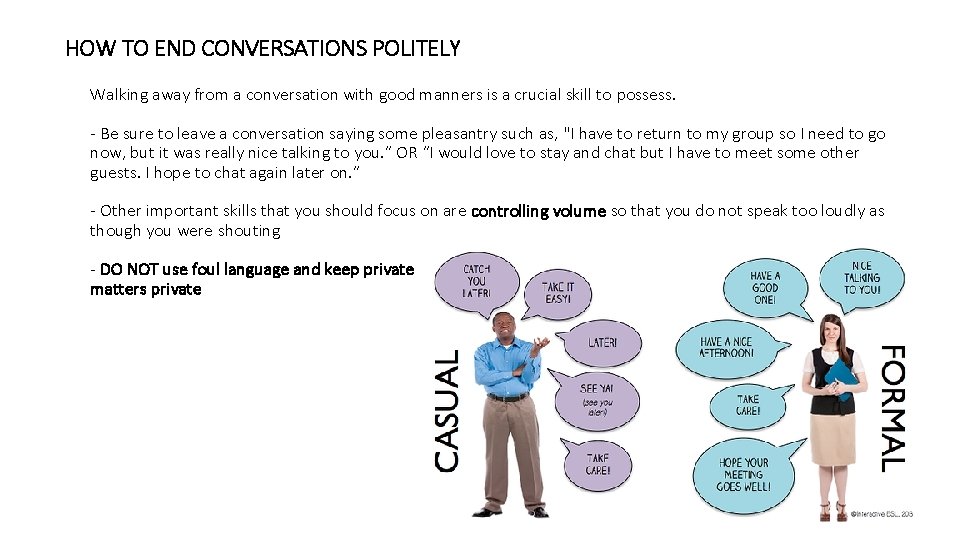
HOW TO END CONVERSATIONS POLITELY Walking away from a conversation with good manners is a crucial skill to possess. - Be sure to leave a conversation saying some pleasantry such as, "I have to return to my group so I need to go now, but it was really nice talking to you. ” OR “I would love to stay and chat but I have to meet some other guests. I hope to chat again later on. ” - Other important skills that you should focus on are controlling volume so that you do not speak too loudly as though you were shouting - DO NOT use foul language and keep private matters private
Exercise 4 – Practicing conversations and listening skills Working in pairs, have a conversation on any of the following topics with the person next to you – How to stay fit, Challenges on the field, Training for upcoming tournaments, Goals to work towards in cricket, End of year or special events that are coming up, new goals and records for 2015. While one person speaks, the other is supposed to be listening and showing the speaker that they are listening carefully to what they are saying. While the speaker talks, observe the following: - Are they nervous? - Can you follow their thoughts easily? - How does their tone sound? - Are they using casual or formal language? - Are they making eye contact with you - Are they speaking clearly and at a good pace? Now switch roles and change topics. The listener will now speak and be observed. Make notes to discuss with the facilitator.
Tone of Voice TONE OF VOICE is not what you say, but how you say it. This encompasses not only the words you choose, but their order, rhythm and pace. Your tone of voice expresses your personality and what you stand for. Each person’s tone of voice is unique. It is what distinguishes you from others. "People don’t always remember what you say or even what you do, but they always remember how you made them feel. ” It’s often the way we say something that breeds a certain feeling. People can be very sensitive to language, forming impressions of people as soon as they begin to hear or read their words. Tip: Develop your vocabulary, cut out slang, and youthful/urban talk. Take turns when speaking, and don’t hog the conversation
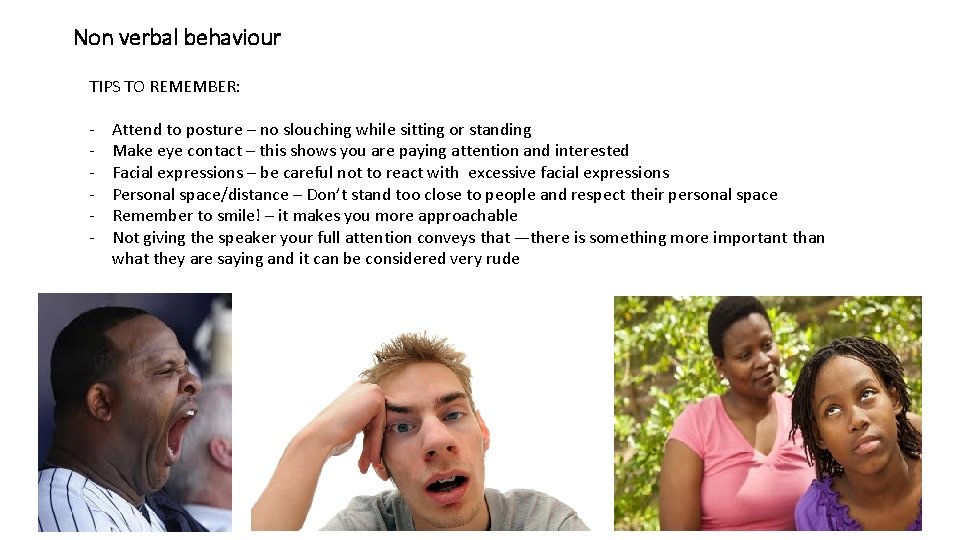
NON VERBAL BEHAVIOUR Did you know that you can express how you feel without actually saying it? What do the following mean? - Applause - Nodding your head - Rolling eyes - Steups or sucking teeth - Folding arms - Twisting hair - Blank facial expression (“zoned out”) You will have to take a look at yourselves to determine if you use rude facial expressions like eye rolling and grimaces as well as yawning at a speaker, hair twisting, turning one's back to the speaker, finger nail picking and checking one's watch or phone – these are all considered to be bad manners! Your nonverbal actions and behaviors can make people feel badly.
Non verbal behaviour TIPS TO REMEMBER: - Attend to posture – no slouching while sitting or standing Make eye contact – this shows you are paying attention and interested Facial expressions – be careful not to react with excessive facial expressions Personal space/distance – Don’t stand too close to people and respect their personal space Remember to smile! – it makes you more approachable Not giving the speaker your full attention conveys that ―there is something more important than what they are saying and it can be considered very rude
GUIDELINES ON DRESS AND GROOMING (Non-verbal cues) It’s critical to be clean and neat from head to toe! Piercings and Creative Hair: Yes, you have a perfect right to be who you are. Just remember, Coaches and sponsors have just as much right to say that lip rings are not the image your organization is trying to project Tattoos/body art: if you have it, make sure it won’t be visible and distracting Clean nails and hands: Nail polish, if you wear any, should be conservative. Eyewear: If you wear glasses, make sure the lenses are clean. Scents: Don’t overdo cologne or perfume. If it is overpowering it can be off putting to others Hair: Have a conservative haircut, which is neatly combed and your hair should not completely cover your face. Ensure that clothing is not wrinkled Quick Checklist: Check hair, face, teeth, and clothes before entering a room. Fresh breath is a must! No gum or mints in your mouth! Women: Conservative jewelry and make-up. Men: Facial hair policies vary by geography, industry and organization. Basic advice: it should be clean, neat and trimmed
GUIDELINES ON HOW TO BEHAVE IN SOCIAL SETTINGS Basic Social Etiquette – if you aren’t sure what to do, follow these simple rules • • Always be punctual If invited to a function bring no one, unless the invitation states "and guest" Don’t smoke, chew gum or tobacco RSVP on an invitation stands for the French phrase "Respondez s'il vous plait, meaning Reply, Please In other words: • Respond to indicate whether you will or will not attend • Don’t show up without having responded • If you said yes and your plans change, let the host know you need to cancel • Don’t be a no-show
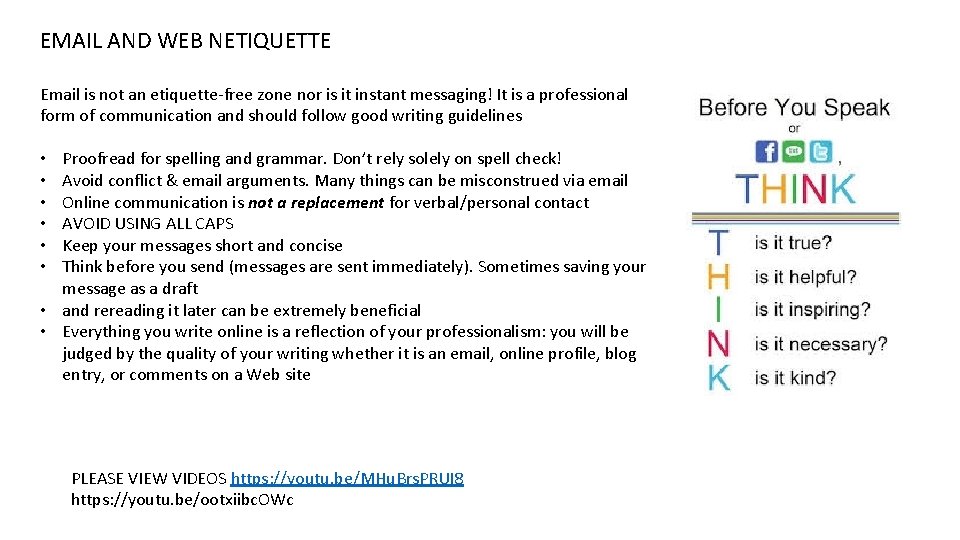
EMAIL AND WEB NETIQUETTE Email is not an etiquette-free zone nor is it instant messaging! It is a professional form of communication and should follow good writing guidelines Proofread for spelling and grammar. Don’t rely solely on spell check! Avoid conflict & email arguments. Many things can be misconstrued via email Online communication is not a replacement for verbal/personal contact AVOID USING ALL CAPS Keep your messages short and concise Think before you send (messages are sent immediately). Sometimes saving your message as a draft • and rereading it later can be extremely beneficial • Everything you write online is a reflection of your professionalism: you will be judged by the quality of your writing whether it is an email, online profile, blog entry, or comments on a Web site • • • PLEASE VIEW VIDEOS https: //youtu. be/MHu. Brs. PRUI 8 https: //youtu. be/ootxiibc. OWc
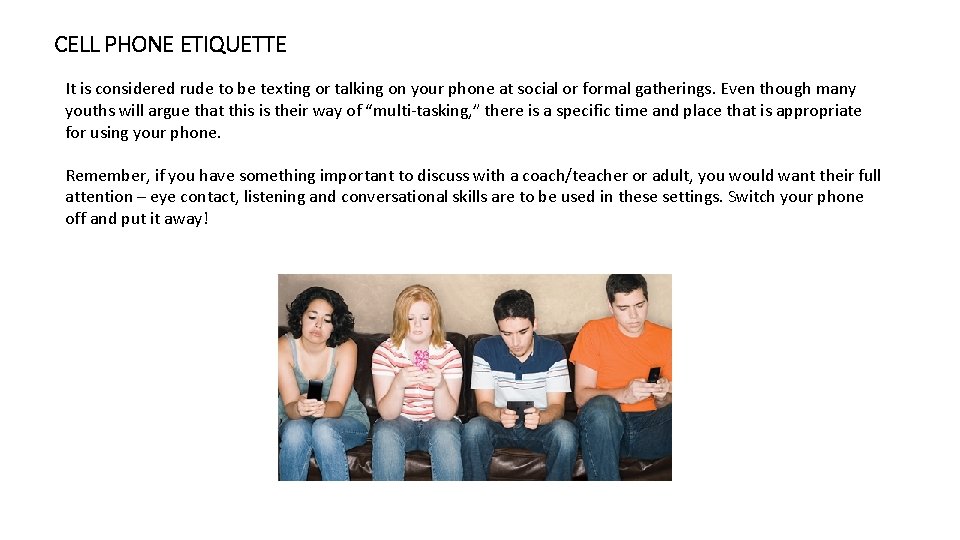
CELL PHONE ETIQUETTE It is considered rude to be texting or talking on your phone at social or formal gatherings. Even though many youths will argue that this is their way of “multi-tasking, ” there is a specific time and place that is appropriate for using your phone. Remember, if you have something important to discuss with a coach/teacher or adult, you would want their full attention – eye contact, listening and conversational skills are to be used in these settings. Switch your phone off and put it away!
HOW TO DINE OUT AMONG COMPANY • • • • Practice proper posture; sit up straight with your arms close to your body When you are not eating, keep your hands on your lap or resting on the table (with wrists on the edge of the table). Elbows on the table are acceptable only between courses. Take responsibility for keeping up the conversation but stay away from controversial subjects Order something easy to eat. Stay away from spaghetti, peas, expensive items and anything that sounds like a large quantity of food. Do not order alcoholic beverages, even if the host does Ask for suggestions from others at the table Wait until everyone has been served before eating Only reach for items that are in front of you. Politely ask others to pass items out of reach. Bring food to your mouth—not your head to the plate Eat at the same pace as everyone else – try to avoid gobbling Take small bites at a time and never chew with your mouth open or talk with your mouth full. If asked a question while you are eating, finish chewing, swallow, then speak Throughout the meal, be sure to say "please" and "thank you. " Your polite attitude will foster an overall positive impression.
THANKING YOUR HOST If you get a good opportunity to meet your host or sponsor representatives, be sure to express your appreciation. For eg: “Thank you for inviting us (me) to this event. I truly appreciate it. ” “ Thank you for considering us so highly, we are pleased to be here. ’ “Thank you for treating us so kindly, we had a very enjoyable time. ” Some people do this upon meeting the host or sponsors, while others say “Thank you” when they are leaving the event.
Exercise 5 Spend one minute expressing thanks to your facilitator for hosting this training workshop. Please stand speak to the entire class when doing this. Highlight one area of the course that was especially useful to you.