
ETICS THE GOVERNANCE THE STRUCTURE AND THE SECRETARIAT

- Slides: 22
ETICS THE GOVERNANCE, THE STRUCTURE AND THE SECRETARIAT THIS PUBLICATION IS COPYRIGHT PROTECTED Copyright © 2016 ETICS, Brussel, Belgium ETICS Governance, Structure and Secretariat July 1 st, 2016 1
ETICS stands for the “European Testing, Inspection and Certification System” By Law of 16 th January and 22 nd 2003 ETICS is an “international not-for-profit association and a public utility establishment” This Association is governed by the Belgian law.
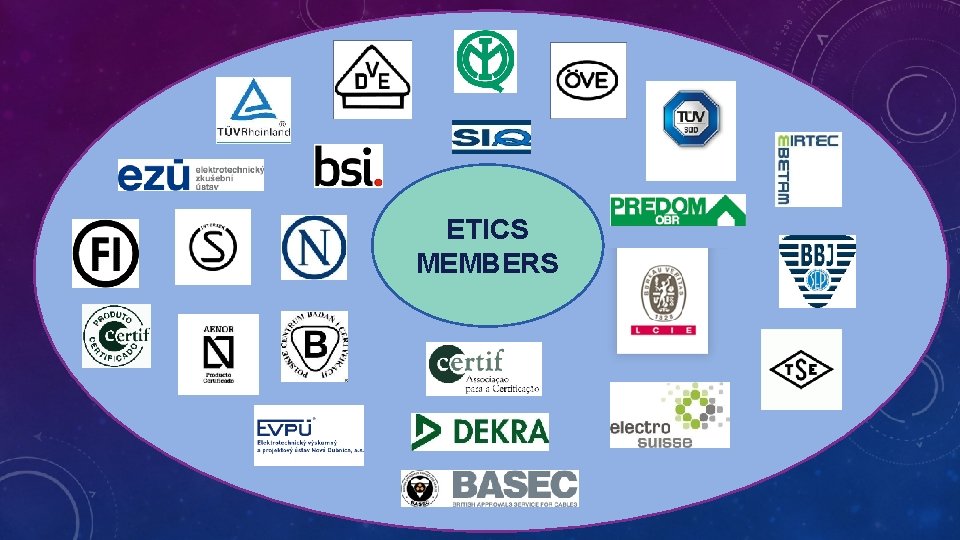
ETICS MEMBERS
Aim of ETICS q The aim of ETICS is the administration of the ENEC Scheme and other third party compliance Schemes such as CCA, HAR and LOVAG. q The Schemes administrated by ETICS operates essentially in the electrotechnical sector, and also in other areas that are associated with inspection, testing and product certification, as well as certifying personnel. q Its main activity is to facilitate access to the European market for certified products by European based third party and independent organisations and in this way to guarantee the safety and good quality of consumer products and equipment in the market place.
Tasks of ETICS To successfully complete its mission, ETICS’ task is to: v Coordinate services supplied by the Members in relation to product testing, inspection and certification before being placed on the market. v Publish and administrate certificates and licences issued by the Members in a centralised database, available and accessible to consumers. v Monitor the use of systems or marks on the market whose licences were issued by the Members of the Association Continue next slide…. .
Tasks of ETICS • Organise training courses for teams of experts in order to ensure consistent methods for conducting standardised testing. • Ensure openness and transparency of the European certification systems in which its members participate, and to maintain an ethical code in its certification activities • Participate in European Commission technical meetings to promote an alternative to the sole CE marking, by independent third party certification • Ensure coordination between European certification systems and international systems, in the interests of European industry.
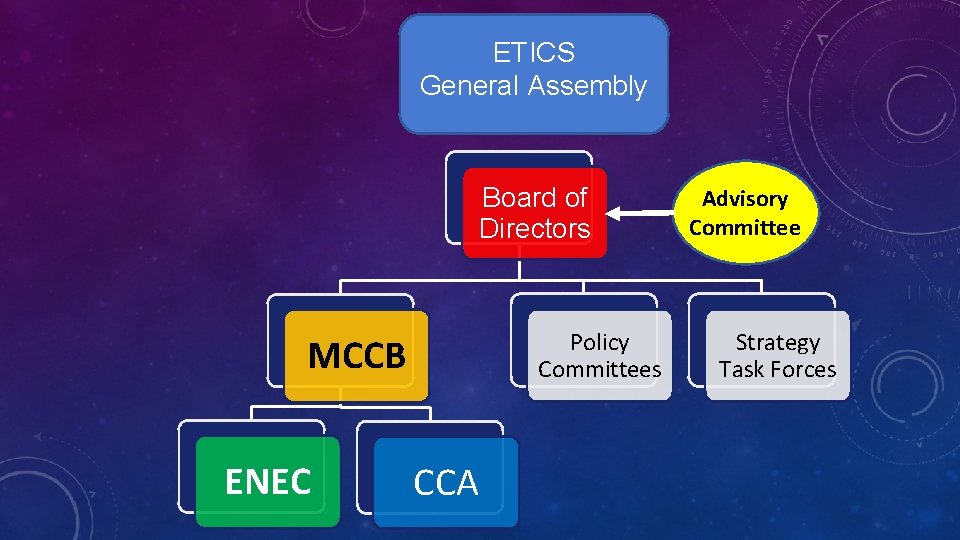
ETICS General Assembly Board of Directors Policy Committees MCCB ENEC CCA Advisory Committee Strategy Task Forces
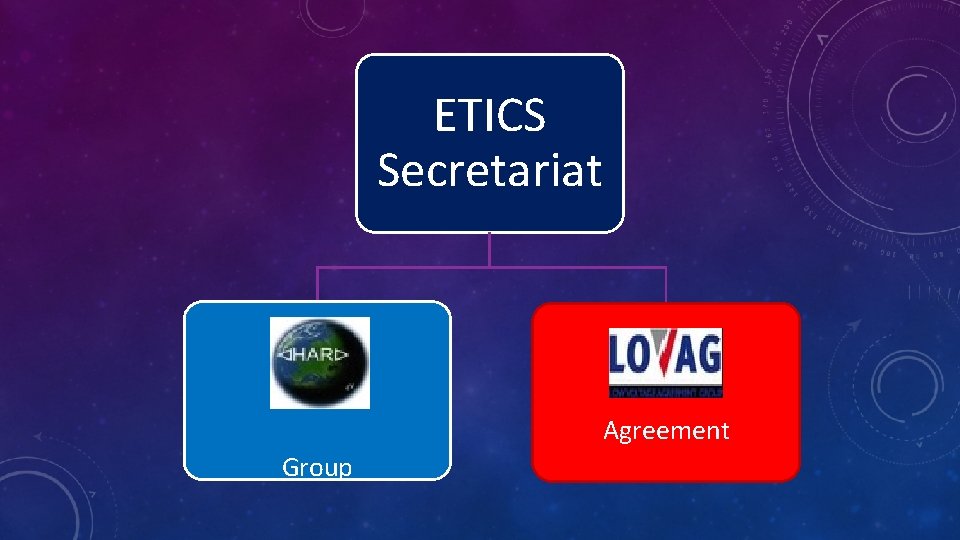
ETICS Secretariat Agreement Group
ETICS Strenght lies on the fact that Member Certification Bodies are the owner of the ENEC Schemes and owner of ETICS, the legal entity administering various Schemes.
ETICS Strenght Being owner of the Legal Entity and owner of ENEC means that Member CBs are the Decision Making organization and that they are in control of their present and future strategies.
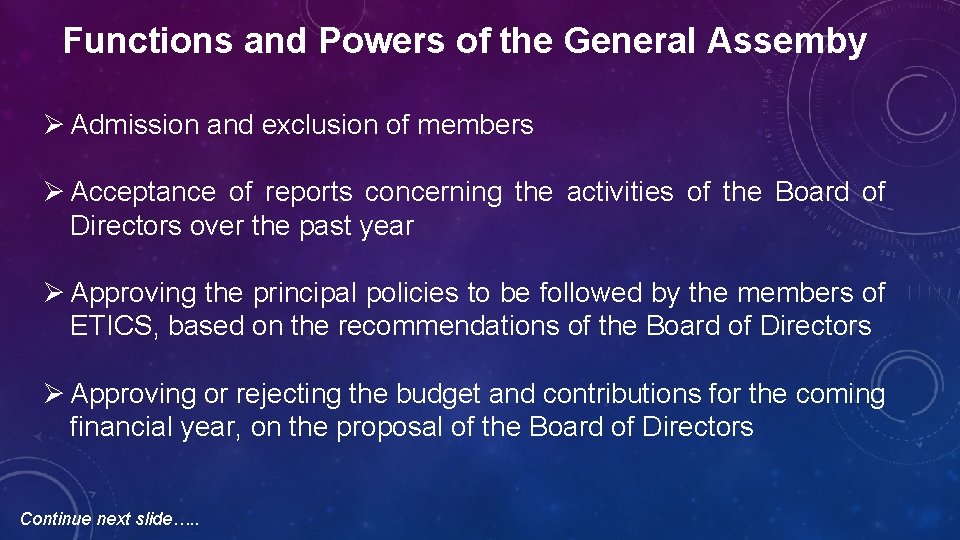
Functions and Powers of the General Assemby Admission and exclusion of members Acceptance of reports concerning the activities of the Board of Directors over the past year Approving the principal policies to be followed by the members of ETICS, based on the recommendations of the Board of Directors Approving or rejecting the budget and contributions for the coming financial year, on the proposal of the Board of Directors Continue next slide…. .
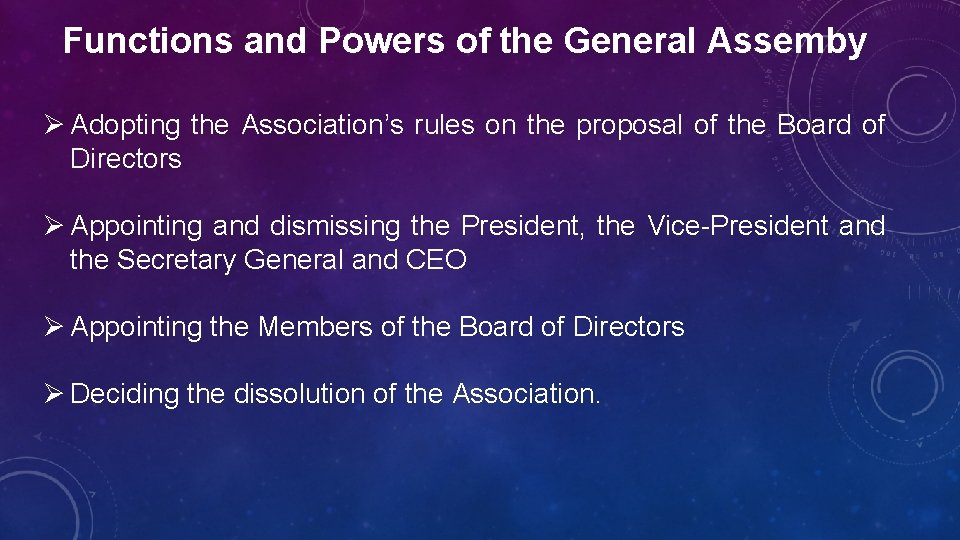
Functions and Powers of the General Assemby Adopting the Association’s rules on the proposal of the Board of Directors Appointing and dismissing the President, the Vice-President and the Secretary General and CEO Appointing the Members of the Board of Directors Deciding the dissolution of the Association.
Powers and obligations of the Board of Directors v The Association ETICS is managed by a Board of Directors whose members are elected from among the full members for three years v The Board of Directors is in charge of the Association’s administration and the management of all its activities v To that end, the Board of Directors has the broadest managerial powers and particularly the right to proceed with all administrative acts and procedures and to make any other necessary arrangement.
Main Tasks of the Board of Directors Preparing the guidelines of the annual work programme of ETICS to be submitted for the approval of the General Assembly. Deciding on any political and administrative questions which may be put to it by the Policy Committees, horizontal working parties or the Secretary General and CEO, provided that such questions are compatible with the guidelines accepted by the General Assembly. Undertaking financial management and the preparation of budgets, including matters concerning contributions, to be submitted to the approval of the General Assembly, and monitoring expenditure.
Governance Good governance is a guiding principle at ETICS. Our definition of good governance has three main elements. 1. Good governance means ensuring that we are strictly following our internal Code of Conduct on issues such as integrity and impartiality 2. Good governance is about having a continuous dialogue with our stakeholders 3. Good governance is acting appropriately in our position as major regional provider of third party conformity assessment and fulfilling the objectives of our governance.
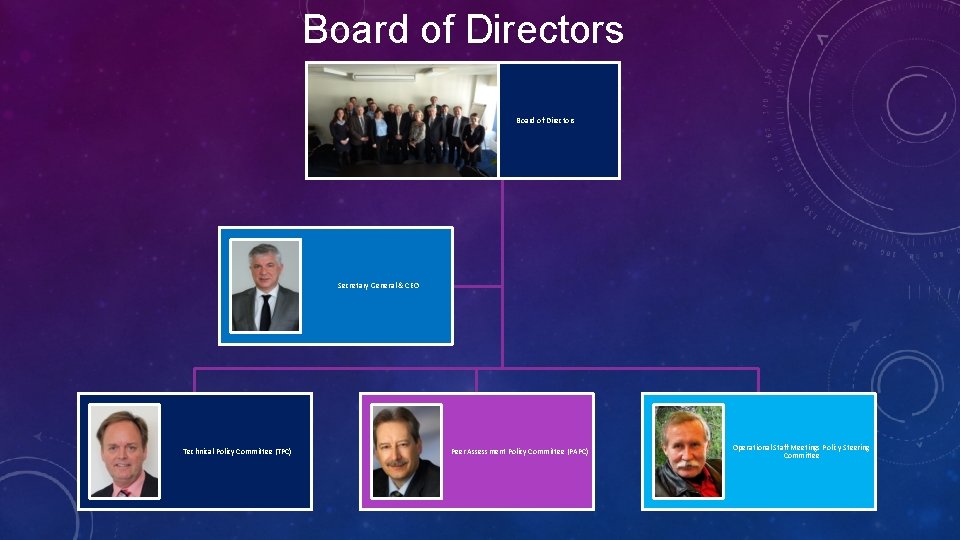
Board of Directors Secretary General & CEO Technical Policy Committee (TPC) Peer Assessment Policy Committee (PAPC) Operational Staff Meetings Policy Steering Committee
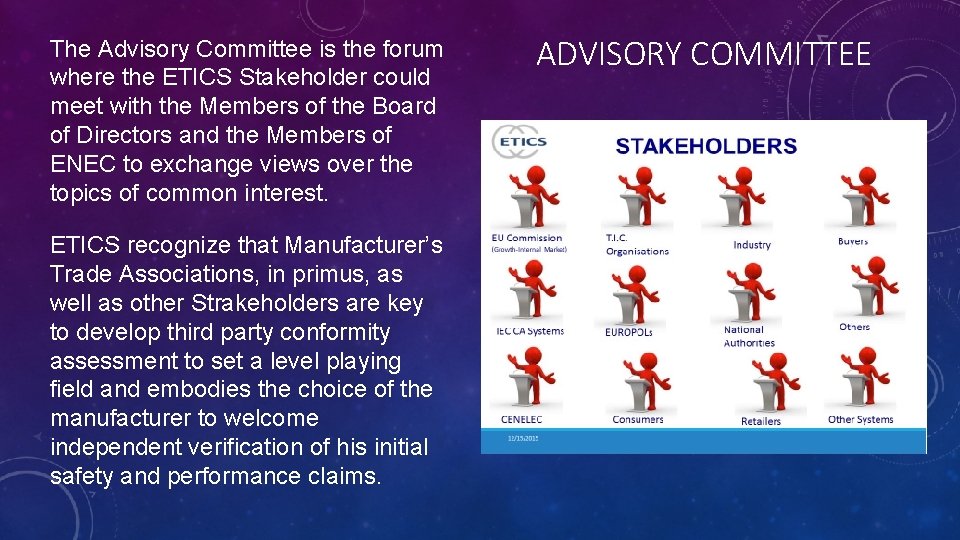
The Advisory Committee is the forum where the ETICS Stakeholder could meet with the Members of the Board of Directors and the Members of ENEC to exchange views over the topics of common interest. ETICS recognize that Manufacturer’s Trade Associations, in primus, as well as other Strakeholders are key to develop third party conformity assessment to set a level playing field and embodies the choice of the manufacturer to welcome independent verification of his initial safety and performance claims. ADVISORY COMMITTEE
ADVISORY COMMITTEE The ETICS advisory committee: • Is a collection of individuals who bring unique knowledge and skills which augment the knowledge and skills of the formal Board of Directors in order to more effectively advice the organization. • Makes recommendations and provide key information and input to the Board of Directors. • Plays an important public relations role as well as providing fresh perspective on programmatic issues.
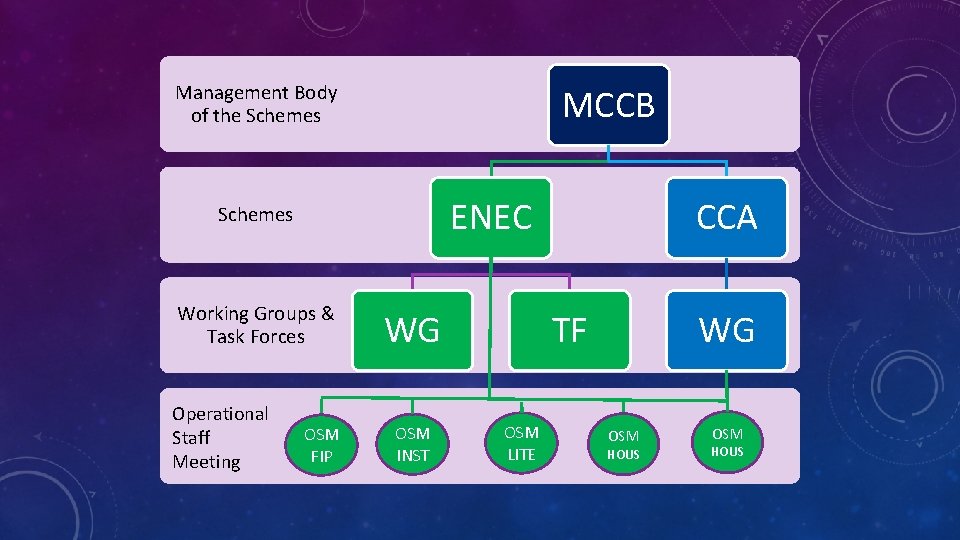
Management Body of the Schemes MCCB ENEC Schemes Working Groups & Task Forces Operational Staff Meeting OSM FIP WG OSM INST CCA TF OSM LITE WG OSM HOUS
MCCB Management Committee of Certification Bodies The purpose of the Management Committee is to foster an entrepreneurial spirit creating the basis for the Schemes to be inventive and adaptable to the market. For this reason, the structure of the committee is both lean and flat.
MCCB Management Committee of Certification Bodies The Management Committee is where all the operational decisions regarding the direction, strategy and financing of ENEC and the other Schemes administered by ETICS are approved.
THANK YOU FOR YOUR ATTENTION ETICS Governance, Structure and Secretariat July 1 st, 2016 22