
Ethylenediamine at AirLiquid and AirSilica Interfaces Protonation Versus
- Slides: 13
Ethylenediamine at Air/Liquid and Air/Silica Interfaces: Protonation Versus Hydrogen Bonding Investigated by Sum Frequency Generation Spectroscopy Man Xu, Dingfang Liu, Heather C. Allen Environmental Science Graduate program The Department of Chemistry The Ohio State University
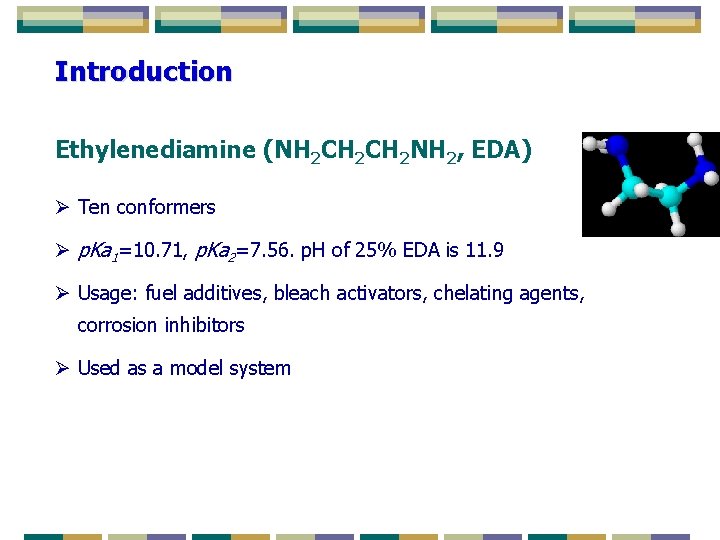
Introduction Ethylenediamine (NH 2 CH 2 NH 2, EDA) Ø Ten conformers Ø p. Ka 1=10. 71, p. Ka 2=7. 56. p. H of 25% EDA is 11. 9 Ø Usage: fuel additives, bleach activators, chelating agents, corrosion inhibitors Ø Used as a model system
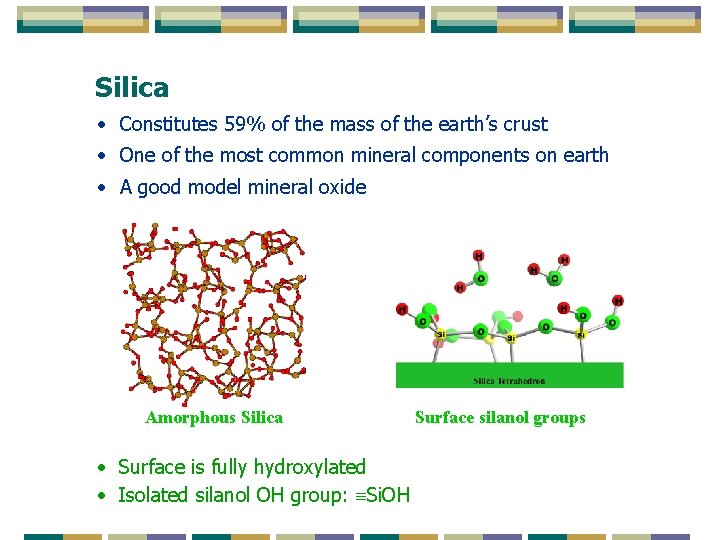
Silica • Constitutes 59% of the mass of the earth’s crust • One of the most common mineral components on earth • A good model mineral oxide Amorphous Silica • Surface is fully hydroxylated • Isolated silanol OH group: Si. OH Surface silanol groups
Adsorption The adsorption process on mineral oxide surfaces is an important factor influencing migration & distribution of contaminants in the soil environment Previous studies: IR, NMR, XPS, total internal reflection fluorescence correlation spectroscopy (TIR-FCS) Present study: SFG, which provides direct molecular level information, is employed to investigate the adsorption of EDA onto Si. O 2 surfaces
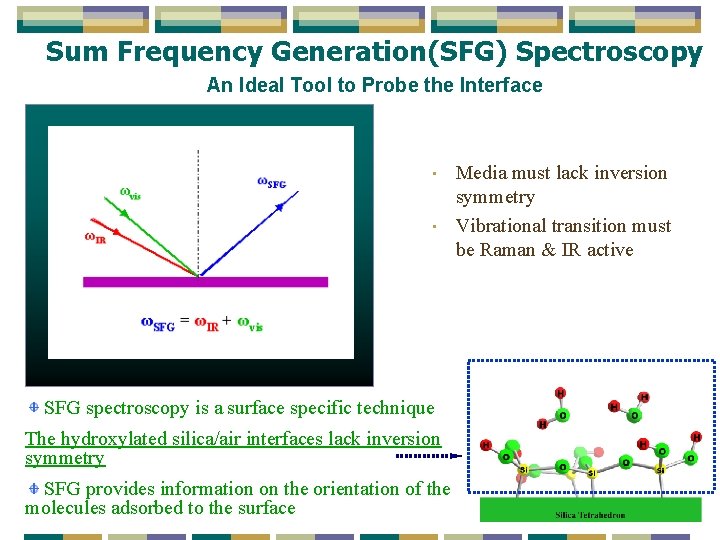
Sum Frequency Generation(SFG) Spectroscopy An Ideal Tool to Probe the Interface • • SFG spectroscopy is a surface specific technique The hydroxylated silica/air interfaces lack inversion symmetry SFG provides information on the orientation of the molecules adsorbed to the surface Media must lack inversion symmetry Vibrational transition must be Raman & IR active
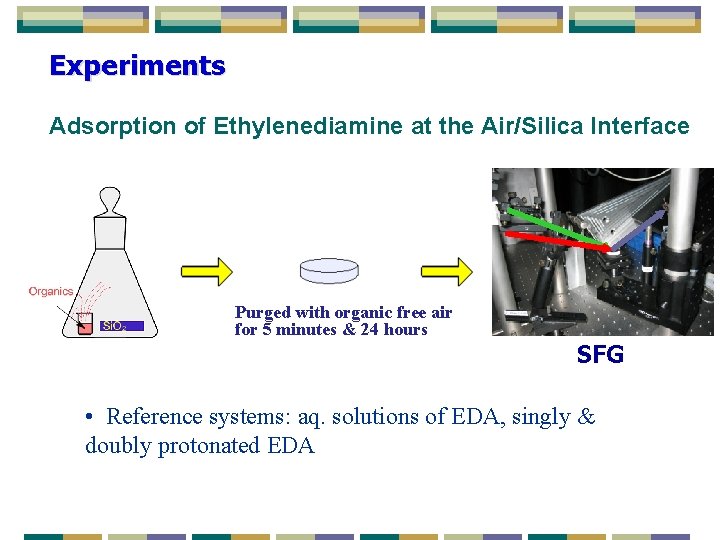
Experiments Adsorption of Ethylenediamine at the Air/Silica Interface Purged with organic free air for 5 minutes & 24 hours SFG • Reference systems: aq. solutions of EDA, singly & doubly protonated EDA
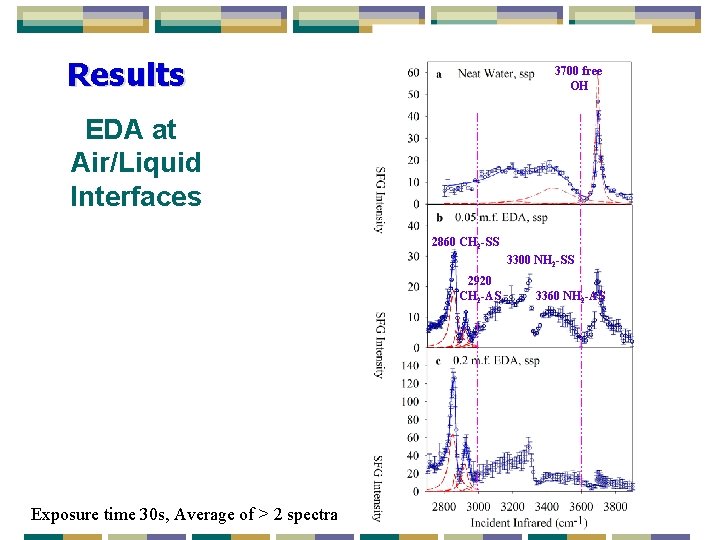
Results 3700 free OH EDA at Air/Liquid Interfaces 2860 CH 2 -SS 3300 NH 2 -SS 2920 CH 2 -AS Exposure time 30 s, Average of > 2 spectra 3360 NH 2 -AS
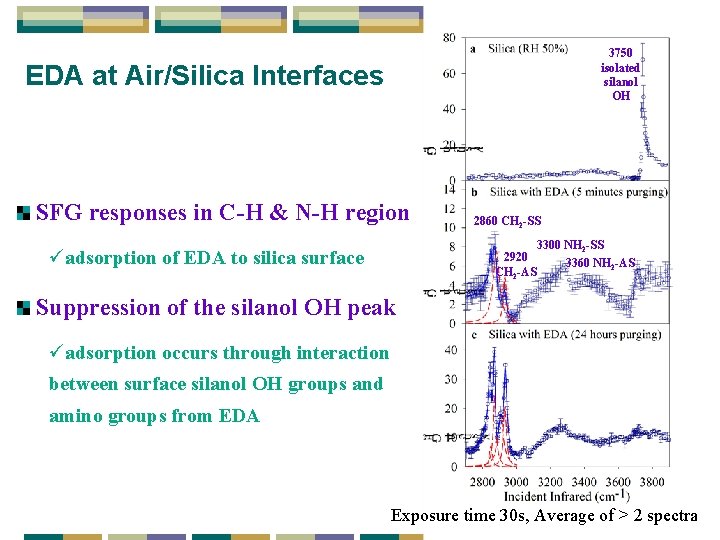
3750 isolated silanol OH EDA at Air/Silica Interfaces SFG responses in C-H & N-H region üadsorption of EDA to silica surface 2860 CH 2 -SS 2920 CH 2 -AS 3300 NH 2 -SS 3360 NH 2 -AS Suppression of the silanol OH peak üadsorption occurs through interaction between surface silanol OH groups and amino groups from EDA Exposure time 30 s, Average of > 2 spectra
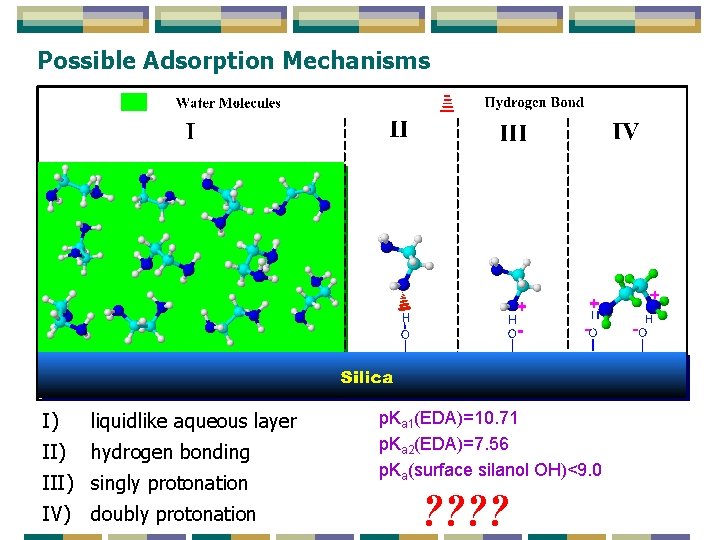
Possible Adsorption Mechanisms I) liquidlike aqueous layer II) hydrogen bonding III) singly protonation IV) doubly protonation p. Ka 1(EDA)=10. 71 p. Ka 2(EDA)=7. 56 p. Ka(surface silanol OH)<9. 0 ? ?
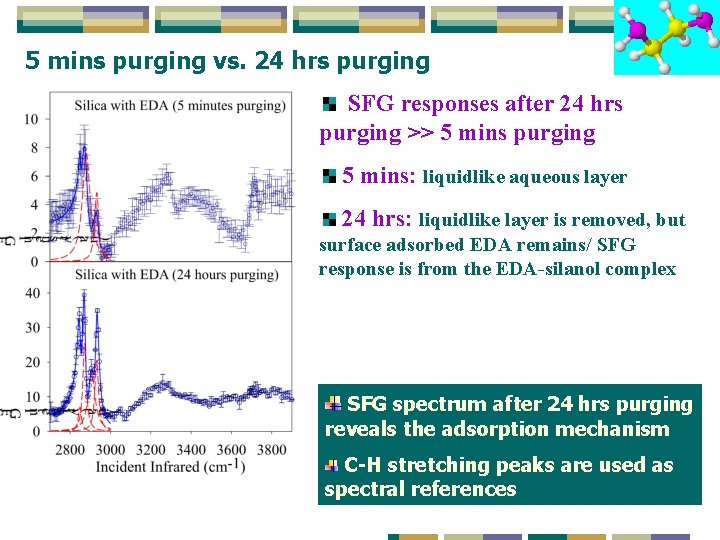
5 mins purging vs. 24 hrs purging SFG responses after 24 hrs purging >> 5 mins purging 5 mins: liquidlike aqueous layer 24 hrs: liquidlike layer is removed, but surface adsorbed EDA remains/ SFG response is from the EDA-silanol complex SFG spectrum after 24 hrs purging reveals the adsorption mechanism C-H stretching peaks are used as spectral references
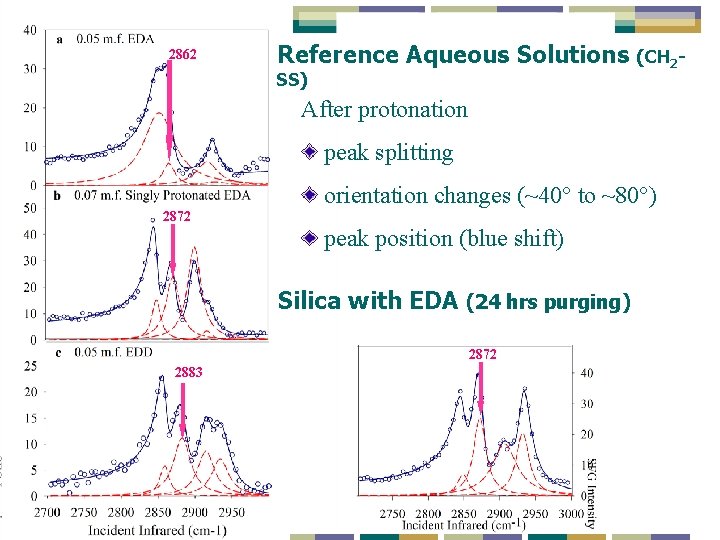
2862 Reference Aqueous Solutions SS) (CH 2 - After protonation peak splitting orientation changes (~40° to ~80°) 2872 peak position (blue shift) Silica with EDA (24 hrs purging) 2872 2883
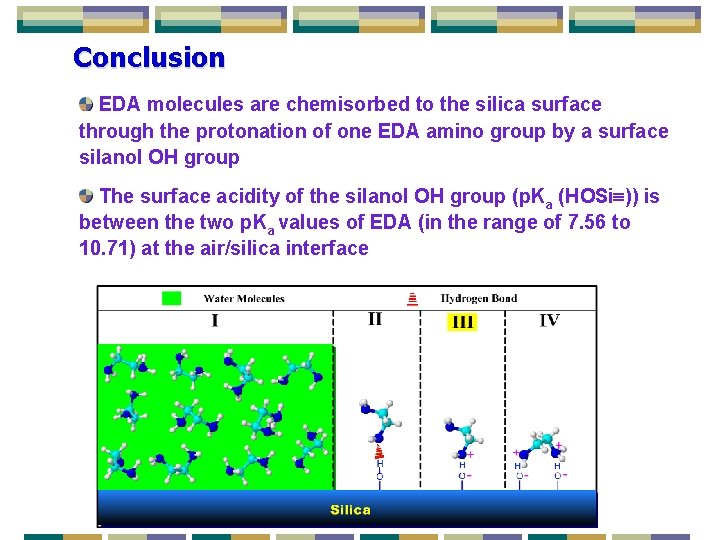
Conclusion EDA molecules are chemisorbed to the silica surface through the protonation of one EDA amino group by a surface silanol OH group The surface acidity of the silanol OH group (p. Ka (HOSi )) is between the two p. Ka values of EDA (in the range of 7. 56 to 10. 71) at the air/silica interface
Acknowledgements • DOE (DOE-BES Geosciences DE-FG 02 -04 ER 15495) • EMSI @ The Ohio State University