
Ethos Pathos and Logos Appeals in Argument n
- Slides: 41
Ethos, Pathos, and Logos Appeals in Argument
n YOU WILL NEED TO TAKE NOTES ON THIS INFORMATION
Persuasive writing n n The goal of argumentative/persuasive writing is to persuade your audience that your ideas are valid, or more valid than someone else's. The Greek philosopher Aristotle divided the means of persuasion, appeals, into three categories--Ethos, Pathos, Logos.
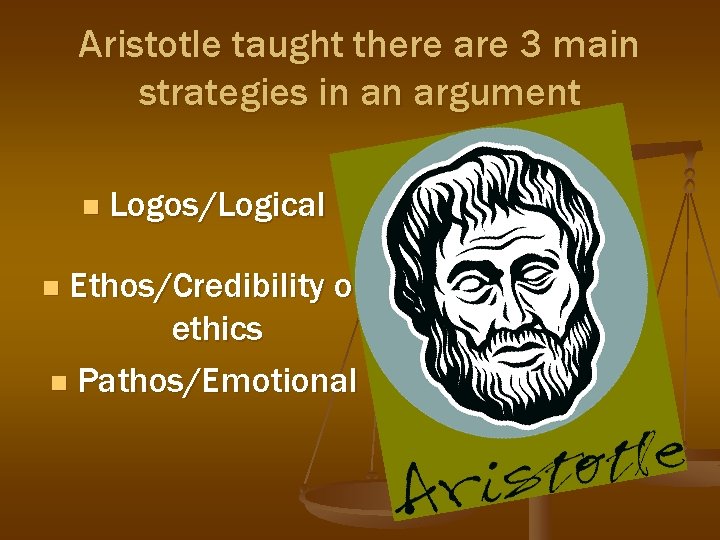
Aristotle taught there are 3 main strategies in an argument n Logos/Logical Ethos/Credibility or ethics n Pathos/Emotional n
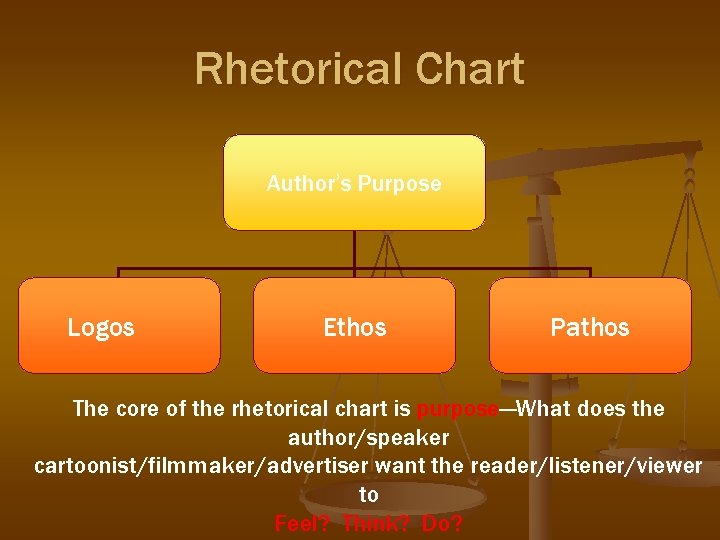
Rhetorical Chart Author’s Purpose Logos Ethos Pathos The core of the rhetorical chart is purpose—What does the author/speaker cartoonist/filmmaker/advertiser want the reader/listener/viewer to Feel? Think? Do?
Ethos: Ethical Appeals the source's credibility, the speaker's/author's authority n n How well an author/speaker presents him/herself Questions for considering a writer’s ethos: n n n Does he or she seem knowledgeable? Reasonable? Trustworthy? Does he or she treat his/her opponents with fairness and respect or does he/she take cheap shots? Does he or she try and establish common ground with the reader/audience?
Ethos-Credibility n n n Appeals to the conscience, ethics, morals, standards, values, and principles. Author or speaker tries to convince you he is of good character. Qualified to make his claims. Cites relevant authorities. Quotes others accurately and fairly.
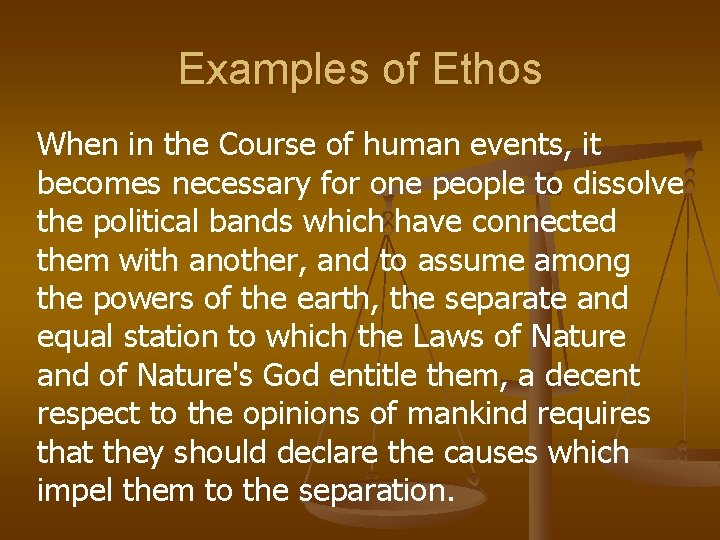
Examples of Ethos When in the Course of human events, it becomes necessary for one people to dissolve the political bands which have connected them with another, and to assume among the powers of the earth, the separate and equal station to which the Laws of Nature and of Nature's God entitle them, a decent respect to the opinions of mankind requires that they should declare the causes which impel them to the separation.
Pathos: Emotional Appeals the emotional or motivational appeals; vivid language, emotional language and numerous sensory details. n n How well the author taps into the emotions of the audience. Questions for considering a writer’s pathos: n n n Does the topic matter to the audience? Does the writer include anecdotes? Does the writer appeal to your emotions, memories, fears, etc. ? Is the emotional appeal effective or overwhelming? Is the writing overloaded with facts and figures?
Pathos-Emotional Appeal n n n n Appeals to the heart, Emotions, Sympathy, Passions, Sentimentality, Uses imagery, figurative language, Carefully constructed sentences. Uses loaded words.
Example of Pathos A Prince whose character is thus marked by every act which may define a Tyrant, is unfit to be the ruler of a free people.
Logos: Logical Appeal the logic used to support a claim; can also be the facts and statistics used to help support the argument. n n How well the author uses text and evidence to support his/her argument or claims. The claims should be well organized. Questions for considering a text’s logos: What is being argued or what is the author’s thesis? n What points does the author offer to support their thesis? n Are ideas presented logically? n
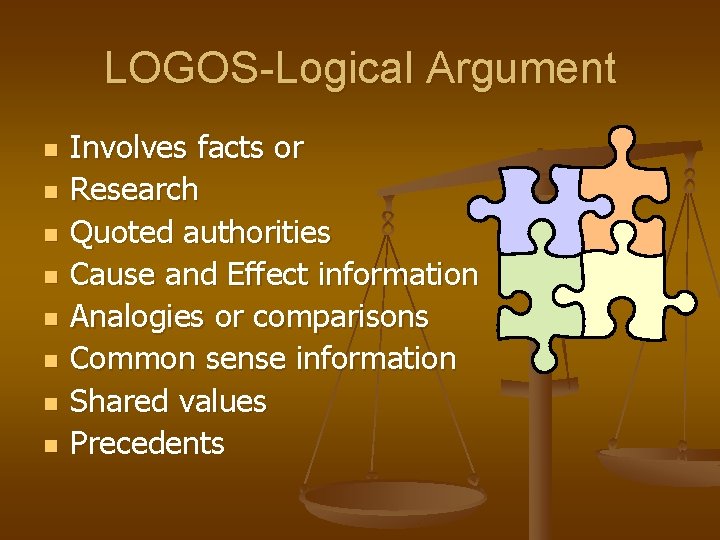
LOGOS-Logical Argument n n n n Involves facts or Research Quoted authorities Cause and Effect information Analogies or comparisons Common sense information Shared values Precedents
Example of Logos n The history of the present King of Great Britain is a history of repeated injuries and usurpations, all having in direct object the establishment of an absolute Tyranny over these States. To prove this, let Facts be submitted to a candid world. n He has refused his Assent to Laws, the most wholesome and necessary for the public good. He has forbidden his Governors to pass Laws of immediate and pressing importance, unless suspended in their operation till his Assent should be obtained; and when so suspended, he has utterly neglected to attend to them.
Logic and Reasoning
G What we need to know… -understand that the use of reason is a way to extend our knowledge from known facts G G -be able to distinguish between inductive and deductive arguments - in both cases to evaluate the strengths and weaknesses of the arguments -understand the premises/conclusion nature of an argument: -be very clear about the relationship between a valid argument and a true conclusion -be aware of the need to be rigorous when using logic, the difficulties associated with choice of premises, the dangers of hidden assumptions and the problems with definitions G -be familiar with some elementary fallacies G -be able to apply these ideas to everyday examples G -appreciate that real-life problem solving requires imagination and creativity, and more than simple logic
Background Terms n n Logic: the process of correct reasoning Reasoning: drawing inferences or conclusions from known or assumed facts
Inductive and Deductive Reasoning
Inductive Reasoning n n Inductive reasoning, or induction, is when you make an inference about the world (a generalization) based on specific examples or observations. In inductive reasoning, you make an inference based on specific details.
Inductive Reasoning n n n Sometimes this is called part to whole reasoning or specific to general reasoning Part-to-whole: where the whole is assumed to be like individual parts (only bigger). Part-to-whole: This chapter of the book is confusing, so the whole book is probably confusing.
Inductive Reasoning n n Specific-to-general: where you assume every example is like the one you already know Specific-to-general: My basketball coach uses a whistle in practice; most basketball coaches probably use whistles in practice.
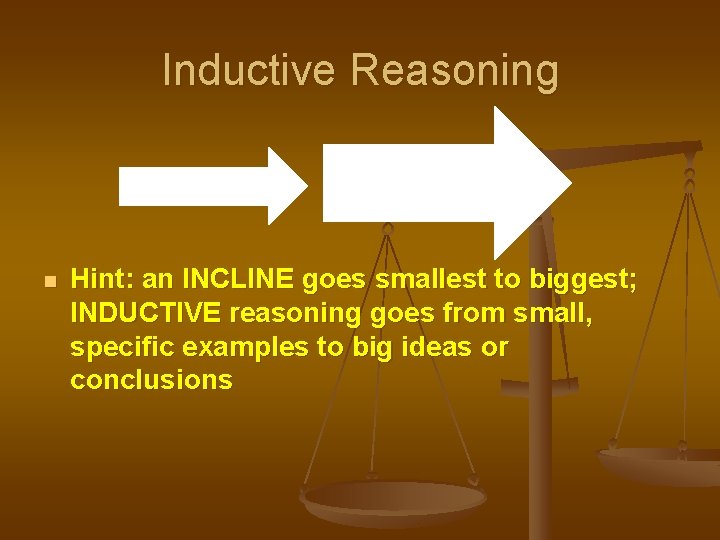
Inductive Reasoning n Hint: an INCLINE goes smallest to biggest; INDUCTIVE reasoning goes from small, specific examples to big ideas or conclusions
Deductive Reasoning n n n Deductive reasoning, or deduction, starts with a general case and figures out specific instances. It’s like taking a general rule, and then applying to ONE specific incidence to test it out Sometimes this is called whole to part reasoning or general to specific reasoning
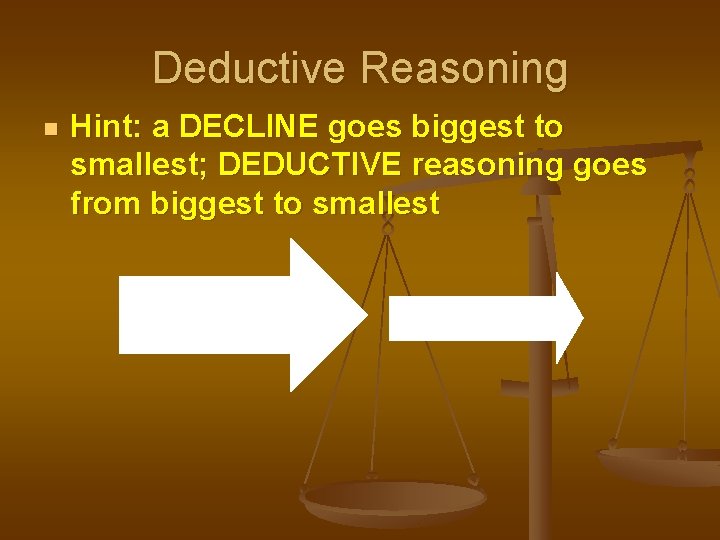
Deductive Reasoning n Hint: a DECLINE goes biggest to smallest; DEDUCTIVE reasoning goes from biggest to smallest
Deductive Reasoning n n n Whole-to-part: where you guess what the specific part is like based on the whole (only smaller). Whole to Part: Our volleyball team has won every game so far, so they will win the next one, too. Whole to Part: The play was entertaining, so the first act was entertaining.
Deductive Reasoning n n n General-to-specific: where you assume one example is going to be like the general rule General to specific: I usually don’t like vegetables, so I don’t think I will like bok choy. General to specific: I love to read poems, so I will enjoy “The Highwayman. ”
What kind of reasoning? n All men are mortal. (premise) Socrates is a man. (premise) Therefore, Socrates is mortal. (conclusion) n Deductive! n n
What kind of reasoning? n n Some horses are big. (premise) All horses have tails. (premise) Therefore, anything with a tail is big. (conclusion) Inductive!
What kind of reasoning? n All students eat pizza. (premise) Connor is a student at GHS. (premise) Therefore, Connor eats pizza. (conclusion) n Deductive! n n
What kind of reasoning? n All cats have fur. Priscilla is a cat. Therefore, Priscilla has fur. n Deductive! n n
What kind of reasoning? n n n All humans have a nose. (premise) S’raje is human. (premise) Therefore, S’raje has a nose. (conclusion)
What kind of reasoning? n n n Mr. Pullen is mean. (premise) My English teacher last year was also mean. (premise) Therefore, all English teachers are mean. (conclusion)
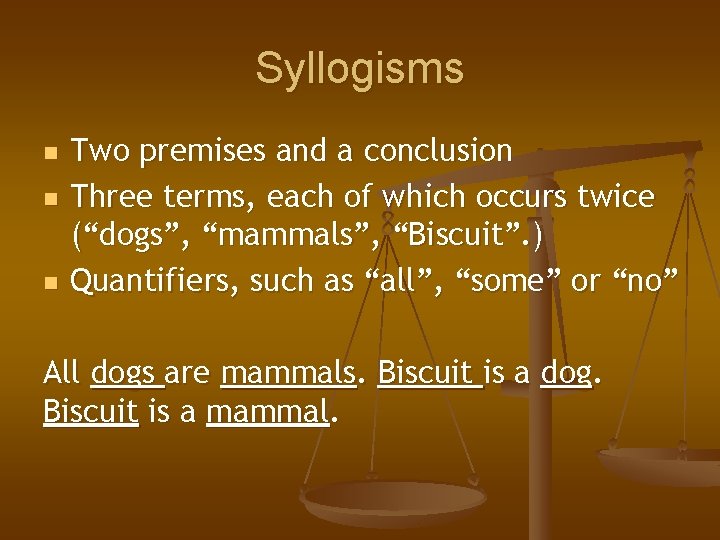
Syllogisms n n n Two premises and a conclusion Three terms, each of which occurs twice (“dogs”, “mammals”, “Biscuit”. ) Quantifiers, such as “all”, “some” or “no” All dogs are mammals. Biscuit is a dog. Biscuit is a mammal.
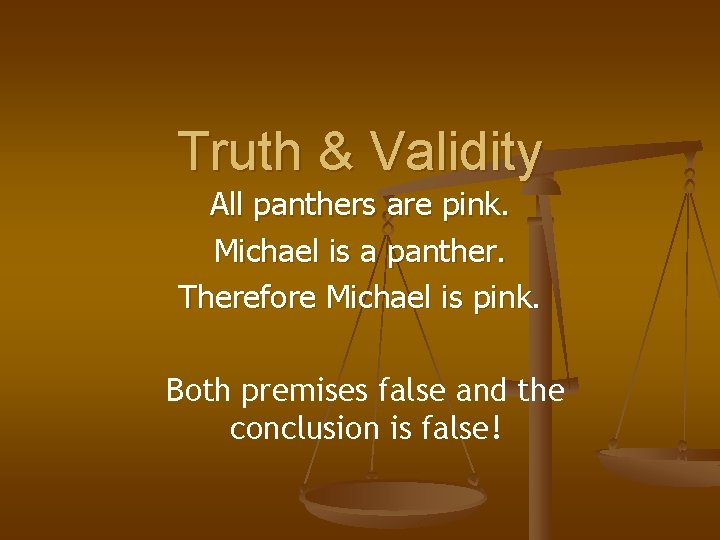
Truth & Validity All panthers are pink. Michael is a panther. Therefore Michael is pink. Both premises false and the conclusion is false!
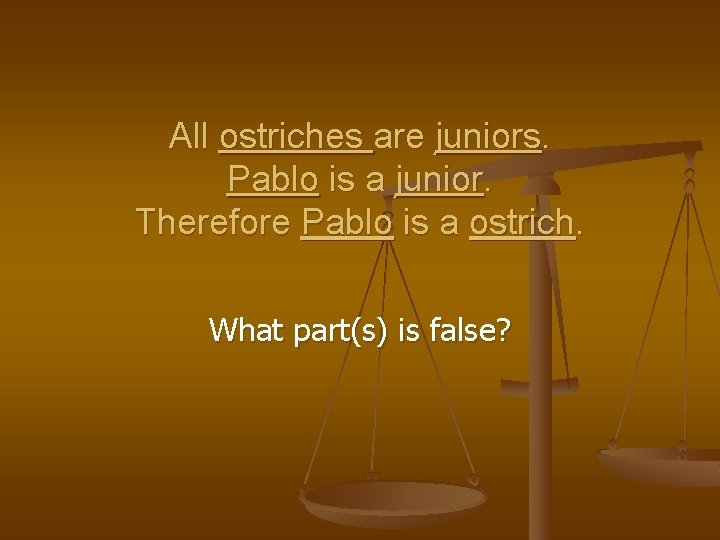
All ostriches are juniors. Pablo is a junior. Therefore Pablo is a ostrich. What part(s) is false?
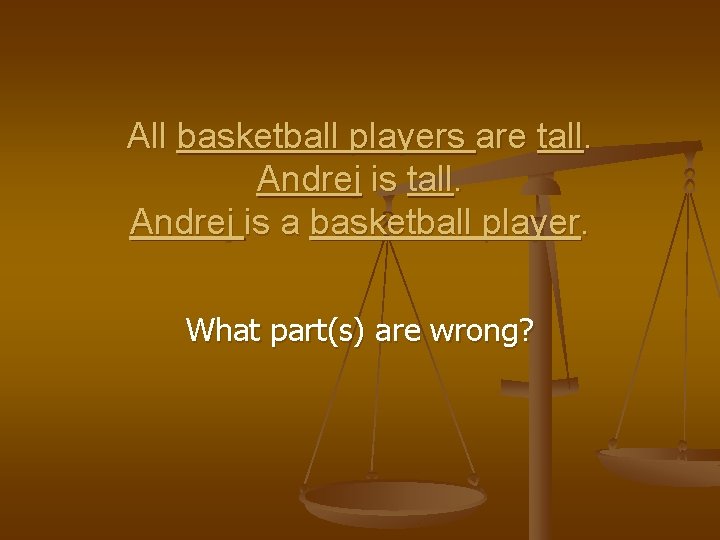
All basketball players are tall. Andrej is a basketball player. What part(s) are wrong?
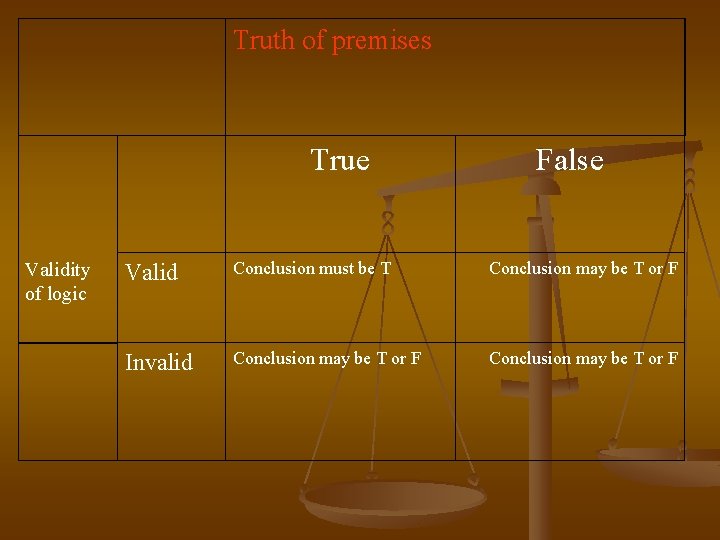
Truth of premises True Validity of logic False Valid Conclusion must be T Conclusion may be T or F Invalid Conclusion may be T or F
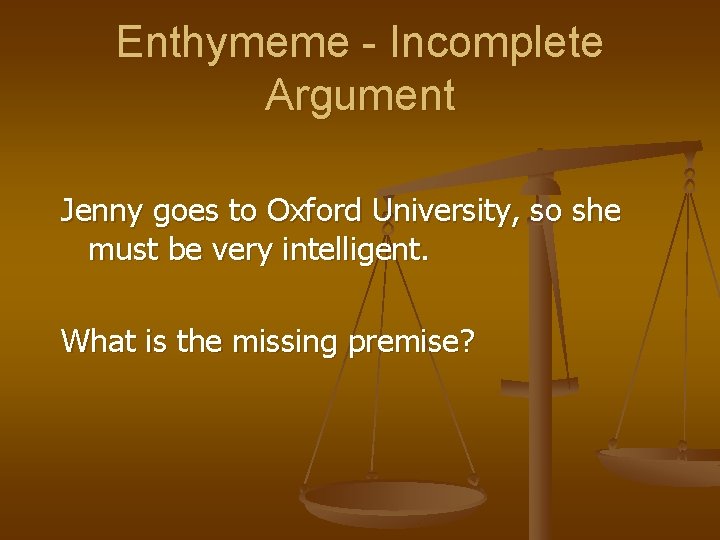
Enthymeme - Incomplete Argument Jenny goes to Oxford University, so she must be very intelligent. What is the missing premise?
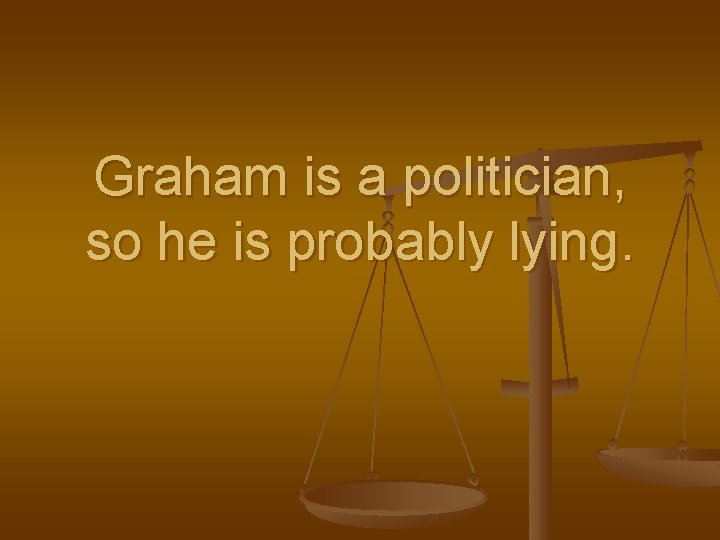
Graham is a politician, so he is probably lying.
Make your own Syllogisms! G G G SELECT THREE. WRITE THEM DOWN. LABEL THEM. Both premises and conclusion true. One true and one false premise with a true conclusion. One true and one false premise with a false conclusion. Two false premises and a true conclusion. Two false premises and a false conclusion.