
Ethnobotany The Antimicrobial Properties of Sambucus mexicana Elderberry
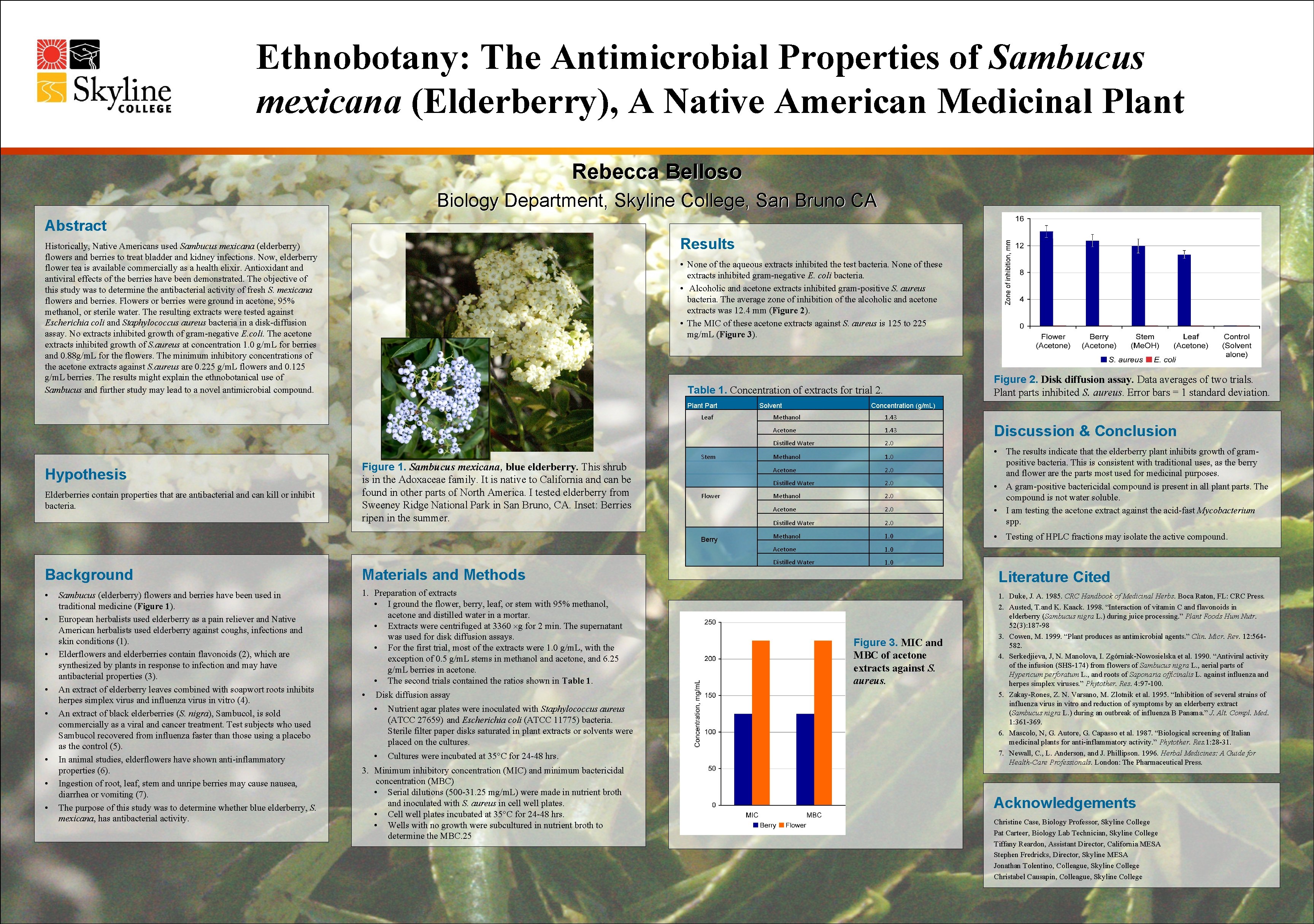
Ethnobotany: The Antimicrobial Properties of Sambucus mexicana (Elderberry), A Native American Medicinal Plant Rebecca Belloso Biology Department, Skyline College, San Bruno CA Abstract Results Historically, Native Americans used Sambucus mexicana (elderberry) flowers and berries to treat bladder and kidney infections. Now, elderberry flower tea is available commercially as a health elixir. Antioxidant and antiviral effects of the berries have been demonstrated. The objective of this study was to determine the antibacterial activity of fresh S. mexicana flowers and berries. Flowers or berries were ground in acetone, 95% methanol, or sterile water. The resulting extracts were tested against Escherichia coli and Staphylococcus aureus bacteria in a disk-diffusion assay. No extracts inhibited growth of gram-negative E. coli. The acetone extracts inhibited growth of S. aureus at concentration 1. 0 g/m. L for berries and 0. 88 g/m. L for the flowers. The minimum inhibitory concentrations of the acetone extracts against S. aureus are 0. 225 g/m. L flowers and 0. 125 g/m. L berries. The results might explain the ethnobotanical use of Sambucus and further study may lead to a novel antimicrobial compound. • None of the aqueous extracts inhibited the test bacteria. None of these extracts inhibited gram-negative E. coli bacteria. • Alcoholic and acetone extracts inhibited gram-positive S. aureus bacteria. The average zone of inhibition of the alcoholic and acetone extracts was 12. 4 mm (Figure 2). • The MIC of these acetone extracts against S. aureus is 125 to 225 mg/m. L (Figure 3). Table 1. Concentration of extracts for trial 2. Plant Part Leaf Hypothesis Elderberries contain properties that are antibacterial and can kill or inhibit bacteria. Figure 1. Sambucus mexicana, blue elderberry. This shrub is in the Adoxaceae family. It is native to California and can be found in other parts of North America. I tested elderberry from Sweeney Ridge National Park in San Bruno, CA. Inset: Berries ripen in the summer. Stem Flower Berry Background Materials and Methods • 1. Preparation of extracts • I ground the flower, berry, leaf, or stem with 95% methanol, acetone and distilled water in a mortar. • Extracts were centrifuged at 3360 g for 2 min. The supernatant was used for disk diffusion assays. • For the first trial, most of the extracts were 1. 0 g/m. L, with the exception of 0. 5 g/m. L stems in methanol and acetone, and 6. 25 g/m. L berries in acetone. • The second trials contained the ratios shown in Table 1. • • Sambucus (elderberry) flowers and berries have been used in traditional medicine (Figure 1). European herbalists used elderberry as a pain reliever and Native American herbalists used elderberry against coughs, infections and skin conditions (1). Elderflowers and elderberries contain flavonoids (2), which are synthesized by plants in response to infection and may have antibacterial properties (3). An extract of elderberry leaves combined with soapwort roots inhibits herpes simplex virus and influenza virus in vitro (4). An extract of black elderberries (S. nigra), Sambucol, is sold commercially as a viral and cancer treatment. Test subjects who used Sambucol recovered from influenza faster than those using a placebo as the control (5). In animal studies, elderflowers have shown anti-inflammatory properties (6). Ingestion of root, leaf, stem and unripe berries may cause nausea, diarrhea or vomiting (7). The purpose of this study was to determine whether blue elderberry, S. mexicana, has antibacterial activity. Figure 2. Disk diffusion assay. Data averages of two trials. Plant parts inhibited S. aureus. Error bars = 1 standard deviation. • Disk diffusion assay • Nutrient agar plates were inoculated with Staphylococcus aureus (ATCC 27659) and Escherichia coli (ATCC 11775) bacteria. Sterile filter paper disks saturated in plant extracts or solvents were placed on the cultures. • Cultures were incubated at 35°C for 24 -48 hrs. 3. Minimum inhibitory concentration (MIC) and minimum bactericidal concentration (MBC) • Serial dilutions (500 -31. 25 mg/m. L) were made in nutrient broth and inoculated with S. aureus in cell well plates. • Cell well plates incubated at 35°C for 24 -48 hrs. • Wells with no growth were subcultured in nutrient broth to determine the MBC. 25 Solvent Concentration (g/m. L) Methanol 1. 43 Acetone 1. 43 Distilled Water 2. 0 Methanol 1. 0 Acetone 2. 0 Distilled Water 2. 0 Methanol 2. 0 Acetone 2. 0 Distilled Water 2. 0 • The results indicate that the elderberry plant inhibits growth of grampositive bacteria. This is consistent with traditional uses, as the berry and flower are the parts most used for medicinal purposes. • A gram-positive bactericidal compound is present in all plant parts. The compound is not water soluble. • I am testing the acetone extract against the acid-fast Mycobacterium spp. Methanol 1. 0 • Testing of HPLC fractions may isolate the active compound. Acetone 1. 0 Distilled Water 1. 0 Discussion & Conclusion Literature Cited Figure 3. MIC and MBC of acetone extracts against S. aureus. 1. Duke, J. A. 1985. CRC Handbook of Medicinal Herbs. Boca Raton, FL: CRC Press. 2. Austed, T. and K. Kaack. 1998. “Interaction of vitamin C and flavonoids in elderberry (Sambucus nigra L. ) during juice processing. ” Plant Foods Hum Nutr. 52(3): 187 -98 3. Cowen, M. 1999. “Plant produces as antimicrobial agents. ” Clin. Micr. Rev. 12: 564582. 4. Serkedjieva, J, N. Manolova, I. Zgórniak-Nowosielska et al. 1990. “Antiviral activity of the infusion (SHS-174) from flowers of Sambucus nigra L. , aerial parts of Hypericum perforatum L. , and roots of Saponaria officinalis L. against influenza and herpes simplex viruses. ” Phytother. Res. 4: 97 -100. 5. Zakay-Rones, Z. N. Varsano, M. Zlotnik et al. 1995. “Inhibition of several strains of influenza virus in vitro and reduction of symptoms by an elderberry extract (Sambucus nigra L. ) during an outbreak of influenza B Panama. ” J. Alt. Compl. Med. 1: 361 -369. 6. Mascolo, N, G. Autore, G. Capasso et al. 1987. “Biological screening of Italian medicinal plants for anti-inflammatory activity. ” Phytother. Res. 1: 28 -31. 7. Newall, C. , L. Anderson, and J. Phillipson. 1996. Herbal Medicines: A Guide for Health-Care Professionals. London: The Pharmaceutical Press. Acknowledgements Christine Case, Biology Professor, Skyline College Pat Carteer, Biology Lab Technician, Skyline College Tiffany Reardon, Assistant Director, California MESA Stephen Fredricks, Director, Skyline MESA Jonathan Tolentino, Colleague, Skyline College Christabel Causapin, Colleague, Skyline College
- Slides: 1