
Ethnobotany of Pentadesma butyracea in Benin A Quantitative
Ethnobotany of Pentadesma butyracea in Benin: A Quantitative Approach. Carolle AVOCÈVOU & Prof Ir Brice SINSIN Faculty of Agronomic Sciences University of Abomey-Calavi, Benin
Contents 1. Background 2. Issues 3. Material and Methods 4. Results and Discussion 5. Conclusion
1. Background Many early ethnobotanical studies were simply to document traditional botanical knowledge, criticized as “unscientific. ” Prance et al. : the first to use the term “quantitative ethnobotany” Quantitative ethnobotanical studies collection plant-use information in consistent manner so intra- & intercultural statistical analyses 3 main methods including informant consensus or informant-indexing (the most used): degree of agreement among different people concerning use of resource.
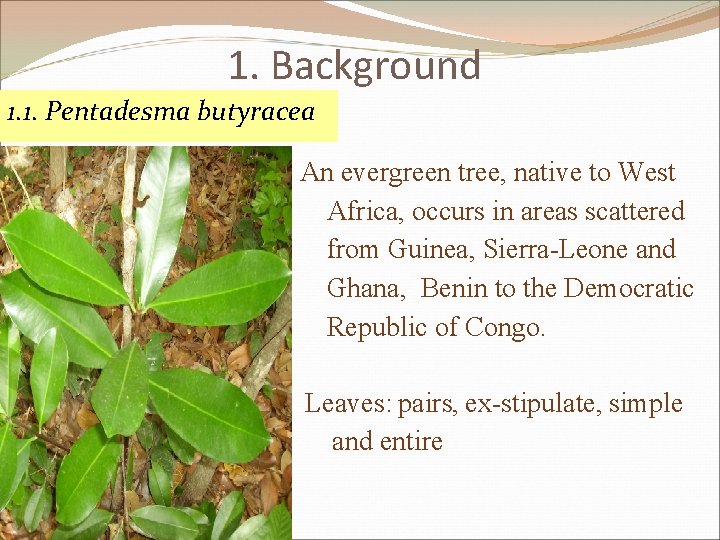
1. Background 1. 1. Pentadesma butyracea DRC An evergreen tree, native to West Africa, occurs in areas scattered from Guinea, Sierra-Leone and Ghana, Benin to the Democratic Republic of Congo. Leaves: pairs, ex-stipulate, simple and entire
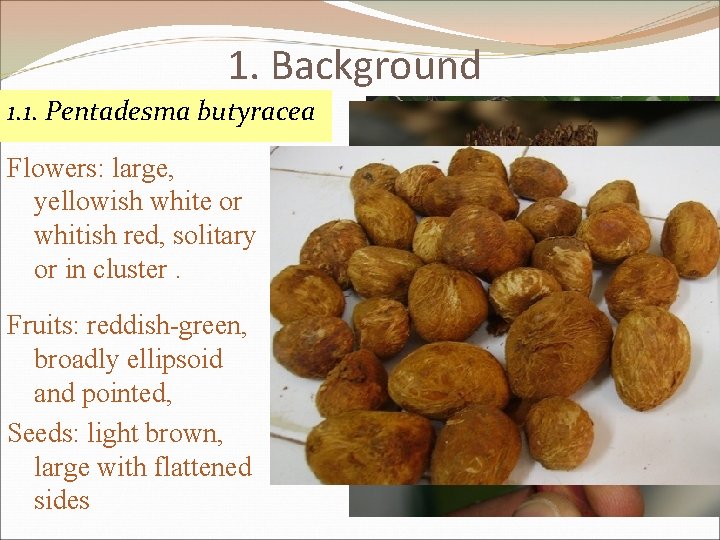
1. Background 1. 1. Pentadesma butyracea Flowers: large, yellowish white or whitish red, solitary or in cluster. Fruits: reddish-green, broadly ellipsoid and pointed, Seeds: light brown, large with flattened sides
2. Issues 2. 1. Issues Benin (located at the Dahomey-Gap): P. butyracea’s natural stands limited to riparian forests stretching along the rivers endangered ecosystems (Natta 2003) P. butyracea: a multi-purpose tree and source of NTFPs submitted to several pressure sources: land clearing in riparian forests for agriculture, increasing demand of products, bush fires and felling of its adult trees for timber. Sustainable management strategies should be developed and implemented for sustainable exploitation.
2. Issues 2. 2. Objectives Description of its current management including diverse local knowledge = One of the essential pieces of information A simple listing of uses of different parts of the species without intercultural comparison Objectives (1) to compare the main social groups from P. butyracea parts importance point of view; (2) to make an intra and interculturally comparison of specific uses of each P. butyracea parts.
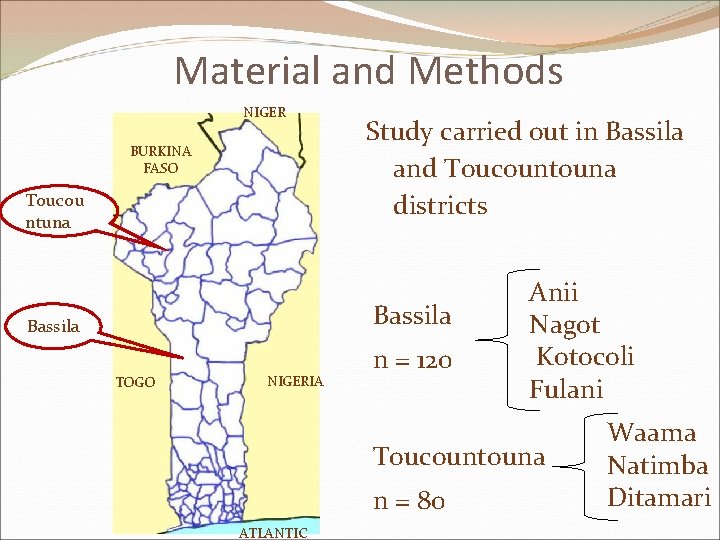
Material and Methods NIGER BURKINA FASO Toucou ntuna Study carried out in Bassila and Toucountouna districts Bassila TOGO NIGERIA n = 120 Anii Nagot Kotocoli Fulani Toucountouna n = 80 ATLANTIC Waama Natimba Ditamari
3. Material and Methods Method adapted from Gomez-Beloz (2000). Informations gathered by mean of questionnaire through interviews with informants: part of the plant used, treated disease, method of preparation and route of administration Uses categorisation (Cook, 1995; Collins et al. , 2006): circulatory system disorders, digestive system disorders, magico-mystics, medico-religious construction, cosmetics, etc. Faculty of Agronomic Sciences University of Abomey-Calavi, Benin
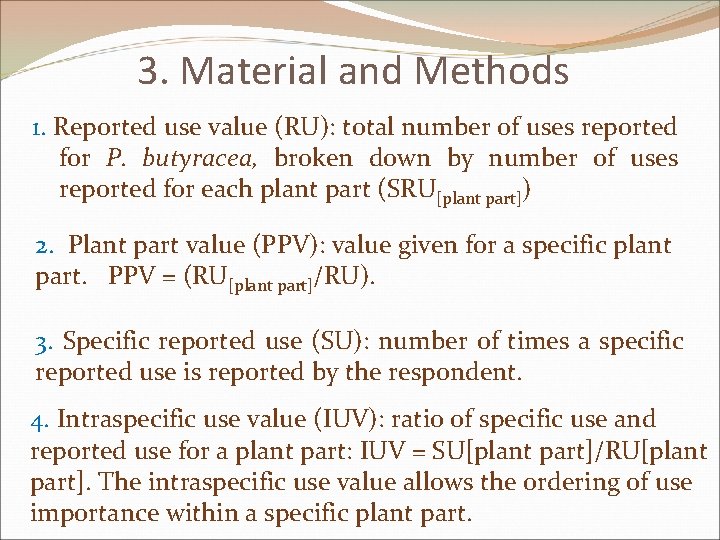
3. Material and Methods 1. Reported use value (RU): total number of uses reported for P. butyracea, broken down by number of uses reported for each plant part (SRU[plant part]) 2. Plant part value (PPV): value given for a specific plant part. PPV = (RU[plant part]/RU). 3. Specific reported use (SU): number of times a specific reported use is reported by the respondent. 4. Intraspecific use value (IUV): ratio of specific use and reported use for a plant part: IUV = SU[plant part]/RU[plant part]. The intraspecific use value allows the ordering of use importance within a specific plant part.
4. Material and Methods Kruskal-Wallis test performed to compare mean Reported use value (RU) between social groups Principal components analysis (PCA) performed on calculated plant part values to compare plant parts importance and use diversity between social groups Faculty of Agronomic Sciences University of Abomey-Calavi, Benin
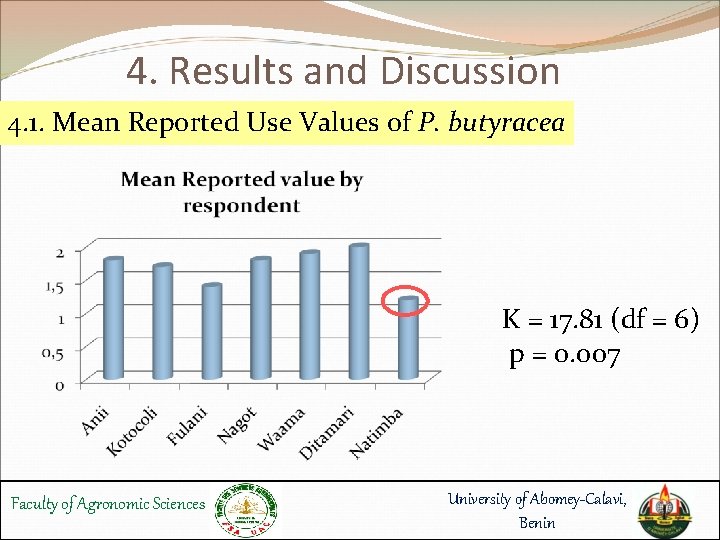
4. Results and Discussion 4. 1. Mean Reported Use Values of P. butyracea K = 17. 81 (df = 6) p = 0. 007 Faculty of Agronomic Sciences University of Abomey-Calavi, Benin
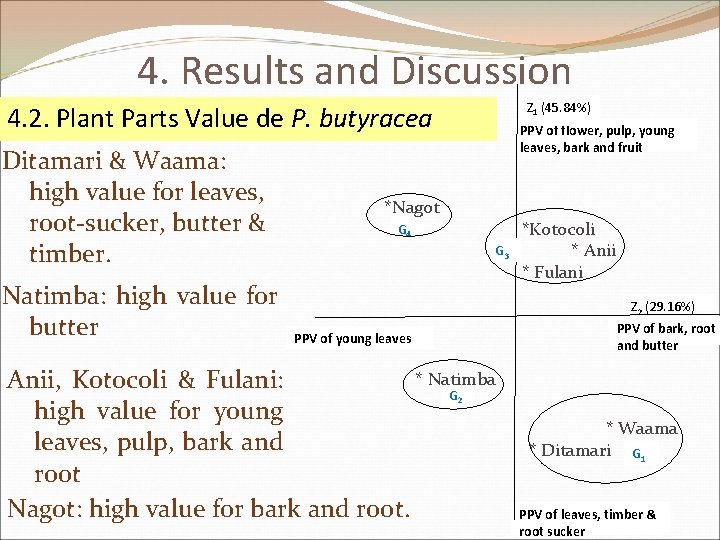
4. Results and Discussion Z 1 (45. 84%) 4. 2. Plant Parts Value de P. butyracea Ditamari & Waama: high value for leaves, root-sucker, butter & timber. Natimba: high value for butter PPV of flower, pulp, young leaves, bark and fruit *Nagot G 4 G 3 *Kotocoli * Anii * Fulani Z 2 (29. 16%) PPV of bark, root and butter PPV of young leaves * Natimba Anii, Kotocoli & Fulani: G high value for young leaves, pulp, bark and root Nagot: high value for bark and root. 2 * Waama * Ditamari G 1 PPV of leaves, timber & root sucker
4. Results and Discussion 4. 2. Plant Parts Value de P. butyracea Social groups living in the same area shared similar P. butyracea part values knowledge exchanges Local knowledge = combination of insights of ancestral knowledge, knowledge of other neighbouring local peoples, practical experience, regional scholarly traditions, and scientific or official knowledge (Nesheim et al. , 2006) Faculty of Agronomic Sciences University of Abomey-Calavi, Benin
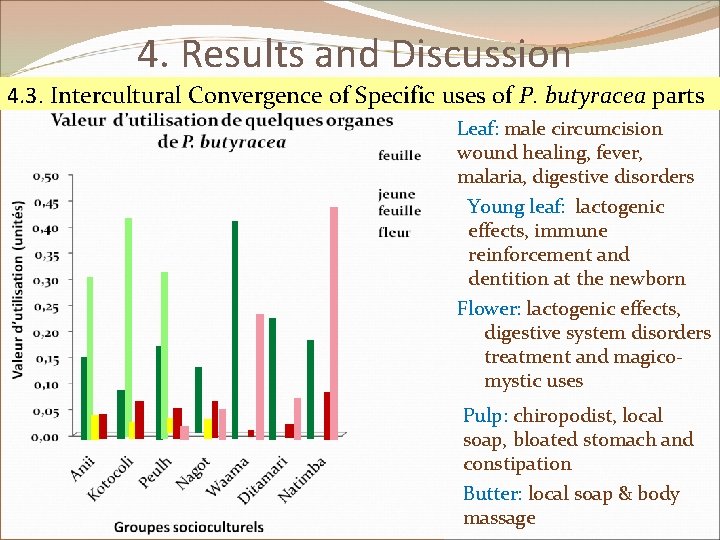
4. Results and Discussion 4. 3. Intercultural Convergence of Specific uses of P. butyracea parts Leaf: male circumcision wound healing, fever, malaria, digestive disorders Young leaf: lactogenic effects, immune reinforcement and dentition at the newborn Flower: lactogenic effects, digestive system disorders treatment and magicomystic uses Pulp: chiropodist, local soap, bloated stomach and constipation Butter: local soap & body massage
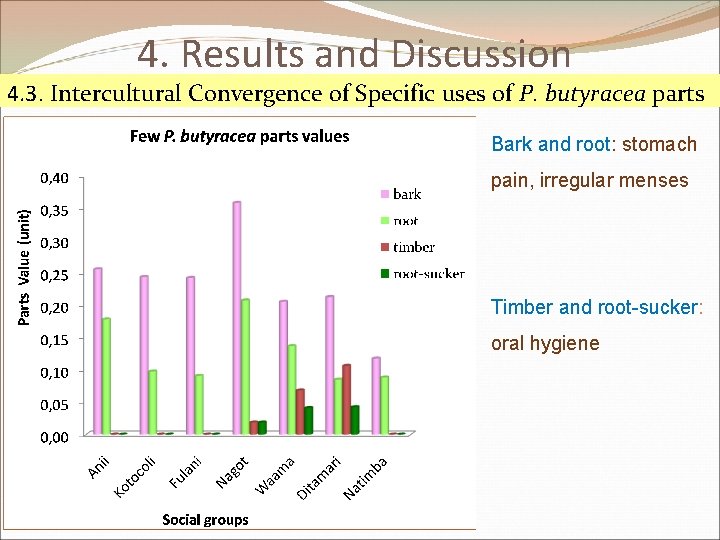
4. Results and Discussion 4. 3. Intercultural Convergence of Specific uses of P. butyracea parts Bark and root: stomach pain, irregular menses Timber and root-sucker: oral hygiene
4. Results and Discussion 4. 3. Intercultural Convergence of Specific uses of P. butyracea parts High IUV for a specific use = synonymous of reliability of a disease treatment. Reliability of the disease treatment is all the greater when IUV of the plant part for a specific use is high for social groups that are not living in the same geographical area. This comparative method allows the selection of indigenous medicinal plants parts for phytochemical and biological/pharmacological studies. IUV is also useful in determining the cultural importance of a particular plant part for a social group in a specific usage category
4. Results and Discussion 4. 3. Intercultural Convergence of Specific uses of P. butyracea parts To make a difference between past and actual use and knowledge of uses P. butyracea products by the different sociocultural groups by measuring the quantities harvested or consumed. Reasons (1) The use of some plant parts is seasonal and may be greater at a particular time of the year (2) The study was concerned only one plant species, the time which has elapsed between two uses was long (several months or years), especially when the informant is not a traditional specialized healer.
5. Conclusions P. butyracea is a multipurpose tree that is used in various ways by Bassila and Toucountouna districts people. A quantitative ethnobotanical approach close to informant consensus allowed allocating a value to each species part. Social groups that are living in the same geographical area shared similar value of the species parts. Several parts of the species were most reported for the same specific use by different social groups (high value of IUV). Faculty of Agronomic Sciences University of Abomey-Calavi, Benin
THANK YOU ALL FOR YOUR KIND ATTENTION! Many thanks to to
- Slides: 20