
Ethics Theory and Business Practice 4 1 Social
Ethics Theory and Business Practice 4. 1 Social Contract Theory – Part One Some Key Themes
aims • to outline social contract theory in its classical format • to explain the importance of voluntarism, tacit agreements and hypothetical constructions in a business context
social contract theory • a political philosophy, aimed at identifying rights and obligations of citizens and the state • can also be used to identify rights and obligations associated with relationships between companies and their stakeholders • and to help us think about the broader relationship between business and society
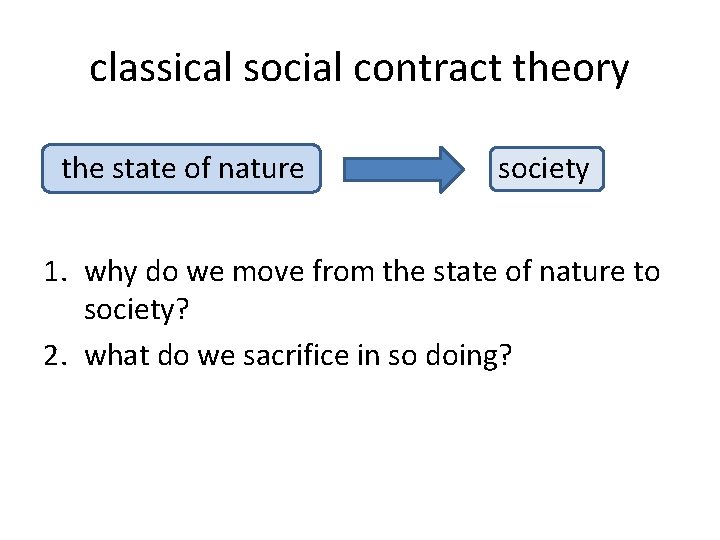
classical social contract theory the state of nature society 1. why do we move from the state of nature to society? 2. what do we sacrifice in so doing?
1. why do we move from the state of nature to society? • Hobbes: to avoid a constant war of all against all • Locke: to ensure respect for property and thus to encourage productive endeavour www. youtube. com/watch? v=Y 3 GZUm. Bt. Zk. Q • Rousseau: to enable information to be shared and knowledge to be captured, which facilitates human progress
2. what do we sacrifice in so doing? • we give up our freedom to do whatever we want to do • we agree, instead, to do what is needed to ensure the smooth running of society
three features of social contract theory social contact theory emphasises the importance of: 1. voluntarism 2. tacit agreements 3. hypothetical constructions
1. voluntarism • the ethical legitimacy of social arrangements derives from the fact that those who are involved in those arrangements have voluntarily agreed to their involvement • they have agreed to be involved while fully aware of the advantages and disadvantages that this presents
2. tacit agreements • an explicit agreement is an agreement that has been stated clearly and precisely • a tacit agreement is an agreement that is understood or implied without being clearly and precisely stated • tacit agreements may be just as compelling as explicit agreements • for example …
theory in practice The psychological contract: a tacit agreement between employers and employees
3. hypothetical constructions • the obligations arising from the social contract are not based on an actual agreement • they should be thought of as if some form of agreement had been made, even though such an agreement has never actually been made • by remaining in society, and by enjoying its benefits, we act as if we have agreed to a social contract
in a business context • by participating in, and by enjoying the benefits of a particular business relationship • we act as if we had agreed to make the associated sacrifices
social contract theory and the relationship between business and society • society offers benefits to business • in enjoying those benefits, business takes on an obligation to make certain sacrifices • such obligations are a matter of voluntary, tacit, hypothetical agreement between business and society
theory in practice Starbucks wakes up and smells the coffee
key points • voluntary agreement to participate in a business relationship gives ethical force to the obligations associated with that relationship • a comprehensive understanding of business obligations should take into account tacit agreements as well as explicit ones • by participating in a business relationship, we could be thought of as agreeing to honour certain obligations
- Slides: 15