
Ethics Overview for Peer Support Specialists Foley L
- Slides: 32
Ethics Overview for Peer Support Specialists Foley L. Nash, LPC-S, LMFT-BAS Carla Neely, Recovery & Resiliency Administrator, and PSS
Confidentiality & Disclosure: CONFIDENTIALITY: By receipt of this presentation, each recipient agrees that the information contained herein will be kept confidential and that the information will not be photocopied, reproduced, distributed to, or disclosed to others at any time without the prior consent of the presenter(s). PRESENTER DISCLOSURES: 1. The information contained in this presentation is intended for educational purposes only, and is not intended to prescribe a standard of care or exclusive course of treatment, nor be a substitute for treatment. 2. Foley L. Nash and Carla Neely attest that we do not have any financial relationship and/or commercial interest whose product and/or service may be relevant to the educational content of my presentation, and/or in the planning of this educational activity. 3. We therefore attest that we have no relationship or interest of any type that could be reasonably construed as a conflict of interest. 2
About the Presenters: Foley Nash, LPC-S, LMFT-BAS is a Licensed Professional Counselor, a Licensed Marriage & Family Therapist, & a clinical supervisor for both disciplines. Foley is a former President (2005 -2007) of the Louisiana Mental Health Counselors Association (LMHCA), & a former Chair of both the Ethics & the Government Relations Committees for the Louisiana Counseling Association (LCA). In practice since 1984, & formerly the Children’s System Administrator of the LBHP under Magellan, he is currently the Director of Behavioral Health for Aetna Better Health of Louisiana. Foley & his wife Glenda have been dually certified as both foster & adoptive parents. Natives of northeast Louisiana (Monroe area), Foley & Glenda have also lived in Lafayette (1990 -2001), & in Slidell (2001 -2012), & relocated to Baton Rouge in 2013. They have one son, now 30, whom they adopted from foster care when he was age six. They have both worked closely over the years with the problems that stem from his early childhood abuse (& early ACEs): Bipolar Disorder, Attachment Disorder, Conduct Disorder, ADHD, PTSD, & Pervasive Developmental (ASD) issues. As a result of history & education, Foley has considerable experience working at various levels with both the clinical & the family issues impacting the Medicaid-eligible population of Louisiana, as well as the related ethical considerations. 3
About the Presenters: Carla Neely, Recovery and Resiliency Administrator, Aetna Better Health of Louisiana, PRSS Carla is a native of Philadelphia, Pennsylvania, who relocated to Baton Rouge in February, 2012 to assume the position of Recovery and Resiliency Coordinator for Magellan Behavioral Health. As such, she created and implemented the Peer Support Whole Health and Resiliency wellness initiative, and supported and helped grow the Louisiana Warm. Line. Both initiatives were targeted to the peer community to support holistic health. Currently, as the Recovery and Resiliency Administrator for Aetna Better Health of Louisiana, Carla co-chairs the Aetna Better Health of Louisiana Advocacy Advisory Committee, and works on projects as diverse as healthcare equity and expanding the knowledge and accessibility of peer support, and the incorporation of recovery and resiliency principles in a fully integrated system of care. 4
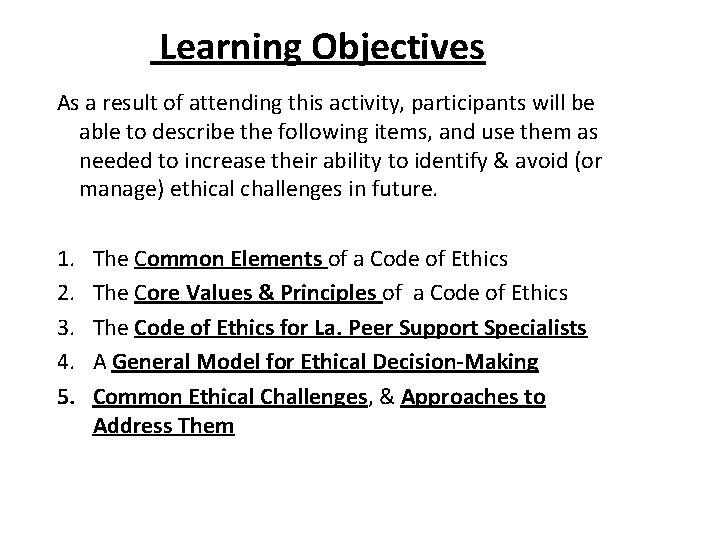
Learning Objectives As a result of attending this activity, participants will be able to describe the following items, and use them as needed to increase their ability to identify & avoid (or manage) ethical challenges in future. 1. 2. 3. 4. 5. 5 The Common Elements of a Code of Ethics The Core Values & Principles of a Code of Ethics The Code of Ethics for La. Peer Support Specialists A General Model for Ethical Decision-Making Common Ethical Challenges, & Approaches to Address Them
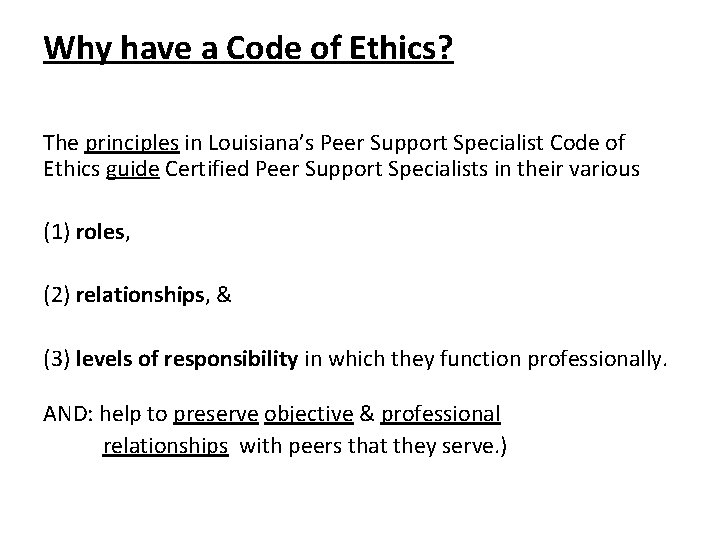
Why have a Code of Ethics? The principles in Louisiana’s Peer Support Specialist Code of Ethics guide Certified Peer Support Specialists in their various (1) roles, (2) relationships, & (3) levels of responsibility in which they function professionally. AND: help to preserve objective & professional relationships with peers that they serve. ) 6
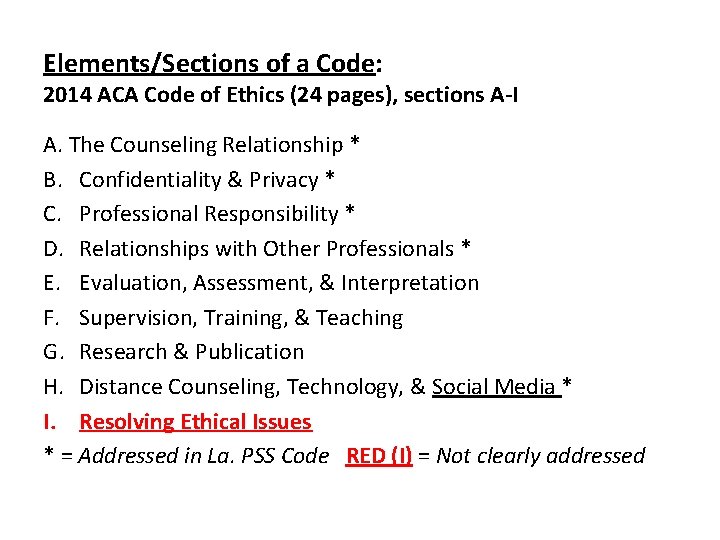
Elements/Sections of a Code: 2014 ACA Code of Ethics (24 pages), sections A-I A. The Counseling Relationship * B. Confidentiality & Privacy * C. Professional Responsibility * D. Relationships with Other Professionals * E. Evaluation, Assessment, & Interpretation F. Supervision, Training, & Teaching G. Research & Publication H. Distance Counseling, Technology, & Social Media * I. Resolving Ethical Issues * = Addressed in La. PSS Code RED (I) = Not clearly addressed 7
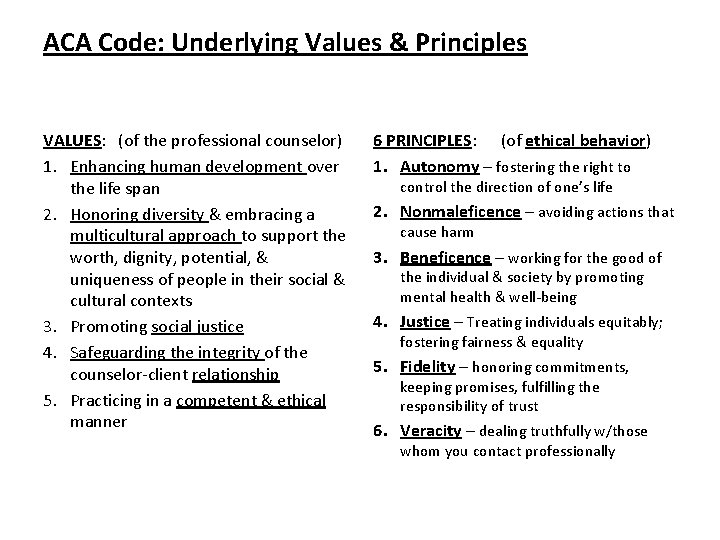
ACA Code: Underlying Values & Principles VALUES: (of the professional counselor) 1. Enhancing human development over the life span 2. Honoring diversity & embracing a multicultural approach to support the worth, dignity, potential, & uniqueness of people in their social & cultural contexts 3. Promoting social justice 4. Safeguarding the integrity of the counselor-client relationship 5. Practicing in a competent & ethical manner 6 PRINCIPLES: (of ethical behavior) 1. Autonomy – fostering the right to control the direction of one’s life 2. Nonmaleficence – avoiding actions that cause harm 3. Beneficence – working for the good of the individual & society by promoting mental health & well-being 4. Justice – Treating individuals equitably; fostering fairness & equality 5. Fidelity – honoring commitments, keeping promises, fulfilling the responsibility of trust 6. Veracity – dealing truthfully w/those whom you contact professionally 8
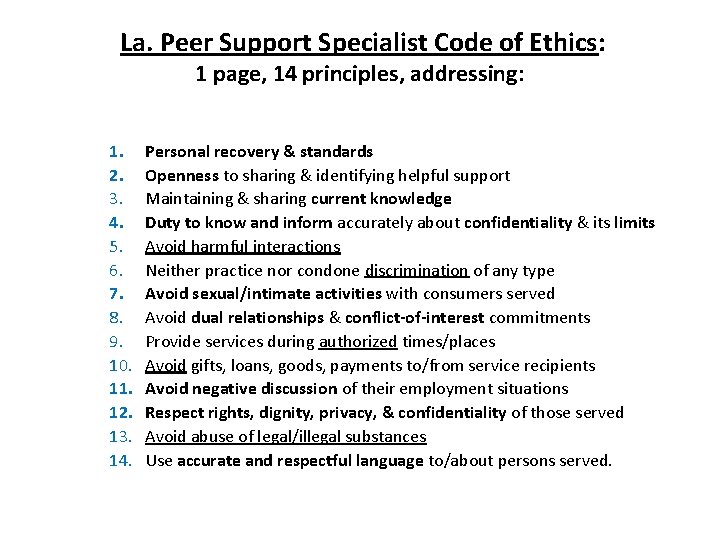
La. Peer Support Specialist Code of Ethics: 1 page, 14 principles, addressing: 1. 2. 3. 4. 5. 6. 7. 8. 9. 10. 11. 12. 13. 14. 9 Personal recovery & standards Openness to sharing & identifying helpful support Maintaining & sharing current knowledge Duty to know and inform accurately about confidentiality & its limits Avoid harmful interactions Neither practice nor condone discrimination of any type Avoid sexual/intimate activities with consumers served Avoid dual relationships & conflict-of-interest commitments Provide services during authorized times/places Avoid gifts, loans, goods, payments to/from service recipients Avoid negative discussion of their employment situations Respect rights, dignity, privacy, & confidentiality of those served Avoid abuse of legal/illegal substances Use accurate and respectful language to/about persons served.
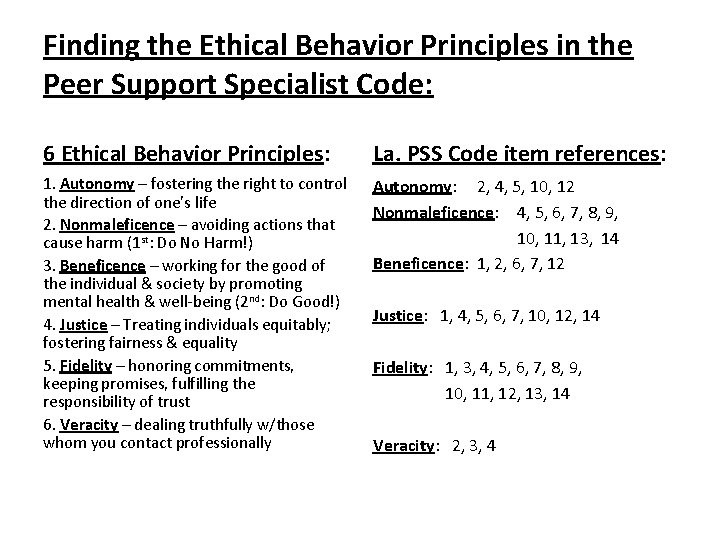
Finding the Ethical Behavior Principles in the Peer Support Specialist Code: 6 Ethical Behavior Principles: La. PSS Code item references: 1. Autonomy – fostering the right to control the direction of one’s life 2. Nonmaleficence – avoiding actions that cause harm (1 st: Do No Harm!) 3. Beneficence – working for the good of the individual & society by promoting mental health & well-being (2 nd: Do Good!) 4. Justice – Treating individuals equitably; fostering fairness & equality 5. Fidelity – honoring commitments, keeping promises, fulfilling the responsibility of trust 6. Veracity – dealing truthfully w/those whom you contact professionally Autonomy: 2, 4, 5, 10, 12 Nonmaleficence: 4, 5, 6, 7, 8, 9, 10, 11, 13, 14 Beneficence: 1, 2, 6, 7, 12 10 Justice: 1, 4, 5, 6, 7, 10, 12, 14 Fidelity: 1, 3, 4, 5, 6, 7, 8, 9, 10, 11, 12, 13, 14 Veracity: 2, 3, 4
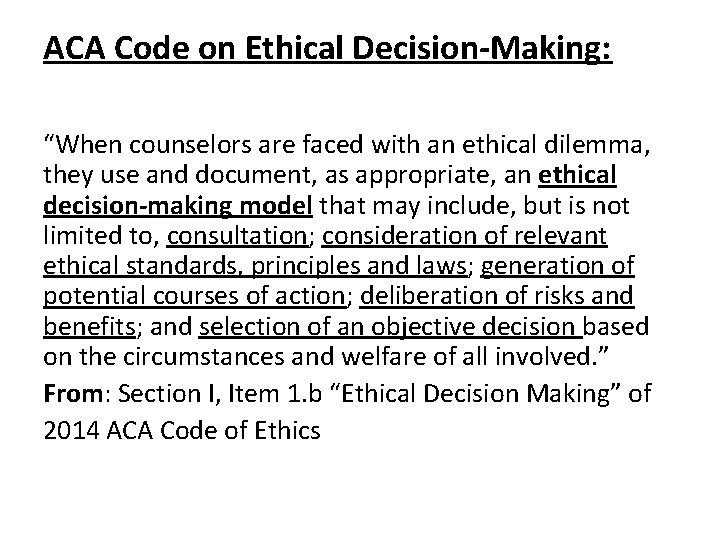
ACA Code on Ethical Decision-Making: “When counselors are faced with an ethical dilemma, they use and document, as appropriate, an ethical decision-making model that may include, but is not limited to, consultation; consideration of relevant ethical standards, principles and laws; generation of potential courses of action; deliberation of risks and benefits; and selection of an objective decision based on the circumstances and welfare of all involved. ” From: Section I, Item 1. b “Ethical Decision Making” of 2014 ACA Code of Ethics 11
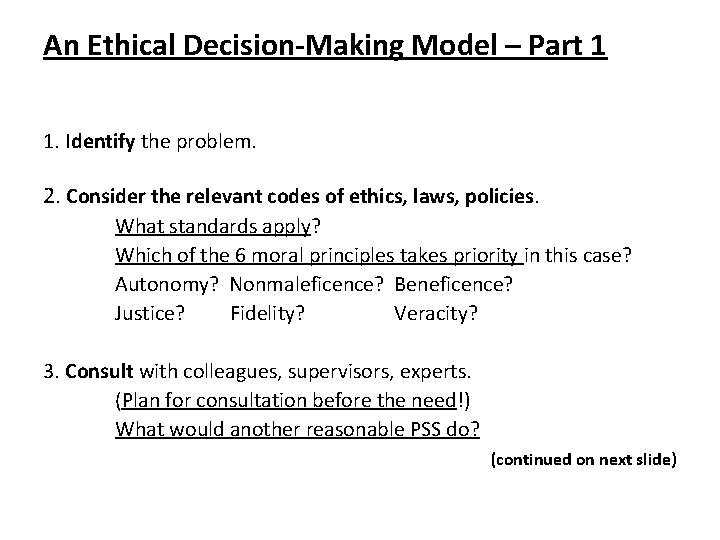
An Ethical Decision-Making Model – Part 1 1. Identify the problem. 2. Consider the relevant codes of ethics, laws, policies. What standards apply? Which of the 6 moral principles takes priority in this case? Autonomy? Nonmaleficence? Beneficence? Justice? Fidelity? Veracity? 3. Consult with colleagues, supervisors, experts. (Plan for consultation before the need!) What would another reasonable PSS do? (continued on next slide) 12
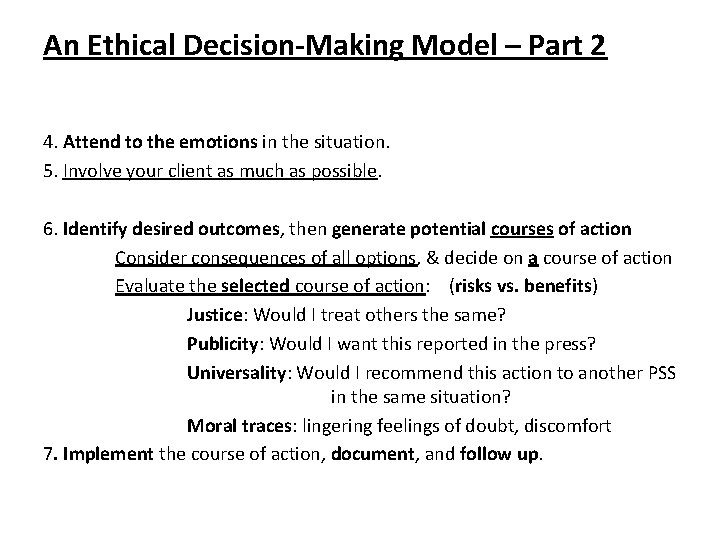
An Ethical Decision-Making Model – Part 2 4. Attend to the emotions in the situation. 5. Involve your client as much as possible. 6. Identify desired outcomes, then generate potential courses of action Consider consequences of all options, & decide on a course of action Evaluate the selected course of action: (risks vs. benefits) Justice: Would I treat others the same? Publicity: Would I want this reported in the press? Universality: Would I recommend this action to another PSS in the same situation? Moral traces: lingering feelings of doubt, discomfort 7. Implement the course of action, document, and follow up. 13
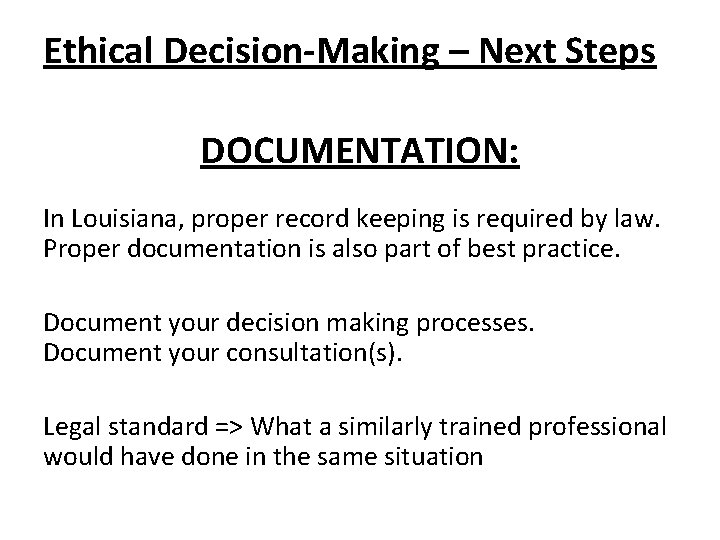
Ethical Decision-Making – Next Steps DOCUMENTATION: In Louisiana, proper record keeping is required by law. Proper documentation is also part of best practice. Document your decision making processes. Document your consultation(s). Legal standard => What a similarly trained professional would have done in the same situation 14
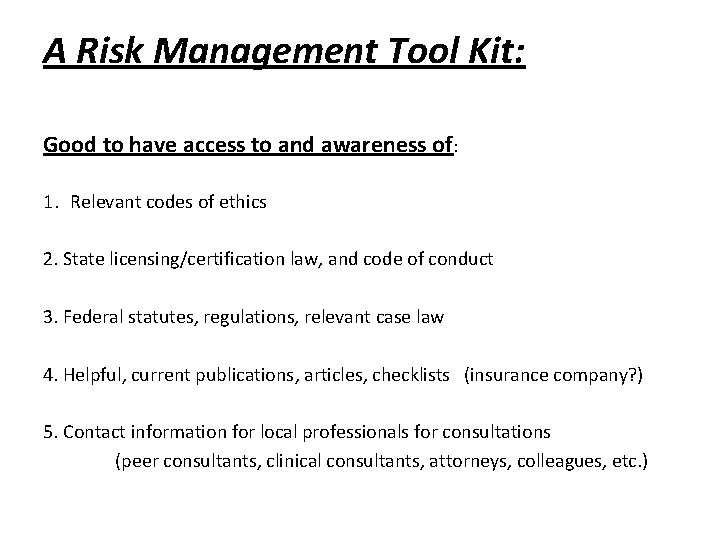
A Risk Management Tool Kit: Good to have access to and awareness of: 1. Relevant codes of ethics 2. State licensing/certification law, and code of conduct 3. Federal statutes, regulations, relevant case law 4. Helpful, current publications, articles, checklists (insurance company? ) 5. Contact information for local professionals for consultations (peer consultants, clinical consultants, attorneys, colleagues, etc. ) 15
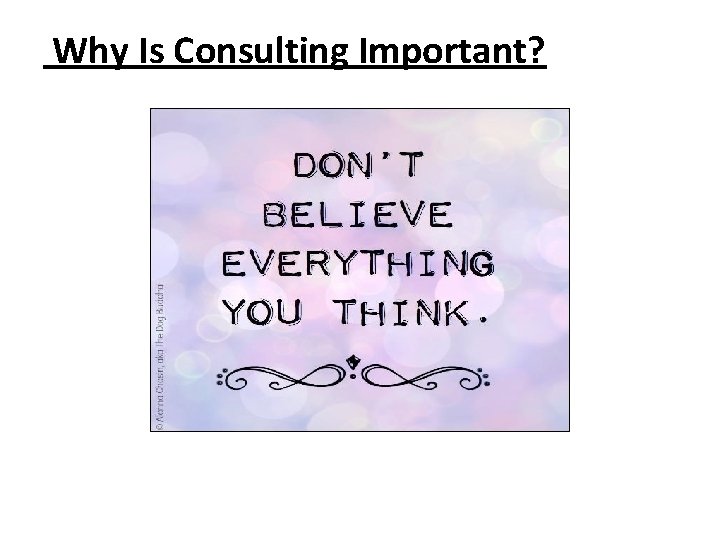
Why Is Consulting Important? 16
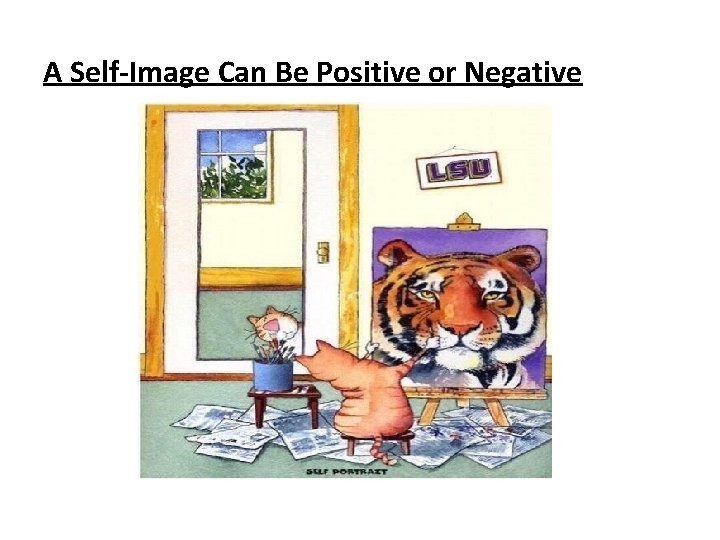
A Self-Image Can Be Positive or Negative 17
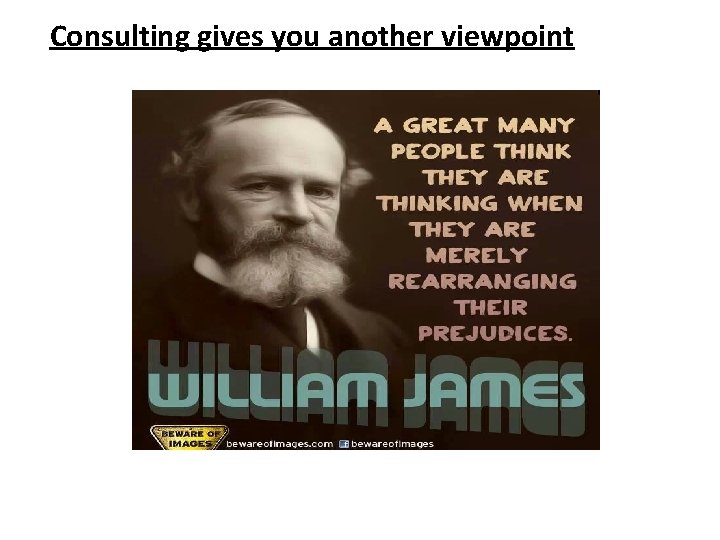
Consulting gives you another viewpoint 18
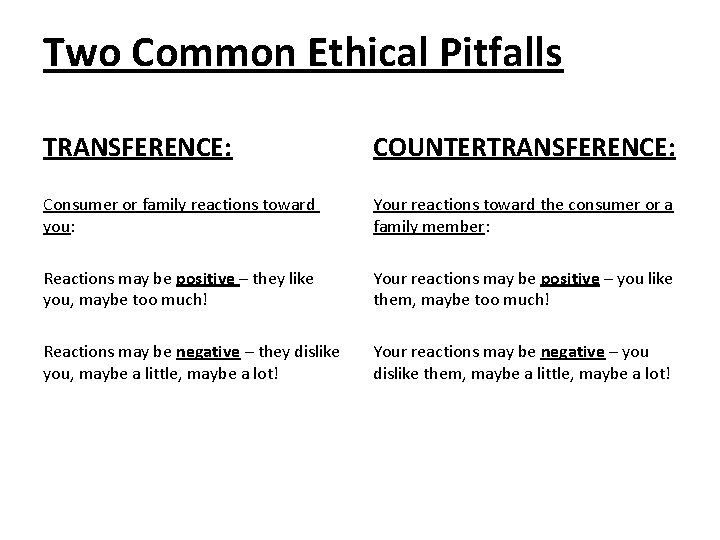
Two Common Ethical Pitfalls TRANSFERENCE: COUNTERTRANSFERENCE: Consumer or family reactions toward you: Your reactions toward the consumer or a family member: Reactions may be positive – they like you, maybe too much! Your reactions may be positive – you like them, maybe too much! Reactions may be negative – they dislike you, maybe a little, maybe a lot! Your reactions may be negative – you dislike them, maybe a little, maybe a lot! 19
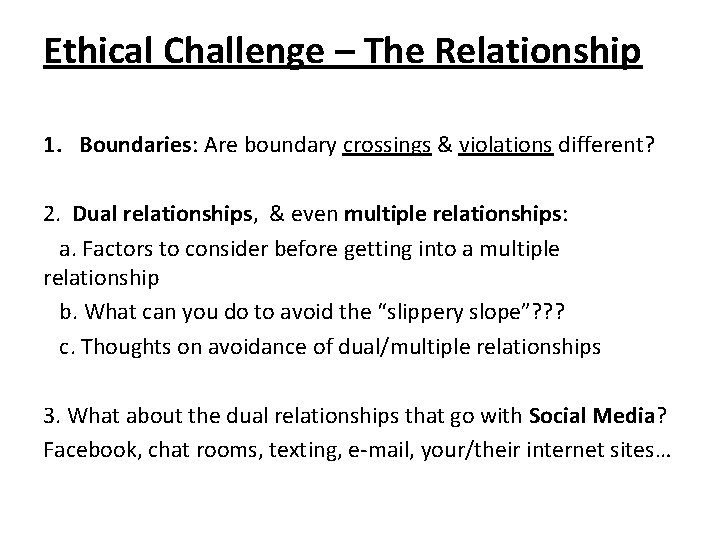
Ethical Challenge – The Relationship 1. Boundaries: Are boundary crossings & violations different? 2. Dual relationships, & even multiple relationships: a. Factors to consider before getting into a multiple relationship b. What can you do to avoid the “slippery slope”? ? ? c. Thoughts on avoidance of dual/multiple relationships 3. What about the dual relationships that go with Social Media? Facebook, chat rooms, texting, e-mail, your/their internet sites… 20
Dependence Challenges This type of relationship challenge may include : 1. Over-importance to you of the helper role, so that you become inclined to foster their dependence on you and your services 2. Resentment of their neediness or demands, so that you may be inclined to take their dependence personally, and perhaps be angry, or be intimidated by interactions with them 3. Taking their anger personally, which can also lead to resentment or feeling intimidated, and avoidant or negative interactions 21
Social Media Scenarios: (ACA Code references) 1. “Why not be Facebook friends? I don’t think it could cause any harm. ” H: 4 b Professional Boundaries, & A: 5 e Personal Virtual Relationships with Current Clients 2. “Use social media to advertise my PSS business? Sounds like a great idea to get the word out. ” H: 6 a Virtual Professional Presence, C: 2 b New Specialty Areas 3. ”A little snooping never hurt anyone. Besides, if I eavesdrop on my client’s personal site, I might just learn how to be more helpful to them. ” H: 6 c Client Virtual Presence Protection, A: 6 e Nonprofessional Interactions 4. “I struggle with making some ethical decisions, & social media (chat-room? ) might be a good way to get input from other professionals, & move toward best practices. ” H: 2 b Confidentiality Maintained by Counselor, I: 1 b Ethical Decision Making 22
Your Own Examples of Ethical Questions: Let’s take some time to hear about and discuss some ethical questions that you (1) have faced, (2) expect to encounter in the future, or (3) have heard about from others. Which of the 14 principles in the Code of Ethics might best apply to address each issue? And, how could the Ethical Decision Making Model be useful? 23
Important to be aware of: 1. The need for clarifying your values and their role in your work 2. The ethics of imposing your values on clients 3. Your stand on value conflicts: To refer or not to refer 24
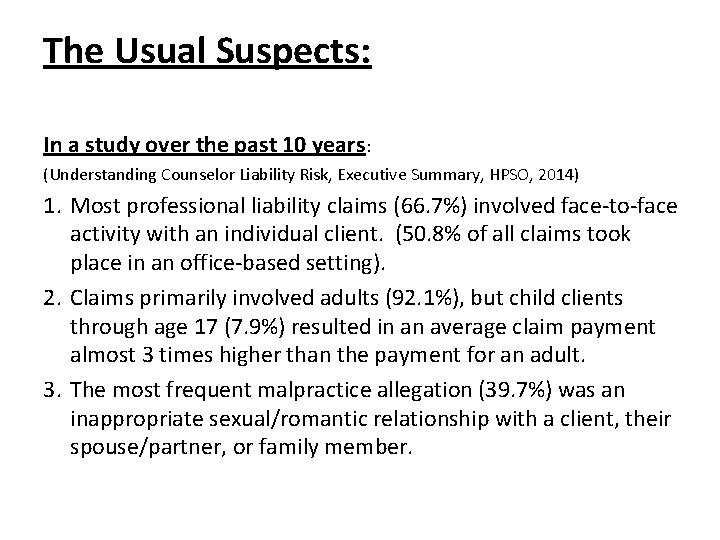
The Usual Suspects: In a study over the past 10 years: (Understanding Counselor Liability Risk, Executive Summary, HPSO, 2014) 1. Most professional liability claims (66. 7%) involved face-to-face activity with an individual client. (50. 8% of all claims took place in an office-based setting). 2. Claims primarily involved adults (92. 1%), but child clients through age 17 (7. 9%) resulted in an average claim payment almost 3 times higher than the payment for an adult. 3. The most frequent malpractice allegation (39. 7%) was an inappropriate sexual/romantic relationship with a client, their spouse/partner, or family member. 25
Making a change …… 26
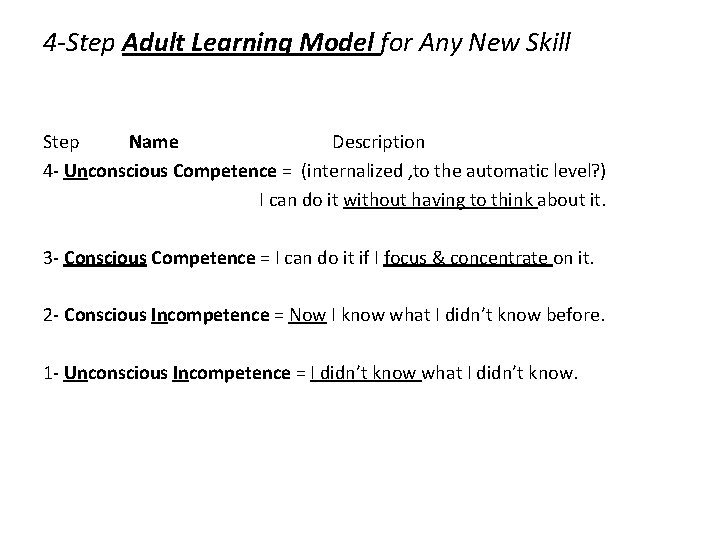
4 -Step Adult Learning Model for Any New Skill Step Name Description 4 - Unconscious Competence = (internalized , to the automatic level? ) I can do it without having to think about it. 3 - Conscious Competence = I can do it if I focus & concentrate on it. 2 - Conscious Incompetence = Now I know what I didn’t know before. 1 - Unconscious Incompetence = I didn’t know what I didn’t know. 27
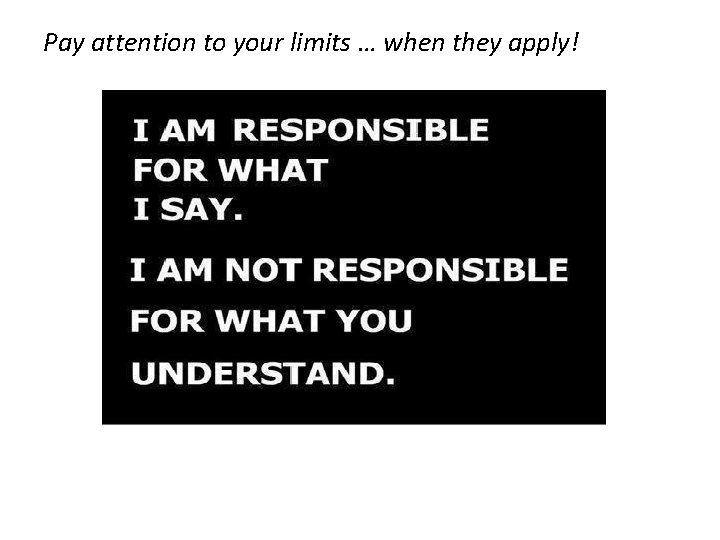
Pay attention to your limits … when they apply! 28
References §American Counseling Association Code of Ethics, www. counseling. org , 2014 §Program Manual, Peer Support Specialist Program, Louisiana Office of Behavioral Health, DHH, pp 10 -11 (Peer Support Specialist Code of Ethics) §Ethical and Legal Issues in Counseling, A Louisiana Licensure Board update, a presentation at the Louisiana Counseling Association Annual Conference, 2011 §Understanding Counselor Liability Risk, Executive Summary, Healthcare Providers Service Organization, www. hpso. com, 2014 29
Q & A: Questions & Answers Discussion, & Action Steps (What will you change? ) 30
Contact Information Foley L. Nash, LPC-S, LMFT-BAS Director of Behavioral Health, ABHLA 504 -667 -4610 (Direct) Nash. F@aetna. com Carla Neely, PRSS Recovery and Resiliency Administrator, ABHLA 504 -402 -2817, Neely. C 1@aetna. com 31
Thank You for Your Time! We Hope You Find the Information Useful!