
Ethics of Stem Cells and Therapeutic Cloning Invited
- Slides: 31
Ethics of Stem Cells and Therapeutic Cloning Invited lecture for Purdue University course SOC 573 James F. Leary, Ph. D. SVM Professor of Nanomedicine Professor of Basic Medical Sciences and Biomedical Engineering Member: Purdue Cancer Center; Oncological Sciences Center; Bindley Biosciences Center; Birck Nanotechnology Center Purdue University
Who should be involved in the ethical debate ? Ø The general public Ø Patient advocacy groups Ø Bioethicists Ø Scientists & clinicians
The general public Ø How we use stem cells ultimately affects us all. So we all have a stake in both its benefits and drawbacks. Ø While no decision about use is likely to make everyone entirely happy, the decision should not be morally reprehensible to a significant fraction of the general population.
Patient advocacy groups Ø Patient advocacy groups are the most personally affected by these decisions. What is a philosophical discussion for some is a lifeor-death decision for others. Ø These groups tend to have a much deeper perspective than the general public.
Bioethicists Ø Bioethicists are formally trained to think about ethical problems across philosophical and religious perspectives. Ethical decisions, while sensitive to the diversity of religious viewpoints, should reflect a general consensus rather than a particular viewpoint. Ø Their function should be to provide a balanced view of the perspectives of advocacy groups and scientists and clinicians, who may be driven by personal stakes in particular decisions.
Scientists & clinicians Ø Scientists and clinicians provide a source of factual information so that ethical debates proceed on the basis of facts rather than misinformation or opinions. Ø They can also make sure that ethical debates are properly focused on present and future, rather than past, state-of the-art science and technology.
My personal beliefs – not necessarily yours! Ø Ø Ø Using embryonic stem cells from aborted fetuses is morally reprehensible to a large enough fraction of society that it should never become the source of choice for human stem cells. Embryonic stem cells will be only a temporary, but unfortunately probably necessary, tool needed by researchers to learn how to modify adult stem cells (for which there is little controversy) for a similar use. But there are different types of embryonic stem cells, some of which are ethically less controversial than others.
“Everything should be made as simple as possible, but not simpler. ” - Albert Einstein
A brief tutorial on human embryonic stem cells and cloning techniques By Dr. James F. Leary Source: http: //www. nih. gov/news/stemcell/fullrptstem. pdf
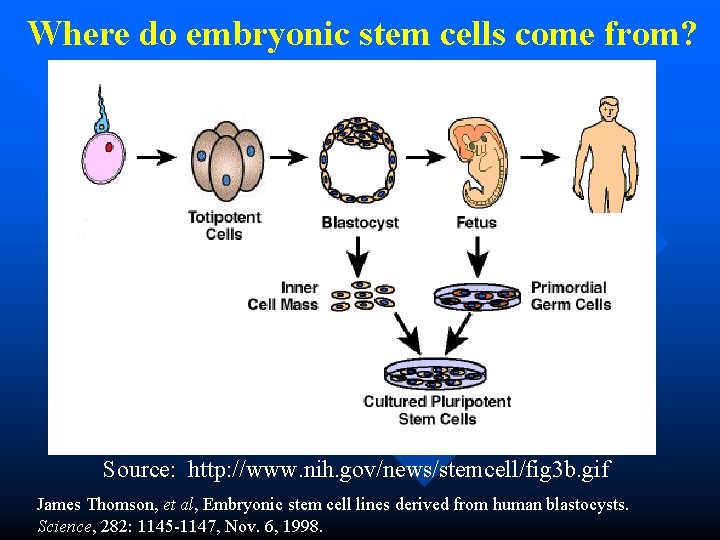
Where do embryonic stem cells come from? Source: http: //www. nih. gov/news/stemcell/fig 3 b. gif James Thomson, et al, Embryonic stem cell lines derived from human blastocysts. Science, 282: 1145 -1147, Nov. 6, 1998.
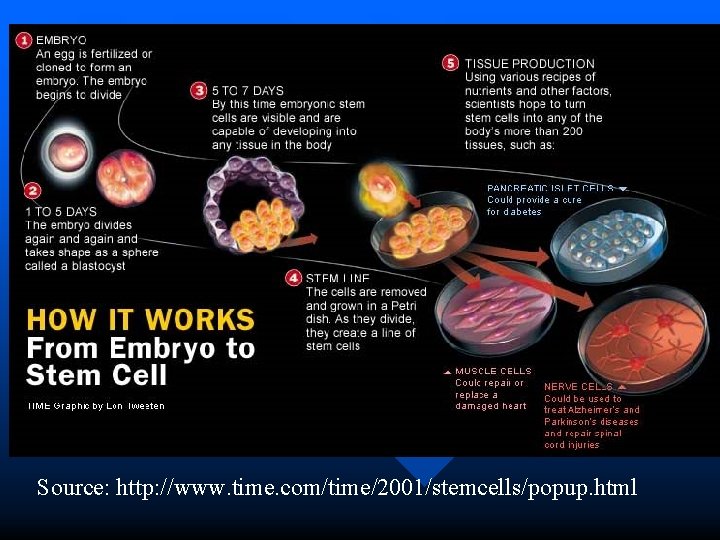
Source: http: //www. time. com/time/2001/stemcells/popup. html
What is ‘cloning” Cloning is one method for producing more adult cells, which do not normally reproduce more copies of themselves.
What is “therapeutic cloning” ? Therapeutic cloning involves the use of cloned cells for medical treatment of an existing person. It is not … production of new human beings ! (which is called “reproductive cloning”)
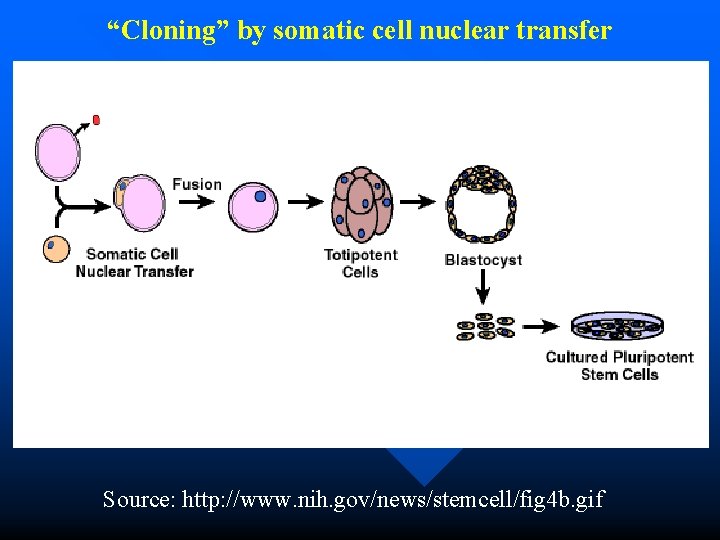
“Cloning” by somatic cell nuclear transfer Source: http: //www. nih. gov/news/stemcell/fig 4 b. gif
Why is a therapeutic cloning approach important? By growing new body parts from existing ones from the same person we can avoid transplant rejection problems. Ø Ø By using cells re-engineered or “cloned” from ourselves we can become our own transplant source - similar to banking blood for ourselves before a surgical operation.
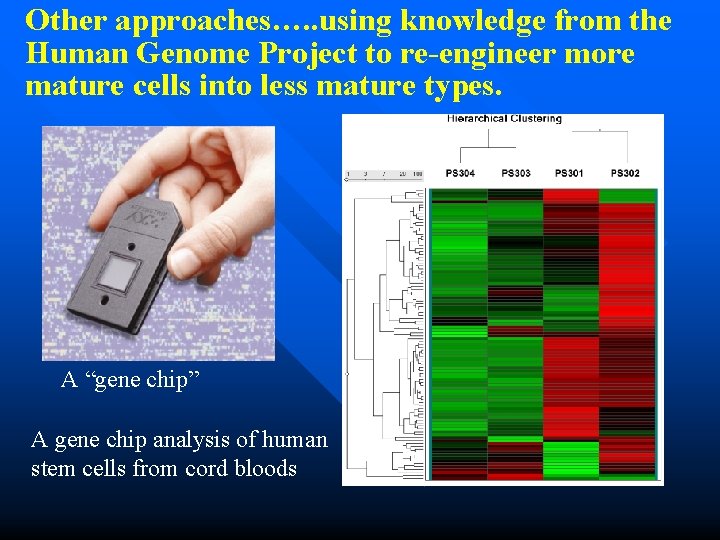
Other approaches…. . using knowledge from the Human Genome Project to re-engineer more mature cells into less mature types. A “gene chip” A gene chip analysis of human stem cells from cord bloods
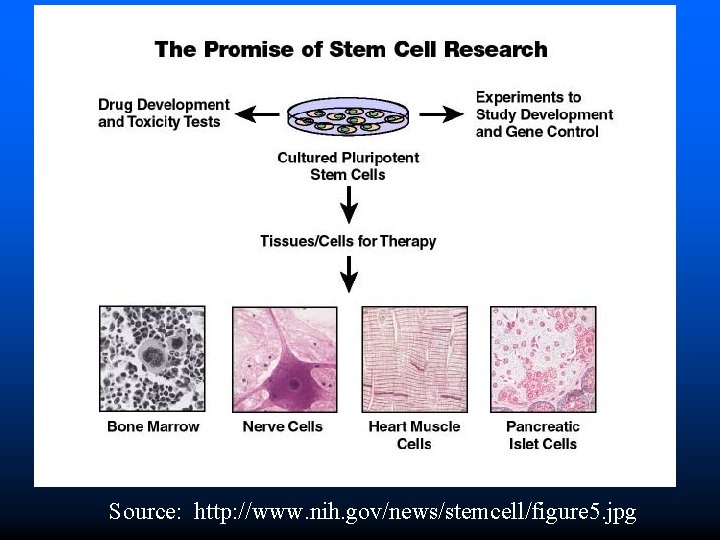
Source: http: //www. nih. gov/news/stemcell/figure 5. jpg
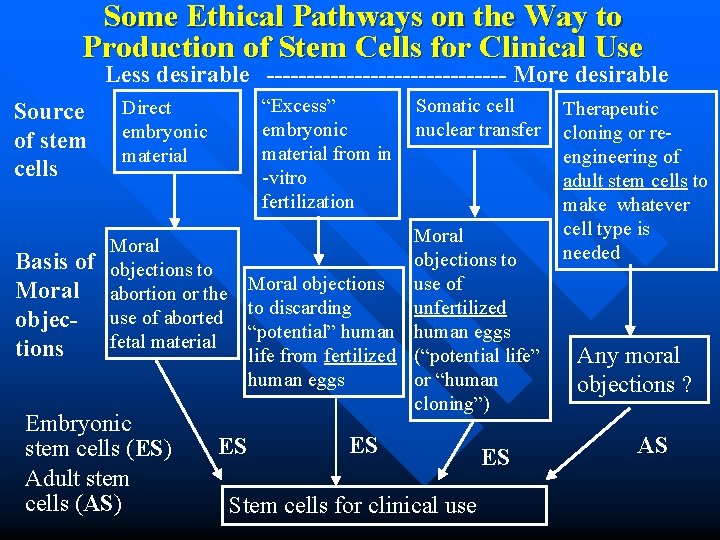
Some Ethical Pathways on the Way to Production of Stem Cells for Clinical Use Less desirable --------------- More desirable Source of stem cells Basis of Moral objections “Excess” embryonic material from in -vitro fertilization Direct embryonic material Moral objections to Moral objections use of to discarding unfertilized “potential” human eggs life from fertilized (“potential life” human eggs or “human cloning”) Moral objections to abortion or the use of aborted fetal material Embryonic stem cells (ES) Adult stem cells (AS) Somatic cell nuclear transfer ES ES Stem cells for clinical use ES Therapeutic cloning or reengineering of adult stem cells to make whatever cell type is needed Any moral objections ? AS
Why not just use adult stem cells?
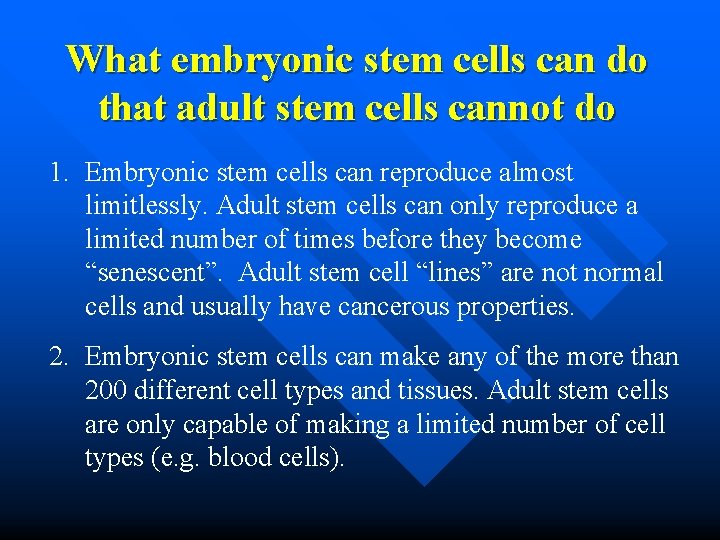
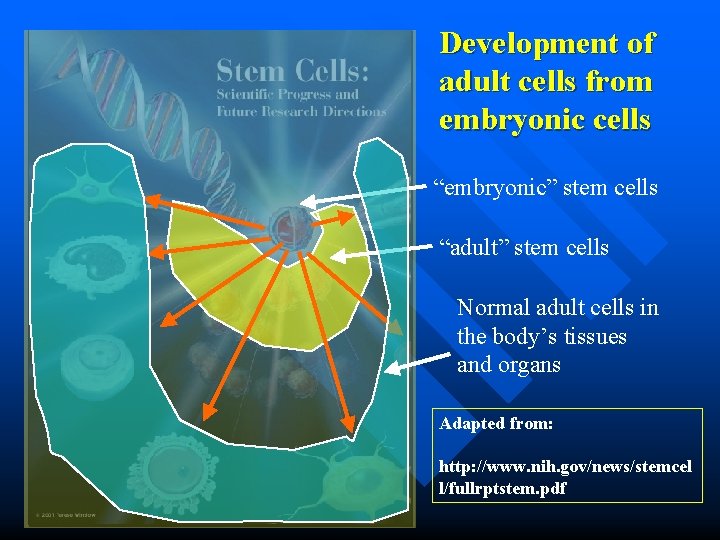
What embryonic stem cells can do that adult stem cells cannot do 1. Embryonic stem cells can reproduce almost limitlessly. Adult stem cells can only reproduce a limited number of times before they become “senescent”. Adult stem cell “lines” are not normal cells and usually have cancerous properties. 2. Embryonic stem cells can make any of the more than 200 different cell types and tissues. Adult stem cells are only capable of making a limited number of cell types (e. g. blood cells).
Development of adult cells from embryonic cells “embryonic” stem cells “adult” stem cells Normal adult cells in the body’s tissues and organs Adapted from: http: //www. nih. gov/news/stemcel l/fullrptstem. pdf
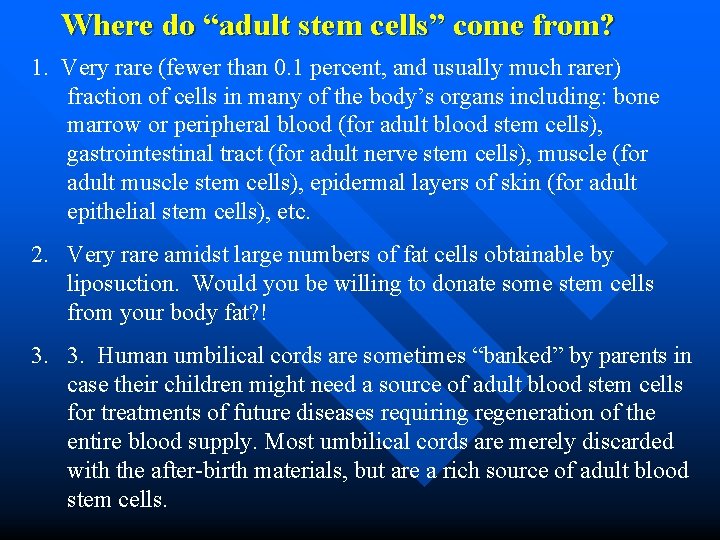
Where do “adult stem cells” come from? 1. Very rare (fewer than 0. 1 percent, and usually much rarer) fraction of cells in many of the body’s organs including: bone marrow or peripheral blood (for adult blood stem cells), gastrointestinal tract (for adult nerve stem cells), muscle (for adult muscle stem cells), epidermal layers of skin (for adult epithelial stem cells), etc. 2. Very rare amidst large numbers of fat cells obtainable by liposuction. Would you be willing to donate some stem cells from your body fat? ! 3. 3. Human umbilical cords are sometimes “banked” by parents in case their children might need a source of adult blood stem cells for treatments of future diseases requiring regeneration of the entire blood supply. Most umbilical cords are merely discarded with the after-birth materials, but are a rich source of adult blood stem cells.
Why Will Embryonic Stem Cells Neither Be Needed Nor Used for General Transplantation in the Future? n n Science is already moving along in directions that should allow more mature adult stem cells to be de-differentiated into embryonic-like stem cells. But we will probably need some embryonic stem cell research to learn how to accomplish this feat. Since there is little controversy about using adult stem cells (and these alternative methods will allow for each person to be his/her own stem cell donor), transplantation of appropriately modified adult stem cells will become the method of choice – and part of general medical practice.
Why Stem Cell Transplantation and/or Therapeutic Cloning will Someday be Commonplace n n Once we are able to remove the inflammatory “embryonic” from stem cell transplantation and properly distinguish between “therapeutic cloning” and “human cloning”, the procedure will considered in the same realm as a blood transfusion. Most people support stem cell therapy and therapeutic cloning. The issue of embryonic stem cell transplantation will eventually become irrelevant. Large segments of the society will demand the use of stem cell transplantation/therapeutic cloning and will legislate it into law over the objections of those who oppose it.
How will religions deal with these issues? n n n Most major religions will adapt to accommodate stem cell transplantation as they have accommodated other medical progress. Some religions will continue to oppose stem cell therapies and therapeutic cloning, just as some have continued to oppose blood transfusions. At some point, society will start intervening to insist that children receive these therapies. Adults will be able to refuse such therapies for themselves on the basis of their religious views.
Some Bad and Very Bad Ways to Attempt to Control Stem Cell Research n n n Prohibiting Federal research dollars only drives the research into the private sector in this country where it is unregulated and driven purely by profit motivations (already happened!). Prohibiting stem cell research or therapeutics in this country will only drive our best scientists and desperate patients and their families to other countries (starting to happen). Banning human embryonic stem cell research by law, or limiting it so much as to make it impractical, will not prevent it. Instead it will create a situation that is totally unregulated and uncontrolled (already happening), even making it a major new “criminal area” driven by profit (not yet).
Not Whether, just how and when… n n n Prediction: Stem cell research will happen because enough people want the benefits of stem cell therapies as soon as possible. At this point most reputable scientists feel that some embryonic stem cell research is needed to teach us how to go beyond it to the use of modified adult stem cells. So let’s find a way to proceed carefully to avoid the bad things and accomplish the good things that can come out of this research.
What we should NOT do… engage in acrimonious, dogmatic debate and make this an issue that politicians and special interest groups use for their own selfish purposes. “Don’t confuse me with the facts – my mind is made up”! n ignore what is currently going on in the labs. Be led by emotional hyperbole and not the facts. n ignore the ramifications of your work. Don’t waste your time trying to educate the public and government officials. (for scientists) n
What we should NOT do (continued) n n n Fellow scientists/colleagues: Ridicule your colleagues who talk to the public and press. Make sure they will never want to do that again! Public: When scientists try to explain their work, either ignore them or, better yet, threaten them with violence. This will help insure a good dialogue and encourage scientists to discuss their research! Ethicists/religious leaders: Make ethical discussions irrelevant by debating the past and ignoring the future. Think only in terms of what current technology can do. Think that you don’t need to understand something to control it, or ban it!
What Should We Do? n n n Have educated, rational, and critical discussions of the relative merits of ways to allow some human embryonic stem cell research to continue. Find a way to proceed carefully and ethically based on knowledge, compromise and consensus without extreme dogma entering into the argument. Use embryonic stem cell research only as a means to eventually learn how to properly modify adult stem cells to perform a similar function. Permit carefully regulated research and some clinical trials to enable us to see the eventual solutions. Then, put modified adult stem cell therapy and therapeutic cloning into use as rapidly as possible to save lives and improve the general quality of life!
Some more factual sources of information on embryonic and adult stem cells and stem cells ethics and policy For research and technical issues search NIH website materials on stem cells at: http: //www. nih. gov The Human Embryonic Stem Cell Debate: Science, Ethics, and Public Policy. Edited by Suzanne Holland, Karen Lebacqz, and Laurie Zoloth. MIT Press, Cambridge, Massachusetts, 2001. Stem Cells and Public Policy. Richard Hayes. The Century Foundation, 2006. (http: //www. tcf. org/Publications/Health. Care/Stemcellbasics. pdf)