
Ethics in Psychological Research Connections with last day

- Slides: 11
Ethics in Psychological Research
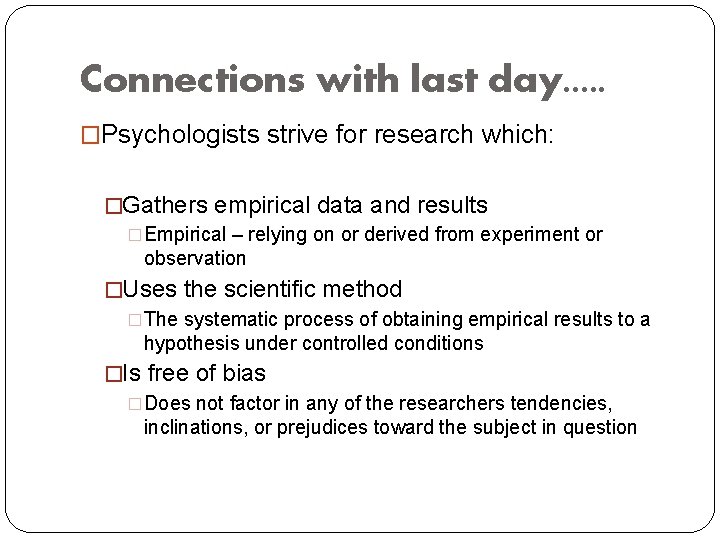
Connections with last day. . . �Psychologists strive for research which: �Gathers empirical data and results �Empirical – relying on or derived from experiment or observation �Uses the scientific method �The systematic process of obtaining empirical results to a hypothesis under controlled conditions �Is free of bias �Does not factor in any of the researchers tendencies, inclinations, or prejudices toward the subject in question
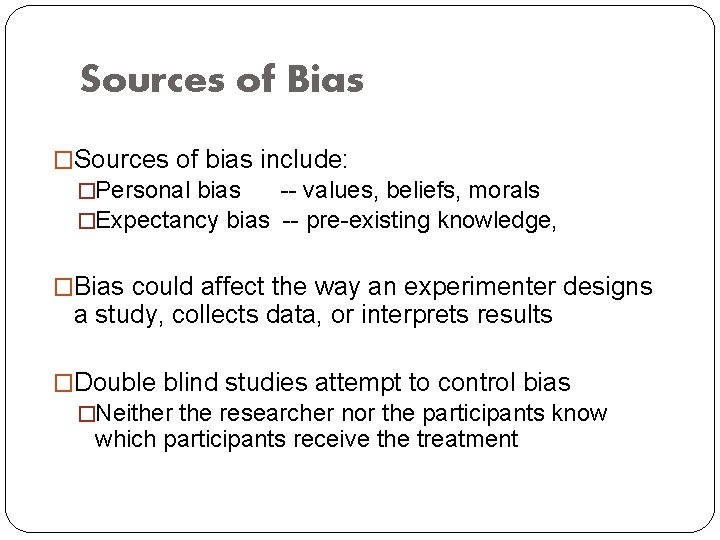
Sources of Bias �Sources of bias include: �Personal bias -- values, beliefs, morals �Expectancy bias -- pre-existing knowledge, �Bias could affect the way an experimenter designs a study, collects data, or interprets results �Double blind studies attempt to control bias �Neither the researcher nor the participants know which participants receive the treatment
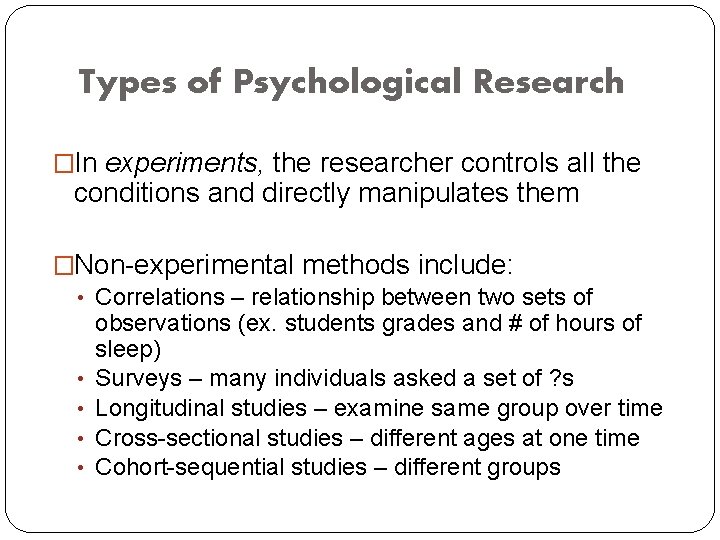
Types of Psychological Research �In experiments, the researcher controls all the conditions and directly manipulates them �Non-experimental methods include: • Correlations – relationship between two sets of observations (ex. students grades and # of hours of sleep) • Surveys – many individuals asked a set of ? s • Longitudinal studies – examine same group over time • Cross-sectional studies – different ages at one time • Cohort-sequential studies – different groups
Questions Science Cannot Answer �The scientific method is not appropriate for answering questions that cannot be put to an objective, empirical test • Ethics • Morality • Religious beliefs • Preferences
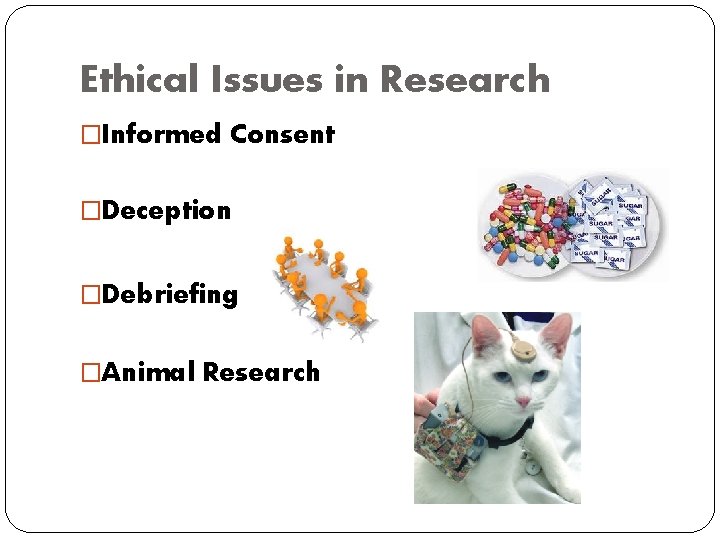
Ethical Issues in Research �Informed Consent �Deception �Debriefing �Animal Research
Informed Consent �Must obtain informed consent from participants �Basically, participants must be informed of the purpose of the research, expected duration, and procedures �they are agreeing to participate despite potential risks involved and that they can withdraw from the study at any time
Deception �Psychologists must use deception only when: justified by the study's significant prospective scientific, educational, or applied value �effective non-deceptive alternative procedures are not possible �No research reasonably expected to cause � physical pain or severe emotional distress may involve deception �Psychologists must explain any deception within an experiment to participants as early as is feasible, and permit participants to withdraw their data.
Debriefing �Psychologists must provide a prompt opportunity for participants to obtain information about the nature, results, and conclusions of the research, �When psychologists become aware that research procedures have harmed a participant, they take reasonable steps to minimize the harm.
Use of Animals in Research � Psychologists acquire, care for, use, and dispose of animals in compliance with current federal, state, and local laws and regulations, and with professional standards. � Psychologists make reasonable efforts to minimize the discomfort, infection, illness, and pain of animal subjects. � Psychologists use a procedure subjecting animals to pain, stress, or privation only when an alternative procedure is unavailable and the goal is justified by its prospective scientific, educational, or applied value. � Psychologists perform surgical procedures under appropriate anaesthesia and follow techniques to avoid infection and minimize pain during and after surgery. � When it is appropriate that an animal's life be terminated, psychologists proceed rapidly, with an effort to minimize pain and in accordance with accepted procedures.
Cafe Activity