
Ethics in Predictive Analytics with a Data Governance
- Slides: 23
Ethics in Predictive Analytics with a Data Governance Twist Enterprise Summit: Analytics April 19, 2019 | Long Beach, CA Denise Nadasen, Association of Public and Land-grant Universities Julie Alig, University of Massachusetts, Lowell
Our purpose today Clarify the problem Review examples of potential bias Foundations of an ethical framework for data and analysis on your campus Review data governance principles Nadasen Alig on Ethics in Analytics April 19, 2019 2
What is said here stays here. Think about an ethical issue that has come up at your campus or someone else’s campus. Nadasen Alig on Ethics in Analytics April 19, 2019 3
How is Analytics Different from IR? Analytics is IR on steroids. Imagine that you are collecting structured and unstructured data, analyzing it in real time, cutting it 100 ways, and immediately disseminating it to your constituents …. Without conversation With IR, we explain things, help people understand the data and the context. It takes time. It is not sexy. Analytics is at risk of contributing to confusion IR is at risk of missing a window of opportunity Nadasen Alig on Ethics in Analytics April 19, 2019 4
How can Predictive Analytics be Used Admissions Financial decisions aid disbursement Predicting course success Predicting retention or graduation Predicting revenue or rankings Nadasen Alig on Ethics in Analytics April 19, 2019 5
Scenario 1 You are a Financial Aid director. You are given the charge to make sure that the financial aid that is disbursed helps students succeed. Your IR office evaluates the effectiveness of financial aid on student retention. They find that students from Montgomery County who received financial aid were more likely to be retained than students from Howard County. You make a decision to increase aid to Montgomery County students and reduce aid to Howard County students. Retention goes up. Nadasen Alig on Ethics in Analytics April 19, 2019 6
Drown the Bunnies Mount St. Mary’s president, Simon Newman, decided to use predictive analytics to increase retention rates Action taken: remove 20 -25 students from the rosters by census date who would likely drop out anyway This would boost retention rates 4 – 5 points Justification: They will be more successful elsewhere (The Promise & Peril of Predictive Analytics in HE, 2016) Nadasen Alig on Ethics in Analytics April 19, 2019 7
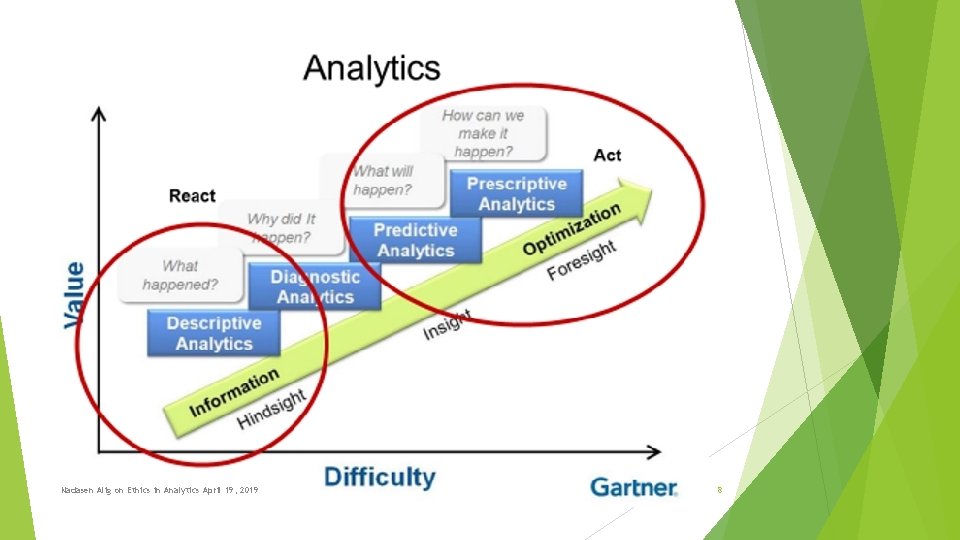
Nadasen Alig on Ethics in Analytics April 19, 2019 8
Predictive Analytics Uses current and historic data to predict a future event Student success Risk scores Areas of weakness Intervention Could limit opportunities for some students Nadasen Alig on Ethics in Analytics April 19, 2019 9
Scenario 2 You are an Admissions Director at a selective university. Your analytics team analyzes historical data and finds that children of alumni don’t perform as well as other incoming students and their performance is trending down. The number of applications has gone up this year. You know that the parents of these students have donated a lot of money to the institution. Traditionally being a child of an alum has weighed heavily in admissions decisions. Do you continue the practice to allow these student to take spots that could go to more deserving students? Nadasen Alig on Ethics in Analytics April 19, 2019 10
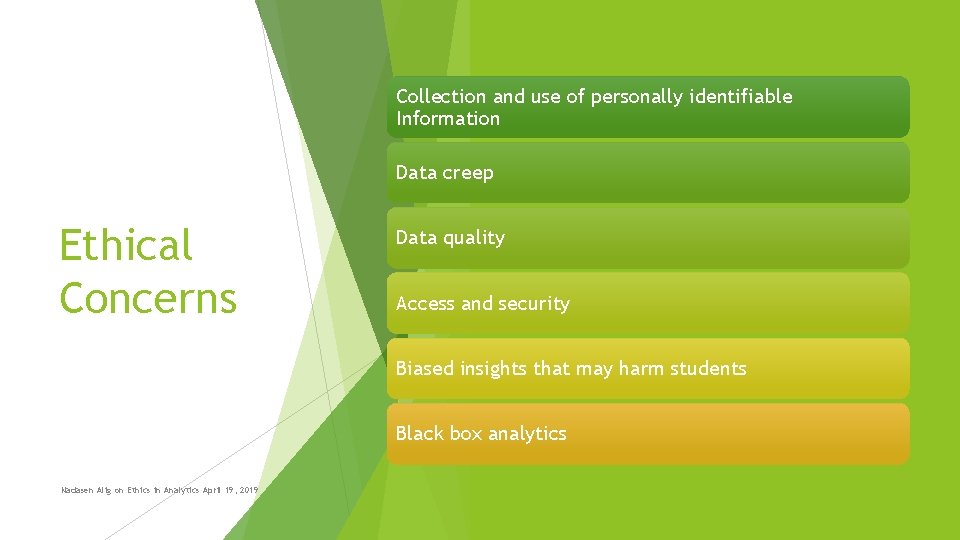
Collection and use of personally identifiable Information Data creep Ethical Concerns Data quality Access and security Biased insights that may harm students Black box analytics Nadasen Alig on Ethics in Analytics April 19, 2019 11
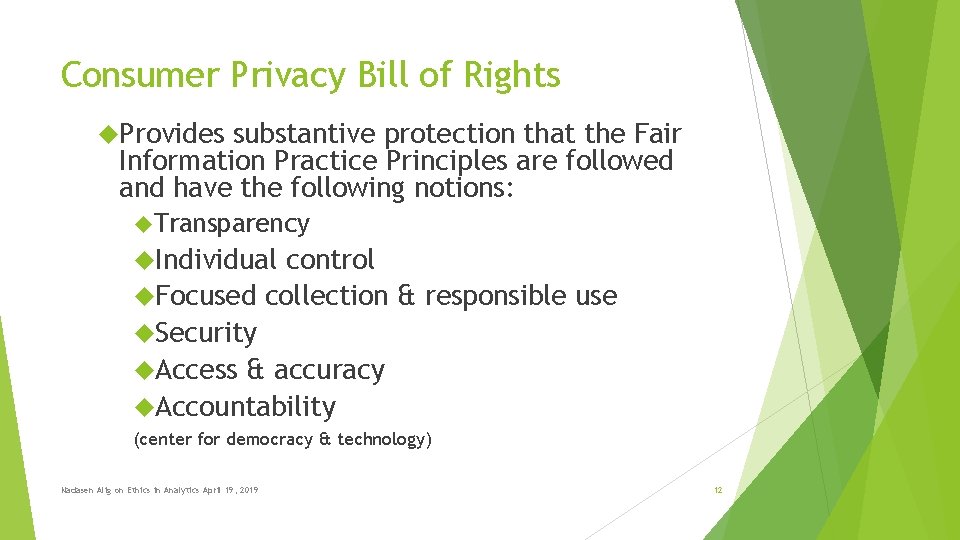
Consumer Privacy Bill of Rights Provides substantive protection that the Fair Information Practice Principles are followed and have the following notions: Transparency Individual control Focused collection & responsible use Security Access & accuracy Accountability (center for democracy & technology) Nadasen Alig on Ethics in Analytics April 19, 2019 12
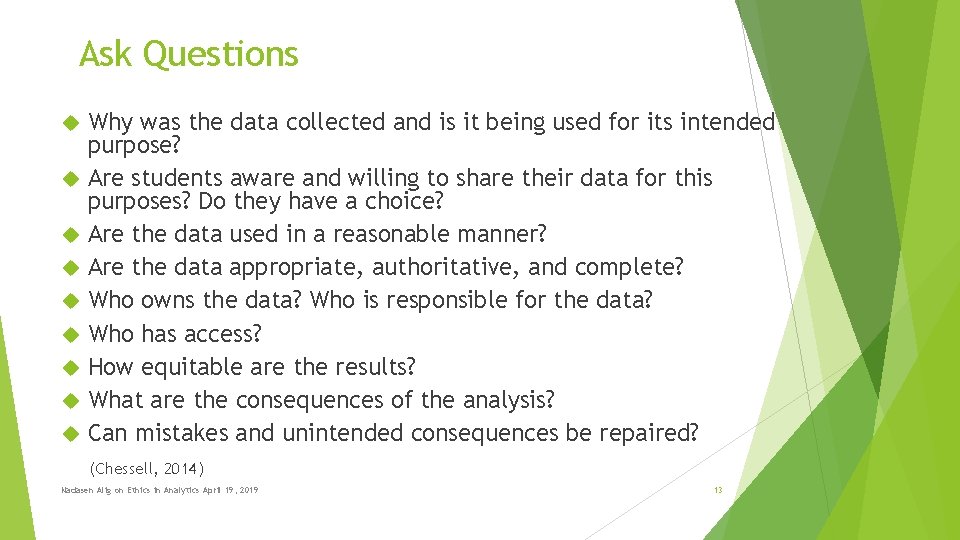
Ask Questions Why was the data collected and is it being used for its intended purpose? Are students aware and willing to share their data for this purposes? Do they have a choice? Are the data used in a reasonable manner? Are the data appropriate, authoritative, and complete? Who owns the data? Who is responsible for the data? Who has access? How equitable are the results? What are the consequences of the analysis? Can mistakes and unintended consequences be repaired? (Chessell, 2014) Nadasen Alig on Ethics in Analytics April 19, 2019 13
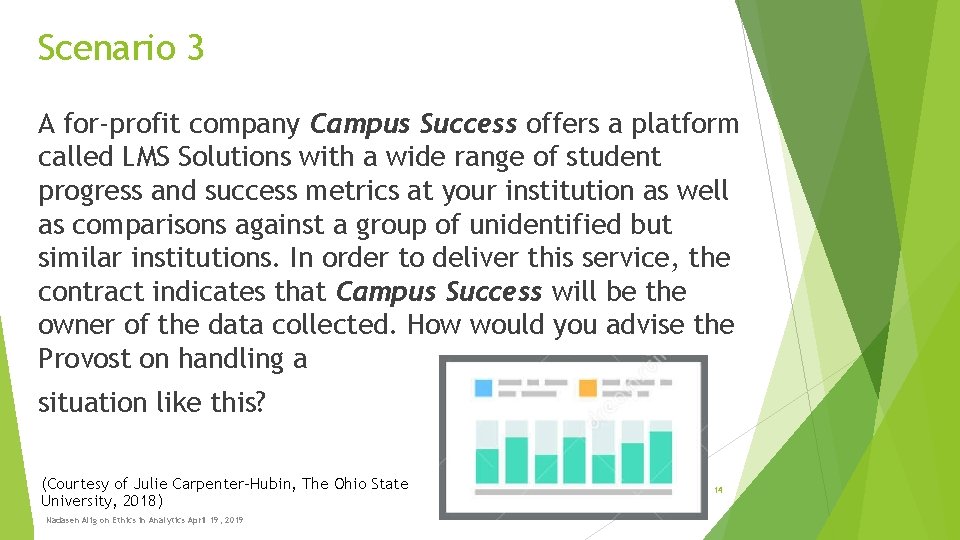
Scenario 3 A for-profit company Campus Success offers a platform called LMS Solutions with a wide range of student progress and success metrics at your institution as well as comparisons against a group of unidentified but similar institutions. In order to deliver this service, the contract indicates that Campus Success will be the owner of the data collected. How would you advise the Provost on handling a situation like this? (Courtesy of Julie Carpenter-Hubin, The Ohio State University, 2018) Nadasen Alig on Ethics in Analytics April 19, 2019 14
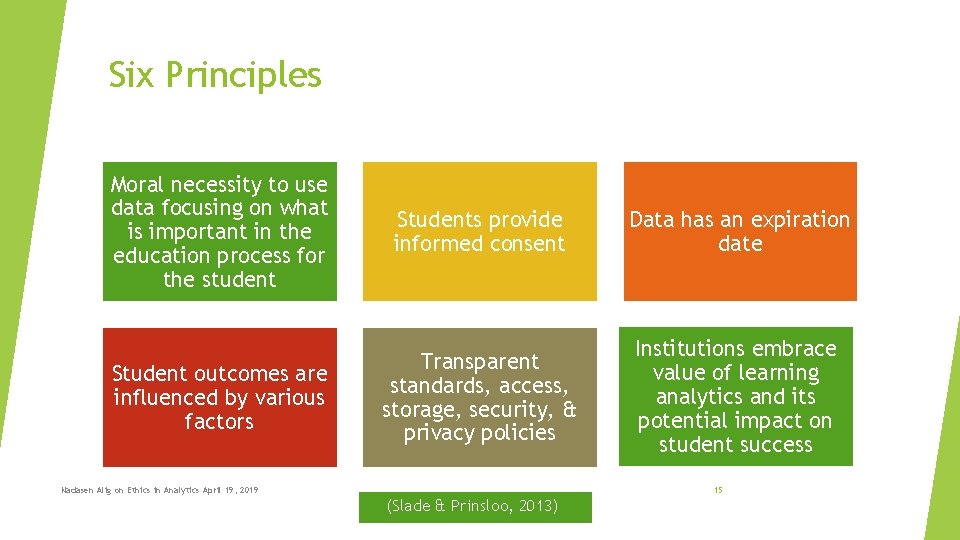
Six Principles Moral necessity to use data focusing on what is important in the education process for the student Students provide informed consent Data has an expiration date Student outcomes are influenced by various factors Transparent standards, access, storage, security, & privacy policies Institutions embrace value of learning analytics and its potential impact on student success Nadasen Alig on Ethics in Analytics April 19, 2019 15 (Slade & Prinsloo, 2013)
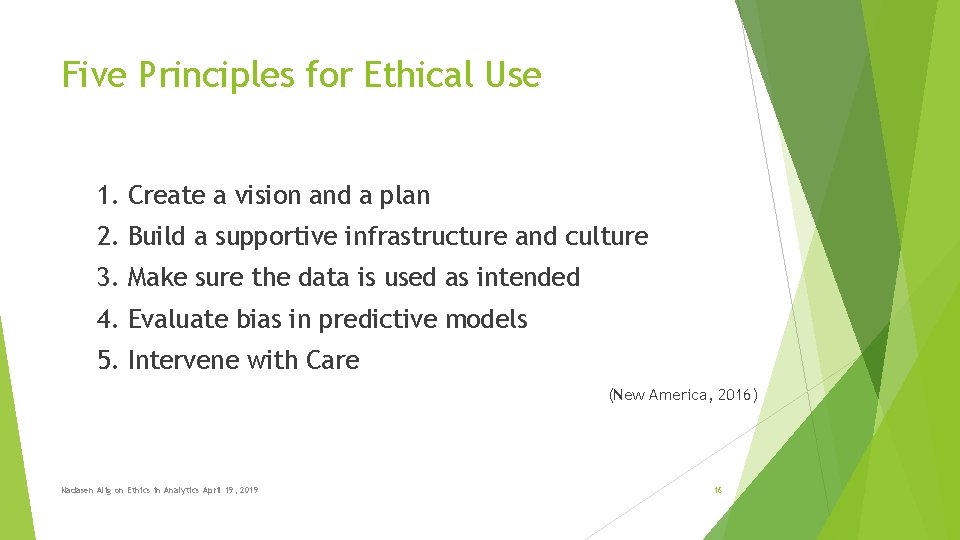
Five Principles for Ethical Use 1. Create a vision and a plan 2. Build a supportive infrastructure and culture 3. Make sure the data is used as intended 4. Evaluate bias in predictive models 5. Intervene with Care (New America, 2016) Nadasen Alig on Ethics in Analytics April 19, 2019 16
Data Governance refers to the organizational bodies, rules, decision rights, and accountabilities of people and information systems as they perform information-related processes (The Data Governance Institute) Nadasen Alig on Ethics in Analytics April 19, 2019 17
Governance Structures Formal governance committee may include: Legal, IT, IR, Registrar, Faculty affairs, Student Affairs, and representatives for Chairs, Deans, or the Provost A Master Plan Data Governance Officer Nadasen Alig on Ethics in Analytics April 19, 2019 18
Governance Content Policies Access Data & security definitions Identify the data steward Guidelines for interpreting data Communication Nadasen Alig on Ethics in Analytics April 19, 2019 plan 19
Governance Startup IT & IR Value statement Roadmap Executive buy-in Organizational structure Communication Policies plan related to data Document, Evaluate, and Adjust Nadasen Alig on Ethics in Analytics April 19, 2019 20
Example from the audience Nadasen Alig on Ethics in Analytics April 19, 2019 21
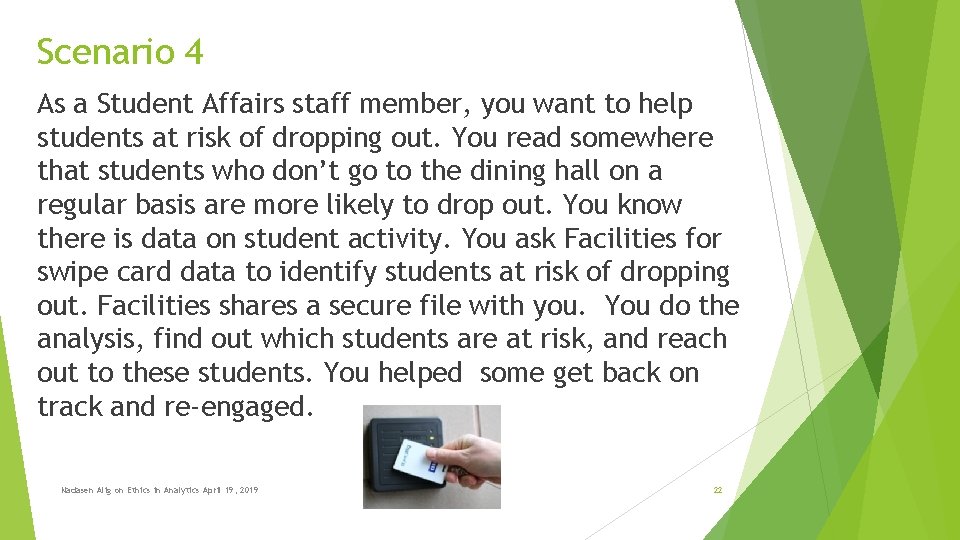
Scenario 4 As a Student Affairs staff member, you want to help students at risk of dropping out. You read somewhere that students who don’t go to the dining hall on a regular basis are more likely to drop out. You know there is data on student activity. You ask Facilities for swipe card data to identify students at risk of dropping out. Facilities shares a secure file with you. You do the analysis, find out which students are at risk, and reach out to these students. You helped some get back on track and re-engaged. Nadasen Alig on Ethics in Analytics April 19, 2019 22
Denise Nadasen, D. M. Director of Research and Data Policy Association of Public and Land-grant Universities 202 -478 -6081 dnadasen@aplu. org Thank you! Julie Alig, Ph. D. Executive Director, Office of Strategic Analysis & Data Management University of Massachusetts Lowell 978 -934 -2506 Julie_Alig@uml. edu Please Complete Your Session Evaluations