
Ethics in ICT Project Proposals Efthimios Tambouris Associate
Ethics in ICT Project Proposals Efthimios Tambouris Associate Professor, University of Macedonia, Greece tambouris@uom. gr
Idealist 2018 Webinar on 'Ethics in ICT Project Proposals' Webinar, 12 January 2016 Ethics Review Experience • Assistant professor at the Applied Informatics dpt, University of Macedonia, Thessaloniki, Greece • ICT academic background • Involved in Ethics Reviews for the last decade • Involved in “remote” (meaning online, i. e. through Internet) reviews and also “central” (meaning in Brussels through physical meetings) reviews • Reviewed proposals from many different areas and instruments, such as e. Health, Food-bio, ICT, People, European Research Council grants etc. • Disclaimer: This presentation reflects personal opinions based on experience and is not an official EU position, thus no “guarantee” is provided! E. Tambouris http: //egov. it. uom. gr/wiki 2
Idealist 2018 Webinar on 'Ethics in ICT Project Proposals' Webinar, 12 January 2016 Content 1. 2. 3. 4. 5. 6. Ethics areas and proposals Ethics issues in most ICT research Ethics issues in Contemporary ICT research areas Common Mistakes in research proposals (Some) Practical Advice Conclusions E. Tambouris http: //egov. it. uom. gr/wiki 3
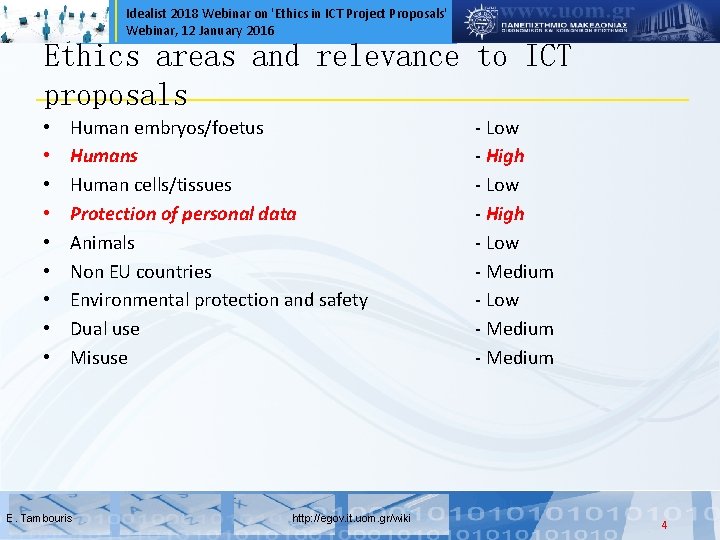
Idealist 2018 Webinar on 'Ethics in ICT Project Proposals' Webinar, 12 January 2016 Ethics areas and relevance to ICT proposals • • • Human embryos/foetus Human cells/tissues Protection of personal data Animals Non EU countries Environmental protection and safety Dual use Misuse E. Tambouris http: //egov. it. uom. gr/wiki - Low - High - Low - Medium 4
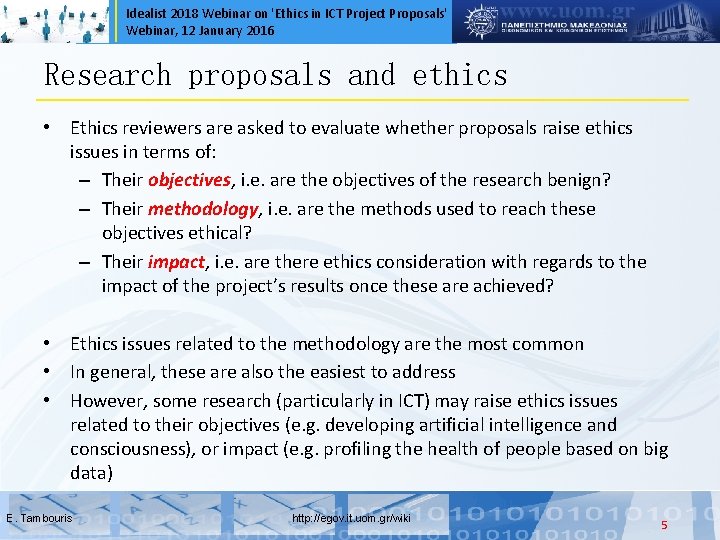
Idealist 2018 Webinar on 'Ethics in ICT Project Proposals' Webinar, 12 January 2016 Research proposals and ethics • Ethics reviewers are asked to evaluate whether proposals raise ethics issues in terms of: – Their objectives, i. e. are the objectives of the research benign? – Their methodology, i. e. are the methods used to reach these objectives ethical? – Their impact, i. e. are there ethics consideration with regards to the impact of the project’s results once these are achieved? • Ethics issues related to the methodology are the most common • In general, these are also the easiest to address • However, some research (particularly in ICT) may raise ethics issues related to their objectives (e. g. developing artificial intelligence and consciousness), or impact (e. g. profiling the health of people based on big data) E. Tambouris http: //egov. it. uom. gr/wiki 5
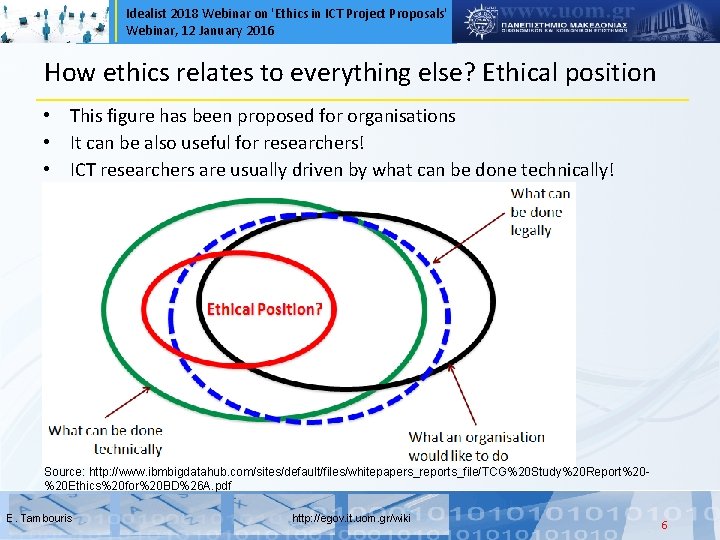
Idealist 2018 Webinar on 'Ethics in ICT Project Proposals' Webinar, 12 January 2016 How ethics relates to everything else? Ethical position • This figure has been proposed for organisations • It can be also useful for researchers! • ICT researchers are usually driven by what can be done technically! Source: http: //www. ibmbigdatahub. com/sites/default/files/whitepapers_reports_file/TCG%20 Study%20 Report%20%20 Ethics%20 for%20 BD%26 A. pdf E. Tambouris http: //egov. it. uom. gr/wiki 6
Idealist 2018 Webinar on 'Ethics in ICT Project Proposals' Webinar, 12 January 2016 Content 1. 2. 3. 4. 5. 6. Ethics areas and proposals Ethics issues in most ICT research Ethics issues in Contemporary ICT research areas Common Mistakes in research proposals (Some) Practical Advice Conclusions E. Tambouris http: //egov. it. uom. gr/wiki 7
Idealist 2018 Webinar on 'Ethics in ICT Project Proposals' Webinar, 12 January 2016 ICT Proposals and System Development • ICT proposals involve software development • Software development follows a software engineering method, e. g. waterfall model, Unified Process, Scrum etc. • These methods include a number of steps, e. g. – User requirements elicitation – System specification – System Analysis and Design – System Development and Testing, etc. • Also, in most projects trials are performed aiming to evaluate the system E. Tambouris http: //egov. it. uom. gr/wiki 8
Idealist 2018 Webinar on 'Ethics in ICT Project Proposals' Webinar, 12 January 2016 Ethics in ICT Proposals • Traditionally, ICT proposals may involve human participants in two major software engineering activities: • Users Requirements Elicitation. Here, potential users outside the consortium may be consulted via questionnaires, interviews, surveys etc. • Trials and evaluation. Here, humans outside the consortium are asked to use the developed system and provide their views on it. • These activities are present in almost all ICT proposals. • Thus, the applicants should investigate whether ethics issues related to humans and data protection are applicable to their proposal, starting from the two above-mentioned activities. E. Tambouris http: //egov. it. uom. gr/wiki 9
Idealist 2018 Webinar on 'Ethics in ICT Project Proposals' Webinar, 12 January 2016 Trials and Evaluation • Trials in ICT proposals can be in areas that are inherently ethicschallenging • For example, some proposals include a use case in e. Health or e. Learning to showcase their systems • Examples: – Combining clinical data from various hospitals to illustrate a new semantic web system • This project raises issues related to data protection (health data are sensitive personal data according to EU legislation) – Including video cameras in classrooms as part of a Learning Analytics project to decrease pupils drop out rates • This project raises issues related to tracking people and the participation of children in research E. Tambouris http: //egov. it. uom. gr/wiki 10
Idealist 2018 Webinar on 'Ethics in ICT Project Proposals' Webinar, 12 January 2016 Content 1. 2. 3. 4. 5. 6. Ethics areas and proposals Ethics issues in most ICT research Ethics issues in Contemporary ICT research areas Common Mistakes in research proposals (Some) Practical Advice Conclusions E. Tambouris http: //egov. it. uom. gr/wiki 11
Idealist 2018 Webinar on 'Ethics in ICT Project Proposals' Webinar, 12 January 2016 Contemporary ICT Research Areas • Many ICT research involves software and system development in new areas • Some of these areas raise ethics issues related to their methodologies but also objectives and/or impact • Some example areas follow: – Big data including Internet of Things • Possible ethics issues: informed consent, data protection, privacy, “write to forget” etc. – Cloud computing • Possible ethics issues: data protection – Robotics • Possible ethics issues: philosophical ethics issues e. g. as to what makes us human – Artificial Intelligence • Possible ethics issues: philosophical ethics issues e. g. as to what makes us human E. Tambouris http: //egov. it. uom. gr/wiki 12
Idealist 2018 Webinar on 'Ethics in ICT Project Proposals' Webinar, 12 January 2016 Example area: Big data and ethics • Why are researchers interested in digital data? – Digital data can be easily collected or even harvested – Digital data can be easily combined with other data – Digital data can be easily stored even without explicit location knowledge (e. g. cloud storage) – Digital data can be easily and quickly transferred – Digital data can be easily re-used – Digital data can be processed in • traditional ways but also in • new (even unexpected or unpredicted) ways • E. g. using data mining, data linkage etc. E. Tambouris http: //egov. it. uom. gr/wiki 13
Idealist 2018 Webinar on 'Ethics in ICT Project Proposals' Webinar, 12 January 2016 Example area: Big data and ethics • Why is this relevant to ethics? – Harvesting data from SM raises issues of informed consent – Big data raise issues of identifiability – …and at the same time they raise problems in authenticating online identities – Data linkage presents risks to privacy and confidentiality – There are emerging and pressing issues of ensuring data security, privacy and governance particularly in cross-border research (like most EU-funded research) – Research objectives can be ethically challenging, e. g. price discrimination, user profiling, public surveillance etc. – Many Social Media (facebook, tweeter) are US-based Source: Carlton Connect Initiative, 2015, Guidelines for the Ethical Use of Digital Data in Human Research, http: //carltonconnect. com. au/wp-content/uploads/2015/06/Ethical-Use-of-Digital-Data. pdf E. Tambouris http: //egov. it. uom. gr/wiki 14
Idealist 2018 Webinar on 'Ethics in ICT Project Proposals' Webinar, 12 January 2016 Example area: Cloud Computing • With cloud computing data can be stored anywhere • Data can also be transferred between locations transparently based on availability etc. • This “flexibility” poses ethics challenges relevant to data protection, accountability etc. E. g. – Which legislation is applicable? • Many cloud providers are based outside the EU E. Tambouris http: //egov. it. uom. gr/wiki 15
Idealist 2018 Webinar on 'Ethics in ICT Project Proposals' Webinar, 12 January 2016 Example: The BRAIN project • BRAIN is 10 -year, 1 B€ FET flagship aiming to investigate the human brain using amongst others massively parallel processing • This project raises ethics issues related to the – Objectives: e. g. is it ethical to “simulate” a part of the human brain? – Methods: e. g. the brain of human participants will be scanned; mice models will be employed etc. – Impact: e. g. what will be the impact if we manage to simulate the whole brain? E. Tambouris http: //egov. it. uom. gr/wiki 16
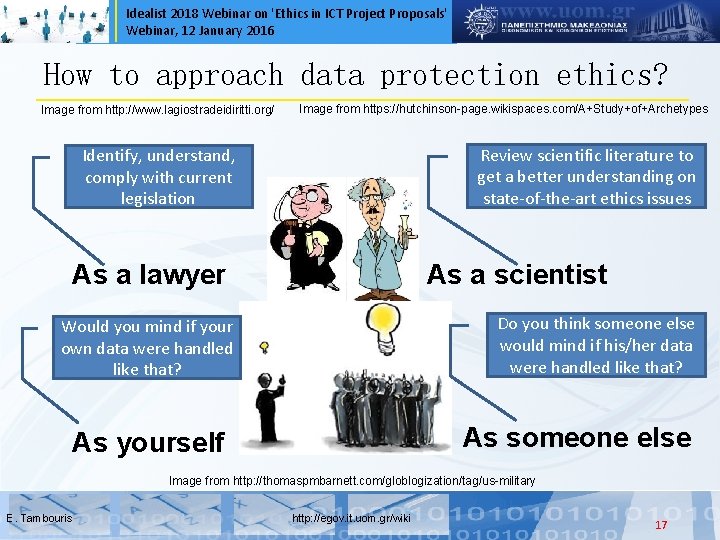
Idealist 2018 Webinar on 'Ethics in ICT Project Proposals' Webinar, 12 January 2016 How to approach data protection ethics? Image from http: //www. lagiostradeidiritti. org/ Image from https: //hutchinson-page. wikispaces. com/A+Study+of+Archetypes Review scientific literature to get a better understanding on state-of-the-art ethics issues Identify, understand, comply with current legislation As a lawyer As a scientist Do you think someone else would mind if his/her data were handled like that? Would you mind if your own data were handled like that? As someone else As yourself Image from http: //thomaspmbarnett. com/globlogization/tag/us-military E. Tambouris http: //egov. it. uom. gr/wiki 17
Idealist 2018 Webinar on 'Ethics in ICT Project Proposals' Webinar, 12 January 2016 Content 1. 2. 3. 4. 5. 6. Ethics areas and proposals Ethics issues in most ICT research Ethics issues in Contemporary ICT research areas Common Mistakes in research proposals (Some) Practical Advice Conclusions E. Tambouris http: //egov. it. uom. gr/wiki 18
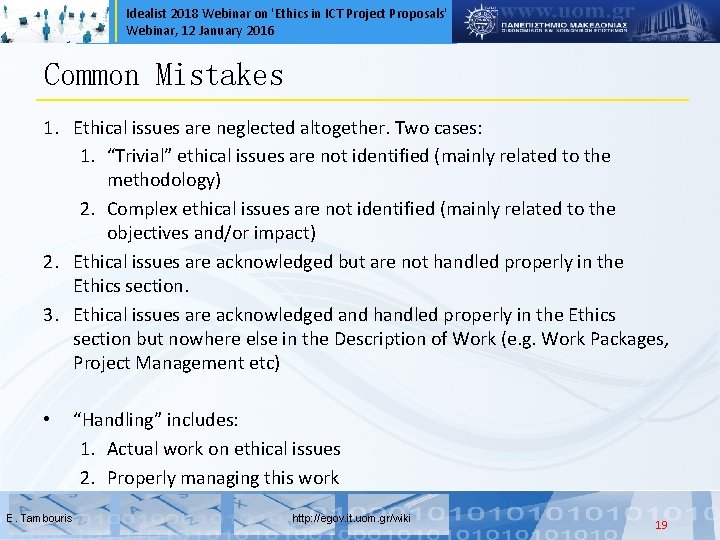
Idealist 2018 Webinar on 'Ethics in ICT Project Proposals' Webinar, 12 January 2016 Common Mistakes 1. Ethical issues are neglected altogether. Two cases: 1. “Trivial” ethical issues are not identified (mainly related to the methodology) 2. Complex ethical issues are not identified (mainly related to the objectives and/or impact) 2. Ethical issues are acknowledged but are not handled properly in the Ethics section. 3. Ethical issues are acknowledged and handled properly in the Ethics section but nowhere else in the Description of Work (e. g. Work Packages, Project Management etc) • E. Tambouris “Handling” includes: 1. Actual work on ethical issues 2. Properly managing this work http: //egov. it. uom. gr/wiki 19
Idealist 2018 Webinar on 'Ethics in ICT Project Proposals' Webinar, 12 January 2016 Content 1. 2. 3. 4. 5. 6. Ethics areas and proposals Ethics issues in most ICT research Ethics issues in Contemporary ICT research areas Common Mistakes in research proposals (Some) Practical Advice Conclusions E. Tambouris http: //egov. it. uom. gr/wiki 20
Idealist 2018 Webinar on 'Ethics in ICT Project Proposals' Webinar, 12 January 2016 (Some) Practical Advice 1. Determine whether your work (in terms of objectives, methodology, impact) raises ethics issues. 2. Get informed on relevant national and international ethics requirements, laws, regulations, good practices etc. 3. Prepare a plan to handle ethics issues. 4. Integrate this plan in your Description of Work. 5. If needed, properly manage work on ethics issues. E. Tambouris http: //egov. it. uom. gr/wiki 21
Idealist 2018 Webinar on 'Ethics in ICT Project Proposals' Webinar, 12 January 2016 1. Identify possible Ethics Issues • Analyse your proposal in terms of its: – Objectives. The fact that a system can be technically developed does not necessarily mean that it is a good idea to develop it! – Methodology. Does your research methods involve the participation of humans (e. g. during requirements elicitation and/or trials and evaluation) or animals? Will the developed system process personal data or observe or track people? – Impact. Does your system have the potential for dual use or misuse? • Common mistake: ethical issues are neglected all together, specifically in research areas where there is no relevant tradition e. g. ICT E. Tambouris http: //egov. it. uom. gr/wiki 22
Idealist 2018 Webinar on 'Ethics in ICT Project Proposals' Webinar, 12 January 2016 1. Identify possible Ethics Issues • Researchers preparing a proposal should: – See proposal guidelines, e. g. – http: //ec. europa. eu/research/participants/data/ref/h 2020/grants_manual/hi/ ethics/ethics-eit_en. pdf and – http: //ec. europa. eu/research/participants/data/ref/h 2020/call_ptef/pt/h 2020 -call-pt-ria-ia_en. pdf#page=27 – Perform the self-assessment exercise, e. g. – http: //ec. europa. eu/research/participants/portal/doc/call/h 2020 -msca -itn-2015/1620147 -h 2020_-_guidance_ethics_self_assess_en. pdf – See EU guidelines on ethics issues – Seek advice from your institution • Common mistake: ethics issues are neglected all together, specifically in research areas where there is no relevant tradition e. g. ICT E. Tambouris http: //egov. it. uom. gr/wiki 23
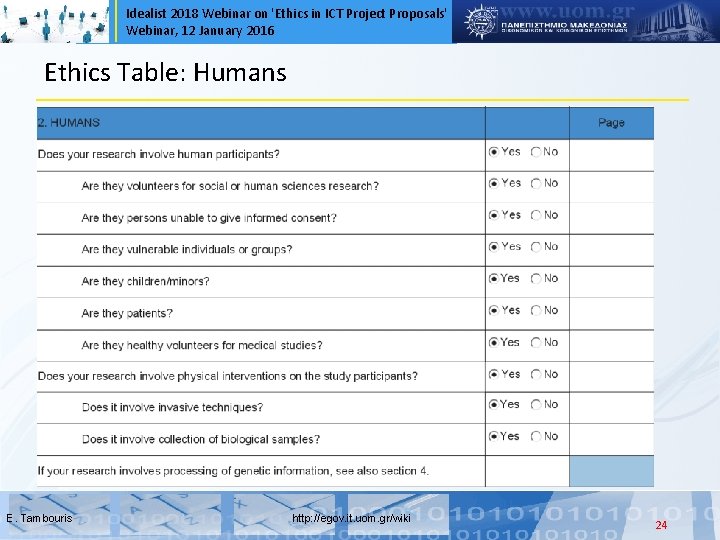
Idealist 2018 Webinar on 'Ethics in ICT Project Proposals' Webinar, 12 January 2016 Ethics Table: Humans E. Tambouris http: //egov. it. uom. gr/wiki 24
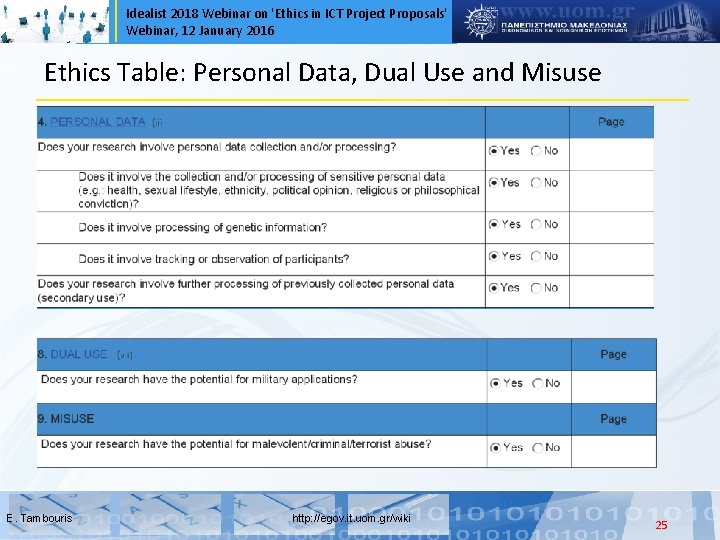
Idealist 2018 Webinar on 'Ethics in ICT Project Proposals' Webinar, 12 January 2016 Ethics Table: Personal Data, Dual Use and Misuse E. Tambouris http: //egov. it. uom. gr/wiki 25
Idealist 2018 Webinar on 'Ethics in ICT Project Proposals' Webinar, 12 January 2016 2. Get Informed on Relevant Requirements • Get informed on relevant national, EU and international ethics requirements, laws, regulations etc. E. g. – Data protection directive 1995/46 and relevant national legislation – Directive on privacy and electronic communications 2002/58 and relevant national legislation • If developing countries are involved in the proposal, compliance to EU standards is required. • Start with your organisation • Check support from the EU • This should be reported in the Ethics section of your proposal. • Common mistake: relevant requirements are not presented or are presented only at the EU level and not national E. Tambouris http: //egov. it. uom. gr/wiki 26
Idealist 2018 Webinar on 'Ethics in ICT Project Proposals' Webinar, 12 January 2016 3. Prepare a Plan • • • Prepare a plan to handle ethics issues. The plan is obviously related to the nature of ethics issues involved. Obtain permissions from local or national authorities, if needed and if possible before proposal. • This should be outlined in the Ethics section of your proposal. • Common mistake: Ethics issues are properly identified and relevant regulations are listed but there is no adequate evident that the consortium will handle them properly. In certain cases, it is evident that the consortium is very experienced in handling ethics issues in the past but did not properly documented the needed work. E. Tambouris http: //egov. it. uom. gr/wiki 27
Idealist 2018 Webinar on 'Ethics in ICT Project Proposals' Webinar, 12 January 2016 4. Integrate Plan in Do. W • • • Integrate this plan in your Description of Work. The relevant work should be clearly stated in the Work Packages etc. If permissions are needed, plan your time accordingly. • This should be presented in the main body of the proposal (besides the Ethics section). • Common mistake: handling ethics issues is reported properly in the Ethics section of the proposal but is not evident whether and where this work would be carried out when someone reads Work Package descriptions. E. Tambouris http: //egov. it. uom. gr/wiki 28
Idealist 2018 Webinar on 'Ethics in ICT Project Proposals' Webinar, 12 January 2016 5. Manage Ethics Issues • • E. Tambouris If needed, manage properly work on ethics issues. This should be outlined in the Ethics Issues section but also integrated in your Description of Work (e. g. in description of Work Packages, Project Management etc). Decide whether you need to: – Manage Ethics Issues at the Task and/or Work Package – Have a Specific Task of Work Package on ethics – Have an (internal or external) ethics expert in the Steering Committee or Board Common mistake: The proposal has properly identified and handled serious ethics issues but experts responsible for ethics issues are not high enough in the management hierarchy http: //egov. it. uom. gr/wiki 29
Idealist 2018 Webinar on 'Ethics in ICT Project Proposals' Webinar, 12 January 2016 Content 1. 2. 3. 4. 5. 6. Ethics areas and proposals Ethics issues in “Traditional” ICT research Ethics issues in Contemporary ICT research areas Common Mistakes in research proposals (Some) Practical Advice Conclusions E. Tambouris http: //egov. it. uom. gr/wiki 30
Idealist 2018 Webinar on 'Ethics in ICT Project Proposals' Webinar, 12 January 2016 Conclusions Traditionally ethics and ICT research were disjoint fields This is no longer the case! Ethics issues can be related to objectives, methodology and impact System development may raise issues related to data protection Research is new areas (big data, Io. T, cloud, robotics, AI etc) may also raise issues related to objectives and/or impact • Sometimes building something is technologically interesting but might not actually be a good idea • • • E. Tambouris http: //egov. it. uom. gr/wiki 31
Idealist 2018 Webinar on 'Ethics in ICT Project Proposals' Webinar, 12 January 2016 Conclusions • In most cases, ethics issues can be easily handled by a consortium • In some cases, it is evident that a consortium has the relevant expertise but has not devoted proper resources for the documentation • This presentation aimed to present some guidelines for the most straightforward cases • In certain cases however, ethics issues are not trivial and require much more attention; in this cases, advice from an ethics expert on the specific field might be needed • Note: all views expressed in this presentation are based on personal experience; they are not the result of an academic investigation or other systematic method E. Tambouris http: //egov. it. uom. gr/wiki 32
Idealist 2018 Webinar on 'Ethics in ICT Project Proposals' Webinar, 12 January 2016 Thank you very much for your attention!! E. Tambouris http: //egov. it. uom. gr/wiki 33
- Slides: 33