
Ethics in healthcare Basic ethics in health care
Ethics in healthcare Basic ethics in health care Ethical issues in decision-making in prenatal risk assessment (= technology) Ethics and scientific methods
2 Lene Toxvig, Lecturer at Department of Midwifery, Global Health February 19, 2021 Outline Basic ethics in health care, • The concept of informed choice and informed consent in healthcare • The concept of autonomy in healthcare Ethical issues in decision-making in prenatal risk assessment, • Decision-making in prenatal risk assessment as an example of implementation of technology in healthcare as described by Schwennesen, Svendsen and Koch Group work, • I: Ethics in relation to desicions about technology in health care • II: Ethics in relation to methods of data collection in the project work
Ethical concepts in relation to healthcare Informed choice Informed consent Autonomy
4 Lene Toxvig, Lecturer at Department of Midwifery, Global Health February 19, 2021 The concept of informed choice Informed choice; The patient may choose between different opportunities; for instance between different kind of medical, surgical or painrelieving treatment. It is a way of giving patients sufficient and adjusted information and in the light of this, patients are meant to choose between different kinds of treatment. Informed consent; The patient may or may not give his informed consent to a certain kind of treatment. He or she is not allowed to choose between different kinds of treatment, but only to give consent to the proposed treatment Question; Why is this an important difference – ethically and legally speaking?
5 Lene Toxvig, Lecturer at Department of Midwifery, Global Health February 19, 2021 The concept of autonomy in healthcare • Autonomy origins from the Greek auto (self) and nomos (legislation) and means self-determinating • In modern medical ethics, the concept refers to a person who has the ability to relate to himself, his situation and on the basis of this is able to choose between different alternatives – or the ability to make decisons independently and take action
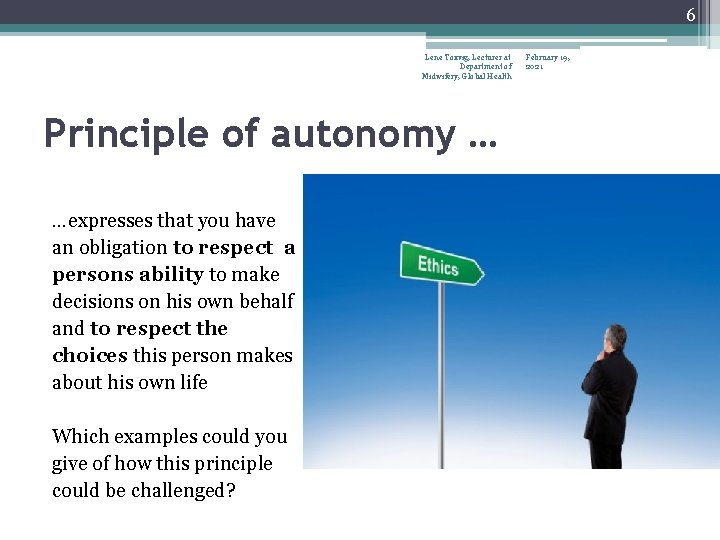
6 Lene Toxvig, Lecturer at Department of Midwifery, Global Health Principle of autonomy … …expresses that you have an obligation to respect a persons ability to make decisions on his own behalf and to respect the choices this person makes about his own life Which examples could you give of how this principle could be challenged? February 19, 2021
7 Lene Toxvig, Lecturer at Department of Midwifery, Global Health February 19, 2021 Principle of autonomy, continued … …in medical treatment it means that the patient has the right to be informed about diagnosis, prognosis and treatment and on the basis of this information the right to decide if he or she will accept an offered diagnostic test or a treatment
8 Lene Toxvig, Lecturer at Department of Midwifery, Global Health February 19, 2021 Principle of autonomy, continued … …is consistent with the patient who wishes no information by request…. and who hands over the decision to the doctor or to another health professional …is also consistent with a patients refusal of lifeessential treatment Could you give examples of refusal of life-essential treatment?
9 Lene Toxvig, Lecturer at Department of Midwifery, Global Health February 19, 2021 Reflective activty • How is the concept of informed choice understood in your profession and according to your specific nationality? Explain and discuss similarities and differences • How is the concept of autonomy used in your profession and in your specific nationality? Explain and discuss similarities and differences
Decision-making in prenatal risk assessment An example of application of technology in health-care
11 Lene Toxvig, Lecturer at Department of Midwifery, Global Health February 19, 2021 Background concerning prenatal risk assesment (PRA) • In 2004 PRA became a routine offer to all pregnant women in Denmark • The aim was to give all pregnant women an informed choice whether to undergo prenatal testing • The authors of the article question if more information and more choice is experienced as a source of empowerment and control by the parents • Although PRA present itself in opposition to paternalistic ways of governing the couple, it seems to represent other ways of governing through the notion of choice • An ethics of shared responsibility when decisions are going to be taken as a result of PRA is suggested (Schwennesen, Svendsen and Koch 2008)
12 Lene Toxvig, Lecturer at Department of Midwifery, Global Health February 19, 2021 The technology in PRA • Risk assesment is carried out in 11. -13. weeks of pregnancy as a noninvasive intervention • The risk of having a fetus with chromosomal disease is measured by combining HCG in maternal serum with an ultrasound scan (See following internetadress www. nakkefold-herlev. dk for a scan of the nuchal translucency) • These two parameters are combined with the pregnant women´s age -related risk and an overall risk is calculated • This calculated risk provides the basis for the decision about whether to undergo invasive procedures as CVS or amniocentesis
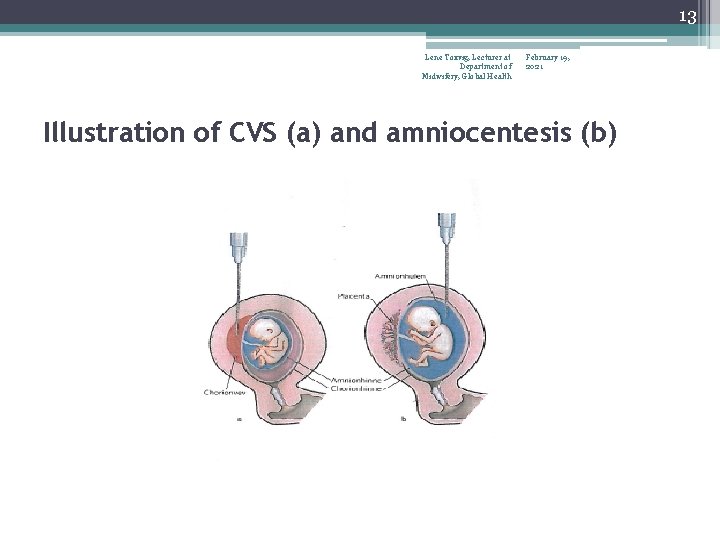
13 Lene Toxvig, Lecturer at Department of Midwifery, Global Health February 19, 2021 Illustration of CVS (a) and amniocentesis (b)
14 Lene Toxvig, Lecturer at Department of Midwifery, Global Health February 19, 2021 The implication of the routine offer of PRA • ”A biomedical category of the fetus at risk is created” • Only 2 % of couples offered PRA actively refused the offer • The pregnant woman is seen as an autonomous individual who acts rationally on the basis of objective knowledge
15 Lene Toxvig, Lecturer at Department of Midwifery, Global Health February 19, 2021 Risk assessment in your profession Consider examples of risk assessment in your profession with the person sitting next to you Consider pros and cons of risk assessment in general
16 Lene Toxvig, Lecturer at Department of Midwifery, Global Health February 19, 2021 Questions asked in the article • Are the users of PRA well informed? • Are they provided with non-directive councelling? • Do the conditions concerning PRA lead to a true autonomous choice? • Is it possible to meassure the level of informed choice? (Schwennesen, Svendsen and Koch 2008, p. 13)
17 Lene Toxvig, Lecturer at Department of Midwifery, Global Health February 19, 2021 What is appropriate information? In a general context which information should patients in health care be given in order to make an informed choice?
18 Lene Toxvig, Lecturer at Department of Midwifery, Global Health February 19, 2021 The new guidelines represent a paradigm shift in prenatal examinations Before 2004 After 2004 • Specific criteria, e. g. age formed the grounds on which PRA was offered • PRA is offered to all pregnant women no matter their risk of having a child with a chromosomal abnormality • PRA represent a selfdetermination orientated paradigm • The purpose is to assist pregnant women to make their own choices • PRA represent a prevention orientated paradigm • The purpose is to prevent children with serious diseases to be born
19 Lene Toxvig, Lecturer at Department of Midwifery, Global Health February 19, 2021 Limits of selfdetermination • The aim of The Danish Board of Health was to orient the programme towards self-determination and autonomy • This aim has some limits. Only women who have a risk higher than or equal to 1: 250 will be offered invasive examinations. It is named as a cut-off point • No considerations of the relationship between the cut-off point and the risk of inducing miscarriage (app. 1 %) by undergoing invasive examinations are mentioned in the guidelines
20 Lene Toxvig, Lecturer at Department of Midwifery, Global Health February 19, 2021 A small exercise If a women´s calculated risk of having a child with Down´s syndrome is 1: 300 and if the cut-off point is 1: 250; how would you advise the woman?
21 Lene Toxvig, Lecturer at Department of Midwifery, Global Health February 19, 2021 One pregnant woman and her partners (Patricia and Peters) journey through PRA • When offered PRA by their general practitioner Patricia and Peter said ”Yes please, we accept that, just as we accept midwife and antenatal care, we accept the whole package” • They saw PRA as an offer, you could not refuse • So what the guidelines described as an autonomous and informed choice was performed as a routinised and non-problematised act. The decision making rather had the character of informed compliance (Schwennesen, Svendsen and Koch 2008, p. 18)
22 Lene Toxvig, Lecturer at Department of Midwifery, Global Health February 19, 2021 The motives for undergoing PRA Patricia said ”We have used it to prove that there is something in there”. Peter said ”If it is possible in any way to rule out that something is wrong with the foetus, then you want to do that”. Patricia emphasized that she had not thought through how she would act if the PRA indicated that something was wrong with the foetus.
23 Lene Toxvig, Lecturer at Department of Midwifery, Global Health February 19, 2021 The result of the risk assessment • Patricias risk of having a child with Down´s syndrome was calculated to 1: 661 • Her age-related risk was 1: 907 • As the nurse points out to the couple: Patricias risk at arrival is lower (her risk of having a child with Down´s Syndrome is 1 out of 907) than her risk at departure (her risk after the scan of the nuchal translucency and the double test is 1 out of 661)
24 Lene Toxvig, Lecturer at Department of Midwifery, Global Health February 19, 2021 Autonomy in relation to prenatal risk assessment • It seems as if the PRA is so imbedded in an organisational routine, that the people involved hardly experience it as a choice • If the aim is to render a choice to the expectant parents, the users of PRA seem rather unwilling to give up the health professionals as experts • While the intension in the guidelines may be to transfer authority to the pregnant women, the users of PRA rather seem to reinstall authority in the medical experts
25 Lene Toxvig, Lecturer at Department of Midwifery, Global Health February 19, 2021 Self-determination in relation to PRA • The new guideline about PRA were written to represent a self-determination orientated paradigm in opposition the old guideline, which was to represent a prevention orientated paradigm • The new guideline seems to direct peoples decisions towards the samme preventive effects - only using choice as its underlying motive
26 Lene Toxvig, Lecturer at Department of Midwifery, Global Health February 19, 2021 Conclusion • The outcome of the programme of prenatal examinations is in accordance with the preventive intentions • The aims of self-determination and autonomy appears as lacking in meaning, when the existence of these values are ignored • A shared value about PRA has emerged; as the right pathway of having a healthy baby • The Danish Board of Health should recognize the value of prevention underlying the whole organisation of PRA in Denmark and this value is shared by the users • In the light of this, the solution would be shared responsibility, which is more in agreement with how desicions actually are made
Questions for a group work Ethics in relation to desicions about technology in health care

28 Lene Toxvig, Lecturer at Department of Midwifery, Global Health February 19, 2021 Group work in project groups You are supposed to prepare an answer to share with the rest of the group of international students After the group work there will be a discussion of the posed questions
29 Lene Toxvig, Lecturer at Department of Midwifery, Global Health February 19, 2021 Questions for group work 1. Which ethical dilemmas does the technology of prenatal risk assessment (PRA) imply on the expectant couple? 2. Why is it a difficult task to involve the expectant parents in the decision-making process? 3. How could e. g. autonomy, paternalism, shared decisionmaking or ethical dilemmas become relevant to your project work? Discuss with the group how it could become a part of the project. 4. Point out problematic consequences of the way the communication with Peter and Patricia is handled. 5. Explain which significance the couple may pose on the cutoff point. 6. Discuss whether you find the offer of PRA as a source of empowering and control from the expectant parents´perspective.
30 Lene Toxvig, Lecturer at Department of Midwifery, Global Health February 19, 2021 Presentation of group work I Each project group (5) presents the answer of one question The last question we will discuss all together
Science and Ethics in relation to project work
32 Lene Toxvig, Lecturer at Department of Midwifery, Global Health February 19, 2021 Ethics in relation to participant observation – dangerous knowledge • There is a risk of having “dirty hands” which means that the researcher come across in legal activities • The researcher may come across so called “guilty knowledge” which is traumatic, sensitive, intimate or private knowledge • The researcher must endeavour to secure that the results of the research do not harm the explored people • There will often be a dilemma between potential costs and advantages; e. g. in relation to developing friendship with some of the participants. The friendship brings you closer to the field, but on the other hand you might feel that you exploit this friendship in the research. The participant might feel it as a breach of confidence
33 Lene Toxvig, Lecturer at Department of Midwifery, Global Health February 19, 2021 Ethical principles of research The principle of informed consent Research projects may not be carried out unless the participants have given their informed consent. The consent must be given on a well-informed basis The principle of anonymity Participants in research must not could be recognized in public. The principal rule is that information retrieved in research is anonymized by removing name and picture – if there is a such. The principle of confidentiality The researcher must guarantee that the retrieved information • is not discussed with colleagues, friends, family • is destroyed after the project is terminated The researcher must guarantee that privacy is protected
34 Lene Toxvig, Lecturer at Department of Midwifery, Global Health February 19, 2021 Group work II The project groups discuss question 1) and 2) after having read ”Science and Ethics” In: Holm, A. B: Philosophie of Science. An Introduction for Future Knowledge Workers, p. 220 -228. 1) Discuss the three mentioned norms defining good scientific practice (p. 220). What do these norms imply in relation to the project work? 2) Discuss which ethical norms you must observe if you are going to interviewe a person at the study visits 3) Discuss which ethical norms you must observe in the case of paticipant observation at the study visits (the answer of this question must be deduced from the lessons)
35 Lene Toxvig, Lecturer at Department of Midwifery, Global Health February 19, 2021 Presentation of group work II Ethical consideration concerning…. 1) First question …. good scientific practice transferred to the project work 2) Second question …. . interview of a person at the study place 3) Third question…. paticipant observation at the study place
36 Lene Toxvig, Lecturer at Department of Midwifery, Global Health February 19, 2021 Materials • Holm, A. B. Philosophie of Science. An Introduction for Future Knowledge Workers. Samfundslitteratur 2013 • Kristiansen, S. Etiske udfordringer ved deltagende observation In: Pedersen, M. Klitmøller, J. Nielsen, K. (Eds): Deltagerobservation. En metode til undersøgelse af psykologiske fænomener. Hans Reitzels Forlag 2012, p. 213 -229 • Rossel, P. Autonomien og dens grænser In: Journal of the Danish Medical Association 166/24. The 7. of June 2004, p. 2330 -2333 • Schwennesen, N. , Svendsen, M. N. and Koch, L. Beyond informed choice: Prenatal risk assesment, decision-making and trust. Nordic journal of applied ethics. Trondheim. Tapir Akademisk forlag. 2008, p. 11 -31
37 Lene Toxvig, Lecturer at Department of Midwifery, Global Health February 19, 2021 Evaluation What was good, less satisfactory and what could be better for the next time concerning … …. the pedagogical planning? …. the professional content? …. the oral communication?
- Slides: 37