
ETHICS IN ENGINEERING Lecture 23 ENGR 10 OUTLINE



















- Slides: 64
ETHICS IN ENGINEERING Lecture 2/3 ENGR 10
OUTLINE: Brief Review Pentium Case Framework for Ethical Decision-Making Moral Reasoning Case Studies
ETHICS (REVIEW) q System of moral principles § Principles of right and wrong, justice and injustice, good and evil, vice and virtue, rights and responsibilities q Principles governing conduct or behavior of an individual or a group
WHAT ETHICS IS NOT: Feelings Religion Following the law Following cultural norms http: //www. scu. edu/ethics/practicing/decision/framework. html
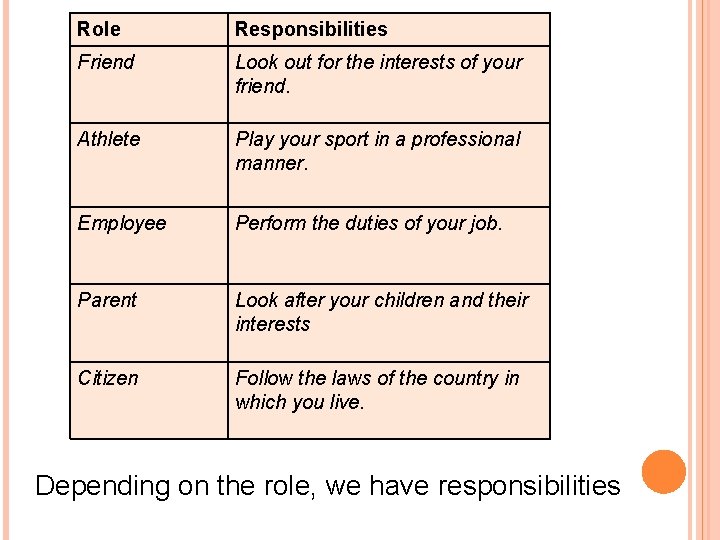
Role Responsibilities Friend Look out for the interests of your friend. Athlete Play your sport in a professional manner. Employee Perform the duties of your job. Parent Look after your children and their interests Citizen Follow the laws of the country in which you live. Depending on the role, we have responsibilities
SOCIAL RESPONSIBILITY One main connection between ethics and engineering comes from the impact that engineered products and processes have on society. Engineers have to think about designing, building, and marketing products that benefit society. Social Responsibility requires taking into consideration the needs of society.
PROFESSIONAL RESPONSIBILITY Social responsibility requires professional responsibility. National Society of Professional Engineers (NSPE) Fundamental Canons of Ethics
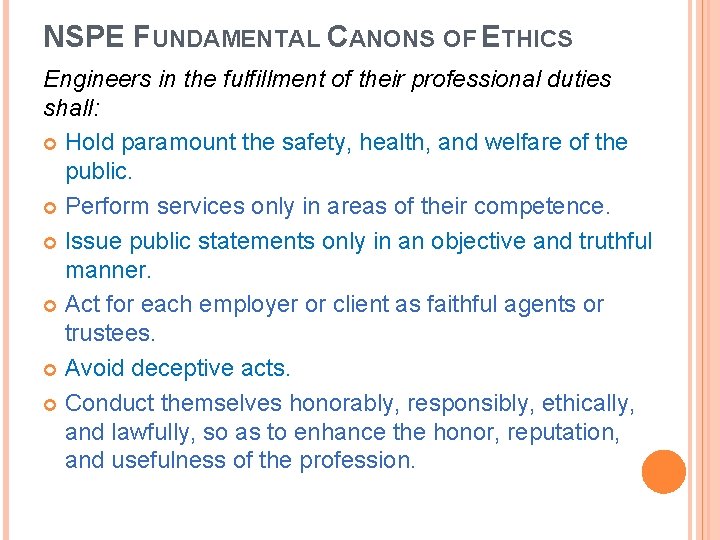
NSPE FUNDAMENTAL CANONS OF ETHICS Engineers in the fulfillment of their professional duties shall: Hold paramount the safety, health, and welfare of the public. Perform services only in areas of their competence. Issue public statements only in an objective and truthful manner. Act for each employer or client as faithful agents or trustees. Avoid deceptive acts. Conduct themselves honorably, responsibly, ethically, and lawfully, so as to enhance the honor, reputation, and usefulness of the profession.
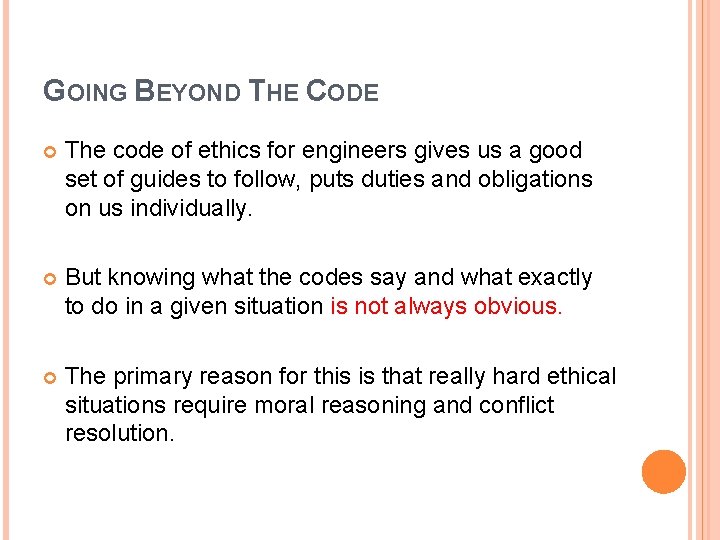
GOING BEYOND THE CODE The code of ethics for engineers gives us a good set of guides to follow, puts duties and obligations on us individually. But knowing what the codes say and what exactly to do in a given situation is not always obvious. The primary reason for this is that really hard ethical situations require moral reasoning and conflict resolution.
ETHICAL ISSUES (CONFLICTS) THAT ENGINEERS ENCOUNTER Safety Acceptable risk Compliance Confidentiality Environmental health Data integrity Conflict of interest Honesty/Dishonesty Societal impact Fairness Accounting for uncertainty, etc.
PENTIUM CASE
FRAMEWORK FOR SOLVING ETHICAL DILEMMAS: What is the Ethical Dilemma? Get the Facts Evaluate Viewpoints Make a Decision Position of Action Humphreys, K. K. (1999). What every engineer should know about ethics, New York, CRC Press
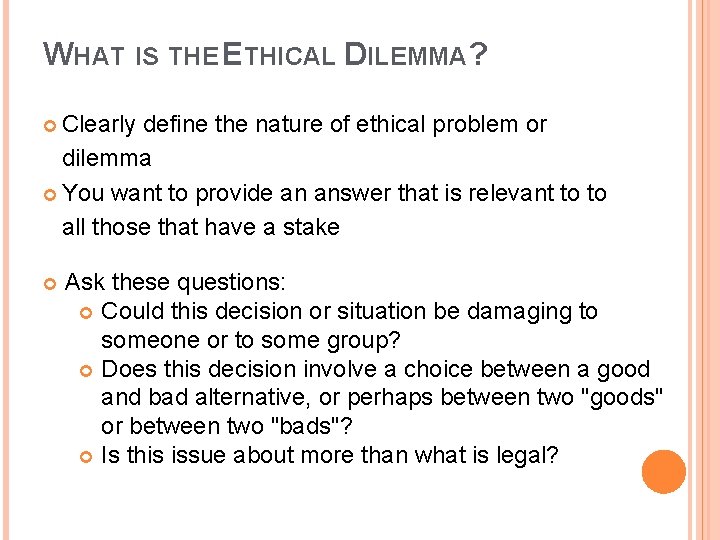
WHAT IS THE ETHICAL DILEMMA? Clearly define the nature of ethical problem or dilemma You want to provide an answer that is relevant to to all those that have a stake Ask these questions: Could this decision or situation be damaging to someone or to some group? Does this decision involve a choice between a good and bad alternative, or perhaps between two "goods" or between two "bads"? Is this issue about more than what is legal?
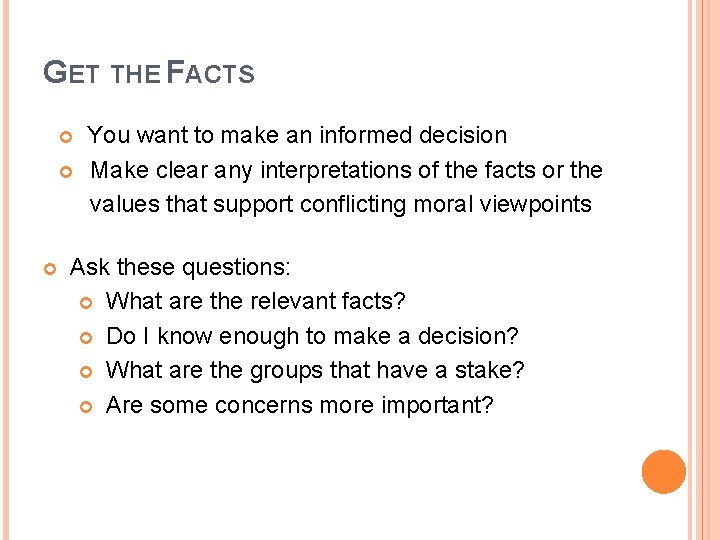
GET THE FACTS You want to make an informed decision Make clear any interpretations of the facts or the values that support conflicting moral viewpoints Ask these questions: What are the relevant facts? Do I know enough to make a decision? What are the groups that have a stake? Are some concerns more important?
EVALUATING VIEWPOINTS Use moral considerations to assess the pros and cons of competing moral viewpoints Be able to identify the most compelling reason for the course of action You must be able to justify the course of action Ask the following questions: What outcomes are desirable for a given situation, and what will achieve the best consequences? (Consequentialist-Based View) What obligations do you have and what things should you not do? (Duty-Based View) What would a virtuous person do? (Virtue. Based View)
MAKE A DECISION AND ACT Decide which of the viewpoints is the most compelling Write out your position-of-action as an argument that uses the factors you have chosen as reasons for your position of action. Attempt to defend your position of action against responses a person may have to your position. If I chose an option, what would an objective group say? Will judgment be confirmed to be morally correct
POSITION OF ACTION How can the decision be implemented given the concerns of all those involved? What have you learned from this action?
Moral Considerations
WHAT ARE MORAL CONSIDERATIONS? Moral considerations come from moral theories. It is a type of practical reasoning that concerns certain societal or life-form goals, such as justice, equality, freedom, health and safety. They are considerations important in evaluating whether an action or a way of being is morally right or good. There are many different moral theories. Some of them overlap in various ways. Others are completely distinct.
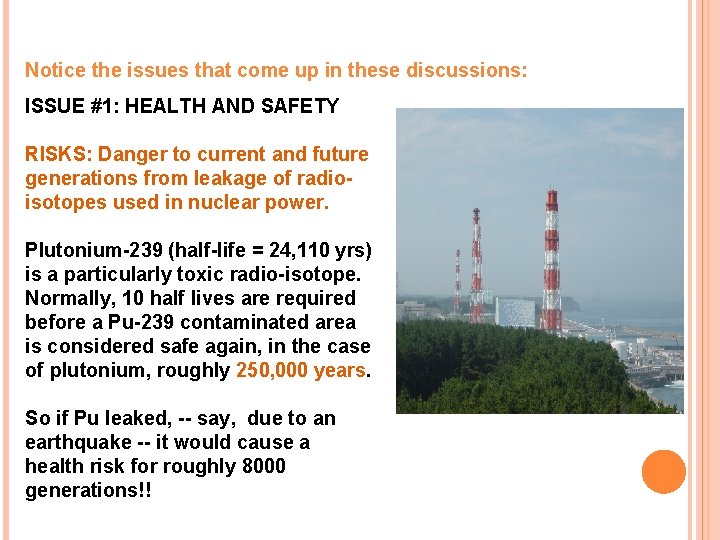
23 The Fukushima I Nuclear Power Plant
Notice the issues that come up in these discussions: ISSUE #1: HEALTH AND SAFETY Plutonium-239 (half-life = 24, 110 yrs) is a particularly toxic radio-isotope. Normally, 10 half lives are required before a Pu-239 contaminated area is considered safe again, in the case of plutonium, roughly 250, 000 years. So if Pu leaked, -- say, due to an earthquake -- it would cause a health risk for roughly 8000 generations!! 24 RISKS: Danger to current and future generations from leakage of radioisotopes used in nuclear power.
Issues (cont. ): a) The possibility of medical science discovering a cure for cancer sometime in the current or next centuries adds uncertainty to the long-term health risks of leakages of radio-active isotopes. 25 ISSUE #1: HEALTH AND SAFETY RISKS, FURTHER CONSIDERATIONS:
Issues (cont. ): b) The use of nuclear power may increase our knowledge of radioisotopes used for medical purposes (possible benefit? ). 26 ISSUE #1: HEALTH AND SAFETY RISKS, FURTHER CONSIDERATIONS:
Issues that come up in these discussions: ISSUE #2: DEPLETION OF RESOURCES: Fossil fuels, oil, natural gas and coal, are non-renewable. These resources also affect the goal of health because of their impact on pollution and climate changes. 27 CONSEQUENCES OF ALTERNATIVES TO NUCLEAR POWER.
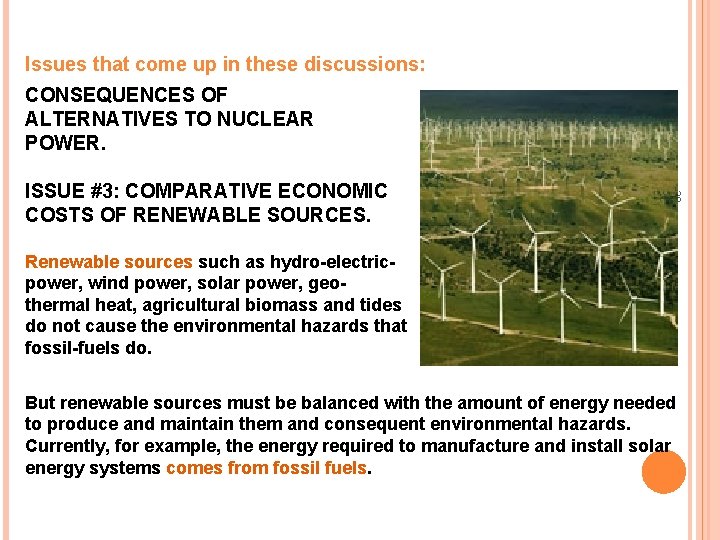
Issues that come up in these discussions: CONSEQUENCES OF ALTERNATIVES TO NUCLEAR POWER. 28 ISSUE #3: COMPARATIVE ECONOMIC COSTS OF RENEWABLE SOURCES. Renewable sources such as hydro-electricpower, wind power, solar power, geothermal heat, agricultural biomass and tides do not cause the environmental hazards that fossil-fuels do. But renewable sources must be balanced with the amount of energy needed to produce and maintain them and consequent environmental hazards. Currently, for example, the energy required to manufacture and install solar energy systems comes from fossil fuels.
REASONING The kind of reasoning that goes on in such discussions involves certain goals such as, in this case, health, safety and biodiversity. The reasoning then focuses on finding the best – or at least the reasonably better -- means for obtaining those goals.
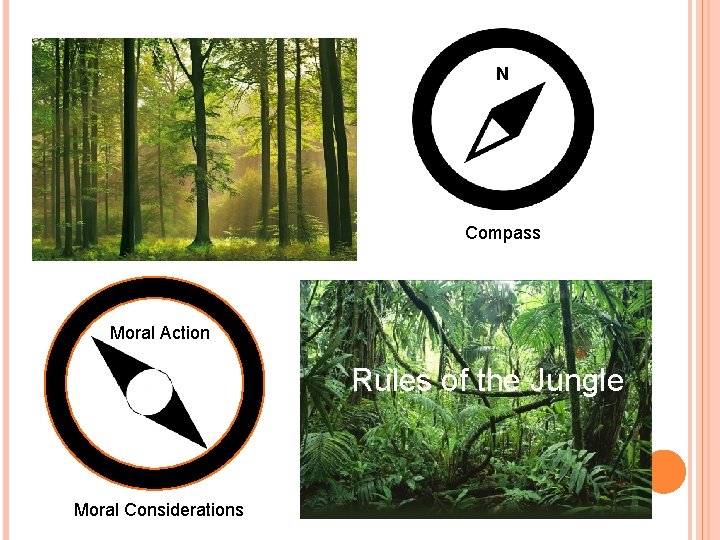
N Compass Moral Action Rules of the Jungle Moral Considerations
RECALL SAMPLE MORAL THEORIES Utilitarian Provides the most good and the least harm Justice Maintains all equals should be treated equally This option treats people as you wanted to be treated Rights Best protects and respects rights of others This option best respects the rights of all who have stake Harm/Care Ensures kindness and gentleness to those in need This option is best for those in need Virtue It’s virtuous if consistent with an ideal virtue This option leads me to act as a responsible person
OTHER MORAL THEORIES – PRIMA FACIE DUTIES Prima Facie Duties are guidelines, used for moral consideration, that give moral reason for action Fidelity Reparation Gratitude Non-Maleficence Beneficence Justice Non-parasitism Ethical Theory Based on W. D. Ross http: //people. wku. edu/jan. garrett/ethics/rossethc. htm
PRIMA FACIE DUTIES Fidelity involves keeping one’s promises, contracts and duties, and not lying. Reparation is the duty to make up for the injuries one has done to others. Gratitude is the duty to be grateful for benefits that have been given to you. http: //people. wku. edu/jan. garrett/ethics/rossethc. htm
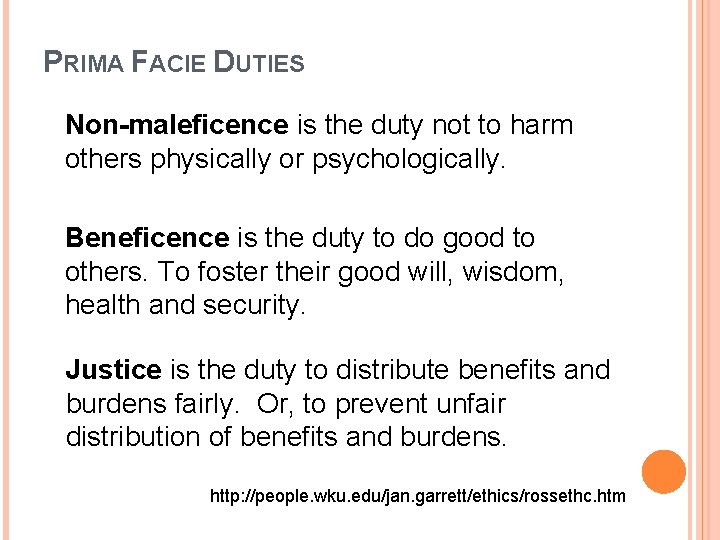
PRIMA FACIE DUTIES Non-maleficence is the duty not to harm others physically or psychologically. Beneficence is the duty to do good to others. To foster their good will, wisdom, health and security. Justice is the duty to distribute benefits and burdens fairly. Or, to prevent unfair distribution of benefits and burdens. http: //people. wku. edu/jan. garrett/ethics/rossethc. htm
PRIMA FACIE DUTIES Non-parasitism is the duty to not free-ride on society either professionally or personally. It involves taking only the appropriate benefits from the burdens one has undergone. http: //people. wku. edu/jan. garrett/ethics/rossethc. htm
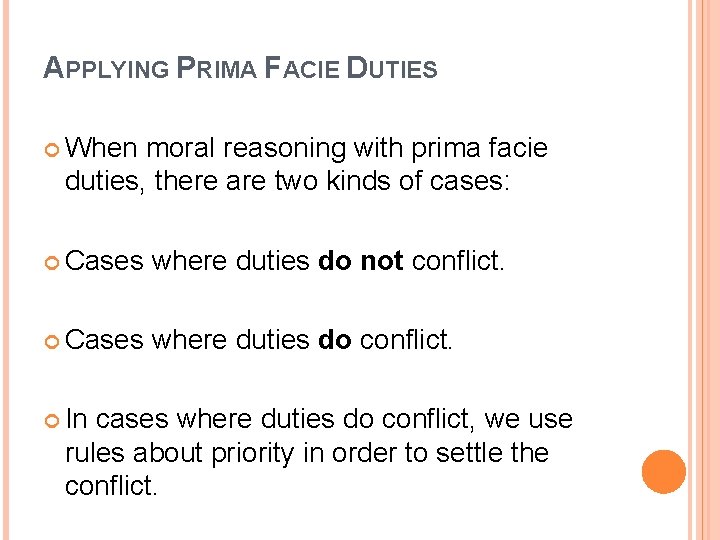
APPLYING PRIMA FACIE DUTIES When moral reasoning with prima facie duties, there are two kinds of cases: Cases where duties do not conflict. Cases where duties do conflict. In cases where duties do conflict, we use rules about priority in order to settle the conflict.
RULES OF PRIORITY Non-injury normally overrides all other prima facie duties. o You can’t harm a person to save another. Fidelity overrides beneficence. o You cannot forgo a contract in order to be kind to someone else. Beneficence and non-maleficence in relation to lasting positive qualities override prima facie duties that give one short term pleasure or pain
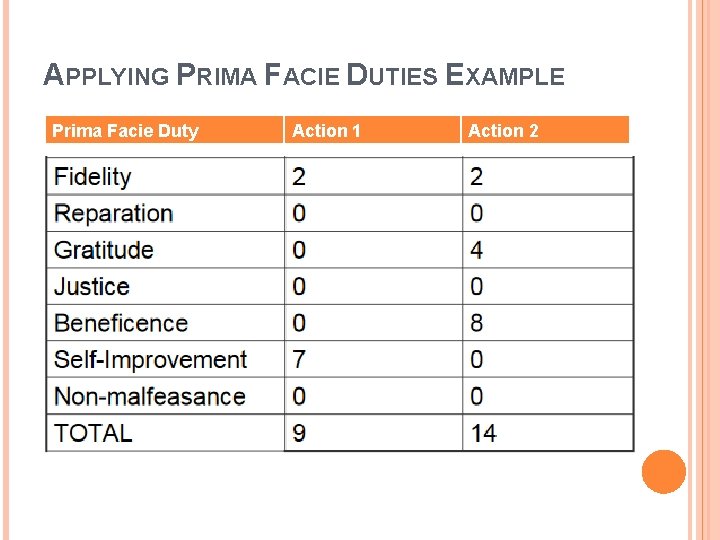
APPLYING PRIMA FACIE DUTIES EXAMPLE Prima Facie Duty Action 1 Action 2
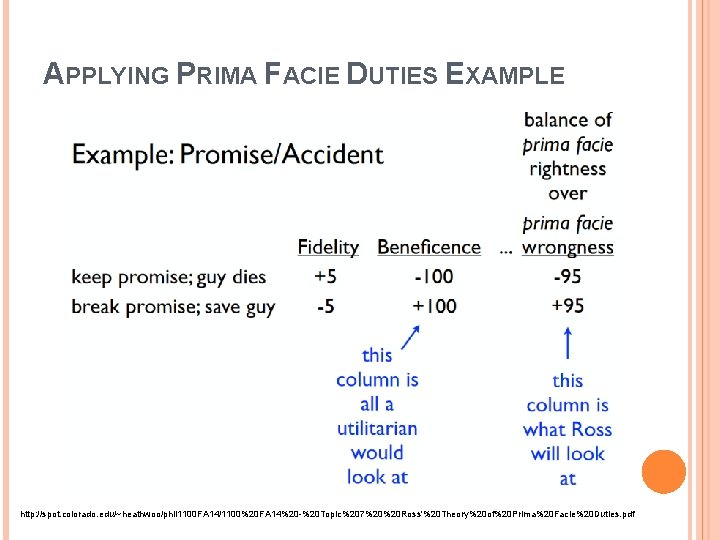
APPLYING PRIMA FACIE DUTIES EXAMPLE http: //spot. colorado. edu/~heathwoo/phil 1100 FA 14/1100%20 FA 14%20 -%20 Topic%207%20%20 Ross'%20 Theory%20 of%20 Prima%20 Facie%20 Duties. pdf
From Codes to Cases
WHERE WE WILL BEGIN To start our exploration into case analysis, we will simply begin by looking at some cases. Our goal will be to engage in a form of proto-moral reasoning about the cases, which involves the following: � Taking note of which codes of engineering ethics apply (moral considerations). � Identifying conflicts. � Making a choice of what to do. All of this will lead us to a discussion of moral considerations and reasoning.
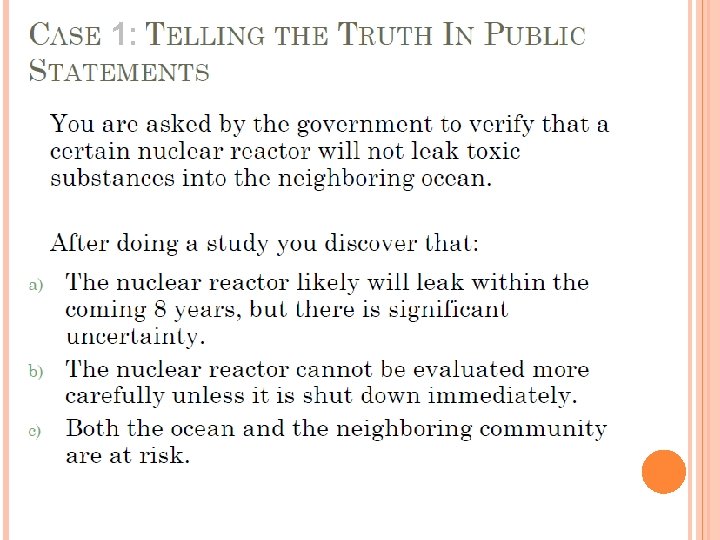
1:
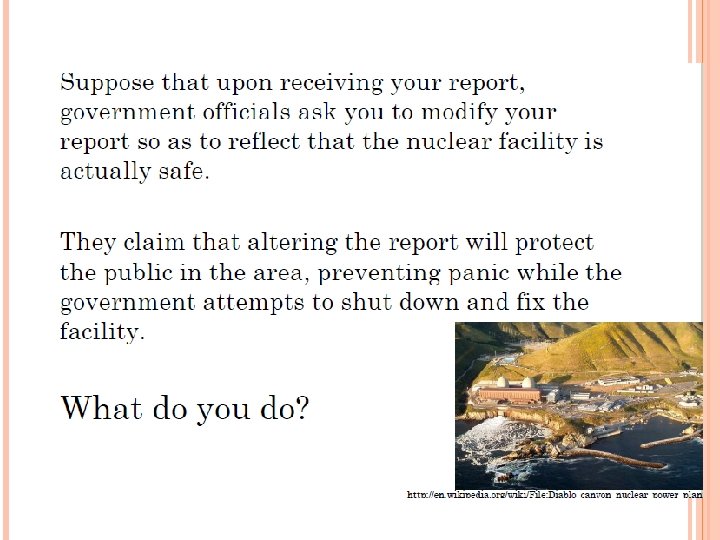
WHAT IS THE CONFLICT? The code of ethics requires that you Safeguard the public’s welfare. But it also requires that you Tell the truth when making public statements concerning your area of engineering. To solve this conflict, you must Correctly understand what each code is telling you And choose to act on the obligation that is of priority.
WHAT IS THE CONFLICT? What does protecting the public mean? Making sure that they are safe What does issue public statements in an objective and truthful manner mean. Telling the public the nuclear reactor is not safe but outlining the uncertainties But the government is asking you to alter your report in order to protect the public.
WHAT IS THE CONFLICT? Your obligation is to safeguard public safety and to tell the truth in your role as an engineer. This means that you cannot alter data as an engineer, and that you must tell the truth about the nuclear reactor. The government is calling on you as a citizen to alter documents as a way to protect your fellow citizens. The conflict is between your obligations as an engineer and your obligations as a citizen.
WHAT IS MORE IMPORTANT? Role conflicts are hard!!! No easy answer!!! This is where thinking about other moral considerations matter. � What about the public’s right to know? � What about the government’s obligation to tell the truth? In this case your duty as an engineer to tell the truth when making public statement supercedes your civic duty to be loyal to your government.
CASE 2: PROTECTING THE SAFETY OF SOCIETY Suppose you are asked by your employer to design a bridge that will cost only $1 billion. After doing a study you determine the following: a) b) c) An ideal bridge can be built for $1. 5 billion. Given the design constraints, a bridge built for $1 billion will collapse in a moderate earthquake. A bridge built for $1. 25 billion, will survive a moderate earthquake, but in an infrequent extreme earthquake it will collapse.
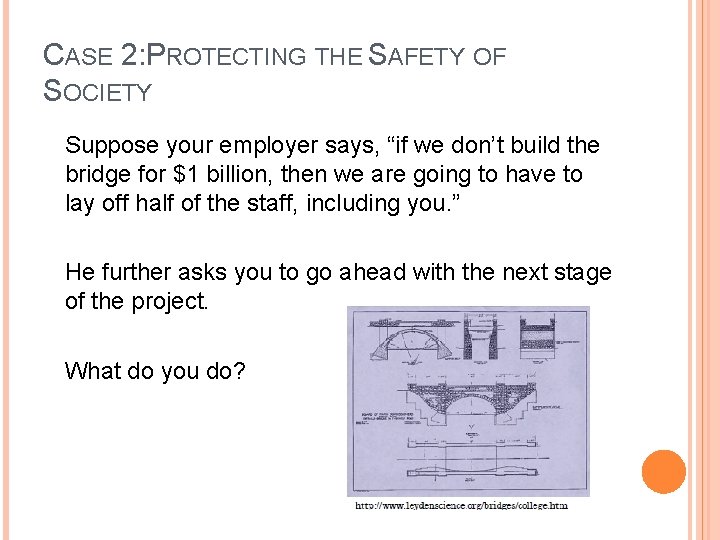
CASE 2: PROTECTING THE SAFETY OF SOCIETY Suppose your employer says, “if we don’t build the bridge for $1 billion, then we are going to have to lay off half of the staff, including you. ” He further asks you to go ahead with the next stage of the project. What do you do?
WHAT IS THE CONFLICT? The code of ethics for engineers requires: You to take the safety of society as being of paramount importance. However, you also feel a personal sense of loyalty to your company and fellow co-workers. You don’t want anyone to lose their job. The conflict is between your duty to society and your loyalty to your own career and the welfare of your other fellow employees.
WHAT IS MORE IMPORTANT? In a case like this the welfare of society comes first. We have to take into account the fact that your duty to protect the public is greater than your duty to your own career, and that of your fellow employees.
CASE 3: ACKNOWLEDGING MISTAKES You approach your boss and tell him that you are sure that your team is responsible for the failure in the device. Your boss says, “Well we will just replace it with a fixed design. We don’t need to tell them anything. It could undermine our relationship with the company, they might not come back for business. ” Should you go ahead and tell the client?
UNDERSTANDING YOUR OBLIGATION The code of ethics for engineers requires: You to avoid deceptive acts. Your boss is asking you to not reveal something to the client because by not revealing it you can maintain their confidence while at the same time replacing the device. Are you violating the code of ethics?
DECEPTION BY COMMISSION VS. OMISSION There are two kinds of deceptive practices. Deception by commission occurs when a person tells a lie, such as when one reports data that one knows to be false. Deception by omission occurs when one omits something that another party has a right and interest in knowing.
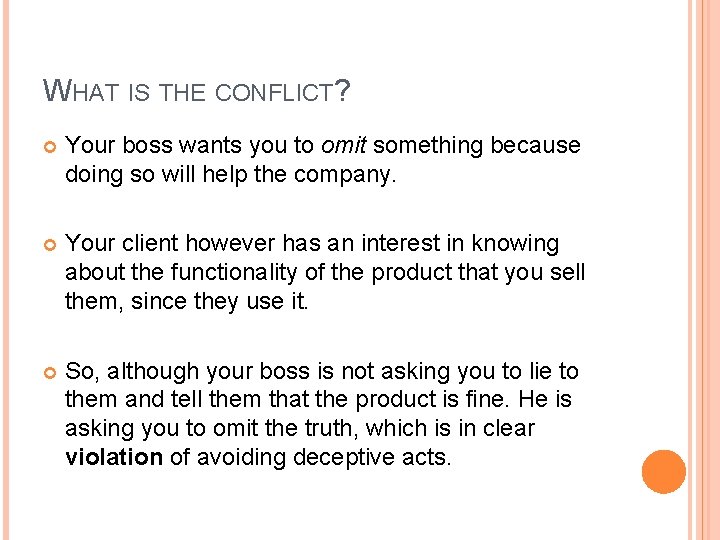
WHAT IS THE CONFLICT? Your boss wants you to omit something because doing so will help the company. Your client however has an interest in knowing about the functionality of the product that you sell them, since they use it. So, although your boss is not asking you to lie to them and tell them that the product is fine. He is asking you to omit the truth, which is in clear violation of avoiding deceptive acts.
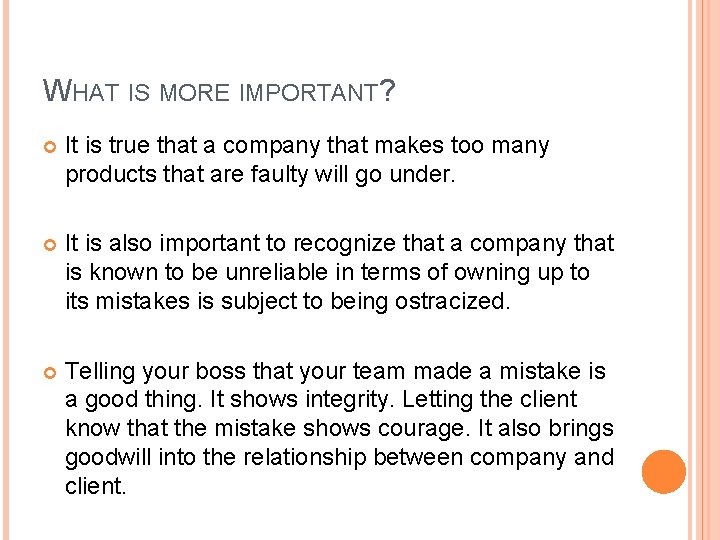
WHAT IS MORE IMPORTANT? It is true that a company that makes too many products that are faulty will go under. It is also important to recognize that a company that is known to be unreliable in terms of owning up to its mistakes is subject to being ostracized. Telling your boss that your team made a mistake is a good thing. It shows integrity. Letting the client know that the mistake shows courage. It also brings goodwill into the relationship between company and client.
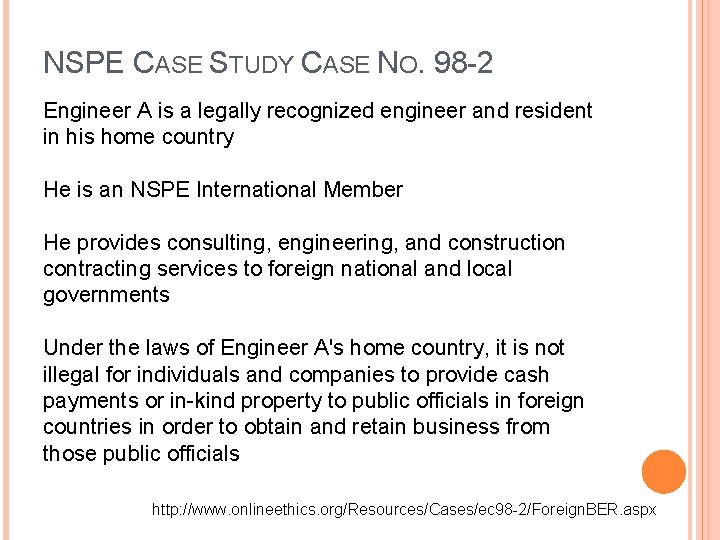
NSPE CASE STUDY CASE NO. 98 -2 Engineer A is a legally recognized engineer and resident in his home country He is an NSPE International Member He provides consulting, engineering, and construction contracting services to foreign national and local governments Under the laws of Engineer A's home country, it is not illegal for individuals and companies to provide cash payments or in-kind property to public officials in foreign countries in order to obtain and retain business from those public officials http: //www. onlineethics. org/Resources/Cases/ec 98 -2/Foreign. BER. aspx
ETHICAL DILEMMA? Would it be ethical for Engineer A to provide cash payments or in-kind property to public officials in foreign countries in order to get their business?
NSPE CODE OF ETHICS REFERENCES “Section II. 1. d. - Code of Ethics: Engineers shall not permit the use of their name or associate in business ventures with any person or firm which they believe is engaged in fraudulent or dishonest enterprise. Section II. 5. b. - Code of Ethics: Engineers shall not offer, give, solicit or receive, either directly or indirectly, any contribution to influence the award of a contract by public authority, or which may be reasonably construed by the public as having the effect or intent of influencing the awarding of a contract. They shall not offer any gift, or other valuable consideration in order to secure work. They shall not pay a commission, percentage or brokerage fee in order to secure work, except to a bona fide employee or bona fide established commercial or marketing agencies retained by them. Section III. 8. a. - Code of Ethics: Engineers shall conform with state licensure laws in the practice of engineering. ” http: //www. onlineethics. org/Resources/Cases/ec 98 -2/Foreign. BER. aspx
SUMMING UP AT THIS STAGE Being an ethical engineer requires: Knowing your obligations and duties as specified by the code of ethics. Recognizing what your obligations require of you. Being able to reason to a conclusion about what to do by employing moral considerations.
A RECURRING ETHICAL DILEMMA Engineering commitment to safety vs. All of the factors management must consider VS “It’s time to take off your engineering hat and put on your management hat. ” Morton Thiokol Senior Vice President Jerry Mason 61
ACKNOWLEDGEMENT “This framework for thinking ethically is the product of dialogue and debate in the seminar Making Choices: Ethical Decisions at the Frontier of Global Science held at Brown University in the spring semester 2011. It relies on the Ethical Framework developed at the Markkula Center for Applied Ethics at Santa Clara University and the Ethical Framework developed by the Center for Ethical Deliberation at the University of Northern Colorado as well as the Ethical Frameworks for Academic Decision-Making on the Faculty Focus website which in turn relies upon Understanding Ethical Frameworks for E-Learning Decision-Making, December 1, 2008, Distance Education Report (find url) Primary contributors include Sheila Bonde and Paul Firenze, with critical input from James Green, Margot Grinberg, Josephine Korijn, Emily Levoy, Alysha Naik, Laura Ucik and Liza Weisberg. It was last revised in May, 2013” http: //www. brown. edu/academics/science-and-technology-studies/framework-making-ethicaldecisions
BACK UP
WHAT DOES IT MEAN WHEN SOMETHING IS SAFE? SAFE Does it mean - - 100% chance nothing bad will happen? Does it mean 1 in a million change something bad will happen? 1 in 100, 000? 1 in a billion?
ACCEPTABLE RISK “A thing is safe if, were its risks fully known, those risks would be judged acceptable by reasonable persons in light of their settled value principles. ” William W. Lowrance, 1976 If I told you that the probability of a poisonous release occurring from the Student union construction in one year is 1 in 20, 000 – would you consider that acceptable risk?
ACCEPTABLE RISK If I told you that the annual probability of you dying from a transport accident is 1 in 6, 000, how would you feel about the 1 in 20, 000 odds of the poisonous release? Finally – If I told you that the annual odds of you dying from a fall is also 1 in 20, 000, does that change the way you feel about the student union?