
Ethics and Privacy CHAPTER 3 Ethical Frameworks Utilitarian

- Slides: 17
Ethics and Privacy CHAPTER 3
Ethical Frameworks Utilitarian approach: an ethical action is the one that provides the most good or does the least harm. Rights approach: ethical action is the one that best protects and respects the moral rights of the affected parties. Fairness approach: ethical actions treat all humans equally, or if unequally, then fairly, based on some defensible standard. Common good approach: highlights the interlocking relationships that underlie all societies.
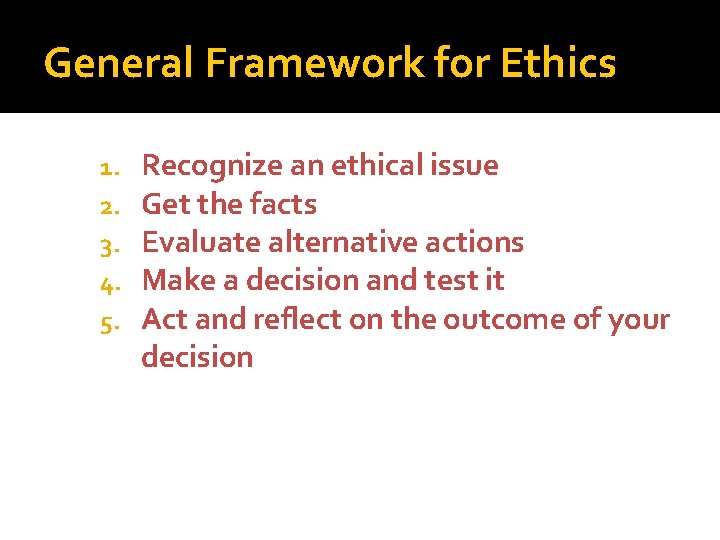
General Framework for Ethics 1. 2. 3. 4. 5. Recognize an ethical issue Get the facts Evaluate alternative actions Make a decision and test it Act and reflect on the outcome of your decision
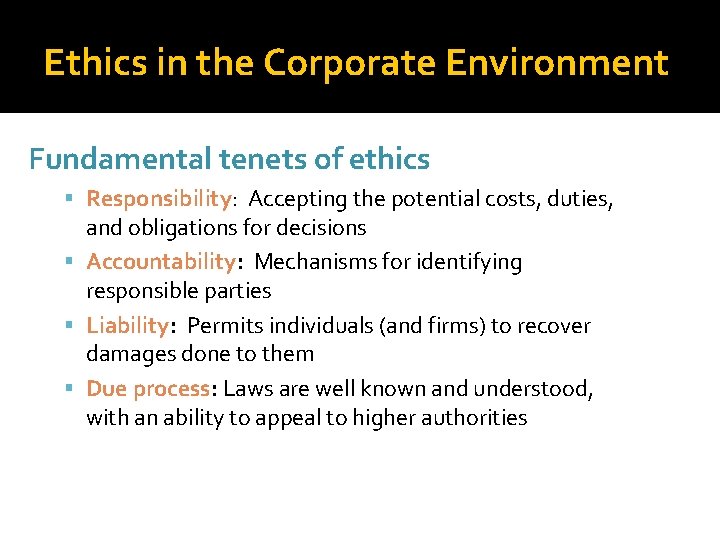
Ethics in the Corporate Environment Fundamental tenets of ethics Responsibility: Accepting the potential costs, duties, and obligations for decisions Accountability: Mechanisms for identifying responsible parties Liability: Permits individuals (and firms) to recover damages done to them Due process: Laws are well known and understood, with an ability to appeal to higher authorities
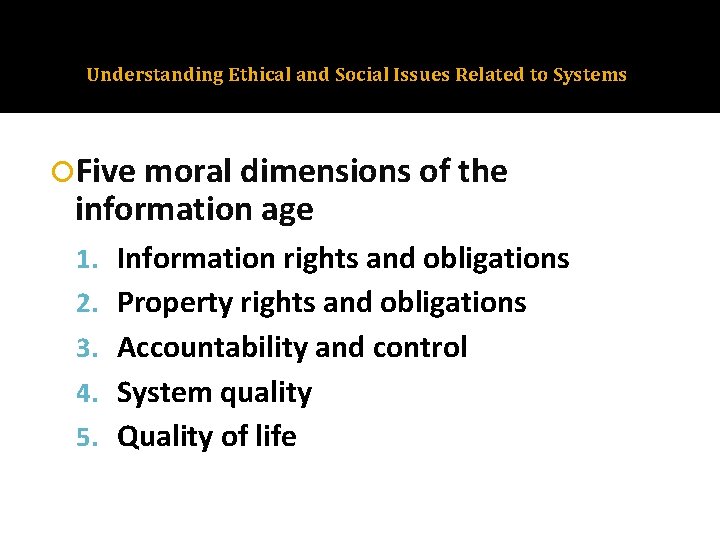
Understanding Ethical and Social Issues Related to Systems Five moral dimensions of the information age 1. Information rights and obligations 2. Property rights and obligations 3. Accountability and control 4. System quality 5. Quality of life 5 © Prentice Hall 2011
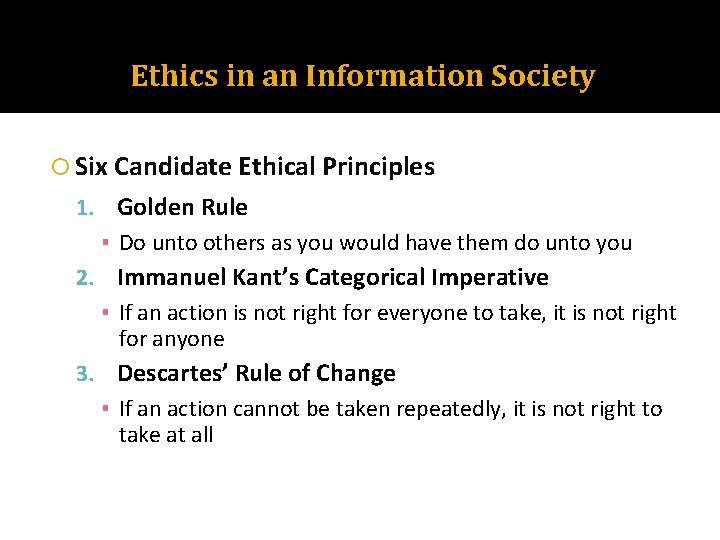
Ethics in an Information Society Six Candidate Ethical Principles 1. Golden Rule ▪ Do unto others as you would have them do unto you 2. Immanuel Kant’s Categorical Imperative ▪ If an action is not right for everyone to take, it is not right for anyone 3. Descartes’ Rule of Change ▪ If an action cannot be taken repeatedly, it is not right to take at all 6 © Prentice Hall 2011
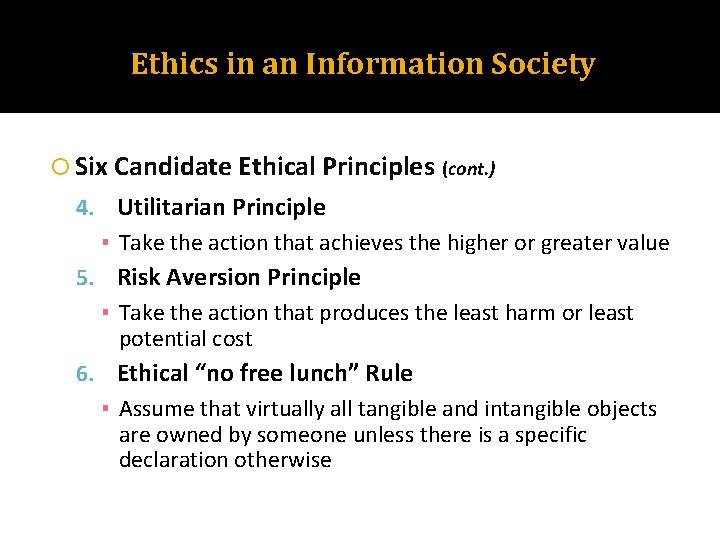
Ethics in an Information Society Six Candidate Ethical Principles (cont. ) 4. Utilitarian Principle ▪ Take the action that achieves the higher or greater value 5. Risk Aversion Principle ▪ Take the action that produces the least harm or least potential cost 6. Ethical “no free lunch” Rule ▪ Assume that virtually all tangible and intangible objects are owned by someone unless there is a specific declaration otherwise 7 © Prentice Hall 2011
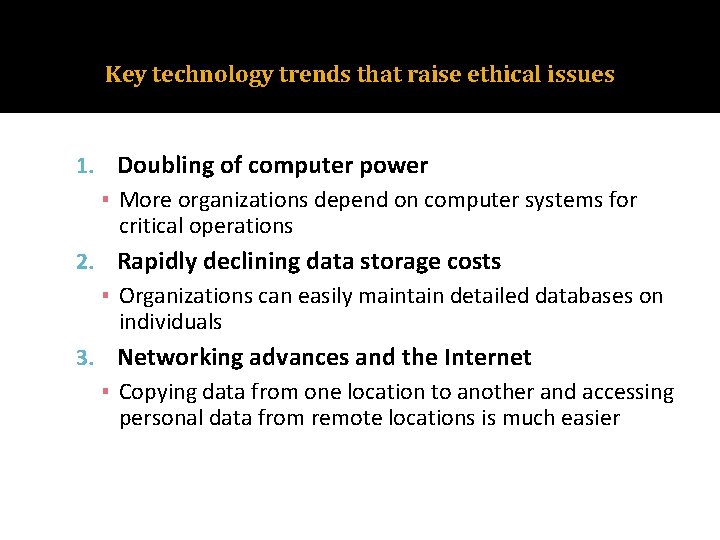
Key technology trends that raise ethical issues 1. Doubling of computer power ▪ More organizations depend on computer systems for critical operations 2. Rapidly declining data storage costs ▪ Organizations can easily maintain detailed databases on individuals 3. Networking advances and the Internet ▪ Copying data from one location to another and accessing personal data from remote locations is much easier 8 © Prentice Hall 2011
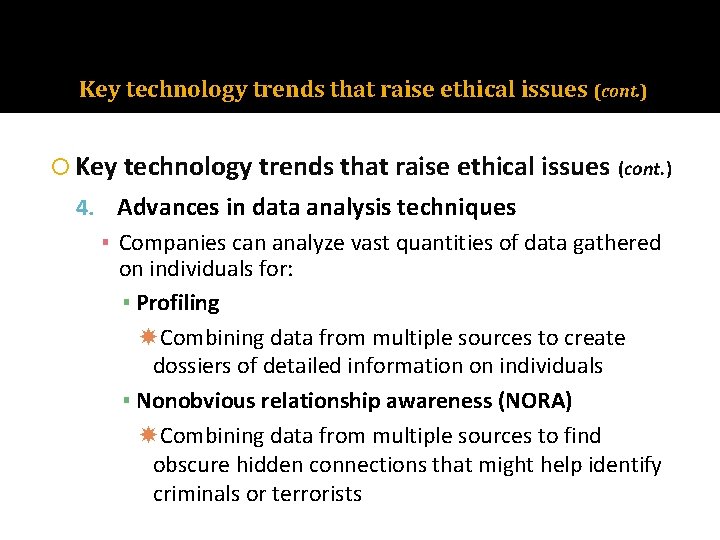
Key technology trends that raise ethical issues (cont. ) 4. Advances in data analysis techniques ▪ Companies can analyze vast quantities of data gathered on individuals for: ▪ Profiling Combining data from multiple sources to create dossiers of detailed information on individuals ▪ Nonobvious relationship awareness (NORA) Combining data from multiple sources to find obscure hidden connections that might help identify criminals or terrorists 9 © Prentice Hall 2011
Ethics and Information Technology Privacy Issues involve collecting, storing and disseminating information about individuals. Accuracy Issues involve the authenticity, fidelity and accuracy of information that is collected and processed. Property Issues involve the ownership and value of information. Accessibility Issues revolve around who should have access to information and whether they should have to pay for this access.
3. 2 Privacy Court decisions have followed two rules: (1) The right of privacy is not absolute. Your privacy must be balanced against the needs of society. (2) The public’s right to know is superior to the individual’s right of privacy.
Threats to Privacy Data aggregators are companies that collect public data Digital dossiers is an electronic description of you and your habits. Profiling is the process of creating a digital dossier Electronic Surveillance Personal Information in Databases Information on Internet Bulletin Boards, Newsgroups, and Social Networking Sites
What Can You Do? First, be careful what information you post on social networking sites. Second, a company, Reputation. Defender, says it can remove derogatory information from the Web.
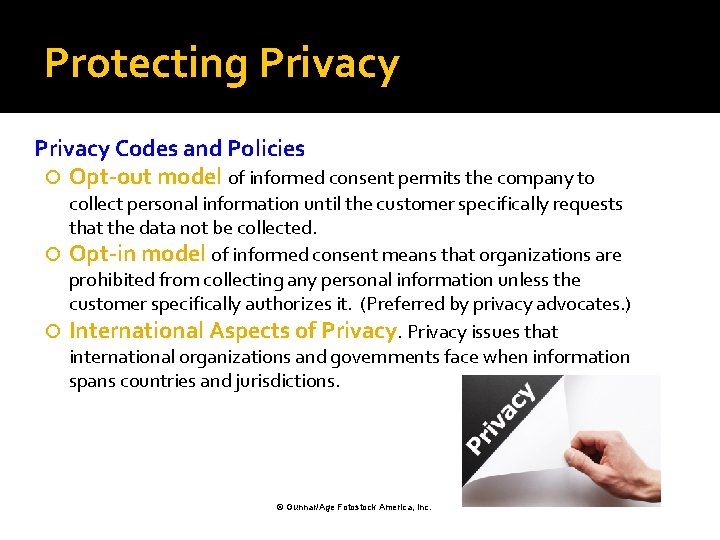
Protecting Privacy Codes and Policies Opt-out model of informed consent permits the company to collect personal information until the customer specifically requests that the data not be collected. Opt-in model of informed consent means that organizations are prohibited from collecting any personal information unless the customer specifically authorizes it. (Preferred by privacy advocates. ) International Aspects of Privacy issues that international organizations and governments face when information spans countries and jurisdictions. © Gunnar/Age Fotostock America, Inc.
Social Networking Sites Can Cause You Problems Anyone can post derogatory information about you anonymously. (See this Washington Post article. ) You can also hurt yourself, as this article shows.
Electronic Surveillance See "The State of Surveillance" article in Business. Week See the surveillance slideshow See additional surveillance slides And you think you have privacy? (video)
Unethical vs. Illegal What is unethical is not necessarily illegal. Ethics scenarios