
Ethics and Leadership Outline What is ethics Three
- Slides: 25
Ethics and Leadership
Outline • What is ethics? • Three approaches to resolving ethical conflicts • Making ethical decisions
Ethics: What Does It Really Mean? Definitions • Ethics involves a discipline that examines good or bad practices within the context of a moral duty • Moral conduct is behavior that is right or wrong
Two Key Branches of Ethics • Descriptive ethics involves describing, characterizing and studying morality – “What is” • Normative ethics involves supplying and justifying moral systems – “What should be”
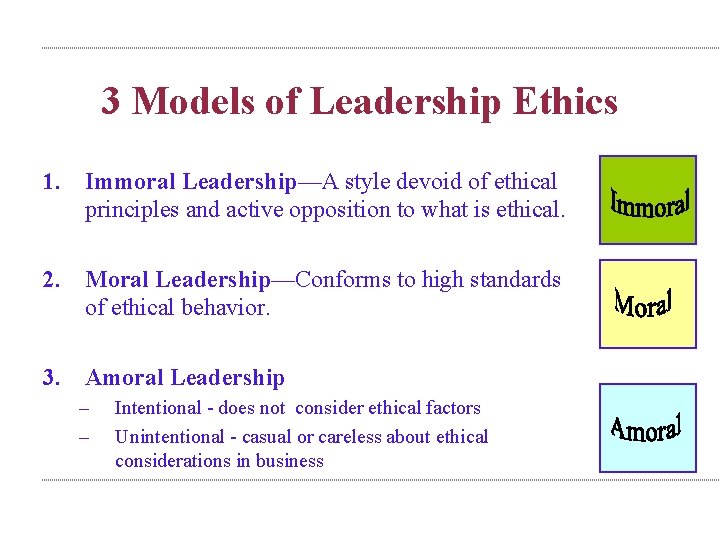
3 Models of Leadership Ethics 1. Immoral Leadership—A style devoid of ethical principles and active opposition to what is ethical. 2. Moral Leadership—Conforms to high standards of ethical behavior. 3. Amoral Leadership – – Intentional - does not consider ethical factors Unintentional - casual or careless about ethical considerations in business
Resolving Ethical Conflicts Three Approaches • Conventional • Principles • Ethical tests
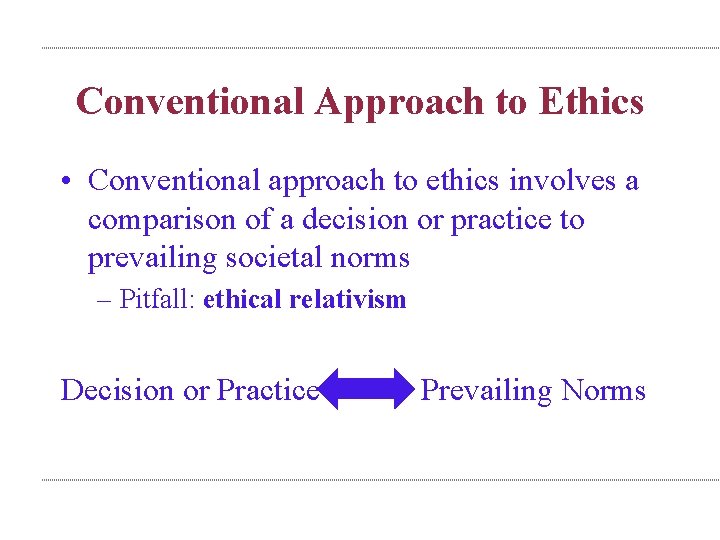
Conventional Approach to Ethics • Conventional approach to ethics involves a comparison of a decision or practice to prevailing societal norms – Pitfall: ethical relativism Decision or Practice Prevailing Norms
Leadership and Ethics Culture Relativism Many people in contemporary society are inclined toward relativism - roughly, the view that there is no objective truth in morality, right and wrong are only matters of opinion that vary from culture to culture, and possibly, from person to person.
Leadership and Ethics Culture Relativism Descriptive relativism claims that members of different cultures have different moral beliefs. Normative relativism claims that the truth of moral beliefs depends upon particular cultures, such that the belief that cannibalism is right can be true for culture A but false for culture B.
Leadership and Ethics Culture Relativism Normative relativism has some rather undesirable implications: – it prohibits us from ever morally condemning another culture’s values and practices; – it suggests that we need look no further that our own culture for moral guidance; – it renders the notions of moral progress and moral reform incoherent.
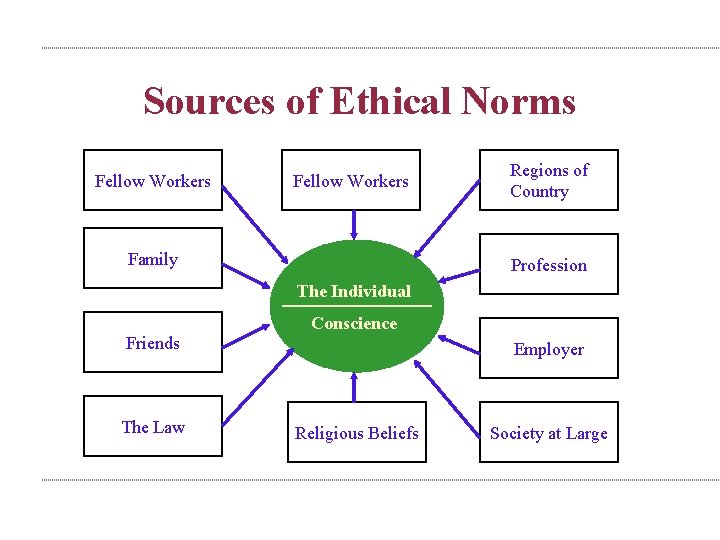
Sources of Ethical Norms Fellow Workers Family Regions of Country Profession The Individual Friends The Law Conscience Employer Religious Beliefs Society at Large
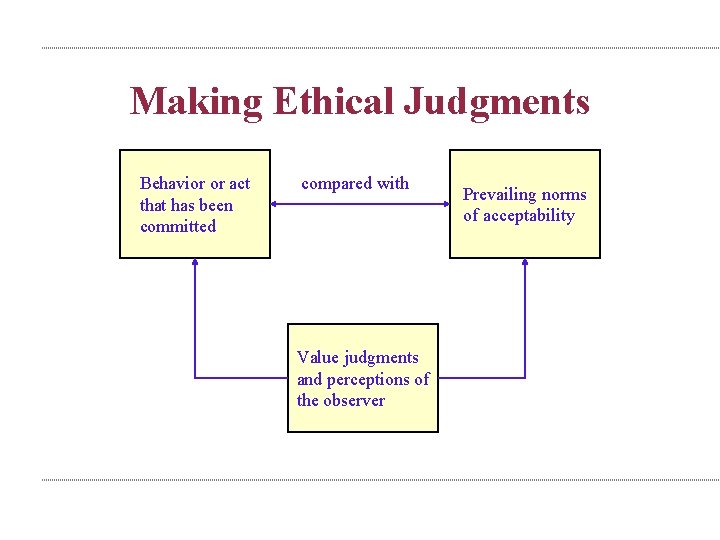
Making Ethical Judgments Behavior or act that has been committed compared with Value judgments and perceptions of the observer Prevailing norms of acceptability
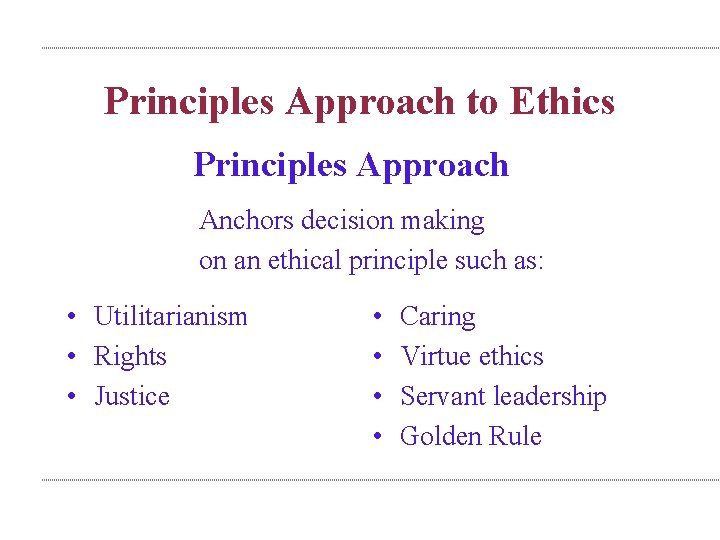
Principles Approach to Ethics Principles Approach Anchors decision making on an ethical principle such as: • Utilitarianism • Rights • Justice • • Caring Virtue ethics Servant leadership Golden Rule
Principles Approach to Ethics Principle of Utilitarianism focuses on an act that produces the greatest ratio of good to evil for everyone – Consequentialist theory
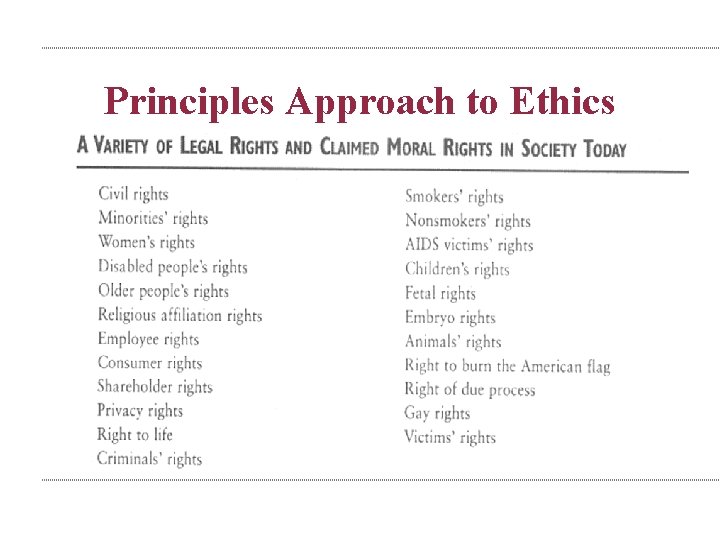
Principles Approach to Ethics Principle of Rights focuses on examining and possibly protecting individual moral or legal rights
Principles Approach to Ethics
Principles Approach to Ethics • Principle of justice involves considering what alternative promotes fair treatment of people • Types of justice – Distributive – Compensatory – Procedural
Principles Approach to Ethics • Principle of caring focuses on a person as a relational (cooperative) and not as an individual – Feminist theory • Virtue ethics focuses on individuals becoming imbued with virtues – Aristotle and Plato
Servant Leadership and Ethics Characteristics of Servant Leaders • • • Listening Empathy Healing Persuasion Awareness • Foresight • Conceptualization • Commitment to the growth of people • Stewardship • Building community
Golden Rule Golden rule focuses on the premise that you should of unto others as you would have them do unto you
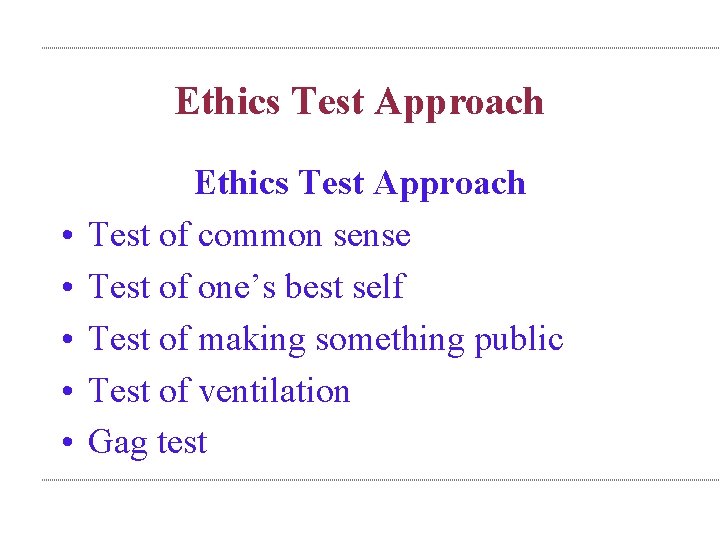
Ethics Test Approach • • • Ethics Test Approach Test of common sense Test of one’s best self Test of making something public Test of ventilation Gag test
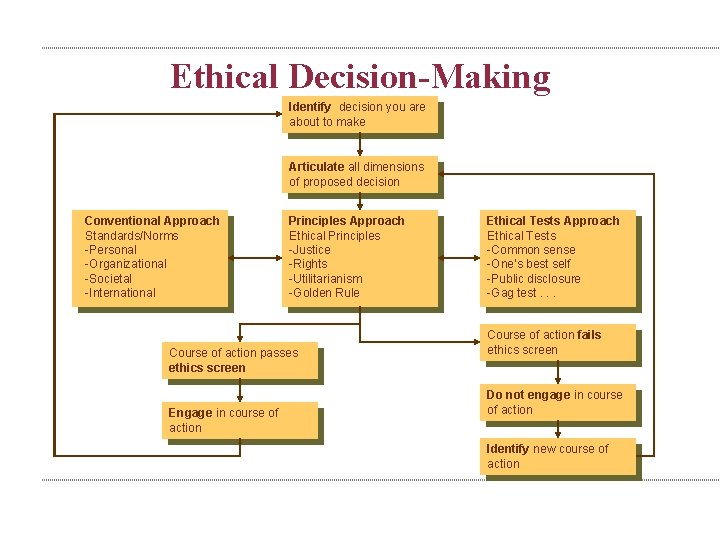
Ethical Decision-Making Identify decision you are about to make Articulate all dimensions of proposed decision Conventional Approach Standards/Norms -Personal -Organizational -Societal -International Principles Approach Ethical Principles -Justice -Rights -Utilitarianism -Golden Rule Course of action passes ethics screen Engage in course of action Ethical Tests Approach Ethical Tests -Common sense -One’s best self -Public disclosure -Gag test. . . Course of action fails ethics screen Do not engage in course of action Identify new course of action
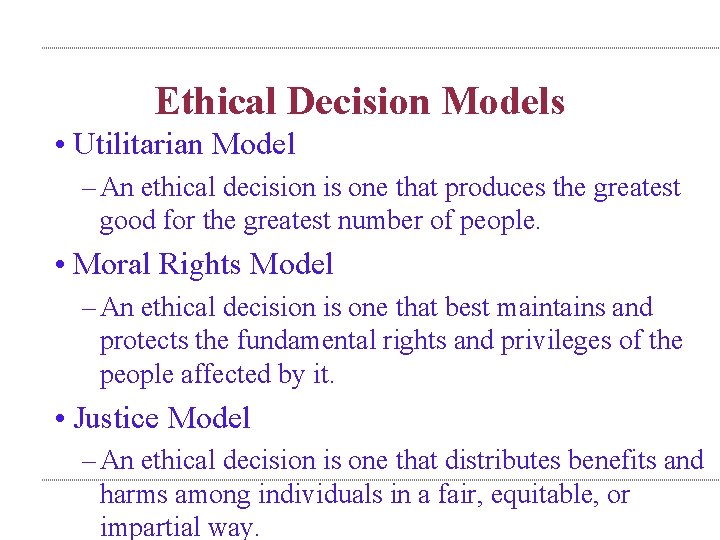
Ethical Decision Models • Utilitarian Model – An ethical decision is one that produces the greatest good for the greatest number of people. • Moral Rights Model – An ethical decision is one that best maintains and protects the fundamental rights and privileges of the people affected by it. • Justice Model – An ethical decision is one that distributes benefits and harms among individuals in a fair, equitable, or impartial way.
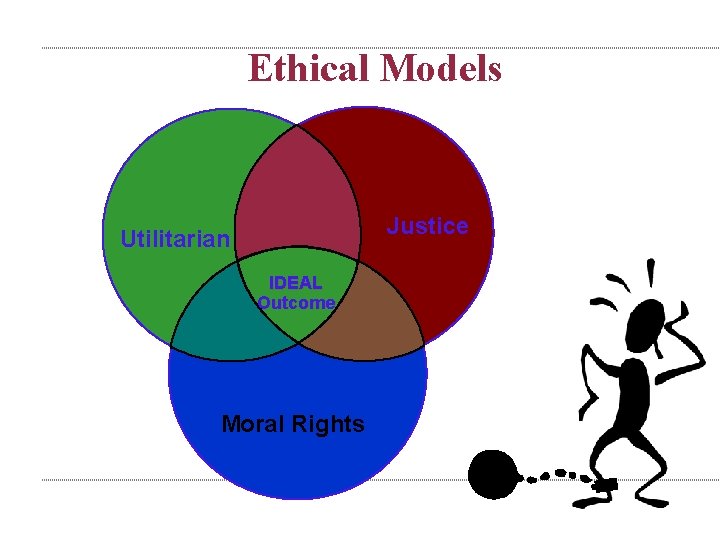
Ethical Models Justice Utilitarian IDEAL Outcome Moral Rights
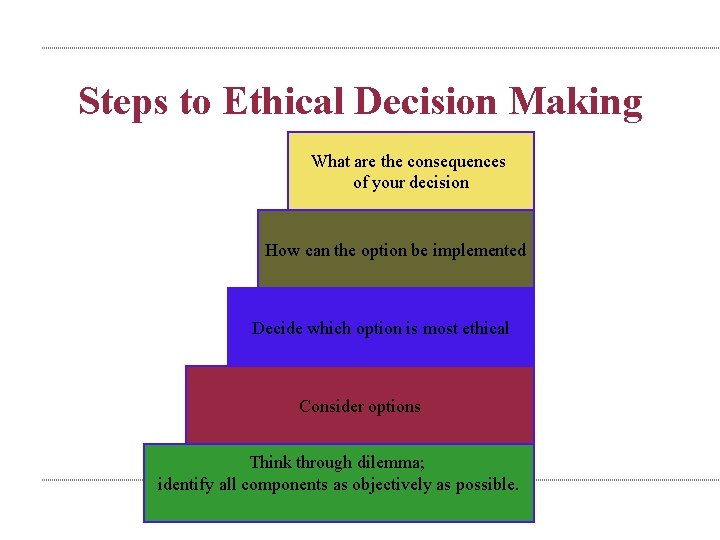
Steps to Ethical Decision Making What are the consequences of your decision How can the option be implemented Decide which option is most ethical Consider options Think through dilemma; identify all components as objectively as possible.