
ETHICS AND BOUNDARIES FOR COMMUNITY HEALTH WORKERS ETHICAL
ETHICS AND BOUNDARIES FOR COMMUNITY HEALTH WORKERS

ETHICAL CONSIDERATIONS
WHAT ARE ETHICS? Ethics n. The rules or standards governing the conduct of a person or the conduct of the members of a profession. The American Heritage® Medical Dictionary Copyright © 2007, 2004 by Houghton Mifflin Company. Published by Houghton Mifflin Company. All rights reserved.

FOUR PRINCIPLES OF BIOETHICS BY TOM L. BEAUCHAMP AND JAMES R. CHILDRESS (1994) The four principles are: Respect for autonomy. Allow people to make decisions about themselves for themselves. It is respect for human dignity and belief in a person's ability to make good decisions. It is the opposite of paternalism. Nonmaleficence. Actions should not harm others. It is derived from the Hippocratic oath, “First, do no harm. " Beneficence. This is the mirror image of nonmaleficence, meaning that actions are taken in order to maximize benefits to individuals and society. It is the principle of doing good. Justice. This is the principle that benefits and harms should be equally distributed among people. Related ideas are fairness, equity, and impartiality. Read more: http: //www. answers. com/topic/ethics-of-public-health#ixzz 2 o 3 Lcrvs. D
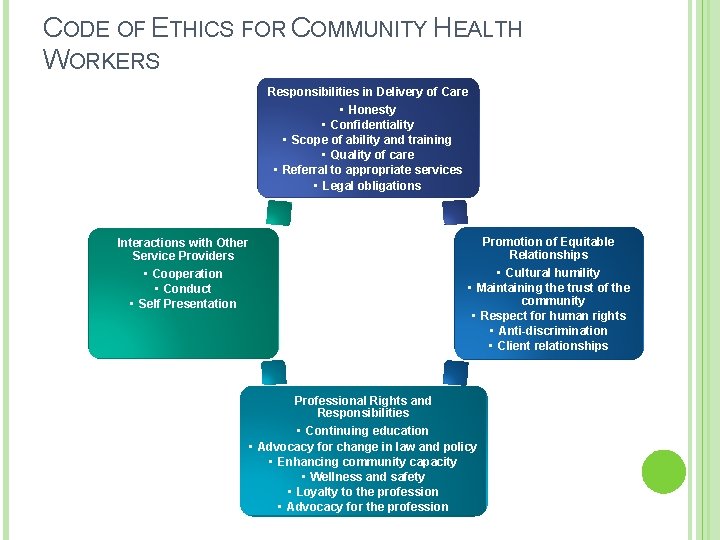
CODE OF ETHICS FOR COMMUNITY HEALTH WORKERS Responsibilities in Delivery of Care • Honesty • Confidentiality • Scope of ability and training • Quality of care • Referral to appropriate services • Legal obligations Interactions with Other Service Providers • Cooperation • Conduct • Self Presentation Promotion of Equitable Relationships • Cultural humility • Maintaining the trust of the community • Respect for human rights • Anti-discrimination • Client relationships Professional Rights and Responsibilities • Continuing education • Advocacy for change in law and policy • Enhancing community capacity • Wellness and safety • Loyalty to the profession • Advocacy for the profession • Recognition of others
In addition, the Oregon Health Authority has developed Standards of Professional Conduct for Traditional Health Workers (Community Health Workers, Peer Wellness Specialists, Peer Support Specialists, Health Navigators, and Doulas). These standards are found within the Oregon Administrative Rules in OAR 410 -180 -340.
ETHICS EXERCISE: Group: Discuss the ethics of them as they relate to Community Health Workers in these 3 scenarios.
BOUNDARIES
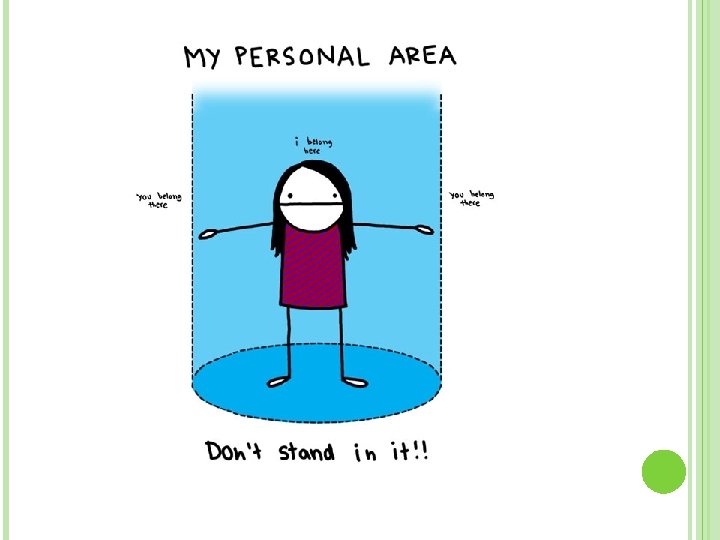
WHAT ARE BOUNDARIES? Boundaries are the personal rules or limits that an individual sets with others about what behavior is reasonable, safe, and permissible around him or her. They also outline how the individual will respond when someone steps outside of those limits. Boundaries are build out of a mix of beliefs, opinions, attitudes, past experiences, and social learning.
TYPES OF BOUNDARIES Physical Boundaries Mental Boundaries Emotional Boundaries
WHY HAVE PROFESSIONAL BOUNDARIES? § § Reduces risk of exploitation workers and service recipients Reduces anxiety from workers as rules and roles are clear Provides role model for service recipients Increases well-being of workers
SIGNS THAT A MEMBER HAS UNHEALTHY BOUNDARIES Telling all (sharing too much information) Talks at an intimate level at the first meeting Falls in love with acquaintances Takes as much as possible regardless of need Gives as much as he/she can give for the sake of giving
MORE SIGNS THAT A MEMBER HAS UNHEALTHY BOUNDARIES Believes others should anticipate his/her and fulfill their needs Falls apart so someone will take care of them Self-abuse Goes against personal values or rights to please others Allows other people to take advantage of him/her
SIGNS THAT STAFF HAVE UNHEALTHY BOUNDARIES Giving your home phone number to clients or telling them to call any time Giving intimate information about yourself to clients Believing that only you can “save” this person Believing that colleagues don’t understand when you discuss/defend your behavior with clients Lending clients money
MORE SIGNS THAT STAFF HAVE UNHEALTHY BOUNDARIES Taking sides in an argument between clients Considering yourself “part of the family” with clients Experiencing stress induced illnesses when involved in interactions with clients Taking clients home
GROUP EXERCISE How would you categorize these interactions by a Community Health Worker? ü Zone of Safety (Always okay) ü Zone of Vulnerability (Sometimes okay; Sometimes not okay) ü Zone of Abuse (Never Okay)
ACTIONS: ZONE OF SAFETY (ALWAYS OKAY) ZONE OF VULNERABILITY (SOMETIMES OKAY; SOMETIMES NOT OKAY) ZONE OF ABUSE (NEVER OKAY) § § § § Giving a gift Accepting a gift Lending money Borrowing or accepting money Giving a hug “You’re a very special person” “You’re a very special person to me. ”
ACTIONS: ZONE OF SAFETY (ALWAYS OKAY) ZONE OF VULNERABILITY (SOMETIMES OKAY; SOMETIMES NOT OKAY) ZONE OF ABUSE (NEVER OKAY) § § § Invitation to holiday dinner Sexual relationship with a member’s family member Giving cell phone number Using profanity Using drug culture slang
ACTIONS: ZONE OF SAFETY (ALWAYS OKAY) ZONE OF VULNERABILITY (SOMETIMES OKAY; SOMETIMES NOT OKAY) ZONE OF ABUSE (NEVER OKAY) § § § “I’m going through a rough divorce myself right now. ” “You’re very attractive. ” Addressing person by their first name Attending recovery support meeting together Hiring person to do work at your home Source: Ethical Guidelines for the Delivery of Peer-based Recovery Support Services - Philadelphia Department of Behavioral Health and Mental Retardation Services & Pennsylvania Recovery Organization—Achieving Community Together
CREATING HEALTHY BOUNDARIES
WAYS TO SET HEALTHY BOUNDARIES Be up front about your role with the member. Set limits and be clear from the beginning. Set firm limits and be prepared to reinforce them. Stop and think when about to self-disclose. Understand where disclosure is helpful, and when it is about you and your needs.
HEALTHY BOUNDARIES CONTINUED Self-awareness is key. Listen to your gut feelings and take the time to explore what is causing them. Take a step back. Ask for help when you need it. When in doubt, ask. Discuss any concerns or worries with your coworkers and supervisor. Know that there may be a time that you cannot alleviate unhealthy boundaries with a client. You may have to stop being their Community Health Worker, for assistance make sure to talk with your supervisor.
Remember: We teach people how to treat us. By setting up healthy boundaries we are helping create effective relationships with our members and modeling healthy boundary setting.
- Slides: 26