
Ethical web principles Amy M Drayer What is
Ethical web principles Amy M. Drayer
What is ethical web design?
Ethical web design is designing for the wellbeing of the person consuming the content.
“This is how bad design makes it out into the world. Not due to malicious intent, but having no intent at all. ”
Accessible Inclusive Mindful Sustainable Trustful Truthful Universal
Accessible “All information resources that are provided directly or indirectly by the library, regardless of technology, format, or methods of delivery, should be readily, equally, and equitably accessible to all library users. ”
Inclusive Design is made for everyone regardless of gender, sexual orientation, race, ethnicity, cultural background, and emotional state.
Mindful Be aware of our own biases and assumptions, and recognize we are not the user. Lead with person-first design, embracing people as complex. Make decisions based on user wellbeing over product.
Sustainable Sustainability is as much about our planet’s wellbeing as it is our own, as they are intertwined.
Trustful Safe, secure, private. These are the 3 tenets that users expect, and which are often exploited. Promote personal data ownership.
Truthful Fight disinformation, the act of intentionally deceiving. Promote fairness and use non-biased language.
Universal Avoid building to one way of doing or being. Build to be understandable and simple, and in a way that allows us to be human and make errors.
Accessible Inclusive Mindful Sustainable Trustful Truthful Universal

Elegant accessibility. semantic HTML more accessibility less code less energy
Readable content. cognitive and learning accessible mindful of time and attention less energy
Good performance is good. more inclusive less energy

Analytical compromises. 1 GB of data transmission = 0. 0042 kg of pollution 3, 771, 656 trees annually to zero the carbon Lost privacy ownership
Typography selection. dyslexia != dyslexic-designed font sets more legibility universal less energy
Dark patterns. dark patterns = everything unethical
Thought exercise. 1. What world are you building for your visitors? What capabilities are you granting or enabling? 2. What kind of person do you become by doing this, and is that the kind of person you aspire to be? 3. Would you want every other person in your position to make the same decision you just made? Are you upholding your duties of care? 4. Does this improve the lives of everyone affected?
Bibliography. ● How Designers Destroyed the World by Mike Monteiro, Webstock 2013 ● ALA’s core values of librarianship ● The Danger of a Single Story by Chimamanda Ngozi Angzie, TEDGlobal 2009 ● Sustainable Software Engineering by Asim Hussain principles ● Elegant Accessibility by Dafydd Henke-Reed, Inclusive Design 24 (ID 24) 2018 ● Performance as User Experience by Aaron Gustafson, An Event Apart 2017 ● ● ● Developer’s Guide to Accessibility Mechanics by Leonie Watson, You Gotta Love Front End 2016 Readability & Web by Damien Senger, Inclusive Design 24 (ID 24) 2018 Investigating the Correlation between Performance Scores and Energy Consumption of Mobile Web Apps Calculating the Pollution Cost of Website Analytics by Gerry Mc. Govern Delete 90%: Principles of Digital Earth Experience Design by Gerry Mc. Govern Dark Patterns Using Ethics in Web Design by Morten Rand-Hendriksen, Smashing Magazine 2018 ● ●
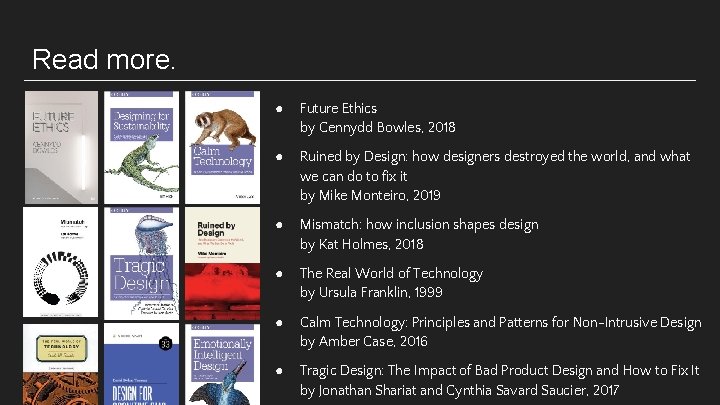
Read more. ● Future Ethics by Cennydd Bowles, 2018 ● Ruined by Design: how designers destroyed the world, and what we can do to fix it by Mike Monteiro, 2019 ● Mismatch: how inclusion shapes design by Kat Holmes, 2018 ● The Real World of Technology by Ursula Franklin, 1999 ● Calm Technology: Principles and Patterns for Non-Intrusive Design by Amber Case, 2016 ● Tragic Design: The Impact of Bad Product Design and How to Fix It by Jonathan Shariat and Cynthia Savard Saucier, 2017
Explore more online. Ethical Explorer https: //ethicalexplorer. org/ Spotify’s Ethics Assessment worksheet Calm Tech https: //calmtech. com/

Thank you. Amy Drayer adrayer@umn. edu
- Slides: 24