
Ethical Thought Introductory ideas People have values Where


- Slides: 21
Ethical Thought: Introductory ideas People have values. Where do they get these values from? If they follow “right” values consistently, they are considered to be a moral person. • Is this simply social expectation? • Or is there something real about goodness?
Introduction to Ethics • Normative ethics – From “nomos” – norms or laws. – What does a particular theory tell us about what we should do? • Applied ethics – Applying a particular normative theory to moral problems – Evaluating effectiveness of that theory in solving moral problems • Meta-ethics – Thinking about moral reasoning itself – What do we mean when we use words as “good”, “bad”? – What is morality based on? Feelings or reasoning? Social contract? Psychology?
Your views on morality, in general… Are there moral facts/truths Is something objectively right or wrong, no matter who, when, what, how? Does morality emerge from character, or is it about their actions? Does God decide what is right? Does morality come from pressures in society? Our duties as citizens, workers, family commitments? Is morality subjective? Decided by our opinions or feelings ? Do moral facts only reflect the way we humans, are made? Eg feeling pain, pleasure, having a sense of dignity? Use these prompts to summarise your own thinking on morality. Look at the table showing how moral theories may be different. - Which ones decide right/wrong objectively? - Which ones decide morality subjectively - What is the difference between deontological and consequentialist?
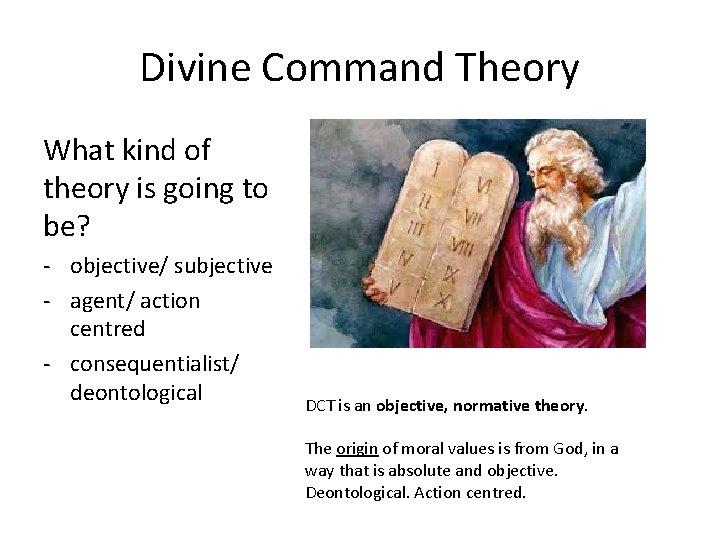
Divine Command Theory What kind of theory is going to be? - objective/ subjective - agent/ action centred - consequentialist/ deontological DCT is an objective, normative theory. The origin of moral values is from God, in a way that is absolute and objective. Deontological. Action centred.
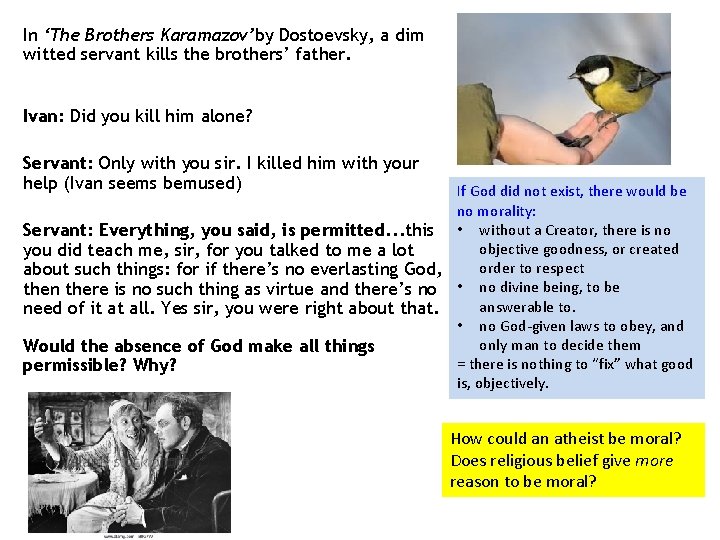
In ‘The Brothers Karamazov’by Dostoevsky, a dim witted servant kills the brothers’ father. Ivan: Did you kill him alone? Servant: Only with you sir. I killed him with your help (Ivan seems bemused) If God did not exist, there would be no morality: Servant: Everything, you said, is permitted. . . this • without a Creator, there is no objective goodness, or created you did teach me, sir, for you talked to me a lot order to respect about such things: for if there’s no everlasting God, then there is no such thing as virtue and there’s no • no divine being, to be answerable to. need of it at all. Yes sir, you were right about that. • no God-given laws to obey, and only man to decide them Would the absence of God make all things = there is nothing to “fix” what good permissible? Why? is, objectively. How could an atheist be moral? Does religious belief give more reason to be moral?
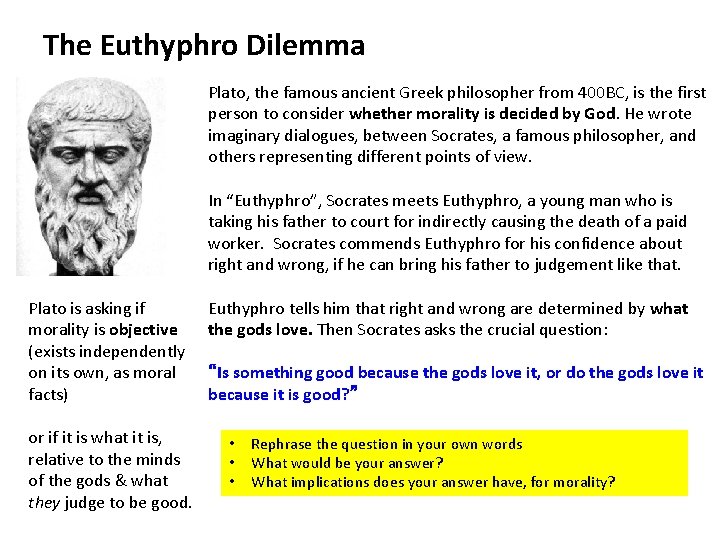
The Euthyphro Dilemma Plato, the famous ancient Greek philosopher from 400 BC, is the first person to consider whether morality is decided by God. He wrote imaginary dialogues, between Socrates, a famous philosopher, and others representing different points of view. In “Euthyphro”, Socrates meets Euthyphro, a young man who is taking his father to court for indirectly causing the death of a paid worker. Socrates commends Euthyphro for his confidence about right and wrong, if he can bring his father to judgement like that. Plato is asking if morality is objective (exists independently on its own, as moral facts) or if it is what it is, relative to the minds of the gods & what they judge to be good. Euthyphro tells him that right and wrong are determined by what the gods love. Then Socrates asks the crucial question: “Is something good because the gods love it, or do the gods love it because it is good? ” • • • Rephrase the question in your own words What would be your answer? What implications does your answer have, for morality?
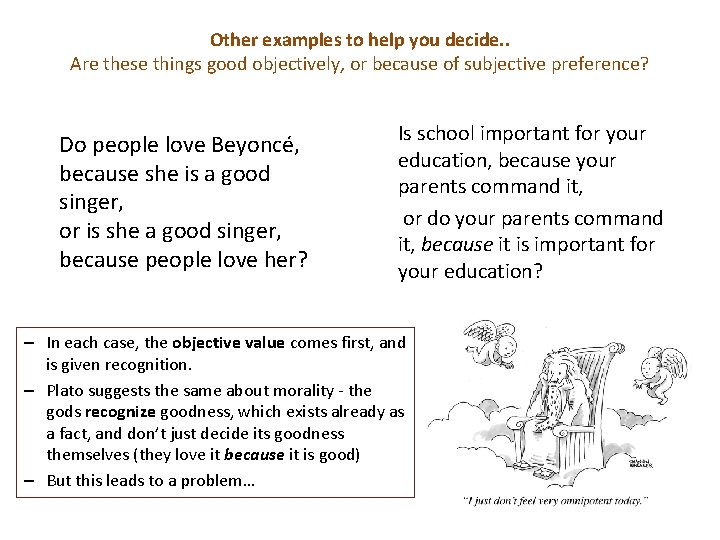
Other examples to help you decide. . Are these things good objectively, or because of subjective preference? Do people love Beyoncé, because she is a good singer, or is she a good singer, because people love her? Is school important for your education, because your parents command it, or do your parents command it, because it is important for your education? – In each case, the objective value comes first, and is given recognition. – Plato suggests the same about morality - the gods recognize goodness, which exists already as a fact, and don’t just decide its goodness themselves (they love it because it is good) – But this leads to a problem…
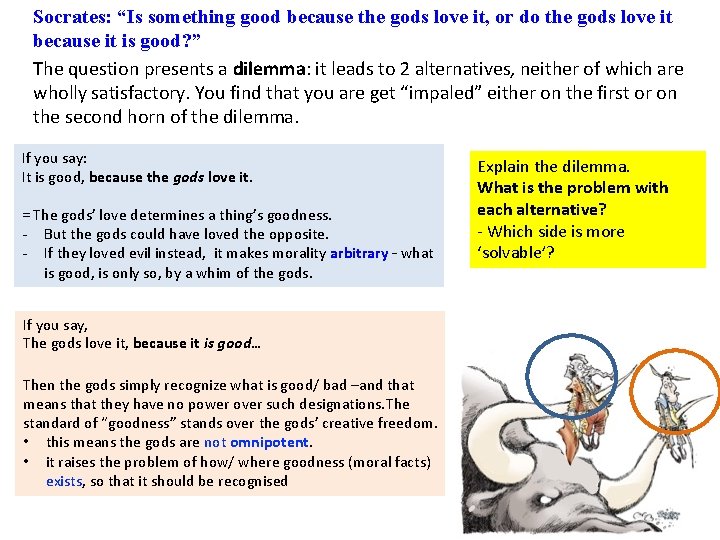
Socrates: “Is something good because the gods love it, or do the gods love it because it is good? ” The question presents a dilemma: it leads to 2 alternatives, neither of which are wholly satisfactory. You find that you are get “impaled” either on the first or on the second horn of the dilemma. If you say: It is good, because the gods love it. = The gods’ love determines a thing’s goodness. - But the gods could have loved the opposite. - If they loved evil instead, it makes morality arbitrary – what is good, is only so, by a whim of the gods. If you say, The gods love it, because it is good… Then the gods simply recognize what is good/ bad –and that means that they have no power over such designations. The standard of “goodness” stands over the gods’ creative freedom. • this means the gods are not omnipotent. • it raises the problem of how/ where goodness (moral facts) exists, so that it should be recognised Explain the dilemma. What is the problem with each alternative? - Which side is more ‘solvable’?
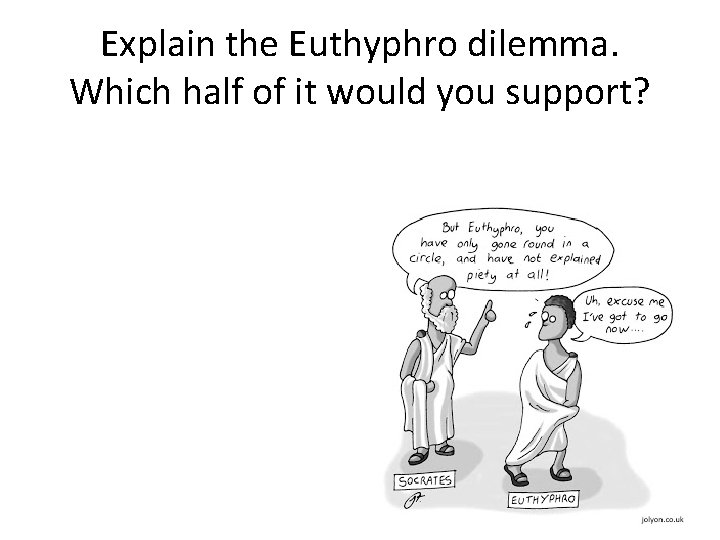
Explain the Euthyphro dilemma. Which half of it would you support?
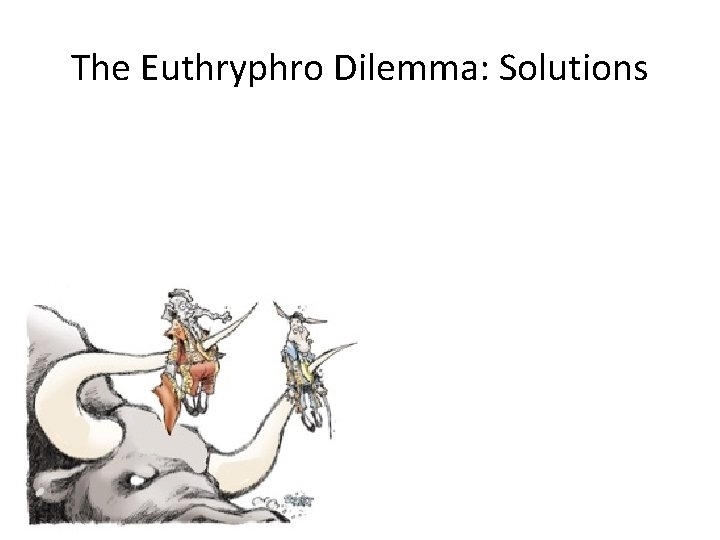
The Euthryphro Dilemma: Solutions
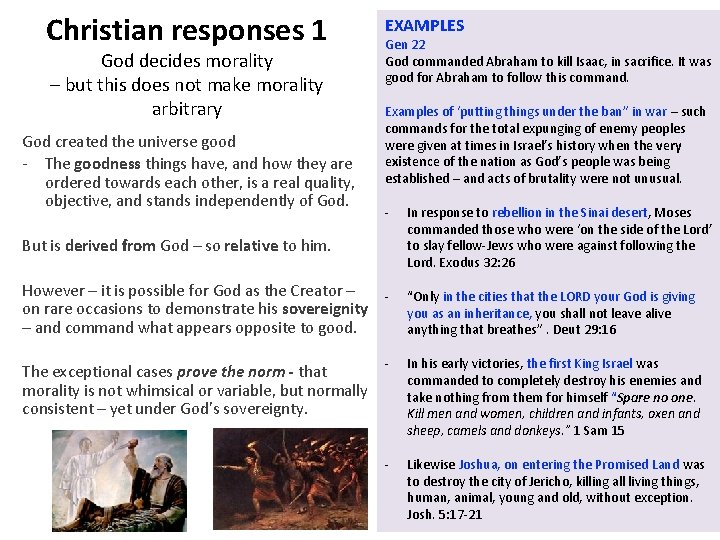
Christian responses 1 God decides morality – but this does not make morality arbitrary God created the universe good - The goodness things have, and how they are ordered towards each other, is a real quality, objective, and stands independently of God. EXAMPLES Gen 22 God commanded Abraham to kill Isaac, in sacrifice. It was good for Abraham to follow this command. Examples of ‘putting things under the ban” in war – such commands for the total expunging of enemy peoples were given at times in Israel’s history when the very existence of the nation as God’s people was being established – and acts of brutality were not unusual. - But is derived from God – so relative to him. However – it is possible for God as the Creator – on rare occasions to demonstrate his sovereignity – and command what appears opposite to good. The exceptional cases prove the norm - that morality is not whimsical or variable, but normally consistent – yet under God’s sovereignty. In response to rebellion in the Sinai desert, Moses commanded those who were ‘on the side of the Lord’ to slay fellow-Jews who were against following the Lord. Exodus 32: 26 “Only in the cities that the LORD your God is giving you as an inheritance, you shall not leave alive anything that breathes”. Deut 29: 16 - In his early victories, the first King Israel was commanded to completely destroy his enemies and take nothing from them for himself “Spare no one. Kill men and women, children and infants, oxen and sheep, camels and donkeys. ” 1 Sam 15 - Likewise Joshua, on entering the Promised Land was to destroy the city of Jericho, killing all living things, human, animal, young and old, without exception. Josh. 5: 17 -21
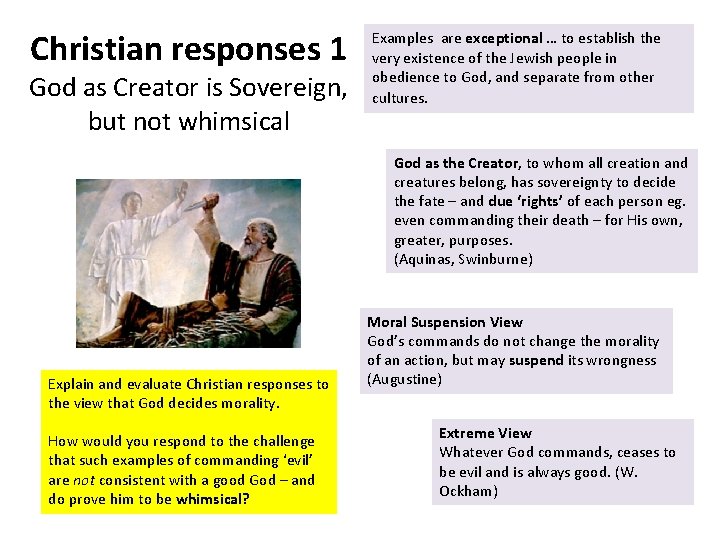
Christian responses 1 God as Creator is Sovereign, but not whimsical Examples are exceptional … to establish the very existence of the Jewish people in obedience to God, and separate from other cultures. God as the Creator, to whom all creation and creatures belong, has sovereignty to decide the fate – and due ‘rights’ of each person eg. even commanding their death – for His own, greater, purposes. (Aquinas, Swinburne) Explain and evaluate Christian responses to the view that God decides morality. How would you respond to the challenge that such examples of commanding ‘evil’ are not consistent with a good God – and do prove him to be whimsical? Moral Suspension View God’s commands do not change the morality of an action, but may suspend its wrongness (Augustine) Extreme View Whatever God commands, ceases to be evil and is always good. (W. Ockham)
Christian response 2 God decides morality – but this does not make morality arbitrary Adams’ Modified DCT God exists, morality comes from God, as God is the creator of everything. God is the necessary, omnipotent being, there is no other moral ”standard” apart from him. God also establishes morality itself by revealing His will eg 10 Commandments. Adams is concerned to show that the possibility of God commanding evil is excluded. But what about the arbitrariness of God’s commands? Is Ockham right, when he argues that: “Whatever God commands, ceases to be evil and is always good”? He does this, by referring to God’s good and perfect nature.
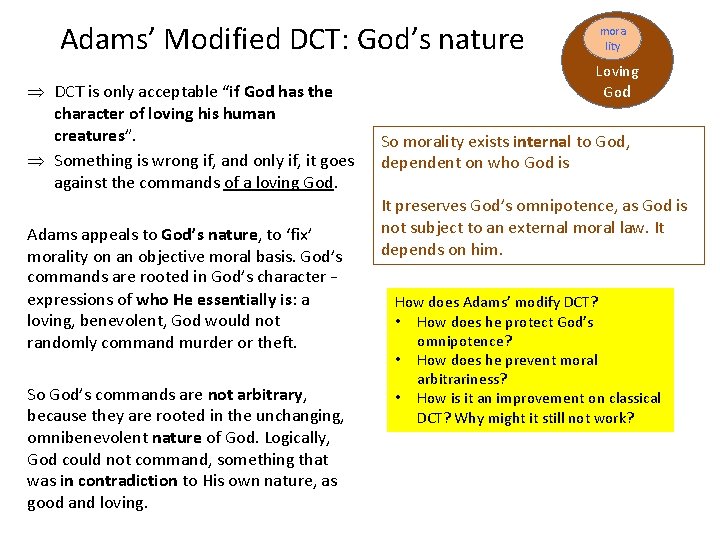
Adams’ Modified DCT: God’s nature Þ DCT is only acceptable “if God has the character of loving his human creatures”. Þ Something is wrong if, and only if, it goes against the commands of a loving God. Adams appeals to God’s nature, to ‘fix’ morality on an objective moral basis. God’s commands are rooted in God’s character – expressions of who He essentially is: a loving, benevolent, God would not randomly command murder or theft. So God’s commands are not arbitrary, because they are rooted in the unchanging, omnibenevolent nature of God. Logically, God could not command, something that was in contradiction to His own nature, as good and loving. mora lity Loving God So morality exists internal to God, dependent on who God is It preserves God’s omnipotence, as God is not subject to an external moral law. It depends on him. How does Adams’ modify DCT? • How does he protect God’s omnipotence? • How does he prevent moral arbitrariness? • How is it an improvement on classical DCT? Why might it still not work?
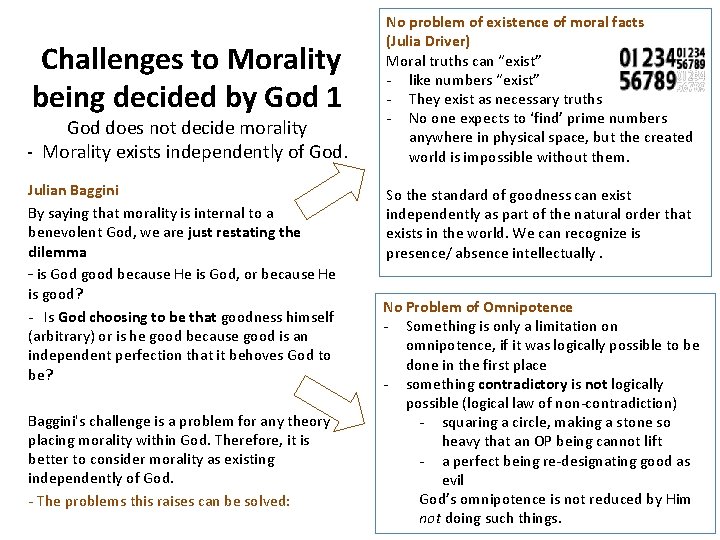
Challenges to Morality being decided by God 1 God does not decide morality - Morality exists independently of God. Julian Baggini By saying that morality is internal to a benevolent God, we are just restating the dilemma – is God good because He is God, or because He is good? - Is God choosing to be that goodness himself (arbitrary) or is he good because good is an independent perfection that it behoves God to be? Baggini's challenge is a problem for any theory placing morality within God. Therefore, it is better to consider morality as existing independently of God. - The problems this raises can be solved: No problem of existence of moral facts (Julia Driver) Moral truths can “exist” - like numbers “exist” - They exist as necessary truths - No one expects to ‘find’ prime numbers anywhere in physical space, but the created world is impossible without them. So the standard of goodness can exist independently as part of the natural order that exists in the world. We can recognize is presence/ absence intellectually. No Problem of Omnipotence - Something is only a limitation on omnipotence, if it was logically possible to be done in the first place - something contradictory is not logically possible (logical law of non-contradiction) - squaring a circle, making a stone so heavy that an OP being cannot lift - a perfect being re-designating good as evil God’s omnipotence is not reduced by Him not doing such things.
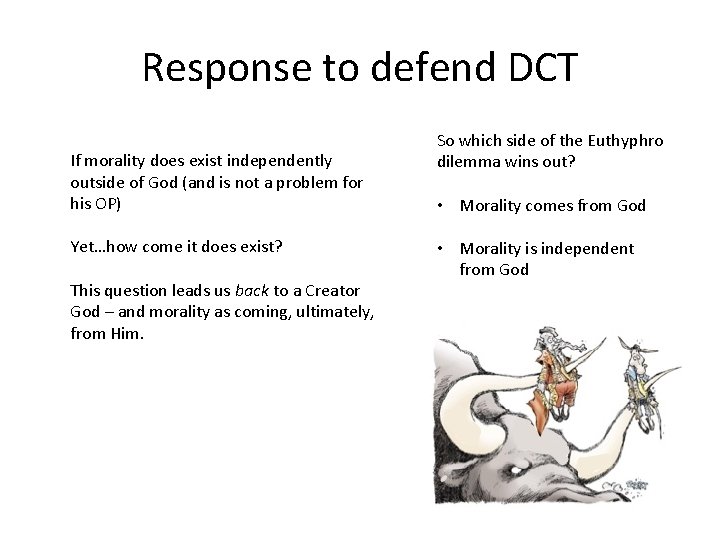
Response to defend DCT If morality does exist independently outside of God (and is not a problem for his OP) Yet…how come it does exist? This question leads us back to a Creator God – and morality as coming, ultimately, from Him. So which side of the Euthyphro dilemma wins out? • Morality comes from God • Morality is independent from God
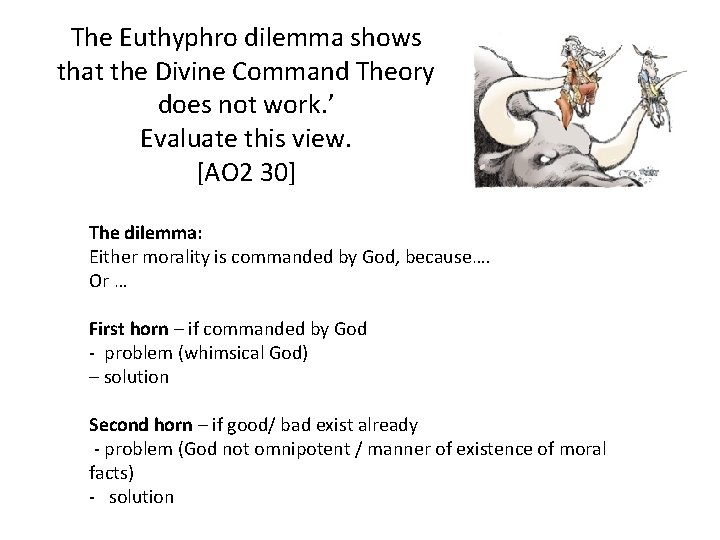
The Euthyphro dilemma shows that the Divine Command Theory does not work. ’ Evaluate this view. [AO 2 30] The dilemma: Either morality is commanded by God, because…. Or … First horn – if commanded by God - problem (whimsical God) – solution Second horn – if good/ bad exist already - problem (God not omnipotent / manner of existence of moral facts) - solution
Evaluating DCT as a normative theory to follow Strengths & Weaknesses
PROS? • Explains the source of morality – God as the creator • Gives morality an objective basis – in the goodness of God. Nonnegotiable (killing can never become good). CONS? • Adams’ solution does not really work (Baggini) • Possible that morality could be relativistic – to what God wants. • Removes individual responsibility • explains the force of the moral law on us - imbued with God’s authority • Morality is selfish – for reward from God, so not truly moral • makes sense of heroic morality : as God is the ultimate judge/rewarder • Intolerant/ inflexible, simplistic answers to complex problems • Fails to explain atheist morality • Challenge of religious pluralism • makes morality easy – clear-cut laws, don’t need to work it out.
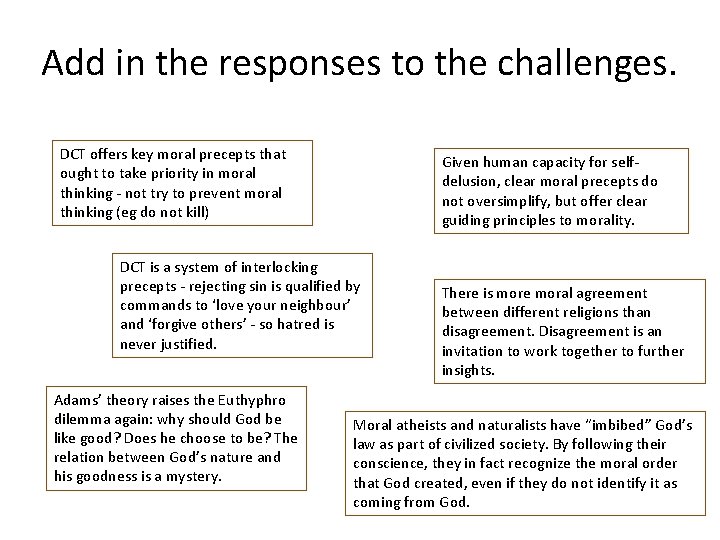
Add in the responses to the challenges. DCT offers key moral precepts that ought to take priority in moral thinking - not try to prevent moral thinking (eg do not kill) Given human capacity for selfdelusion, clear moral precepts do not oversimplify, but offer clear guiding principles to morality. DCT is a system of interlocking precepts - rejecting sin is qualified by commands to ‘love your neighbour’ and ‘forgive others’ - so hatred is never justified. Adams’ theory raises the Euthyphro dilemma again: why should God be like good? Does he choose to be? The relation between God’s nature and his goodness is a mystery. There is more moral agreement between different religions than disagreement. Disagreement is an invitation to work together to further insights. Moral atheists and naturalists have “imbibed” God’s law as part of civilized society. By following their conscience, they in fact recognize the moral order that God created, even if they do not identify it as coming from God.
How good is DCT as a theory of morality?