
Ethical theorists A comparison of main ideas Aristotle
- Slides: 19
Ethical theorists: A comparison of main ideas
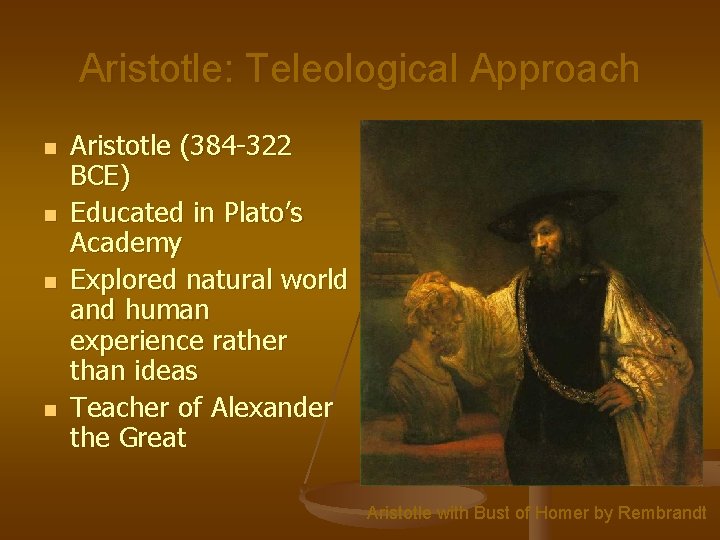
Aristotle: Teleological Approach n n Aristotle (384 -322 BCE) Educated in Plato’s Academy Explored natural world and human experience rather than ideas Teacher of Alexander the Great Aristotle with Bust of Homer by Rembrandt
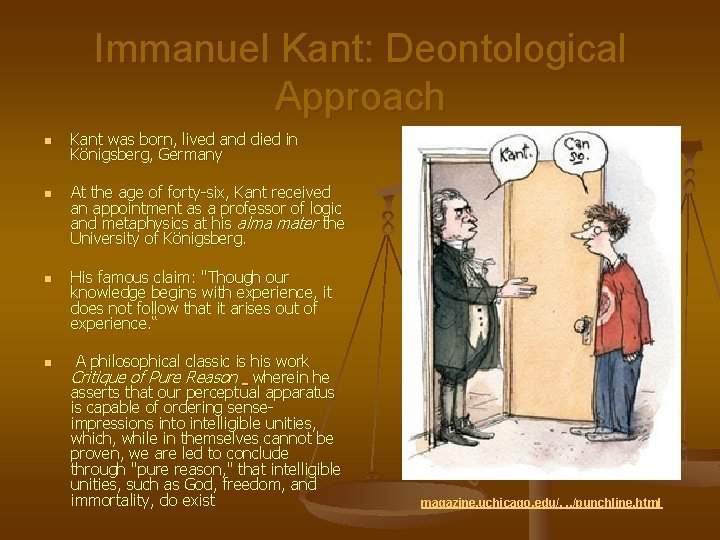
Immanuel Kant: Deontological Approach n n Kant was born, lived and died in Königsberg, Germany At the age of forty-six, Kant received an appointment as a professor of logic and metaphysics at his alma mater the University of Königsberg. His famous claim: "Though our knowledge begins with experience, it does not follow that it arises out of experience. “ A philosophical classic is his work Critique of Pure Reason wherein he asserts that our perceptual apparatus is capable of ordering senseimpressions into intelligible unities, which, while in themselves cannot be proven, we are led to conclude through "pure reason, " that intelligible unities, such as God, freedom, and immortality, do exist magazine. uchicago. edu/. . . /punchline. html
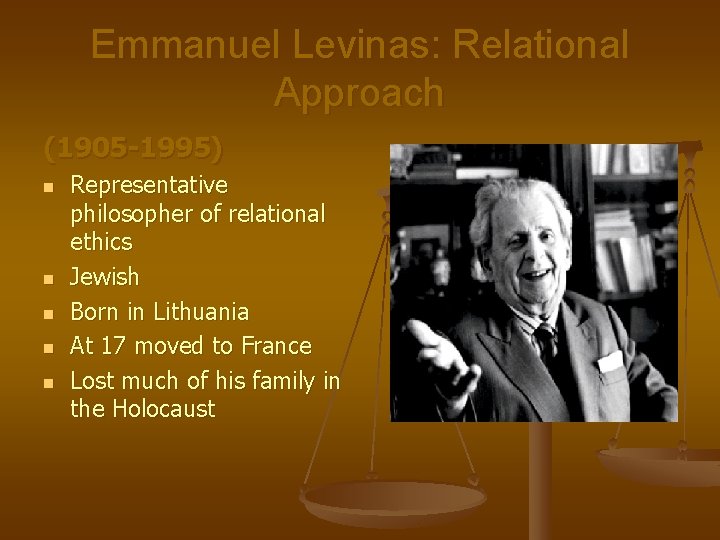
Emmanuel Levinas: Relational Approach (1905 -1995) n n n Representative philosopher of relational ethics Jewish Born in Lithuania At 17 moved to France Lost much of his family in the Holocaust
Ethical theorists: A comparison of main ideas Aristotle 1. Humans find happiness within community
Ethical theorists: A comparison of main ideas Aristotle 1. 2. Humans find happiness within community To be happy is to live well and to do well
Ethical theorists: A comparison of main ideas Aristotle 1. 2. 3. Humans find happiness within community To be happy is to live well and to do well Human activity aims at achieving the good
Ethical theorists: A comparison of main ideas Aristotle 1. 2. 3. 4. Humans find happiness within community To be happy is to live well and to do well Human activity aims at achieving the good Since the highest capacity of humans is to be rational, the highest form of happiness is based on rational behaviour
Ethical theorists: A comparison of main ideas Aristotle 1. 2. 3. 4. 5. Humans find happiness within community To be happy is to live well and to do well Human activity aims at achieving the good Since the highest capacity of humans is to be rational, the highest form of happiness is based on rational behaviour Be moderate in all things
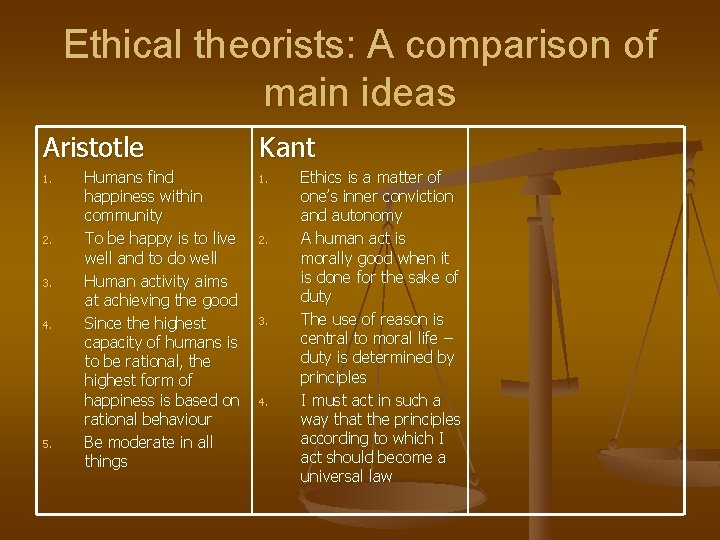
Ethical theorists: A comparison of main ideas Aristotle 1. 2. 3. 4. 5. Humans find happiness within community To be happy is to live well and to do well Human activity aims at achieving the good Since the highest capacity of humans is to be rational, the highest form of happiness is based on rational behaviour Be moderate in all things Kant 1. Ethics is a matter of one’s inner conviction and autonomy
Ethical theorists: A comparison of main ideas Aristotle 1. 2. 3. 4. 5. Humans find happiness within community To be happy is to live well and to do well Human activity aims at achieving the good Since the highest capacity of humans is to be rational, the highest form of happiness is based on rational behaviour Be moderate in all things Kant 1. 2. Ethics is a matter of one’s inner conviction and autonomy A human act is morally good when it is done for the sake of duty
Ethical theorists: A comparison of main ideas Aristotle 1. 2. 3. 4. 5. Humans find happiness within community To be happy is to live well and to do well Human activity aims at achieving the good Since the highest capacity of humans is to be rational, the highest form of happiness is based on rational behaviour Be moderate in all things Kant 1. 2. 3. Ethics is a matter of one’s inner conviction and autonomy A human act is morally good when it is done for the sake of duty The use of reason is central to moral life – duty is determined by principles
Ethical theorists: A comparison of main ideas Aristotle 1. 2. 3. 4. 5. Humans find happiness within community To be happy is to live well and to do well Human activity aims at achieving the good Since the highest capacity of humans is to be rational, the highest form of happiness is based on rational behaviour Be moderate in all things Kant 1. 2. 3. 4. Ethics is a matter of one’s inner conviction and autonomy A human act is morally good when it is done for the sake of duty The use of reason is central to moral life – duty is determined by principles I must act in such a way that the principles according to which I act should become a universal law
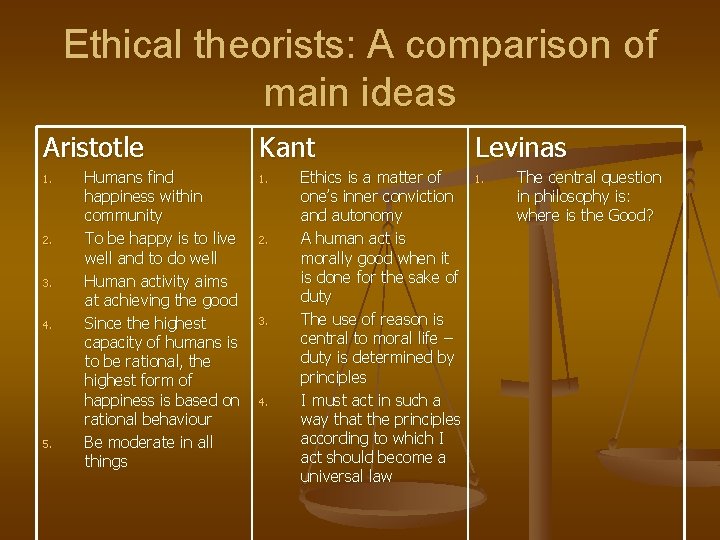
Ethical theorists: A comparison of main ideas Aristotle 1. 2. 3. 4. 5. Humans find happiness within community To be happy is to live well and to do well Human activity aims at achieving the good Since the highest capacity of humans is to be rational, the highest form of happiness is based on rational behaviour Be moderate in all things Kant 1. 2. 3. 4. Ethics is a matter of one’s inner conviction and autonomy A human act is morally good when it is done for the sake of duty The use of reason is central to moral life – duty is determined by principles I must act in such a way that the principles according to which I act should become a universal law Levinas 1. The central question in philosophy is: where is the Good?
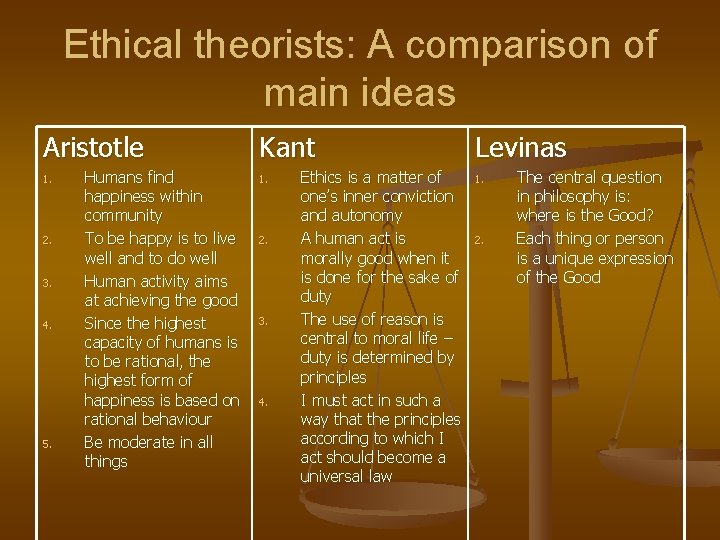
Ethical theorists: A comparison of main ideas Aristotle 1. 2. 3. 4. 5. Humans find happiness within community To be happy is to live well and to do well Human activity aims at achieving the good Since the highest capacity of humans is to be rational, the highest form of happiness is based on rational behaviour Be moderate in all things Kant 1. 2. 3. 4. Ethics is a matter of one’s inner conviction and autonomy A human act is morally good when it is done for the sake of duty The use of reason is central to moral life – duty is determined by principles I must act in such a way that the principles according to which I act should become a universal law Levinas 1. 2. The central question in philosophy is: where is the Good? Each thing or person is a unique expression of the Good
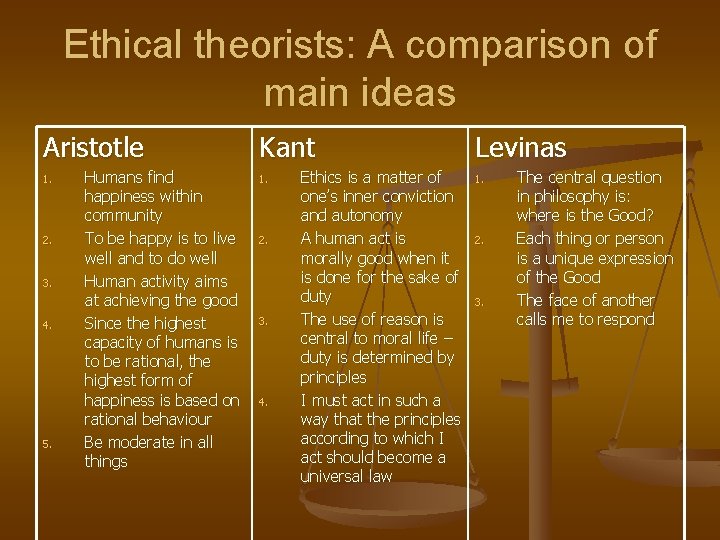
Ethical theorists: A comparison of main ideas Aristotle 1. 2. 3. 4. 5. Humans find happiness within community To be happy is to live well and to do well Human activity aims at achieving the good Since the highest capacity of humans is to be rational, the highest form of happiness is based on rational behaviour Be moderate in all things Kant 1. 2. 3. 4. Ethics is a matter of one’s inner conviction and autonomy A human act is morally good when it is done for the sake of duty The use of reason is central to moral life – duty is determined by principles I must act in such a way that the principles according to which I act should become a universal law Levinas 1. 2. 3. The central question in philosophy is: where is the Good? Each thing or person is a unique expression of the Good The face of another calls me to respond
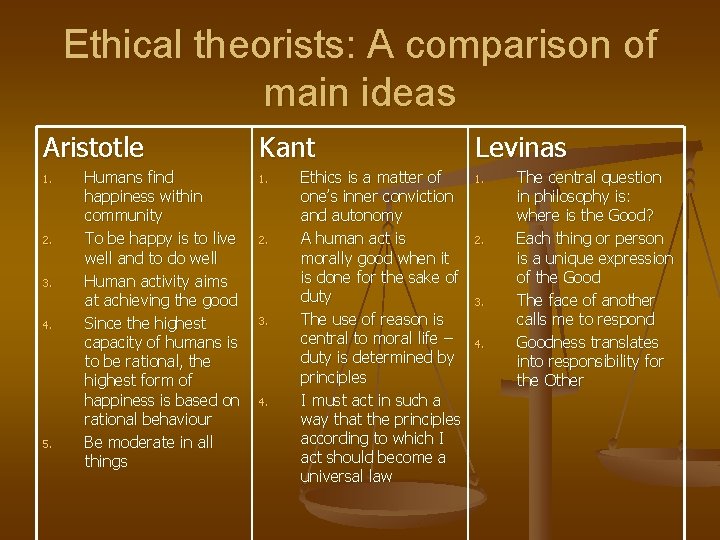
Ethical theorists: A comparison of main ideas Aristotle 1. 2. 3. 4. 5. Humans find happiness within community To be happy is to live well and to do well Human activity aims at achieving the good Since the highest capacity of humans is to be rational, the highest form of happiness is based on rational behaviour Be moderate in all things Kant 1. 2. 3. 4. Ethics is a matter of one’s inner conviction and autonomy A human act is morally good when it is done for the sake of duty The use of reason is central to moral life – duty is determined by principles I must act in such a way that the principles according to which I act should become a universal law Levinas 1. 2. 3. 4. The central question in philosophy is: where is the Good? Each thing or person is a unique expression of the Good The face of another calls me to respond Goodness translates into responsibility for the Other
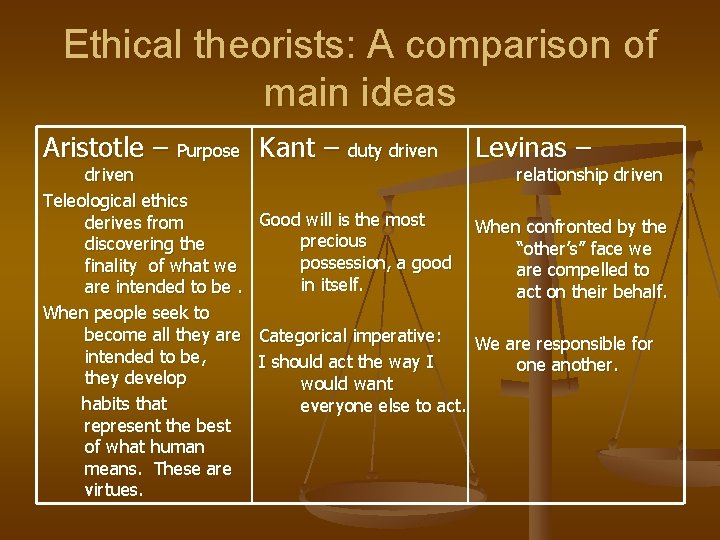
Ethical theorists: A comparison of main ideas Aristotle – Purpose Kant – duty driven Levinas – driven relationship driven Teleological ethics Good will is the most derives from When confronted by the precious discovering the “other’s” face we possession, a good finality of what we are compelled to in itself. are intended to be. act on their behalf. When people seek to become all they are Categorical imperative: We are responsible for intended to be, I should act the way I one another. they develop would want habits that everyone else to act. represent the best of what human means. These are virtues.