
Ethical Relativism Relevant Terms n Subjective Relativism Subjectivism
Ethical Relativism
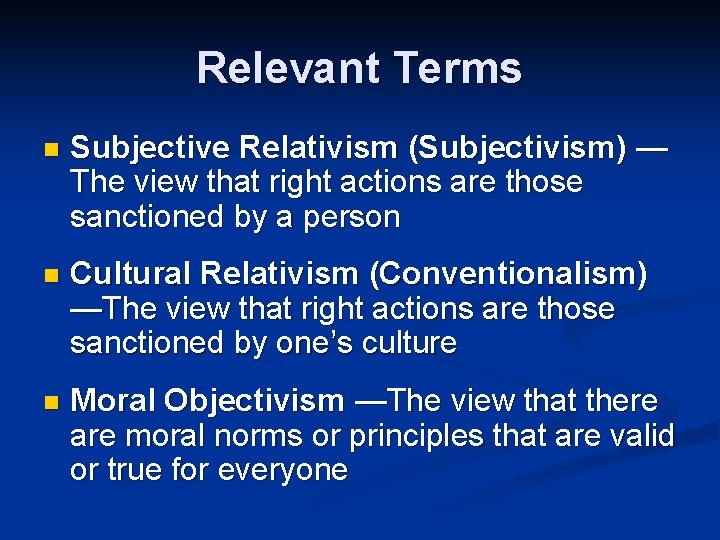
Relevant Terms n Subjective Relativism (Subjectivism) — The view that right actions are those sanctioned by a person n Cultural Relativism (Conventionalism) —The view that right actions are those sanctioned by one’s culture n Moral Objectivism —The view that there are moral norms or principles that are valid or true for everyone
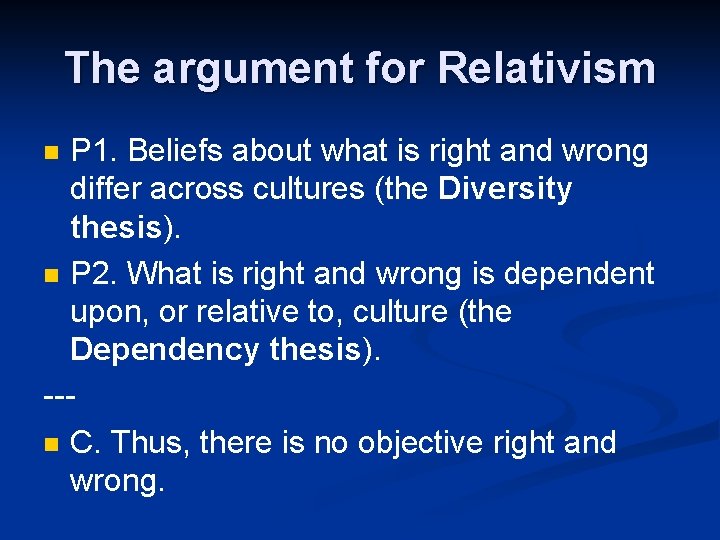
The argument for Relativism P 1. Beliefs about what is right and wrong differ across cultures (the Diversity thesis). n P 2. What is right and wrong is dependent upon, or relative to, culture (the Dependency thesis). --n C. Thus, there is no objective right and wrong. n

The argument appears valid, and thus to defeat the conclusion Pojman will need to defeat at least one of the premises. n P 1 is simply a statement of fact, and thus hard to overcome. Thus the weaker premise is P 2. n The strength of P 2 resides in the nature of the dependency implied by the premise, i. e. what degree of dependency does the relativist require to uphold the conclusion, and can sufficient fault be found to undermine the argument? n
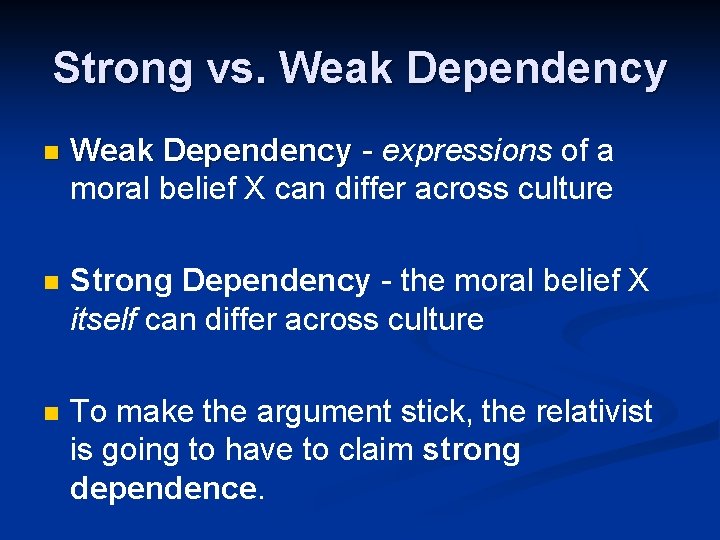
Strong vs. Weak Dependency n Weak Dependency - expressions of a moral belief X can differ across culture n Strong Dependency - the moral belief X itself can differ across culture n To make the argument stick, the relativist is going to have to claim strong dependence.
The attack on P 2 n If relativism is correct, it leads to two possible interpretations: Subjectivism: morality is dependent on individuals, not culture n Conventionalism: morality is dependent on culture n
n For Pojman’s attack to be successful, he will have to show that both subjectivism and conventionalism are false. n Subjectivism leads to absurd conclusions n n n Conventionalism collapses into Subjectivism n n 'morality' has no meaning no interpersonal criticism is possible How do we determine what a society is? How is reform possible within a conventionalist system? No intercultural moral critique is possible. In addition, relativism (in both forms) entails tolerance. relativ If so, then relativism entails at least one objective moral value (tolerance). If so, then relativism is not true for all moral values.
Alternatives to Relativism n Moral Objectivism- there are some (at least one) universalizable moral principles. n Moral Absolutism - there are some (at least one) universalizable moral principles which are inviolable.
The nature of universalizable principles n n n Alleviation of suffering Avoid/resolve social conflicts Promote human flourishing/survival
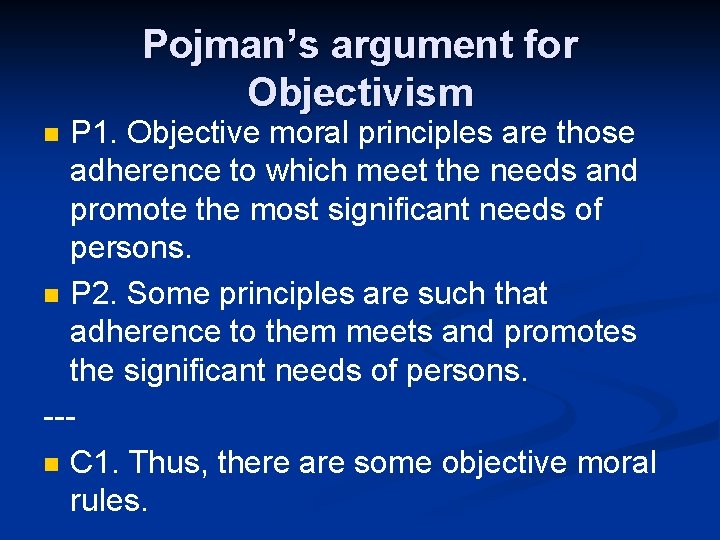
Pojman’s argument for Objectivism P 1. Objective moral principles are those adherence to which meet the needs and promote the most significant needs of persons. n P 2. Some principles are such that adherence to them meets and promotes the significant needs of persons. --n C 1. Thus, there are some objective moral rules. n
- Slides: 10