
Ethical Principles in the Problematic Sexual Behaviors Field

Ethical Principles in the Problematic Sexual Behaviors Field (Part 1 & 2) Carol A. Deel, Ph. D, LCPC, LCMFT
Learning Objectives Understand the need for professional ethical standards Understand the ethical decision-making process Understand the ethical standards and expectations 2
Learning Objectives (cont. ) To minimize ethical dilemmas including bias, transference, dual relationships, confidentiality, recordkeeping, professional relationships, payment for service, professional conduct, etc. To acknowledge the potential conflicts, adhere to safeguards, and thoughtfully address challenges with ethical values and codes. 3

4

5

6
Historical Development of Ethics or moral philosophy is The branch of philosophy that involves systematizing, defending, and recommending concepts of right and wrong conduct The term ethics derives from the Ancient Greek word ethos (habit or custom 7
Historical Development of Ethics (con’t) The term ethics is used in three ways: A general pattern or "way of life, " For example spiritual ethics; Inquiry about ways of life and rules of conduct. A branch of philosophy A set of rules of conduct or "moral code, “ Speaks of professional ethics and of unethical behavior. 8
Greek Ethics Ethical philosophy began in the fifth century BC, with Socrates, His mission was to awaken the general public to the need for rational criticism of their ethical beliefs and practices 9
Aspirational Standards According to Fisher (2009), “Composed of statements of broadly worded ideals and principles that do not attempt to define with any precision right and wrong behaviors” (p. 5). Ethical codes start out as aspirational standards and progressively move to required standards 10
Aspirational Standards (cont. ) The general principles of ethics code are designed to be aspirational, To point mental health counselors and therapist in the right direction, and To inspire them to right behavior 11
Enforceable Ethics Code Enforceable standards are firm requirements, such as those deemed by law. 12
Professional Conduct 13
Professional Conduct Do not let your personal feelings related to a client’s crimes or behaviors interfere with your professional judgment and objectivity — Get supervision or consultation to address the issue Do not discriminate in any way 14
Professional Conduct (cont. ) Be of Good Moral Character — Avoid acts of Moral turpitude — Questionable honesty, fairness, and respect for the rights of others Do not harass, exploit, or demean people 15
Professional Conduct (cont. ) Do not sexually harass anyone — Unlawful discrimination within a professional relationship — Unwelcome verbal or physical sexually oriented conduct That unreasonably interferes with a professional relationship or creating a hostile, intimidating or offensive professional environment. 16
Professional Conduct (cont. ) If you have a felony conviction you must disclose the conviction and disposition upon applying for or renewing ATSA membership Do not engage in illegal behavior 17
Professional Conduct (cont. ) Be aware of the ATSA — Adult Practice Guidelines — Adolescent Practice Guidelines — Code of Ethics It is unethical for ATSA Members to conduct evaluations with the primary purpose of determining guilt or innocence. 18

Payment of Services 19
Payment of Services Do not use your professional relationships relating to the assessment or treatment of a client to further your own interests. Explain to a client all financial arrangements related to professional services including the use of collection agencies or legal measures for nonpayment 20
Payment of Services (cont. ) Bartering may result in a dual relationship Adhere to your professional discipline’s code of ethics BPC&T – MD code says: A counselor may accept goods or services instead of monetary payment only if: § The relationship is not exploitative; § The client requests it; § A clear written contract is established; and § The arrangements are an accepted practice among professionals in the community. 21

Members’ Training and Expertise 22
Members’ Training and Expertise Practice only within your competence, based on: Education Training Supervised experience, and Professional credentials 23
Members’ Training and Expertise (cont. ) When developing competence in a new service or technique, get consultation and get additional education or training in the new area Engage in Continuing Education and Professional Growth activities 24
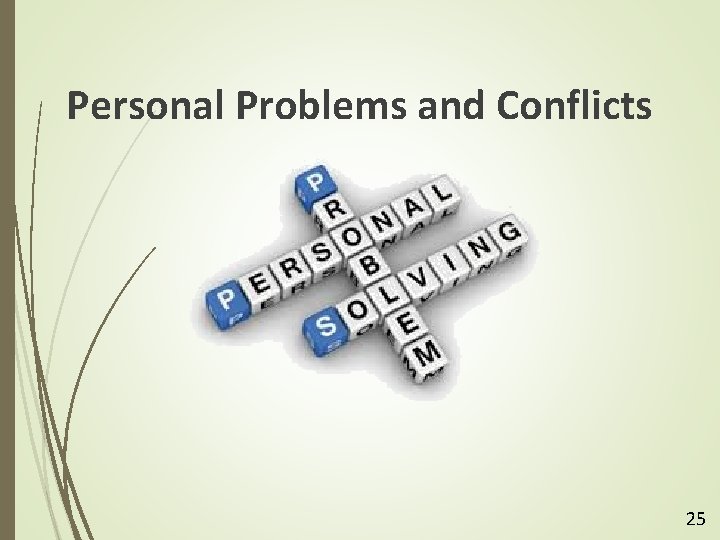
Personal Problems and Conflicts 25
Personal Problems and Conflicts Only engage in activities where it can be reasonably foreseen that the activity will result in the good of a client, colleague, student, research participant, or other person to whom you owe a professional or scientific obligation 26
Personal Problems and Conflicts (cont. ) If issues arise Get help with Addiction Mental Health Medical Services Supervision Peer Consultation Take a break if needed 27

Supervisory Relationships 28
Supervisory Relationships Only delegate responsibilities based on the education and/or experience of the delegatee Make sure delegatee has training to do their work responsibly, competently, and ethically Provide appropriate supervision so that the delegatee is able to perform competent professional work 29
Supervisory Relationships (cont. ) Have a supervision contract Do not engage in sexual behavior with students, supervisees, or others whom you have evaluative or direct authority. 30

Client Relationship 31
Client Relationship Inform clients of the type of service, purposes, goals, expectations and outcomes, procedures, limitations, potential risks, and benefits of services, limits of privilege and confidentiality Protect the welfare of the client 32
Client Relationship (cont. ) Explain to clients the implications of diagnosis, the intended use of tests and reports, fees, and billing arrangements Document attempts to inform other professional persons concurrently providing mental health services to a client 33
Client Relationship (cont. ) Assist clients in making appropriate arrangements for the continuation of treatment due to interruptions including but not limited to vacations and extended illness 34
Client Relationship (cont. ) Make appropriate referrals In the case of involuntary evaluations members shall abide by their pertinent jurisdictional laws regarding private health information and licensure, in your specific professional discipline 35
Client Relationship (cont. ) Never engage in sexual behaviors with clients or former clients, their immediate family, and extended family This includes any person receiving or has received professional services regardless of whether payment for the professional services was involved. 36
Dual-Relationship 37
Dual Relationships Multiple relationships take place when: The professional at the same time is in another role with the same person. At the same time is in a relationship with a person closely associated with or related to the person. Promises to enter into another relationship in the future with the person or a person or closely associated with or related to the person.
Multiple relationships reasonable be expected to impair professionals objectivity, competence, or effectiveness. Risk exploitation or harm to the person whom the professional relationship exists. The primacy of therapeutic relationship is compromised because the relationship is now viewed to be a metal exchange. Dual roles impairs the ability of the practitioner to place the client‘s needs above one‘s own in therapeutic encounter.
In Context Social: occurs when a therapist and client are also friends, or have some type of social relationships in the community. Social relationships include attending or involved in events or such as yoga classes, sports, clubs, etc. Professional: Occur when counselors and clients are also professional colleagues at colleges, training institutions, attend same professional conferences or co-author a book. Other examples include when a client or clients family member is therapists accountant, attorney, investment broker, doctor.
Forensic: Involves clinicians who serve as treating psychotherapists, as well as evaluators and/ or expert witness in trials, court hearing or other legal proceedings. A treating therapist and an expert witness as opposed to fact witness can be complicated and carefully considered. Example: A therapist yields to pressure from client or clients attorney to write child custody recommendation letter without either conducting an official and comprehensive custody evaluation nor being trained or certified s a child custody evaluation. 41
Business: Occur when a therapist and client are also business partners. Situations include joint business such as real estate, investments, or bartering arrangements whereby the client provides services such as gardening, house painting, pet-sitting, or car repair to therapist in exchange for payment of therapy services. Sexual Involves a therapist and a client who are engaged in a sexual relationship. This includes former clients those to be close relatives, guardians, or significant others of current patients/clients.
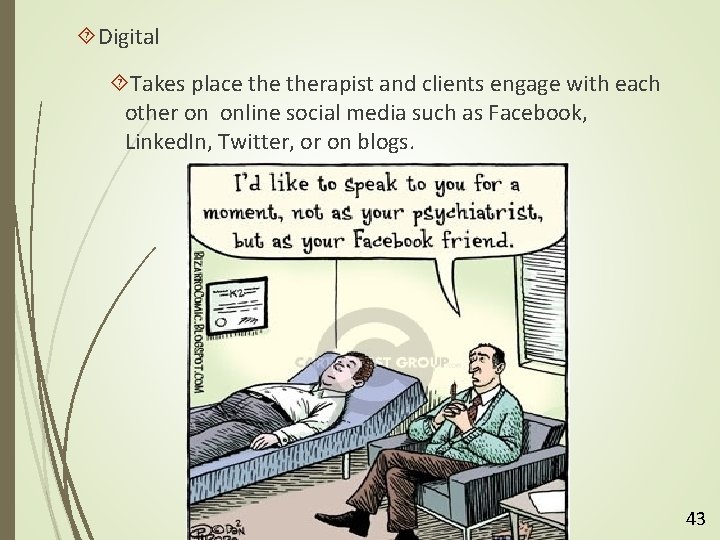
Digital Takes place therapist and clients engage with each other on online social media such as Facebook, Linked. In, Twitter, or on blogs. 43
Patient/Court Relationships Ethical responsibility is to the client. Clients welfare is checked in part by the standard of practice. This is done with informed consent from the client or as needed by law. Important for therapist and client to develop relationships that are separate from the offenders relationships with probation and the court. Client is best served and the public is best served. Legal responsibility is to the courts To share information with county/state corrections, or community as required by law or contractual obligations or as needed to protect the community. Ethical/moral responsibility is to the community.
Practice scenario An adult client presents for intake at an outpatient program in the community. During the interview he reports that he owns an auto repair business near therapist office. The therapist recognizes that she has taken her car to that repair shop many times. How should she proceed? Is this a boundary crossing?
Considerations The ATSA Code Of Ethics: If a potentially harmful multiple relationship develops, due to unforeseen circumstances, the member shall attempt to resolve it as quickly as possible with best interest of the client. Therapist should seek supervision to assess impact on client. Is there a real potential client harm? Is therapist neutrality compromised? What was the experience? Should she continue to patronize the repair shop?
Ethical Or Not? Going for a walk with a client during patient session? Flying with a client who suffers from a fear of flying? Attending a wedding, confirmation, funeral, school play? When a client follows their psychotherapist on therapist Facebook page, “likes” therapist Facebook page?

Confidentiality 48

Confidentiality Maintain the privacy and confidentiality of client's records Release records or information about a client only with a client's consent, or as permitted by State Codes Inform clients of the limits of confidentiality 49
Confidentiality (cont. ) Inform clients about mandatory reporting requirements Threat to self or others and or suspected abuse or neglect of an identified victim or vulnerable person Clarify the types of communication that are available and acceptable and secure Mail Email Text Messages 50
Confidentiality (cont. ) When working with several people who have a relationship, clarify at the beginning how confidentiality will apply among participants and to external parties Let clients know if you are under any kind of supervision and who that person is. Get legally authorized person or agency to provide consent when working with minors or legally incapable clients 51
Confidentiality (cont. ) When consulting with colleagues, do not share confidential information When giving a workshop do not share confidential information that might lead to identification of client, research participant, or other person or organization where you have a confidential relationship 52
Confidentiality (cont. ) If you are working in a criminal justice setting, inform all parties of the level of confidentiality that applies Dispose of records in accordance with your state’s statute Usually for 5 or 7 year period or the length of time your professional licensure has you hold them Except for a minor patient, unless a patient is notified, a health care provider may not destroy a medical record about a patient for 5 or 7 years after the record or report is made. 53

Recordkeeping 54
Medical Records HIPAA: 45 CFR 164 -524(a)(1) “an individual has a right of access to inspect and obtain a copy of protected health information about the individual in a designated record set, for as long as the protected health information is maintained in the designated record set…” MD Code: HGss 4 -303(a) “A health care provider shall disclose a medical record on the authorization of a person in interest in accordance with this section” 55

Releasing Medical Records Can not charge the client for records (hospitals and insurance companies) For your time, no more than $22. 88 Per page, no more than $. 76 56
Releasing Medical Records (cont. ) Plus shipping and handling Within 21 days If you do not you are guilty of a misdemeanor with fine not to exceed $1, 000 first offense and not exceeding $5, 000 for each after that 57
Personal Notes MD Code HGss 4 -307(a)(6)(2)(ii): …a medical record does not include a personal note of a mental health care provider, if the mental health care provider: Keeps the personal note in the mental health care provider’s sole possession for the provider’s own personal use; Maintain the personal note separate from the recipient's medical records AND 58
Personal Notes (cont. ) Does not disclose the personal note to any other person except: The mental health provider’s supervising health care provider A consulting health care provider that maintains the confidentiality of the personal note; or An attorney of the health care provider that maintains the confidentiality of the personal note 59
Progress Notes (eg. Patient file) are not the same as personal notes Progress Notes are a part of the patient’s record/file Document Start and stop time Medication/Prescription and monitoring The modalities and frequencies of treatment furnished Results of clinical tests 60
Progress Note (con’t) They summarize any: Diagnosis Mental status Symptoms Prognosis, and Progress to date 61

Professional Relationships 62
Professional Relationships Do not take other people’s clients without consultation between both practitioners Follow up on prior treatment with consent from client 63
Professional Relationships (cont. ) If a third party requests services for a client, make sure that the nature of the relationship is clear and. . . Role of the Member Use of the services Information obtained Limits of confidentiality 64
Professional Relationships (cont. ) A counselor may not accept or give anything of value for receiving or making a referral. Avoid conflicts of interest If your objectivity or judgment may be affected by: Your own financial, business, property, research, or personal interests Your treatment of another or existing client Any commitment or relationship you may behave with any third party or entity 65

Research and Publications 66
Research and Publications Plan and conduct research in an ethical manner Right to decline Ensure that the participants are protected from physical and mental discomfort 67
Research and Publications (cont. ) Assure that publication credits is assigned to those who have contributed to a publication Incarcerated individuals, Probationers, and Patients in secure forensic settings are vulnerable populations and Additional human subject protections may apply 68

Public Information 69
Public Information Be truthful in your advertising Do not advertise in such a way as to suggest: Unrealistic expectations Brings about a lack of confidence Harms the community 70
Public Information (cont. ) Do not use a name, professional affiliation, or credentials in a way that is false or could be misleading Announce any limitations to your practice including if you are being supervised Represent yourself accurately 71
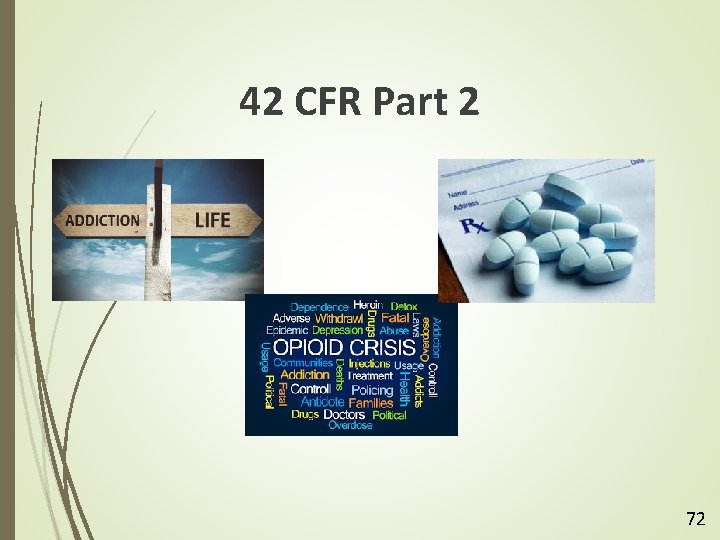
42 CFR Part 2 72
42 CFR Part 2 All records relating to the identity, diagnosis, prognosis, or treatment of any patient in a substance abuse program that is conducted, regulated, or directly or indirectly assisted by the department or agency of the United States First issued 1975, revised 1987 73
42 CFR Part 2 (con’t) Regulations restrict the disclosure and use of alcohol and drug patient records in connection with the performance of any federally assisted alcohol and drug abuse program. This information is any information disclosed by a covered program that identifies an individual directly or indirectly as having a current or past drug or alcohol problem, or as a participant in a covered program. 74
42 CFR Part 2 (con’t) Requires notification of confidentiality, consent forms, and prohibition of redisclosure 75
Why Is Part 2 Important? People living with SUD continue to experience stigma, discrimination, and negative consequences associated with their illness. People with SUD are more likely to seek out and stay in treatment if they know their record will not be disclosed to other without their knowledge or permission. 76
Organizations Subject to Part 2 applies to any “federally assisted” program that provides substance use or alcohol treatment, diagnosis, or referrals to treatment. It applies to both organizations whose sole purpose is to diagnose and treat substance use disorders, as well as unit within larger organizations such as a clinic within a jail, prison, or hospital. 77
Organizations Subject to Part 2 (con’t) Most drug an alcohol programs are “federally assisted” which means that the program derives some type of benefit form the U. S. Government This includes federal grant money, Medicaid, clinics licensed by the DEA to provide medication-assisted treatment, and those receiving non-profit status under federal tax code. 78
Organizations Subject to Part 2 (con’t) Even clinics that do not meet any of these requirement must comply if their state law requires them to follow Part 2. 79
42 CFR Release of Information (1 of 2) Elements of Informed Consent Name of client Name of organization to make the disclosure Name of organization to whom information is being disclosed Kind amount of information being disclosed Purpose of disclosure 80
Release (con’t) Statement that consent may be revoked at any time, except as already relied upon and/or criminal justice system consent Date or condition when consent will terminate Client signature and date Signature of provider assisting client with consent 81
What about the patient? 42 CFR Part 2 Coverage Standards. What is protected? Revealing patient as an alcohol or drug abuser by disclosing name, address, SSN, photograph, fingerprint or other information that can be readily used to identify person Verifying patient’s status in a program Communicating any information from record of patient who has been identified as a patients 82
How does Part 2 work? Patients can directly obtain a copy of their records Part 2 prohibits treatment programs from disclosing patient identities or record to others, particularly in response to law enforcement related inquiries, subpoenas, search warrants, or generic court orders, without patient’s written consent or other authorization. 83
How does Part 2 work? “Other authorization, ” medical emergency, special court order, audits or evaluations, child abuse/neglect reporting, reporting patient crimes on the treatment programs premises/against personnel, research, Qualified Service Organization Agreements. QSOA: Entity that provides services to program such as data processing, bill collecting, dose preparation, laboratory analysis, legal, medical, electronic health exchange. 84
Part 2 and the Criminal Justice System Common Parallel Police Without consent, police will need a court order to obtain information from a substance use treatment provider. Exceptions include Medical emergency or crime committed on premises of the treatment facility 85
Probation Parole and probation officers are not “federally assisted” programs and therefore they can disclose information they learn through interviewing their client to others However, they cannot request and then receive substance use treatment information from community providers without prior, valid consent The courts may require a waiver of confidently for both substance an mental healing information as a condition of release from prison or probation 86
Court Order A court order will generally be required before a court can acquire information from a substance use treatment program without consent. Court orders are granted only when: Disclosure is needed to protect against an existing threat to life or serious bodily injury Disclosure is necessary for further investigation of a serious crime. 87
The Courts Most of the time consent is required before substance use programs can share information with anyone working in the court system. 88
Part 2 has a special provision for when criminal justice entities, like drug courts or diversion programs, make referrals to a substance use treatment producers as part of a conditional disposition This provision allows substance use treatment programs in the community to share information with court (or other entity tasked with monitoring progress), with the individual consent. Courts have upheld that it is constitutional to require confidentiality wavers as a condition of participation in drug court. 89

Philosophy of Ethics As we look to understand more about the code of ethics, let us continue to raise the bar higher and higher. Let it be our aim to be ethical, integral, and respectful of the dignity of every human being. 90

Questions? 91
Contact Information Carol A. Deel, Ph. D, LCPC, LCMFT carol@caroldeel. com 410 -879 -2470 Paul Sheesley, MA, LCPC, LCADC paulbsheesley@gmail. com 410 -245 -4547 92
Reference List Canter, M. B. , Bennett, B. E. , Jones, S. E. , & Nagy, T. F. (1994). Ethics for psychologists: A commentary on the APA Ethics Code. Washington, DC: American Psychological Association. Fisher, C. B. (2009). Decoding the ethics code: A practical guide for psychologists (2 nd ed. ). Thousand Oaks, CA: Sage. ISBN: 9781412959162. Sawyer, S. & Prescott, D. (2011). Boundaries and dual relationships, Sexual Abuse: A Journal of Research and Treatment, 23(3) 365– 380. 93
- Slides: 93