
Ethical Principles Guiding Research Involving Children Specific Topics
- Slides: 31
Ethical Principles Guiding Research Involving Children
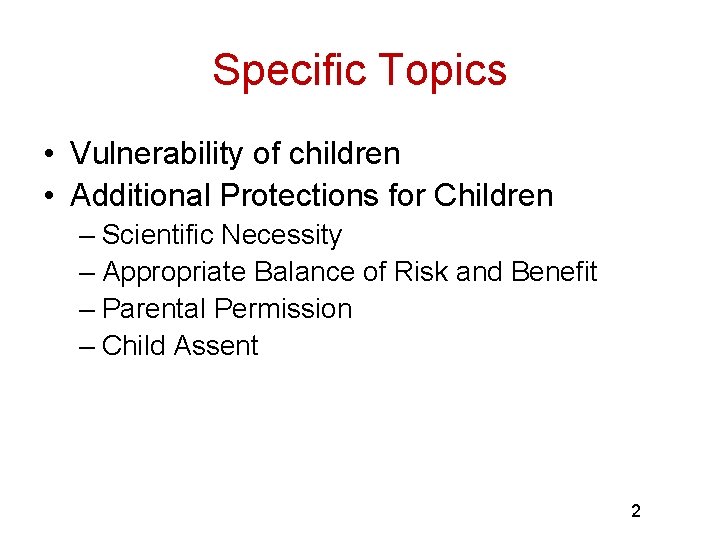
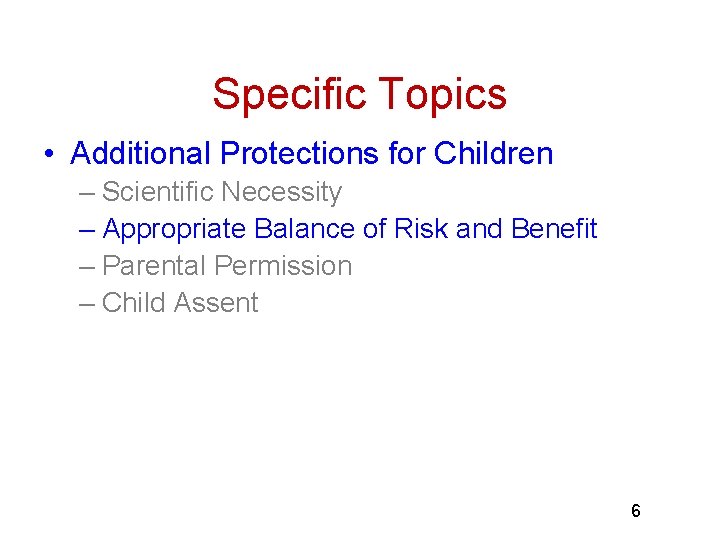
Specific Topics • Vulnerability of children • Additional Protections for Children – Scientific Necessity – Appropriate Balance of Risk and Benefit – Parental Permission – Child Assent 2
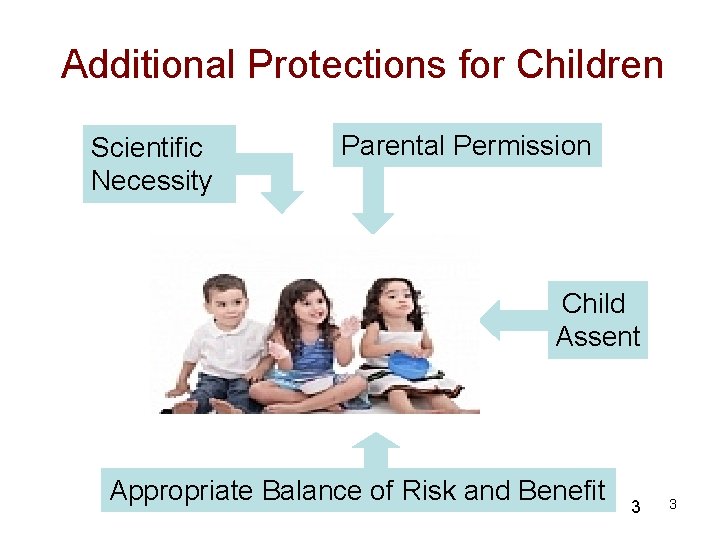
Additional Protections for Children Scientific Necessity Parental Permission Child Assent Appropriate Balance of Risk and Benefit 3 3
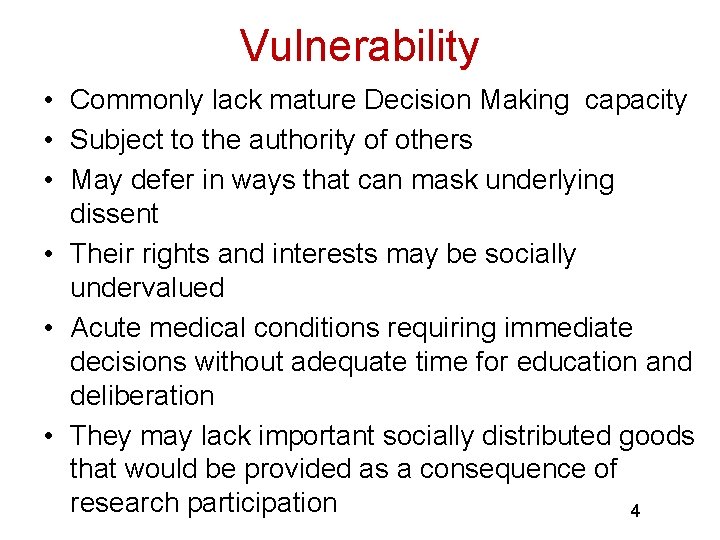
Vulnerability • Commonly lack mature Decision Making capacity • Subject to the authority of others • May defer in ways that can mask underlying dissent • Their rights and interests may be socially undervalued • Acute medical conditions requiring immediate decisions without adequate time for education and deliberation • They may lack important socially distributed goods that would be provided as a consequence of research participation 4
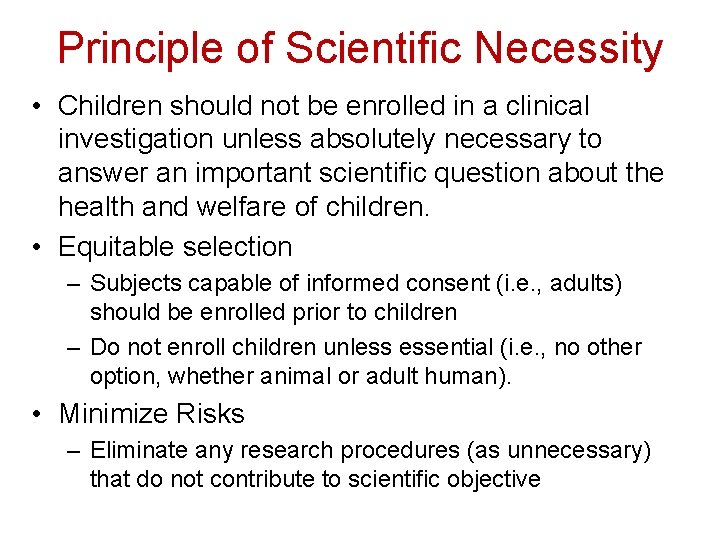
Principle of Scientific Necessity • Children should not be enrolled in a clinical investigation unless absolutely necessary to answer an important scientific question about the health and welfare of children. • Equitable selection – Subjects capable of informed consent (i. e. , adults) should be enrolled prior to children – Do not enroll children unless essential (i. e. , no other option, whether animal or adult human). • Minimize Risks – Eliminate any research procedures (as unnecessary) that do not contribute to scientific objective
Specific Topics • Additional Protections for Children – Scientific Necessity – Appropriate Balance of Risk and Benefit – Parental Permission – Child Assent 6
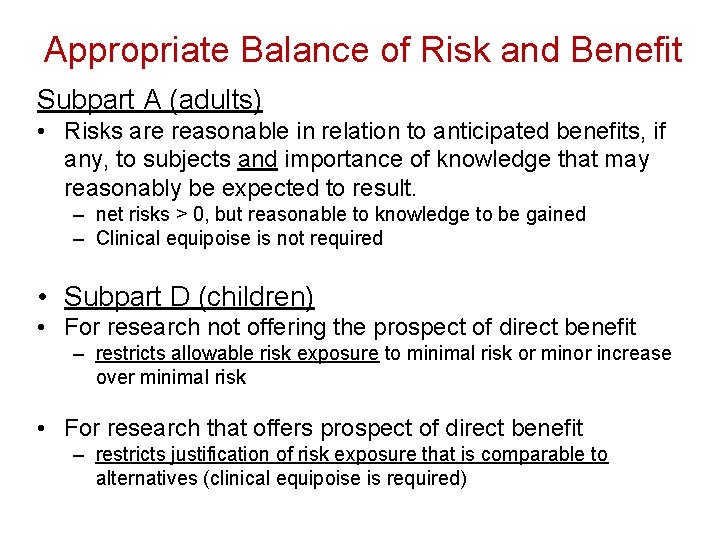
Appropriate Balance of Risk and Benefit Subpart A (adults) • Risks are reasonable in relation to anticipated benefits, if any, to subjects and importance of knowledge that may reasonably be expected to result. – net risks > 0, but reasonable to knowledge to be gained – Clinical equipoise is not required • Subpart D (children) • For research not offering the prospect of direct benefit – restricts allowable risk exposure to minimal risk or minor increase over minimal risk • For research that offers prospect of direct benefit – restricts justification of risk exposure that is comparable to alternatives (clinical equipoise is required)
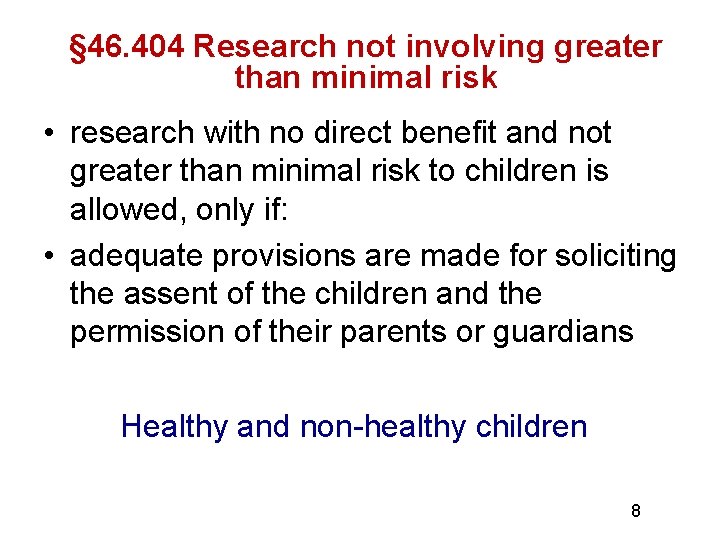
§ 46. 404 Research not involving greater than minimal risk • research with no direct benefit and not greater than minimal risk to children is allowed, only if: • adequate provisions are made for soliciting the assent of the children and the permission of their parents or guardians Healthy and non-healthy children 8
“Normal” or “routine” risks? • The National Commission defined “minimal risk” as those risks “normally encountered” by “healthy children. ” Although not included in the current definition, most ethicists and federal panels (e. g. , SACHRP, IOM) agree with this interpretation. • The administration of an experimental product is neither routine nor minimal risk. • Procedures that do not present a prospect of direct benefit must present a “low” (minor increase over minimal) risk. 9
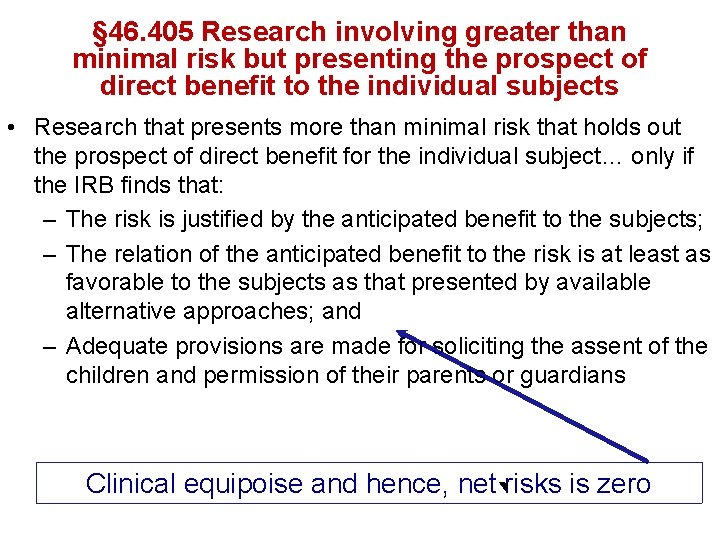
§ 46. 405 Research involving greater than minimal risk but presenting the prospect of direct benefit to the individual subjects • Research that presents more than minimal risk that holds out the prospect of direct benefit for the individual subject… only if the IRB finds that: – The risk is justified by the anticipated benefit to the subjects; – The relation of the anticipated benefit to the risk is at least as favorable to the subjects as that presented by available alternative approaches; and – Adequate provisions are made for soliciting the assent of the children and permission of their parents or guardians Clinical equipoise and hence, net risks is zero
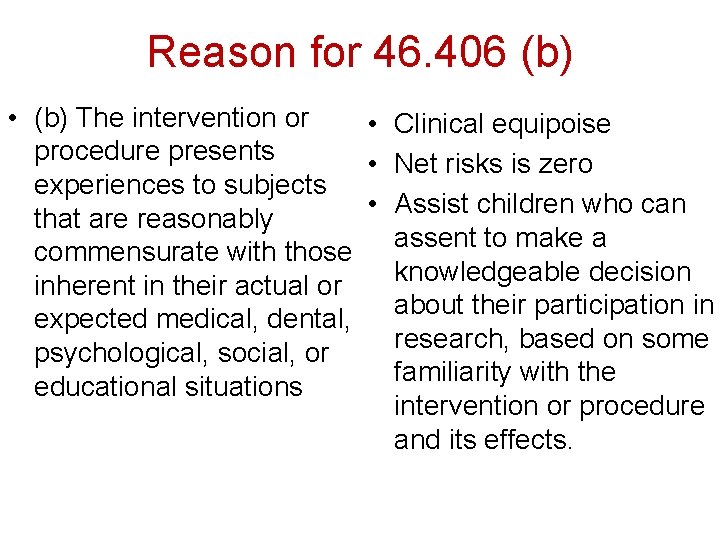
§ 46. 406 Research involving greater than minimal risk and no prospect of direct benefit to individual subjects, but likely to yield generalizable knowledge about the subject's disorder or condition Research is allowed only if: • The risk represents no more than a minor increase over minimal risk; • The intervention or procedure presents experiences to subjects that are reasonably commensurate with those inherent in their actual or expected medical, dental, psychological, social, or educational situations; • The intervention or procedure is likely to yield generalizable knowledge about the subjects' disorder or condition which is of vital importance for the understanding or amelioration of the subjects' disorder or condition; and • Adequate provisions are made for soliciting assent of the children and permission of their parents or guardians
Minor Increase over Minimal Risk • "Minor increase" refers to a risk which, while it goes beyond the narrow boundaries of minimal risk…, poses no significant threat to the child's health or well-being. ” • “Given this conservative limit, the… promise of [substantial future benefits to children other than the subject] does justify research which goes beyond, but only slightly beyond, minimal risk. ” National Commission - Report on Research Involving Children, pages 139 -40 (1977) 12
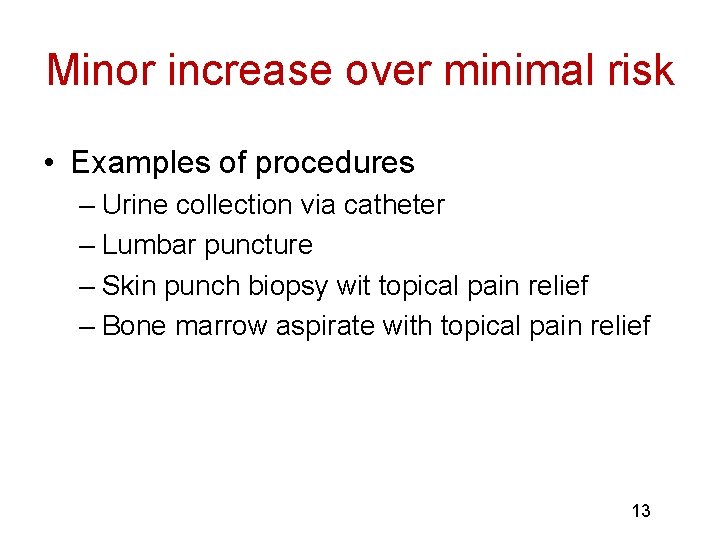
Minor increase over minimal risk • Examples of procedures – Urine collection via catheter – Lumbar puncture – Skin punch biopsy wit topical pain relief – Bone marrow aspirate with topical pain relief 13
Reason for 46. 406 (b) • (b) The intervention or • Clinical equipoise procedure presents • Net risks is zero experiences to subjects • Assist children who can that are reasonably assent to make a commensurate with those knowledgeable decision inherent in their actual or about their participation in expected medical, dental, research, based on some psychological, social, or familiarity with the educational situations intervention or procedure and its effects.
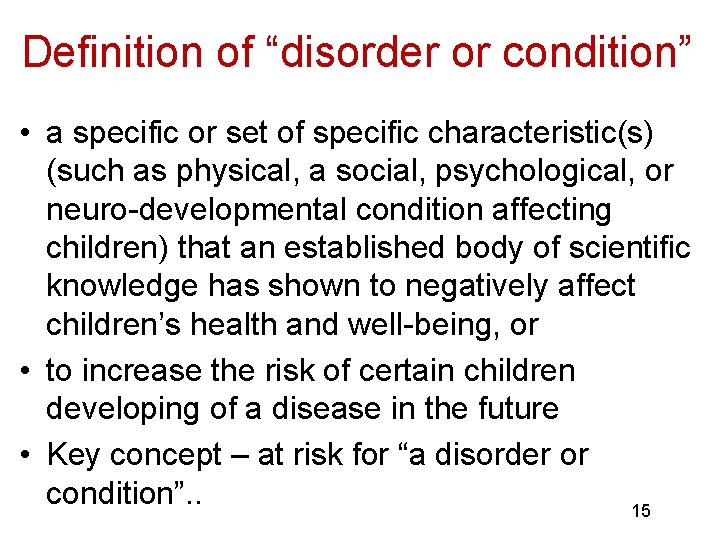
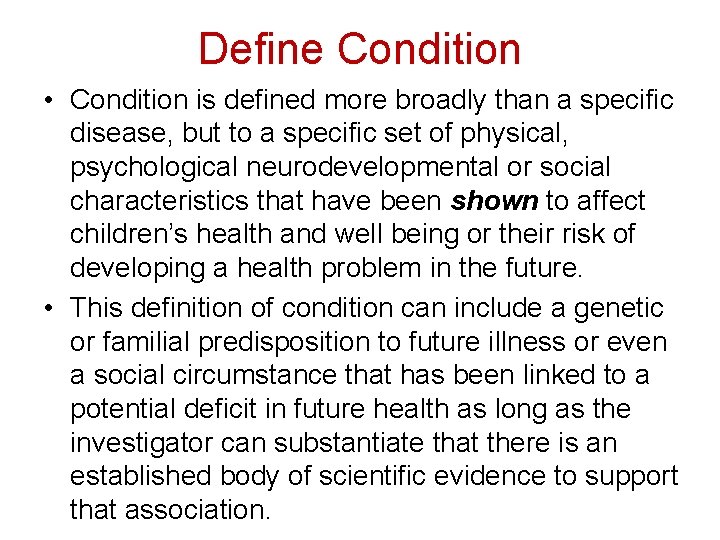
Definition of “disorder or condition” • a specific or set of specific characteristic(s) (such as physical, a social, psychological, or neuro-developmental condition affecting children) that an established body of scientific knowledge has shown to negatively affect children’s health and well-being, or • to increase the risk of certain children developing of a disease in the future • Key concept – at risk for “a disorder or condition”. . 15
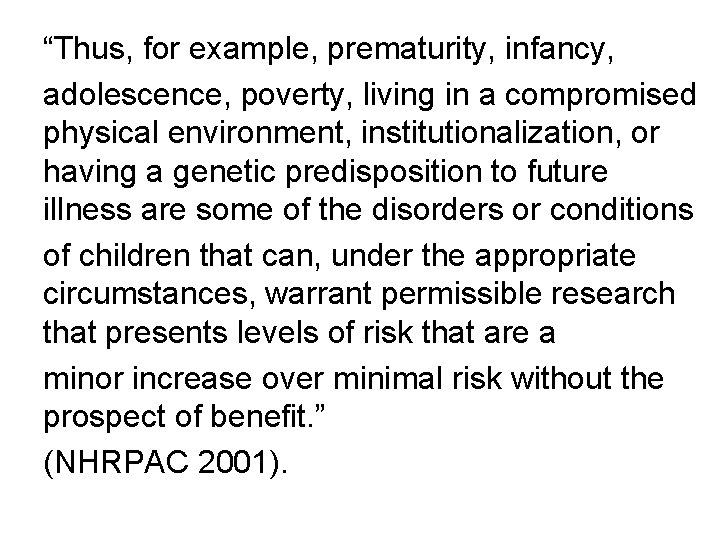
“Thus, for example, prematurity, infancy, adolescence, poverty, living in a compromised physical environment, institutionalization, or having a genetic predisposition to future illness are some of the disorders or conditions of children that can, under the appropriate circumstances, warrant permissible research that presents levels of risk that are a minor increase over minimal risk without the prospect of benefit. ” (NHRPAC 2001).
Define Condition • Condition is defined more broadly than a specific disease, but to a specific set of physical, psychological neurodevelopmental or social characteristics that have been shown to affect children’s health and well being or their risk of developing a health problem in the future. • This definition of condition can include a genetic or familial predisposition to future illness or even a social circumstance that has been linked to a potential deficit in future health as long as the investigator can substantiate that there is an established body of scientific evidence to support that association.
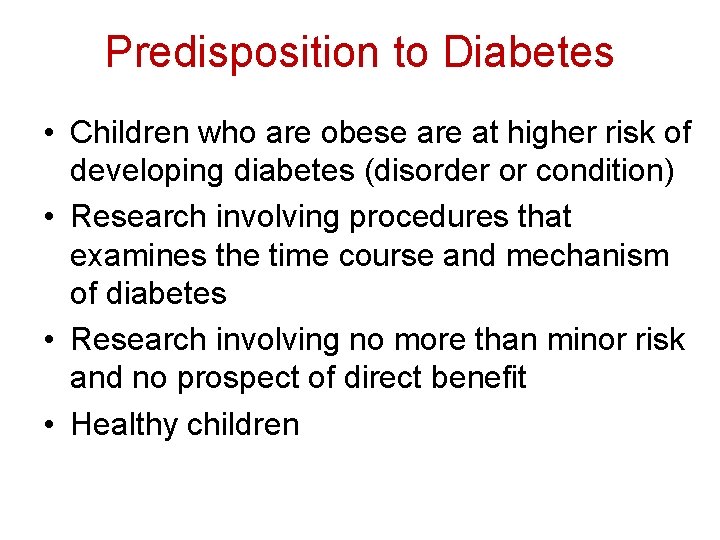
Predisposition to Diabetes • Children who are obese are at higher risk of developing diabetes (disorder or condition) • Research involving procedures that examines the time course and mechanism of diabetes • Research involving no more than minor risk and no prospect of direct benefit • Healthy children
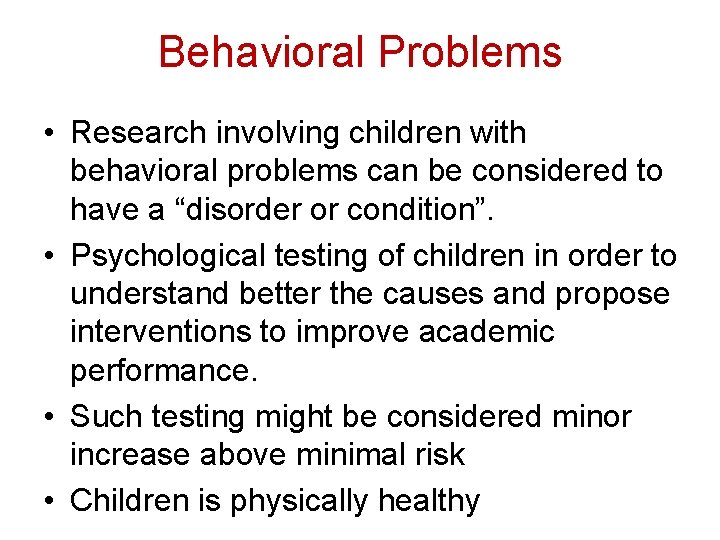
Behavioral Problems • Research involving children with behavioral problems can be considered to have a “disorder or condition”. • Psychological testing of children in order to understand better the causes and propose interventions to improve academic performance. • Such testing might be considered minor increase above minimal risk • Children is physically healthy
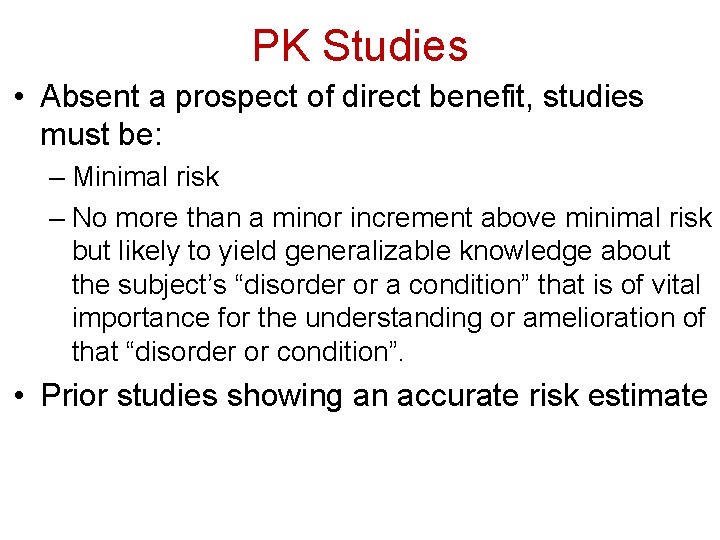
PK Studies • Absent a prospect of direct benefit, studies must be: – Minimal risk – No more than a minor increment above minimal risk but likely to yield generalizable knowledge about the subject’s “disorder or a condition” that is of vital importance for the understanding or amelioration of that “disorder or condition”. • Prior studies showing an accurate risk estimate
PK studies in healthy children • Usually no therapeutic or diagnostic intent • Involves moderate human exposure – near-therapeutic dose, limited duration • Intent: characterize ADME, define pediatric dose – generally occurs after PK/preliminary studies in adults • Given the lack of PDB, what are the conditions under which a non-therapeutic pediatric study could proceed using the “minor increment above minimal risk pathway?
Cough and Cold Products • Single dose PK studies are necessary to establish the correct dose to be used in subsequent efficacy studies. • A single dose of cough and cold product will not offer a potential direct benefit to the enrolled, but can be considered no more than a minor increment above minimal risk. • Enrolled child must have a “disorder or condition. • Children who are symptomatic from a cold has a “disorder” (a disease). • Asymptomatic children may be at risk for a cold based on empirical data
Kopelman • Problematic because each includes people’s social characteristics as a possible way to justify no-benefit, higher risk pediatric studies. • The meaning of the term social is extremely inclusive. • Problematic scientifically – Poverty and obesity • Unfair to enroll because of social characteristics – Bear disproportionately the burdens of research due to social situation that can be generalizable to other classes of children 23
Condition • Having or being at risk of a medical, psychological, or psychiatric illness • But are all such conditions serious enough to justify allowing no benefit higher risk studies? 24
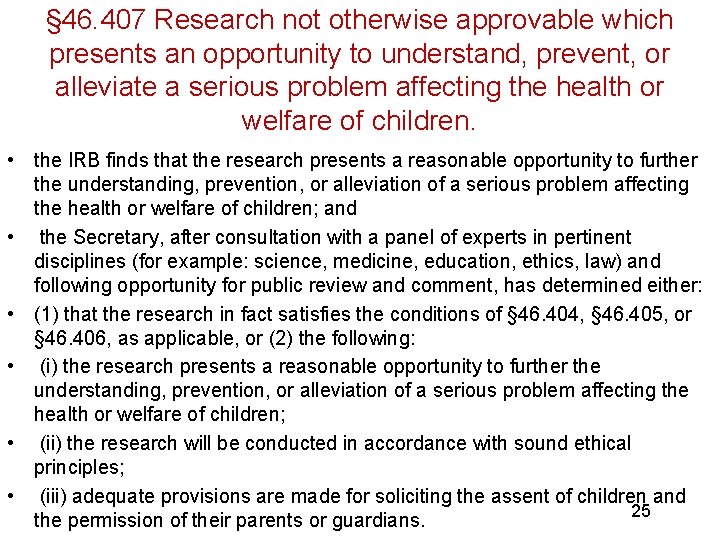
§ 46. 407 Research not otherwise approvable which presents an opportunity to understand, prevent, or alleviate a serious problem affecting the health or welfare of children. • the IRB finds that the research presents a reasonable opportunity to further the understanding, prevention, or alleviation of a serious problem affecting the health or welfare of children; and • the Secretary, after consultation with a panel of experts in pertinent disciplines (for example: science, medicine, education, ethics, law) and following opportunity for public review and comment, has determined either: • (1) that the research in fact satisfies the conditions of § 46. 404, § 46. 405, or § 46. 406, as applicable, or (2) the following: • (i) the research presents a reasonable opportunity to further the understanding, prevention, or alleviation of a serious problem affecting the health or welfare of children; • (ii) the research will be conducted in accordance with sound ethical principles; • (iii) adequate provisions are made for soliciting the assent of children and 25 the permission of their parents or guardians.
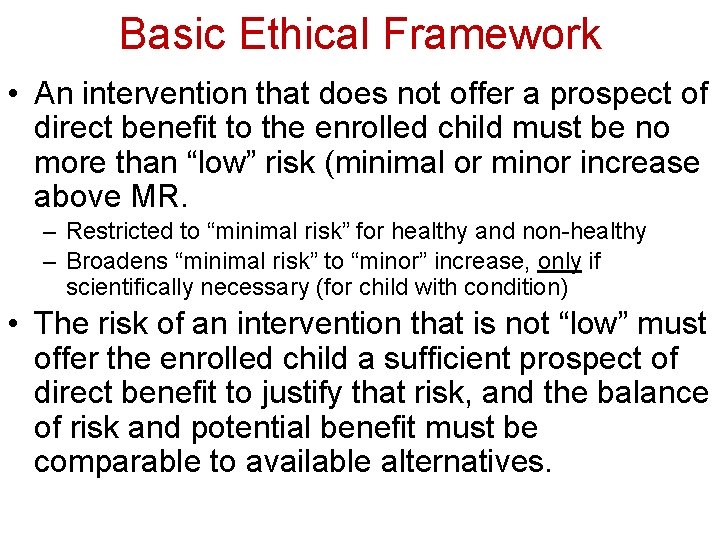
Basic Ethical Framework • An intervention that does not offer a prospect of direct benefit to the enrolled child must be no more than “low” risk (minimal or minor increase above MR. – Restricted to “minimal risk” for healthy and non-healthy – Broadens “minimal risk” to “minor” increase, only if scientifically necessary (for child with condition) • The risk of an intervention that is not “low” must offer the enrolled child a sufficient prospect of direct benefit to justify that risk, and the balance of risk and potential benefit must be comparable to available alternatives.
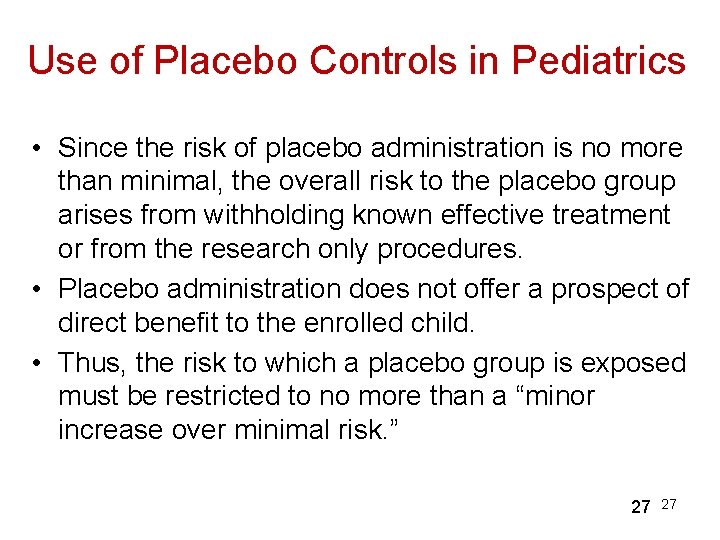
Use of Placebo Controls in Pediatrics • Since the risk of placebo administration is no more than minimal, the overall risk to the placebo group arises from withholding known effective treatment or from the research only procedures. • Placebo administration does not offer a prospect of direct benefit to the enrolled child. • Thus, the risk to which a placebo group is exposed must be restricted to no more than a “minor increase over minimal risk. ” 27 27
Specific Topics • Additional Protections for Children – Scientific Necessity (and Extrapolation) – Appropriate Balance of Risk and Benefit – Parental Permission – Child Assent 28
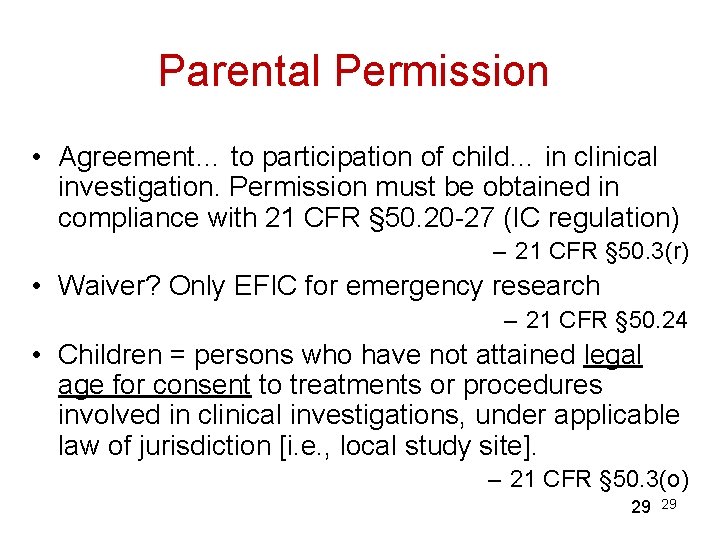
Parental Permission • Agreement… to participation of child… in clinical investigation. Permission must be obtained in compliance with 21 CFR § 50. 20 -27 (IC regulation) – 21 CFR § 50. 3(r) • Waiver? Only EFIC for emergency research – 21 CFR § 50. 24 • Children = persons who have not attained legal age for consent to treatments or procedures involved in clinical investigations, under applicable law of jurisdiction [i. e. , local study site]. – 21 CFR § 50. 3(o) 29 29
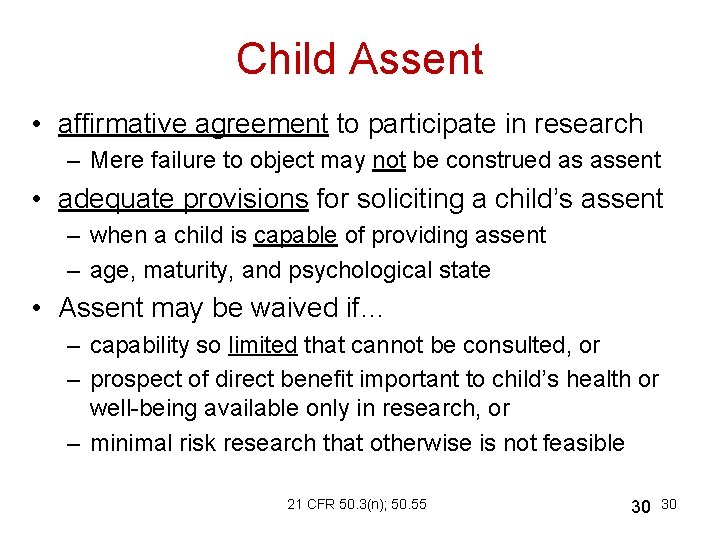
Child Assent • affirmative agreement to participate in research – Mere failure to object may not be construed as assent • adequate provisions for soliciting a child’s assent – when a child is capable of providing assent – age, maturity, and psychological state • Assent may be waived if… – capability so limited that cannot be consulted, or – prospect of direct benefit important to child’s health or well-being available only in research, or – minimal risk research that otherwise is not feasible 21 CFR 50. 3(n); 50. 55 30 30
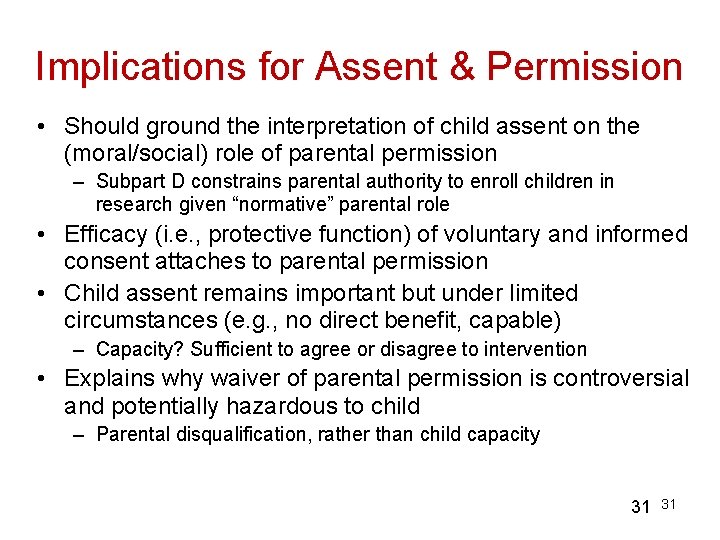
Implications for Assent & Permission • Should ground the interpretation of child assent on the (moral/social) role of parental permission – Subpart D constrains parental authority to enroll children in research given “normative” parental role • Efficacy (i. e. , protective function) of voluntary and informed consent attaches to parental permission • Child assent remains important but under limited circumstances (e. g. , no direct benefit, capable) – Capacity? Sufficient to agree or disagree to intervention • Explains why waiver of parental permission is controversial and potentially hazardous to child – Parental disqualification, rather than child capacity 31 31