
ETHICAL ISSUES IN CLINICAL RADIOLOGY Dr Mahboobeh Saber
ETHICAL ISSUES IN CLINICAL RADIOLOGY Dr Mahboobeh Saber Assistant Professor Medical Ethics


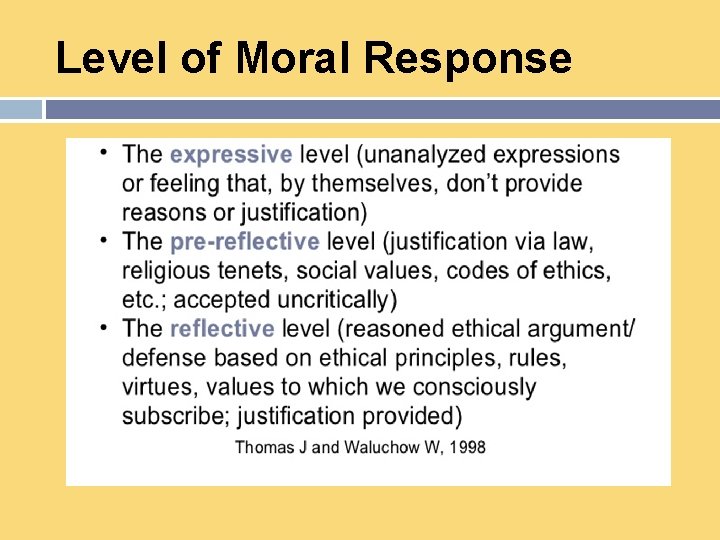
Level of Moral Response
What we will cover Definition and characteristics of ethics Ethics in health care ARRT Radiographers Code of Ethics Patients Bill of Rights Bioethical Dilemmas

Like other health care providers, radiologists should have their own Code of ethics and guidelines to describe standards of profession, disciplinary procedures for violation of ethical and legal rules. These should be preferably provided by the Iranian Society of Radiology
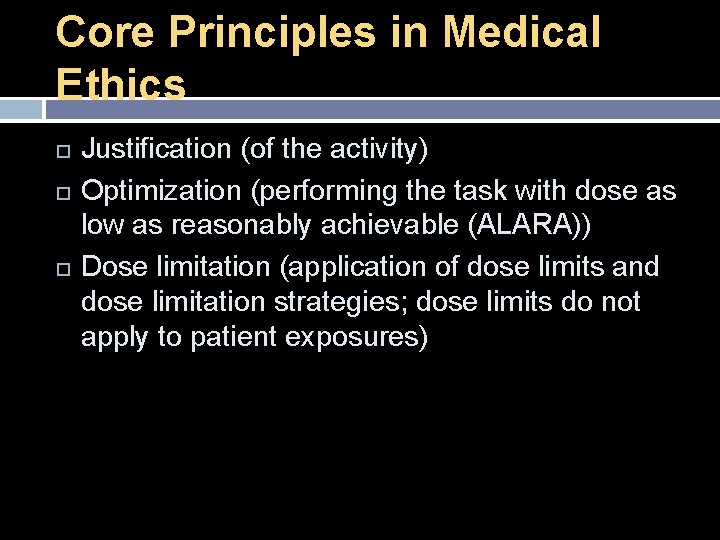
Core Principles in Medical Ethics Justification (of the activity) Optimization (performing the task with dose as low as reasonably achievable (ALARA)) Dose limitation (application of dose limits and dose limitation strategies; dose limits do not apply to patient exposures)
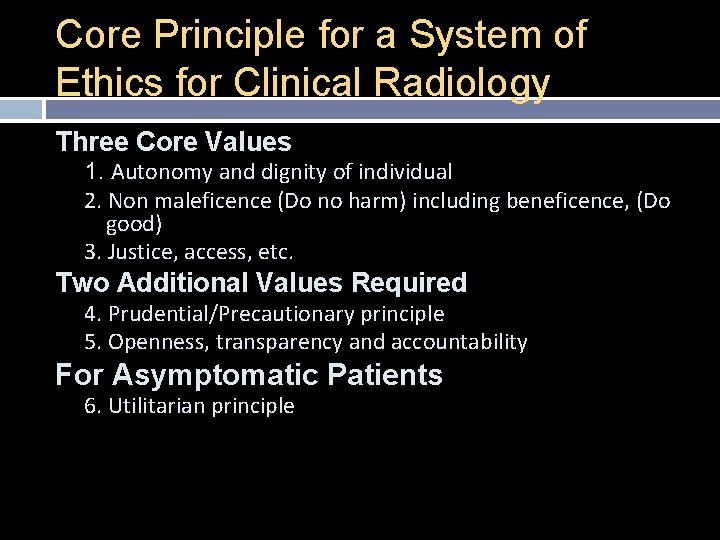
Core Principle for a System of Ethics for Clinical Radiology Three Core Values 1. Autonomy and dignity of individual 2. Non maleficence (Do no harm) including beneficence, (Do good) 3. Justice, access, etc. Two Additional Values Required 4. Prudential/Precautionary principle 5. Openness, transparency and accountability For Asymptomatic Patients 6. Utilitarian principle
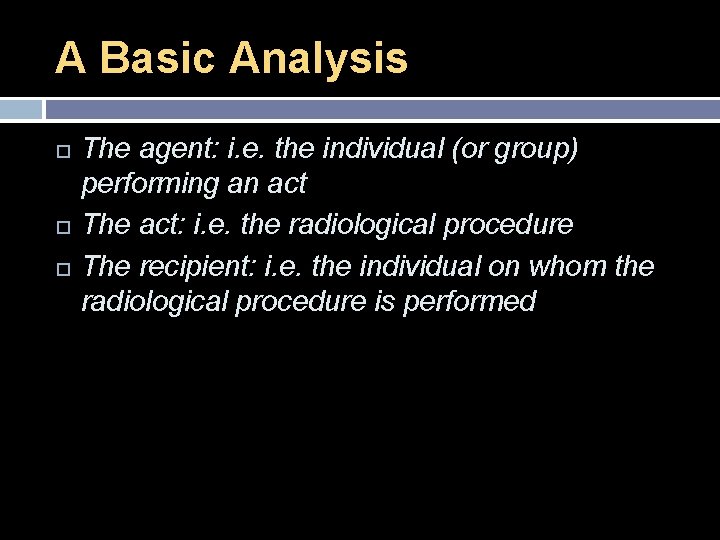
A Basic Analysis The agent: i. e. the individual (or group) performing an act The act: i. e. the radiological procedure The recipient: i. e. the individual on whom the radiological procedure is performed
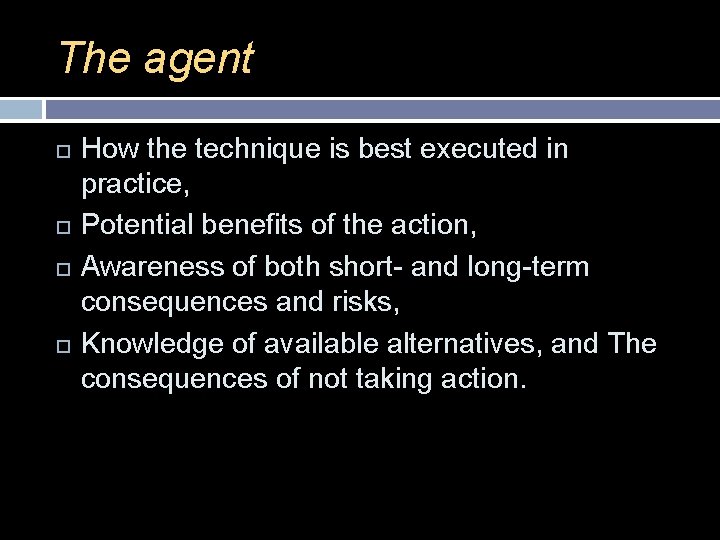
The agent How the technique is best executed in practice, Potential benefits of the action, Awareness of both short- and long-term consequences and risks, Knowledge of available alternatives, and The consequences of not taking action.

The act: The potential benefits, The risks of potential harm, The judgment of the agent, The attitude of the recipient, Considerations arising from need for public accountability, and Considerations arising from health economics and equity.
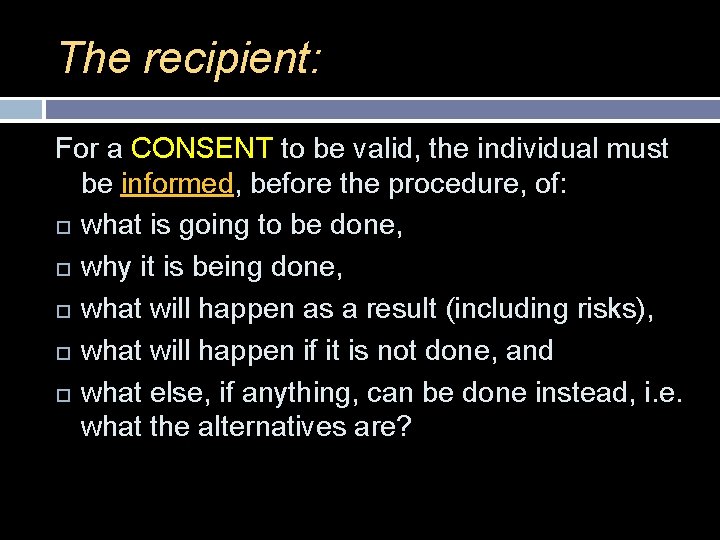
The recipient: For a CONSENT to be valid, the individual must be informed, before the procedure, of: what is going to be done, why it is being done, what will happen as a result (including risks), what will happen if it is not done, and what else, if anything, can be done instead, i. e. what the alternatives are?
The recipient: The disclosure of information should: Be full, frank and open, Include all material risks, which a reasonable person would be likely to attach significance to, Be presented in a way that the individual can understand assimilate, and Be clarified by encouraging questions, which are answered honestly and completely.
MEDICAL, SOCIAL, AND LEGAL CONTEXT FOR RADIOLOGY
1. Deviation from standards, misdiagnoses; 2. Over-charging patients; 3. Poor communication; 4. Refusing to seek consultations when necessary; 5. Referral to site of self-interest and fee splitting (dichotomy); 6. Misleading and untruthful advertising; 7. Other ethical negligence’s such as inadequate respect for "belief and ideas of patients, autonomy, the right to consent and refuse procedure", breach of confidentiality
Finally three areas in which special concerns arise are briefly introduced. First some frankly nonmedical deliberate human exposures occur, and often happen in a clinical context. These need special attention. Second there is a significant lack of alignment between the ethical framework for radiation protection and its medical counterparts. Finally situations involving pregnancy or possible pregnancy of patients to be radiated need special attention
Definition and characteristics of ethics








- Slides: 31