
Ethical Decision Tree Liliana Moreno Mandy Netherland EDU
- Slides: 13
Ethical Decision Tree Liliana Moreno, Mandy Netherland EDU 2003. 02
Ethical Dilemma The Presidential elections are in a few weeks and in your 6 th grade social studies class, you lead a discussion about the voting process and the issues for each candidate. In the discussion, a student brings up the candidates beliefs about gay marriage. This leads to students arguing about their opinions. How do you handle it?
Applicable Texas Code of Ethics • (E) Standard 2. 5. The educator shall not discriminate against or coerce a colleague on the basis of race, color, religion, national origin, age, gender, disability, family status, or sexual orientation. • (D) Standard 3. 4. The educator shall not exclude a student from participation in a program, deny benefits to a student, or grant an advantage to a student on the basis of race, color, misrepresent facts regarding a student. gender [sex] , disability, national origin, religion, [or] family status , or sexual orientation • (G) Standard 1. 7. The educator shall comply with state regulations, written local school board policies, and other [applicable] state and federal laws
Other Ethical Relevant Issues • Teachers personal belief should not interfere with the situation • The teacher should address the situation in a professional matter • Students beliefs may be offended or teacher
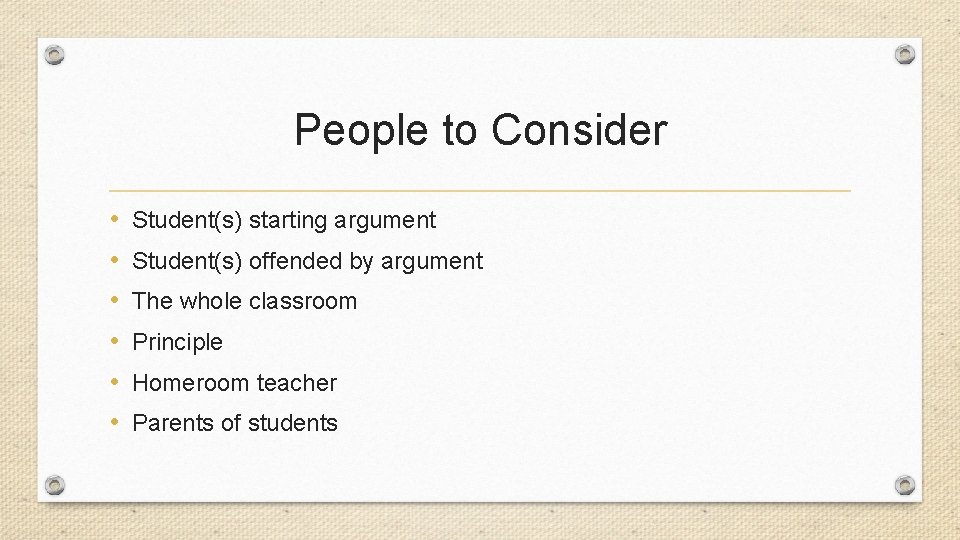
People to Consider • • • Student(s) starting argument Student(s) offended by argument The whole classroom Principle Homeroom teacher Parents of students
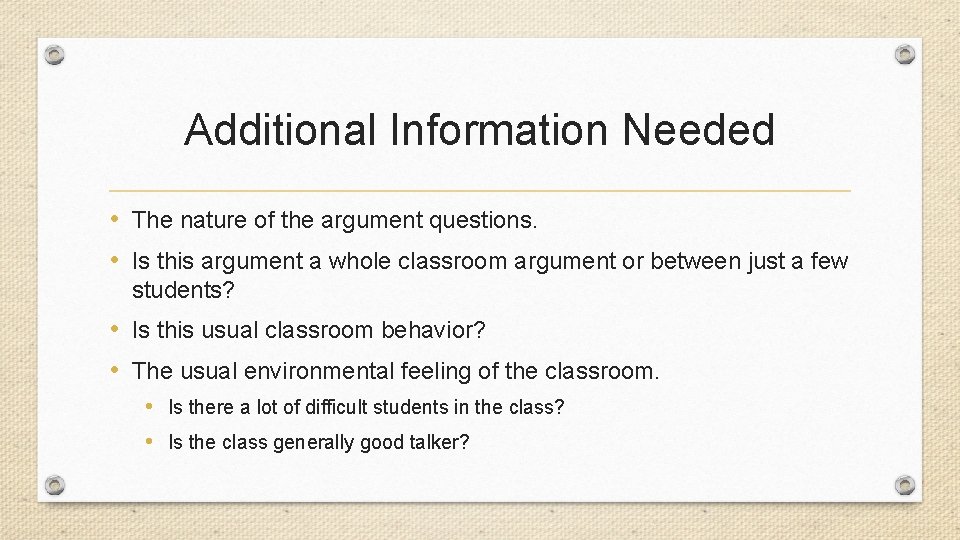
Additional Information Needed • The nature of the argument questions. • Is this argument a whole classroom argument or between just a few students? • Is this usual classroom behavior? • The usual environmental feeling of the classroom. • Is there a lot of difficult students in the class? • Is the class generally good talker?
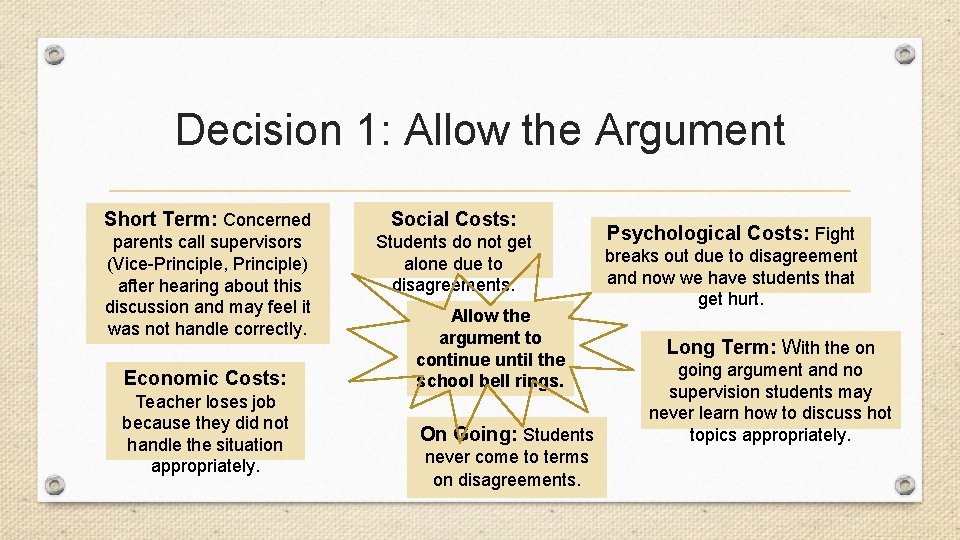
Decision 1: Allow the Argument Short Term: Concerned Social Costs: parents call supervisors (Vice-Principle, Principle) after hearing about this discussion and may feel it was not handle correctly. Students do not get alone due to disagreements. Economic Costs: Teacher loses job because they did not handle the situation appropriately. Allow the argument to continue until the school bell rings. On Going: Students never come to terms on disagreements. Psychological Costs: Fight breaks out due to disagreement and now we have students that get hurt. Long Term: With the on going argument and no supervision students may never learn how to discuss hot topics appropriately.
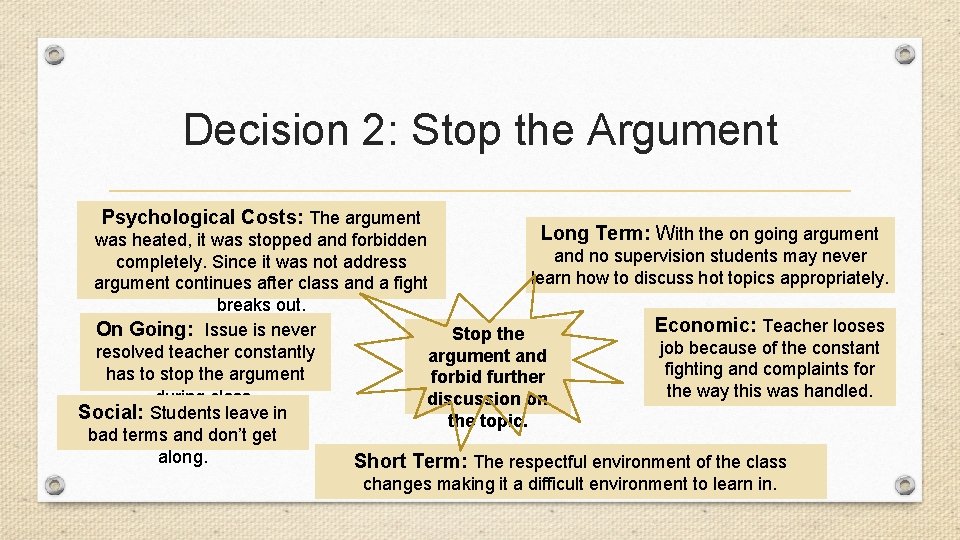
Decision 2: Stop the Argument Psychological Costs: The argument Long Term: With the on going argument was heated, it was stopped and forbidden and no supervision students may never completely. Since it was not address learn how to discuss hot topics appropriately. argument continues after class and a fight breaks out. Economic: Teacher looses On Going: Issue is never Stop the job because of the constant resolved teacher constantly argument and fighting and complaints for has to stop the argument forbid further the way this was handled. during class. discussion on Social: Students leave in the topic. bad terms and don’t get along. Short Term: The respectful environment of the class changes making it a difficult environment to learn in.
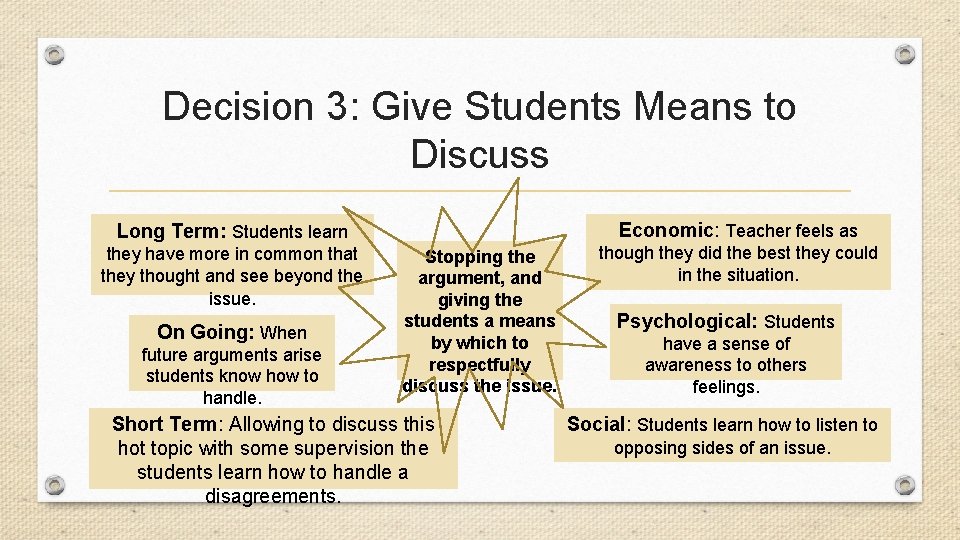
Decision 3: Give Students Means to Discuss Economic: Teacher feels as Long Term: Students learn they have more in common that they thought and see beyond the issue. On Going: When future arguments arise students know how to handle. Stopping the argument, and giving the students a means by which to respectfully discuss the issue. Short Term: Allowing to discuss this hot topic with some supervision the students learn how to handle a disagreements. though they did the best they could in the situation. Psychological: Students have a sense of awareness to others feelings. Social: Students learn how to listen to opposing sides of an issue.
Chosen Decision. . . Decision #3 Give Students Means to Discuss; Stopping the argument, and giving the students a means by which to respectfully discuss the issue.
Commitment Statement • I, the teacher take full responsibility of the course of action taken for this situation. Choosing to allow students to respectfully discuss this topic should give a means to how to properly discuss a hot topic. I understand the possible consequences for this choice and feel this fits appropriately for the situation. I will commit to fix any unresolved issues if need from this choice of action.
Possible Negative Consequences • • Parents might not appreciate the discussion of the hot topic Students may not even learn how to respectfully discuss People may be offended by others beliefs Disagreements may never come to terms
Correct Negative Consequences • Allowing them to discuss with supervision and guidelines should teach students how to maturely discuss and be respectful to others beliefs. • Addressing the situation as a learning experience should give a good insight to what future accruing discussions will be like and hope that the students learn the importance of how to respectfully discuss. • Let the students know that you believe they are mature enough and have gained how to handle a situation like this, but also give them the option to opt out if they feel this will offended them. • Address that they don’t have to change beliefs but be mindful of others discussion and once discussion is done; let go and move on.