
Ethical Decision Making Tools for Enhancing Organizational Safety
- Slides: 41
Ethical Decision Making Tools for Enhancing Organizational Safety Culture Robert Emery, Dr. PH, CHP, CIH, CBSP, CHMM, CPP, ARM Vice President for Safety, Health, Environment & Risk Management The University of Texas Health Science Center at Houston Professor of Occupational Health The University of Texas School of Public Health Robert. J. Emery@uth. tmc. edu
Learning Objectives � Define “ethics” as they pertain to the safety and industrial hygiene professions � Review and discuss the elements of codes of ethics � Define several ethical dilemmas encountered by safety professionals and industrial hygienists � Describe “safety culture” and its links to ethics � List examples of ethical decision making tools that can be used to help address issues with ethical consequences
What is “Ethics”? � “a set of moral principles or values” � “the principles of conduct governing an individual or group” � “conforming to accepted professional standards of conduct” › “If the situation involves risk, then it involves ethics” � Dr. Lawrence Whitehead, UT SPH
ABIH Code of Ethics (Abbreviated – for full document see: abih. org) � Responsibilities to board, the profession, and the public › Comply with laws, regulations › Provide accurate and truthful representations regarding certifications › Maintain security of exam information › Report apparent violations › Refrain from public behavior that is in violation of professional, ethical or legal standard
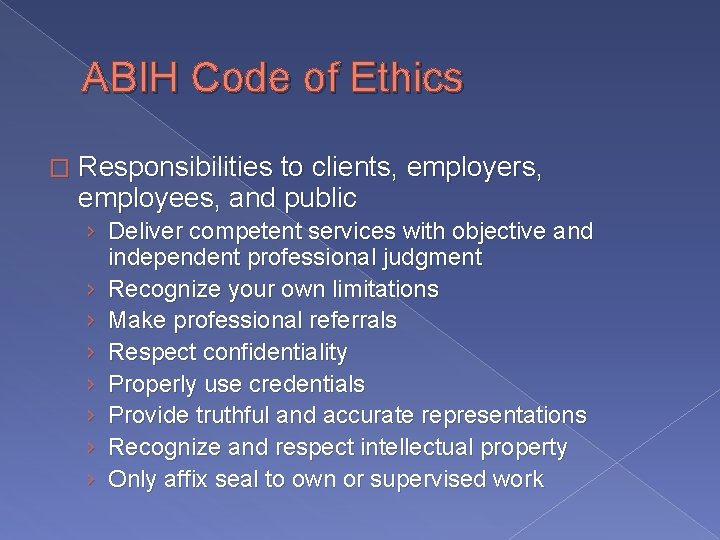
ABIH Code of Ethics � Responsibilities to clients, employers, employees, and public › Deliver competent services with objective and independent professional judgment › Recognize your own limitations › Make professional referrals › Respect confidentiality › Properly use credentials › Provide truthful and accurate representations › Recognize and respect intellectual property › Only affix seal to own or supervised work
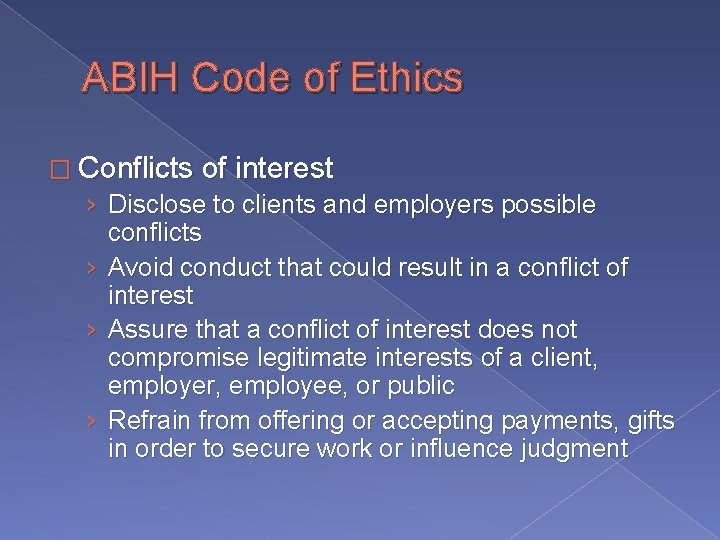
ABIH Code of Ethics � Conflicts of interest › Disclose to clients and employers possible › › › conflicts Avoid conduct that could result in a conflict of interest Assure that a conflict of interest does not compromise legitimate interests of a client, employer, employee, or public Refrain from offering or accepting payments, gifts in order to secure work or influence judgment
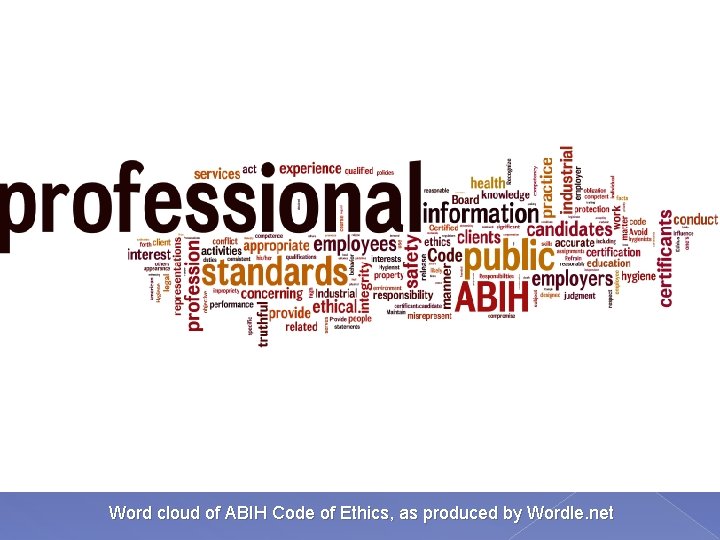
Word cloud of ABIH Code of Ethics, as produced by Wordle. net
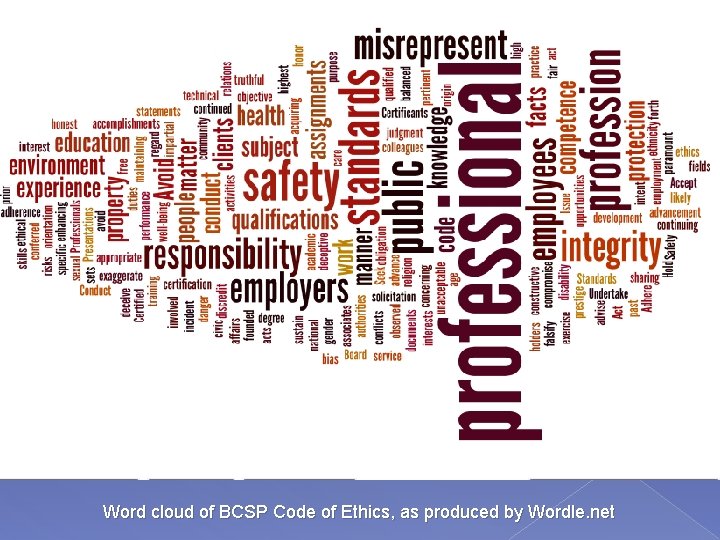
Word cloud of BCSP Code of Ethics, as produced by Wordle. net
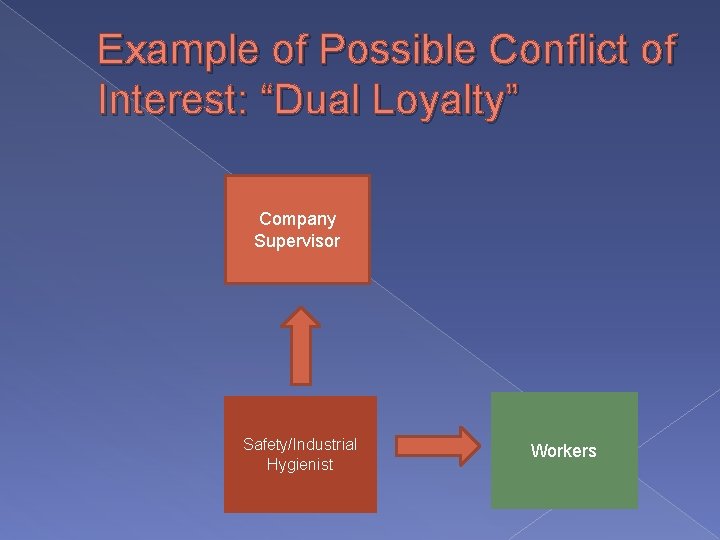
Example of Possible Conflict of Interest: “Dual Loyalty” Company Supervisor Safety/Industrial Hygienist Workers
The “Dual Loyalty” Conundrum � Safety and industrial hygiene programs within an organization have simultaneous obligations, both explicit and implicit, to the workers and to the organization � When these loyalties are incompatible, can result in significant ethical challenges � A key consideration: does an environment of trust exist?
Confidentiality � Recently published study suggests possible link between chemical exposure and specific type of cancer � Chemical is used at your facility � Develop sampling strategy, which consists of personal samplers on certain individuals › Do you tell them why you’re sampling? � Non-sampled workers in same area want to know the results › › Who do you/can you share personal sampling results with? How would you go about doing this? Could this situation be managed differently to avoid ethical dilemmas? What if no legal or suggested limit currently exists?
“Principled Dissent” � Workers voicing concerns about a particular condition › Key points: �Are concerns actually being voiced? �How are they being voiced? �How does the organization respond? � What about situations where the IH has to be the “principled dissenter”? � Again – does an environment of trust exist?
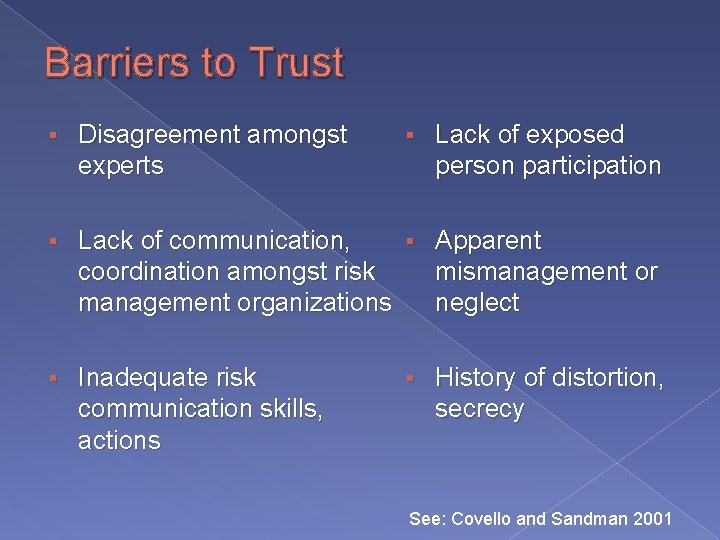
Barriers to Trust Lack of exposed person participation § Disagreement amongst experts § § Apparent Lack of communication, mismanagement or coordination amongst risk neglect management organizations § Inadequate risk communication skills, actions § § History of distortion, secrecy See: Covello and Sandman 2001
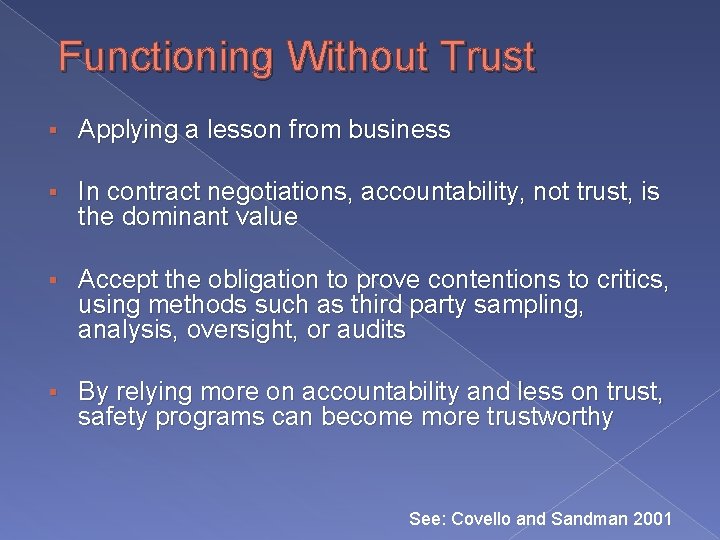
Functioning Without Trust § Applying a lesson from business § In contract negotiations, accountability, not trust, is the dominant value § Accept the obligation to prove contentions to critics, using methods such as third party sampling, analysis, oversight, or audits § By relying more on accountability and less on trust, safety programs can become more trustworthy See: Covello and Sandman 2001
Are Workers Free to Question? � Within your organization, are workers able to speak freely to management (and be heard)? � How would you know? � Does an absence of voiced concerns mean there are none?
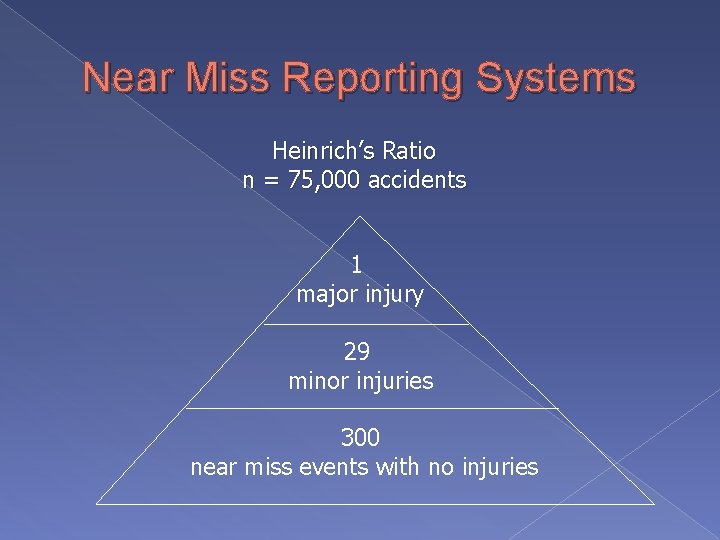
Near Miss Reporting Systems Heinrich’s Ratio n = 75, 000 accidents 1 major injury 29 minor injuries 300 near miss events with no injuries
Near Miss Reporting � Historically applied in settings where the top event was: › Rare, but › Catastrophic � Classic example: › Airline industry
How Near Miss Reporting Systems Work � � � Organizational commitment Worker education – full involvement encouraged Simple method of reporting unsafe acts or conditions: “things that almost happened” › Note: may be acute or chronic, existing or evolving conditions � � May be anonymous – no repercussions for reporting Investigation Intervention Feedback
Effects of Organizational Culture � Near miss reporting systems necessarily rely on open communications between workers and supervision � How workers interact and respond to supervision is critical � Key question: are the workers truly free to question? � Or are we in a situation of “organizational silence? ”
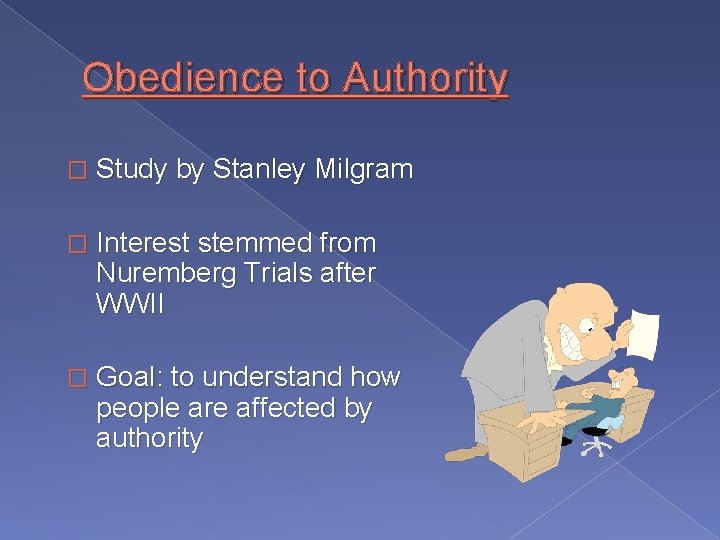
Obedience to Authority � Study by Stanley Milgram � Interest stemmed from Nuremberg Trials after WWII � Goal: to understand how people are affected by authority
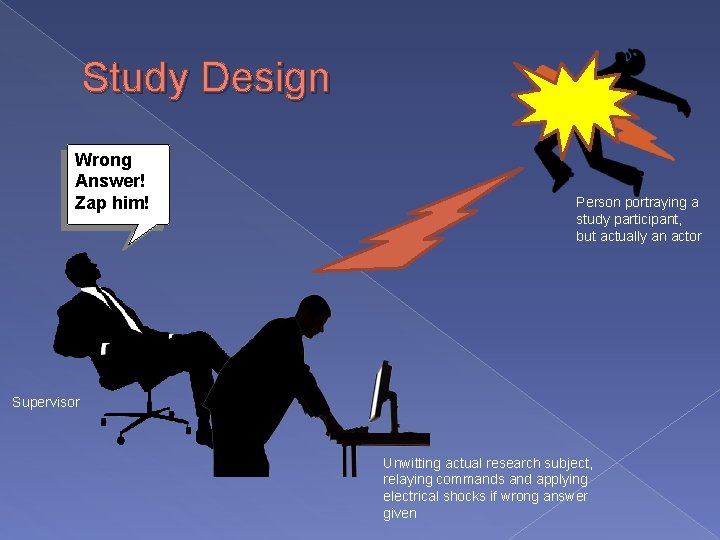
Study Design � Study participants to teach a student � Variable electrical shocks provided when errors occurred � Students actually actors who faked errors and being shocked � Authority figure provided instruction to study participants
Study Design Wrong Answer! Zap him! Person portraying a study participant, but actually an actor Supervisor Unwitting actual research subject, relaying commands and applying electrical shocks if wrong answer given
Results � 63% of study participants provided shocks to students knowingly above the lethal level � Although the study is now noted today for its ethical problems, it did reveal issues inherent to certain organizational environments
How Can We Avoid This? � Organizations must hold safety as a core value, visible to all � Need to encourage input through word and deed –do we say one thing and do another? � Eliminate even the notion of intimidation – acknowledge and reinforce positive acts � Actively solicit input, listen, act, respond
What is ”Safety Culture”? � Many definitions exist, most exhibit similar themes such as › “the attitudes, beliefs, and perceptions shared by natural groups as defining norms and values which determine how they act and react in relation to risk and risk control systems” (Hale 2000) › “Culture” (a noun) is linked inextricably to “behavior” (a verb). Culture can’t be directly measured, but behavior can. Behavior, good or poor, can be an indicator of culture �“Safety Climate” a snapshot indication of overall “Safety Culture” › In short: safety culture is how people behave when no one is looking 25
Examples of Recent Emphasis on Safety Culture � U. S. Chemical Safety Board › Investigation into 120 lab accidents – noted absence of culture of safety › Deepwater Horizon accident noted to be similar to Texas City Refinery event – absence of culture of safety � U. S. Nuclear Regulatory Commission › Focus on safety culture at reactors � American Board of Industrial Hygiene › Ethics continuing education requirement
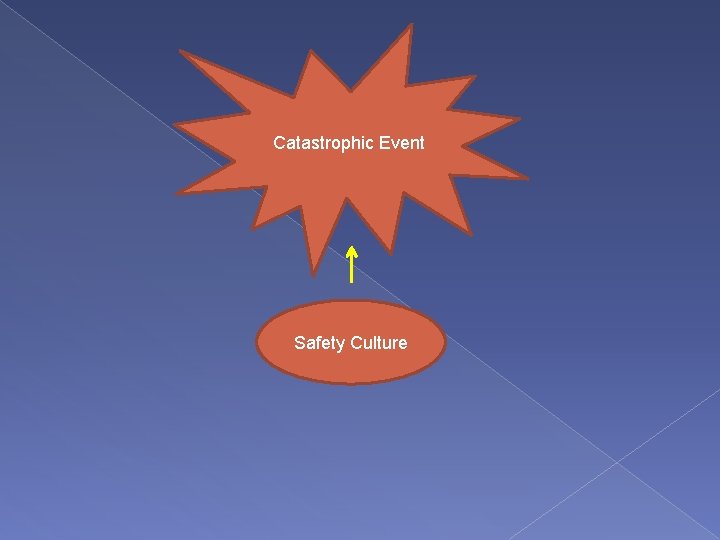
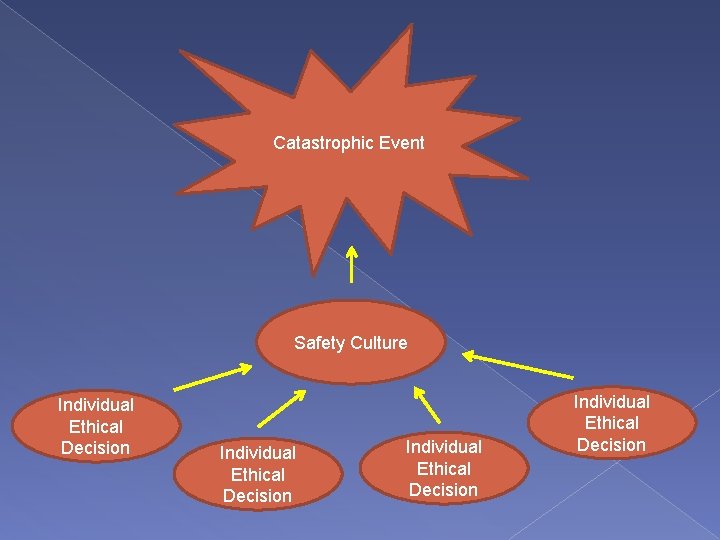
Why this Emphasis on Safety Culture? � Consider this paradox: Addressing the most frequent workplace injuries experienced by an airline – namely injuries to baggage handlers – in no way provides assurance that a plane crash will not occur � Such assurance is achieved only when everyone in the organization is attentive to safety at each step of the process – particularly in highly complex risk settings See: Prof. Andrew Hopkins remarks in US CSB video “Anatomy of a Disaster”
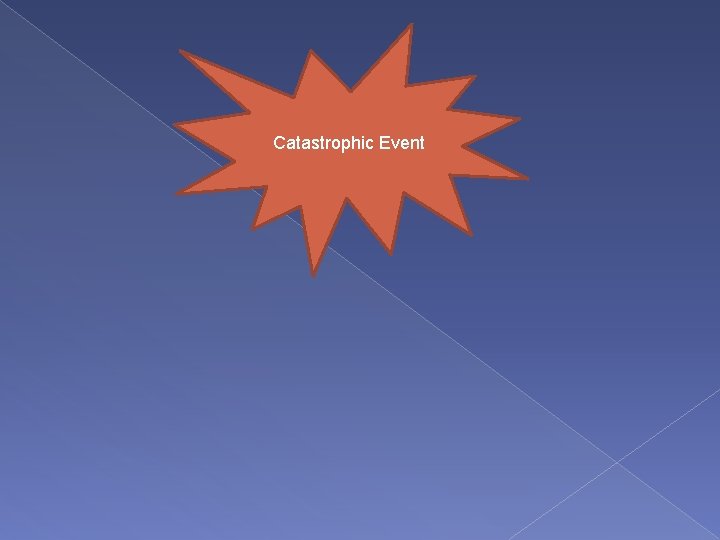
Catastrophic Event
Catastrophic Event Safety Culture
Catastrophic Event Safety Culture Individual Ethical Decision
Ethics and Safety Culture are Linked – and It’s Not Just an EH&S Issue � The existence of an EH&S program, while important, does not ensure a viable safety culture � A true culture of safety requires commitment across the organization – with a particular emphasis on the front line supervisor as they are primarily responsible and accountable for the safe conduct of workers and operations › But are the front line workers equipped with the tools to make ethical decisions regarding safety? � Important for EH&S to function as a role model and in a service capacity, perceived as providing a collegial and valuable service to the organization
Example: Welding Job � Safety’s focus › › � Hot works permit, portable fire extinguisher, fire watch Protective equipment for eyes, lungs, skin Curtains, barriers Confined pace, elevated work surface But was the weld done correctly? How do we know? › › Welder proficiency, professionalism Knowledgeable supervisor who verifies work Worker empowered to voice concerns Management commitment/support
Is it a Labeling Problem? � Perhaps the term “safety” in “culture of safety” is a barrier for upper management � See “Words That Works” Luntz, F. � We say “safety…”, leaders think “safety department” � Maybe a better term: “culture of professionalism”?
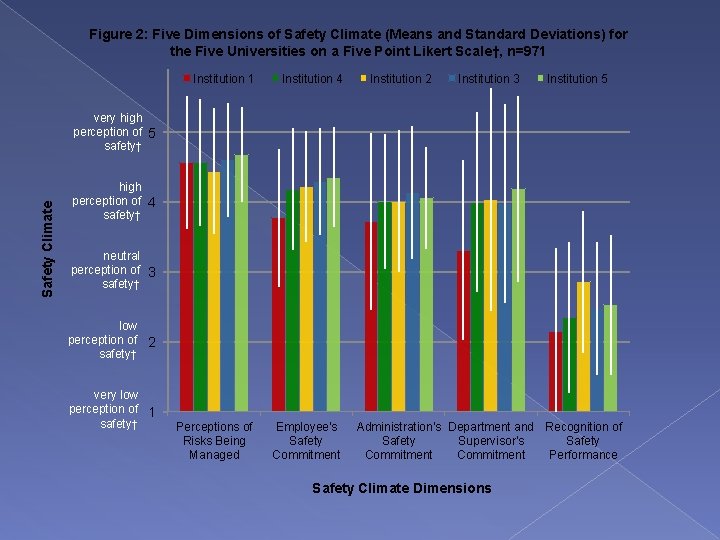
Important Cautionary Note � “Many of the definitions of safety culture present a view of workers having a shared set of values and beliefs regarding safety” � “However, the presence of subcultures within an organization suggests an absence of a cohesive safety culture” � “Therefore, it is questionable whether a culture change program can be designed for any large organization without taking into account the subcultures in place, how they interact and the power relations between them” Pidgeon, 1998 � CSHEMA’s pilot work on measuring safety climate on campuses suggests recognition of safety performance (both good and bad) warrants attention Gutierrez, et al. In revision
Figure 2: Five Dimensions of Safety Climate (Means and Standard Deviations) for the Five Universities on a Five Point Likert Scale†, n=971 Institution 4 Perceptions of Risks Being Managed Employee's Safety Commitment Institution 2 Institution 3 Institution 5 Safety Climate very high perception of 5 safety† high perception of 4 safety† neutral perception of 3 safety† low perception of 2 safety† very low perception of 1 safety† Administration's Department and Recognition of Safety Supervisor's Safety Commitment Performance Safety Climate Dimensions
Understand That it Won’t Happen Overnight � Real culture change requires a long term view and commitment � Not an engineering solution – it’s an organizational solution � Recently published report on a grassroots led, management supported change at a major utility that took 9 years to fully implement Simon and Cistaro, Prof Safe April 2009
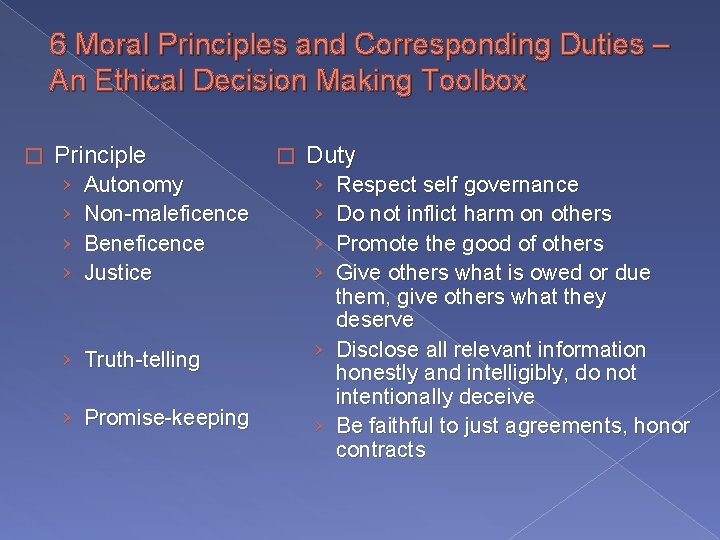
6 Moral Principles and Corresponding Duties – An Ethical Decision Making Toolbox � Principle › › Autonomy Non-maleficence Beneficence Justice › Truth-telling › Promise-keeping � Duty › › Respect self governance Do not inflict harm on others Promote the good of others Give others what is owed or due them, give others what they deserve › Disclose all relevant information honestly and intelligibly, do not intentionally deceive › Be faithful to just agreements, honor contracts
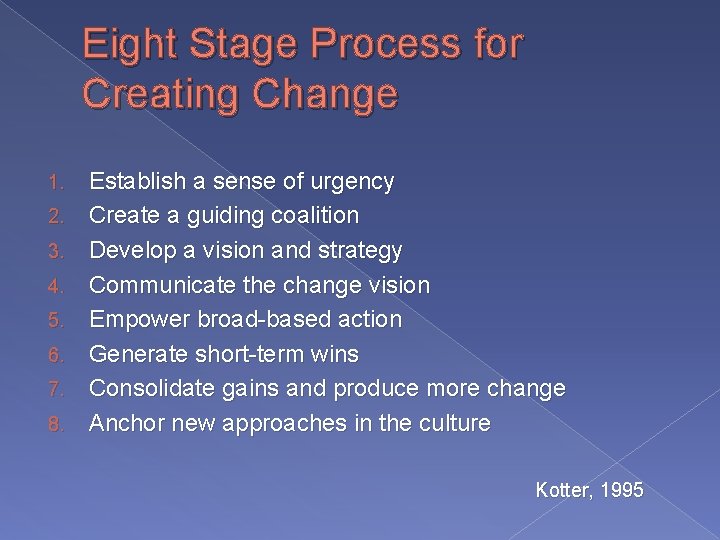
Eight Stage Process for Creating Change 1. 2. 3. 4. 5. 6. 7. 8. Establish a sense of urgency Create a guiding coalition Develop a vision and strategy Communicate the change vision Empower broad-based action Generate short-term wins Consolidate gains and produce more change Anchor new approaches in the culture Kotter, 1995
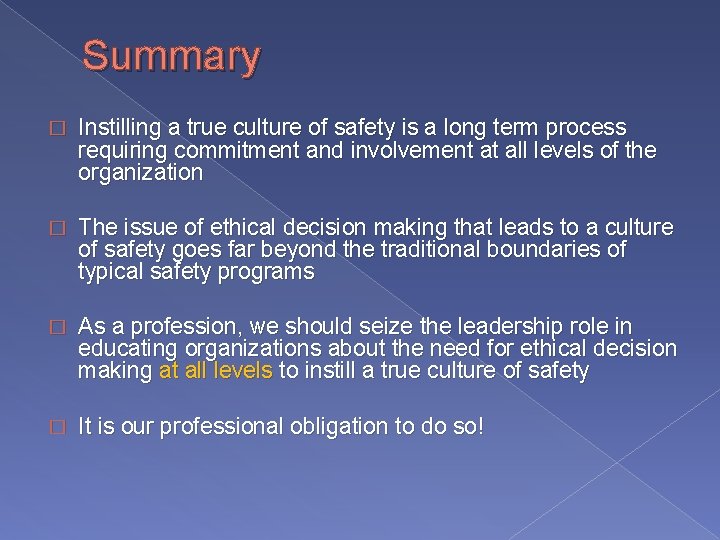
Summary � Instilling a true culture of safety is a long term process requiring commitment and involvement at all levels of the organization � The issue of ethical decision making that leads to a culture of safety goes far beyond the traditional boundaries of typical safety programs � As a profession, we should seize the leadership role in educating organizations about the need for ethical decision making at all levels to instill a true culture of safety � It is our professional obligation to do so!
References � American Board of Industrial Hygiene, Code of Ethics. Available at: http: //abih. org/sites/default/files/downloads/ABIHCodeof. Ethics. pdf � Covello, V. and Sandman, P. Risk communication: evolution and revolution. In Wolbarst A. (ed) Solutions to an Environment in Peril. Baltimore, MD: Johns Hopkins University Press (2001): 164 -178 � Gutiérrez, JM, Emery, RJ, Whitehead, LW, Burau, KD, Felknor, SA. A multi-site pilot test study to measure safety climate in a university work setting. Journal of Chemical Health & Safety, In revision. � Kotter, J. Leading change: Why transformation efforts fail. Harvard Business Review. PN 4231, March-April; 59 -67. 1995. � London, L. Dual loyalties and the ethical and human rights obligations of occupational health professionals. Amer J Industrial Med 47: 322 -332, 2005. � Patankar, MS, Bown, JP, Treadwell, MD. Safety Ethics: Cases from Aviation, Healthcare and Occupational and Environmental Health, Ashgate Publishing 2005. � Pidgeon, NF Systems, organizational learning, and man-made disasters. In A. Mosleh and R. Bari (Eds. ) Proceedings of International Conference on Probabilistic Safety and Management - PSAM IV, London, Springer. Verlag, 2687 -2692, 1998. � Pidgeon, NF Stakeholders, decisions and risk. In A. Mosleh and R. Bari (Eds. ) Proceedings of International Conference on Probabilistic Safety and Management - PSAM IV, London, Springer-Verlag, 1583 -1590, 1998. � Simon S, Cistaro PA. Transforming Safety Culture: Grassroots-Led/Management-Supported Change at a Major Utility. Prof Saf April 28 -35; 2009 � US CSB Anatomy of a Disaster (video) Available at: http: //www. csb. gov/videoroom/detail. aspx? vid=16&F=0&CID=1&pg=1&F_All=y
I appreciate the opportunity to speak to you today. Your comments and questions are welcomed!