
Ethical Decision Making During a Disaster Rebecca Bigoney
Ethical Decision Making During a Disaster Rebecca Bigoney, MD Executive Vice President and Chief Medical Officer Mary Washington Healthcare June 1, 2017
Objectives 1. Identify the major ethical issues which arise in disaster management. 2. Identify ethical principles to guide provision of care and resource distribution in a disaster. 3. Provide practical guidance for policy and procedure development. 2
I have no conflicts of interest to declare. 3
What We Will Talk About • • Ethical issues in disaster medicine Rationing care Ethical options for distributing care Values Principles Policy Development Caveats and pitfalls What to do with all of this information 4
Disasters in Fredericksburg 5
Ethical Issues in Disaster Medicine • Who gets what treatment when there is not enough for everybody? • How do we honor patient rights like privacy or the right to request or refuse treatment? • How far does healthcare workers’ duty to provide care extend even at our own peril? • What do we our fellow providers and first responders by way of fidelity and reciprocity? 6
Rationing • Failure to have the resources to provide all of the care which could be beneficial. 7
Ethical Options • • Save all or save none Medical need General need Queuing – first come, first serve • Lottery • Likelihood of medical success • Immediate usefulness • Give to those who require less resources • Give to those on whom others depend 8
What Gets to Count and What Doesn’t? What does not count. • Social worth • Ability to pay • “Importance”, power, connections What might count. • Constituency? • Age? • Likelihood of success/prognosis? • Self-induced disease or contribution to the problem? 9
Where Do We Start? • We need: • • Values Principles Input Tools and rules 10
Values 11
• Saving lives--? Saving the most lives? Does quality of life matter? Does the length of remaining life matter? • Justice and equity - fair distribution of burdens and benefits • Respect for persons - honor patient rights and civil liberties; minimize necessary breaches. • Nonmaleficence - do no harm. To minimize harm transfer, conserve, reuse, substitute, and avoidable harm. • Transparency - stakeholders should participate in guideline development and be aware of policies. • • Nonabandonment –obligation to continued care and comfort Stewardship - protect, develop, and distribute resources to maximize benefit Proportionality - minimize compromise for minimum time Professionalism - duty to care even at personal risk, with accommodations for our colleagues at higher risk. • Reciprocity - prioritization of those who provide care, not only so that they can continue to do so, but also in return for their assumption of disproportionate burdens 12
Principles 13
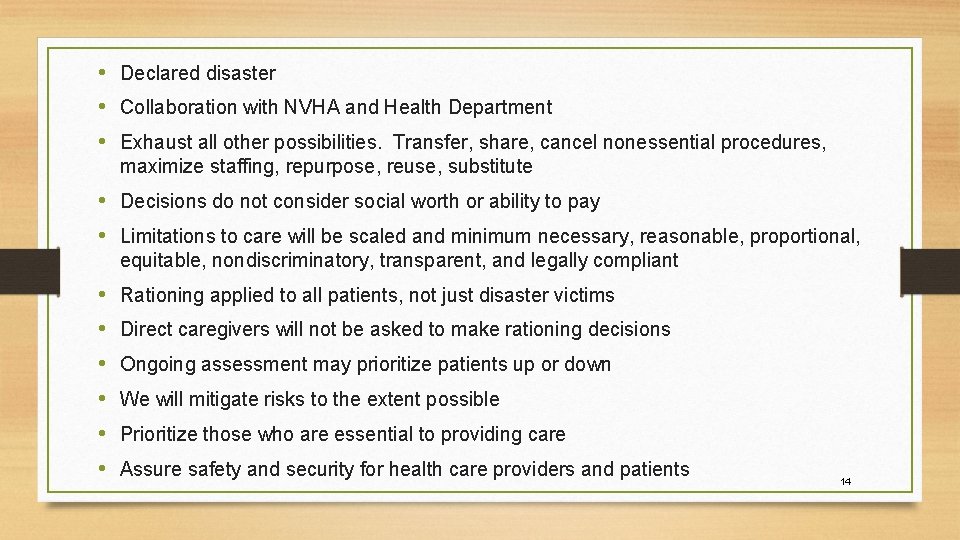
• Declared disaster • Collaboration with NVHA and Health Department • Exhaust all other possibilities. Transfer, share, cancel nonessential procedures, maximize staffing, repurpose, reuse, substitute • Decisions do not consider social worth or ability to pay • Limitations to care will be scaled and minimum necessary, reasonable, proportional, equitable, nondiscriminatory, transparent, and legally compliant • • • Rationing applied to all patients, not just disaster victims Direct caregivers will not be asked to make rationing decisions Ongoing assessment may prioritize patients up or down We will mitigate risks to the extent possible Prioritize those who are essential to providing care Assure safety and security for health care providers and patients 14
Tools and Rules: Policy Development 15
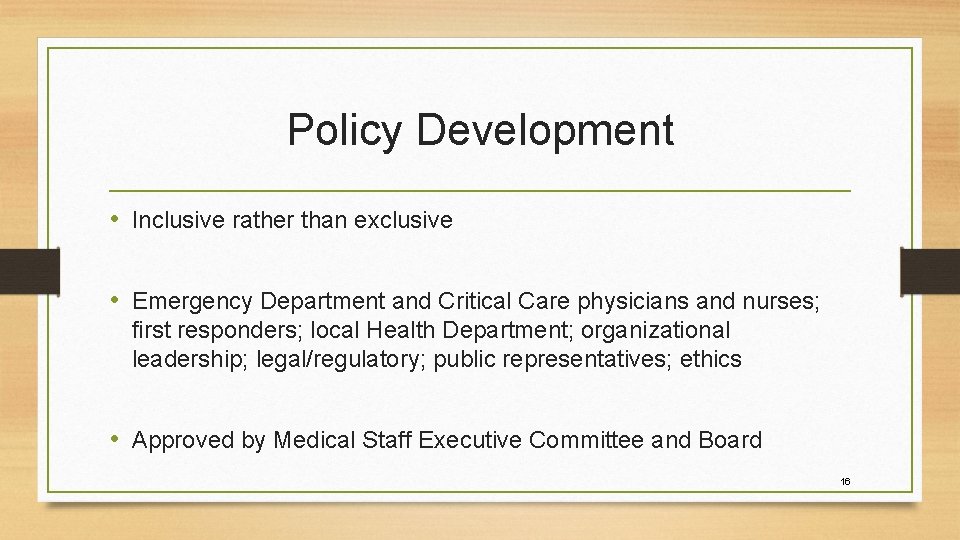
Policy Development • Inclusive rather than exclusive • Emergency Department and Critical Care physicians and nurses; first responders; local Health Department; organizational leadership; legal/regulatory; public representatives; ethics • Approved by Medical Staff Executive Committee and Board 16
Our Policy 17
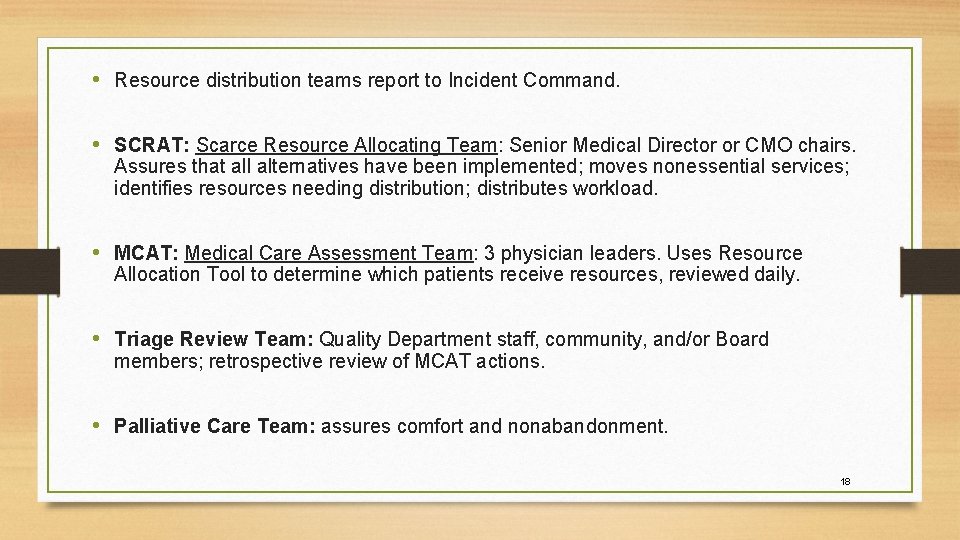
• Resource distribution teams report to Incident Command. • SCRAT: Scarce Resource Allocating Team: Senior Medical Director or CMO chairs. Assures that all alternatives have been implemented; moves nonessential services; identifies resources needing distribution; distributes workload. • MCAT: Medical Care Assessment Team: 3 physician leaders. Uses Resource Allocation Tool to determine which patients receive resources, reviewed daily. • Triage Review Team: Quality Department staff, community, and/or Board members; retrospective review of MCAT actions. • Palliative Care Team: assures comfort and nonabandonment. 18

Resource Allocation Tool 19
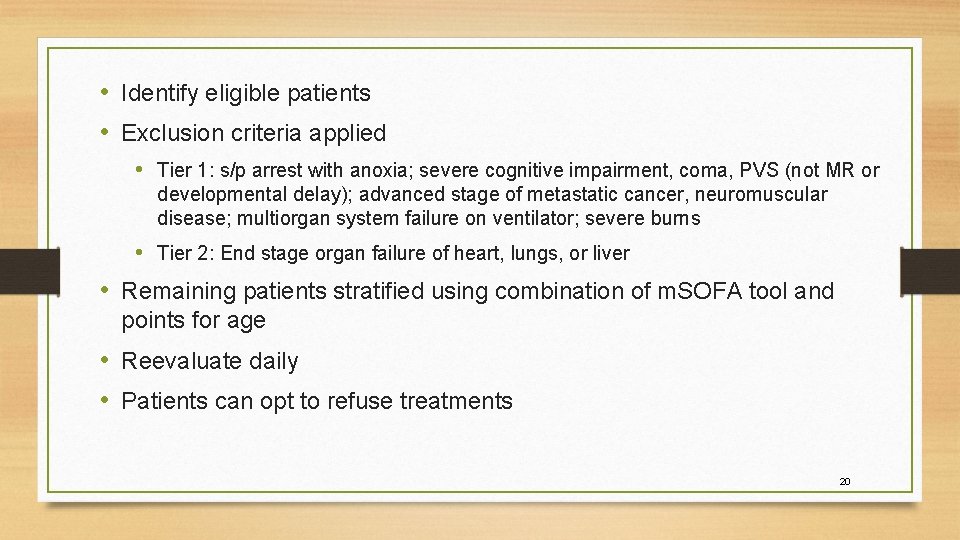
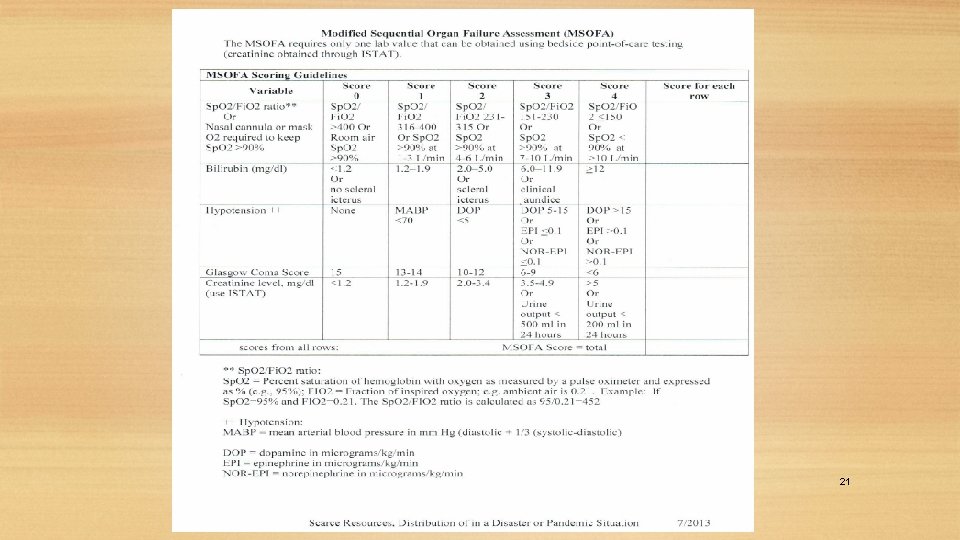
• Identify eligible patients • Exclusion criteria applied • Tier 1: s/p arrest with anoxia; severe cognitive impairment, coma, PVS (not MR or developmental delay); advanced stage of metastatic cancer, neuromuscular disease; multiorgan system failure on ventilator; severe burns • Tier 2: End stage organ failure of heart, lungs, or liver • Remaining patients stratified using combination of m. SOFA tool and points for age • Reevaluate daily • Patients can opt to refuse treatments 20
21
Liability and Crisis Standards of Care • Three Levels of Activation: 1. Conventional 2. Contingency 3. Crisis • Legal protection in Virginia for declared emergency. 22
Caveats and Pitfalls • No perfect tool • Justice concerns • Different guidelines in different facilities – opportunity to game system? • ? Right to appeal? • Decision making on the fly; you can’t turn back 23
So, What Do We Do? • Better off with something than nothing for guidance. • Clarify your own values and principles and those of your organization. • Encourage proactive conversation and guideline development. • Recognize the ambiguity and moral distress associated. • Ultimate goal to have a statewide standard. 24
End 25
- Slides: 25