
Ethical Control of Unmanned Systems using Formal Mission
- Slides: 50
Ethical Control of Unmanned Systems using Formal Mission Ontologies for Undersea Warfare Don Brutzman and Curt Blais Naval Postgraduate School (NPS) 4 May 2020
Ethical Control Project synopsis • Mission orders must be understandable by both humans and machines • Logical testing and command trust possible using Semantic Web standards • Ready for cross-disciplinary thesis work in USW and other majors Projections for future work • Rich set of scenarios are in hand with initial set of logical queries, now ready for more sophisticated ethical queries and mission adaptation • Promoting ethical thinking: NPS needs a Center for Ethical Warfighting Acknowledgements • Thanks to CRUSER and Raytheon past support for this many-year project • NPS–Raytheon CRADA partnership offers new possibilities for influence
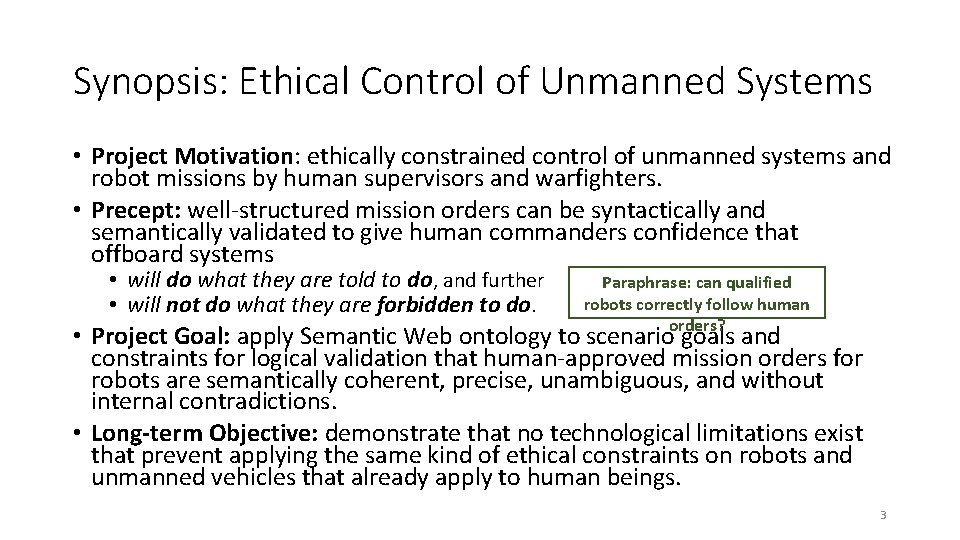
Synopsis: Ethical Control of Unmanned Systems • Project Motivation: ethically constrained control of unmanned systems and robot missions by human supervisors and warfighters. • Precept: well-structured mission orders can be syntactically and semantically validated to give human commanders confidence that offboard systems • will do what they are told to do, and further • will not do what they are forbidden to do. Paraphrase: can qualified robots correctly follow human orders? • Project Goal: apply Semantic Web ontology to scenario goals and constraints for logical validation that human-approved mission orders for robots are semantically coherent, precise, unambiguous, and without internal contradictions. • Long-term Objective: demonstrate that no technological limitations exist that prevent applying the same kind of ethical constraints on robots and unmanned vehicles that already apply to human beings. 3
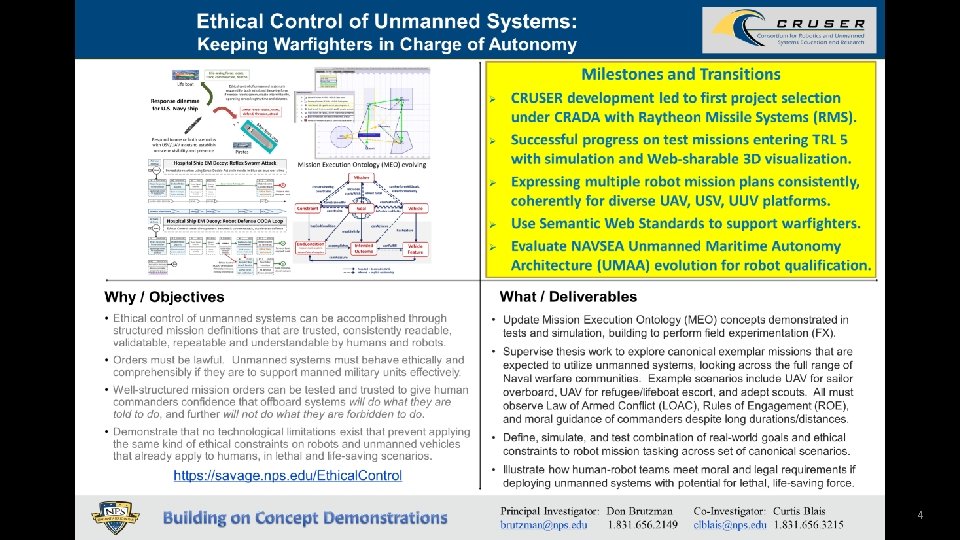
Ethical Control quad chart 4
Key Insights regarding Human Ethical Control 1. Humans in military units are able to deal with moral challenges without ethical quandaries, • by using formally qualified experience, and by following mission orders that comply with Rules of Engagement (ROE) and Laws of Armed Conflict (LOAC). 2. Ethical behaviors don’t define the mission plan. Instead, ethical constraints inform the mission plan. 3. Naval forces can only command mission orders that are • Understandable by (legally culpable) humans, then • Reliably and safely executed by robots. Reference: CRUSER Tech. Con Overview 2016 https: //gitlab. nps. edu/Savage/Ethical. Control/tree/master/documents/presentations 5
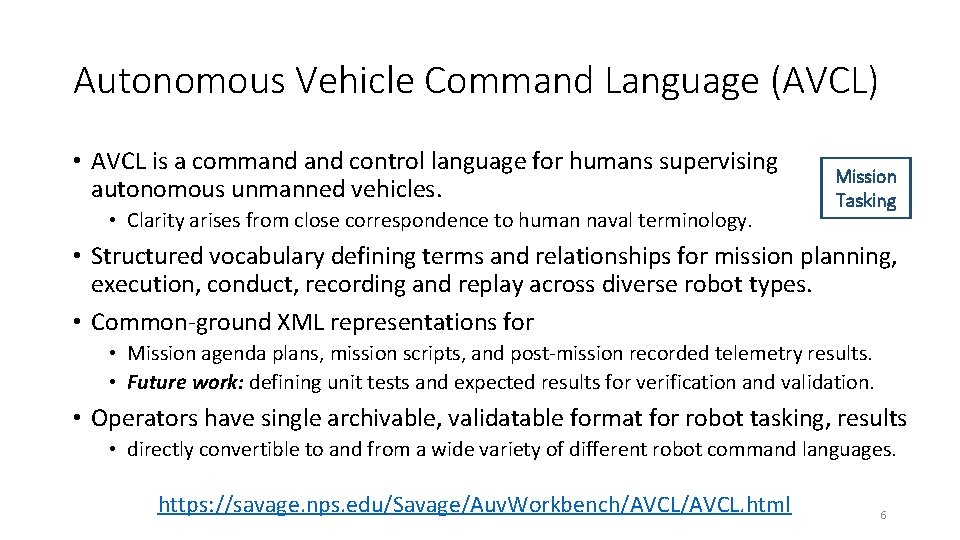
Autonomous Vehicle Command Language (AVCL) • AVCL is a command control language for humans supervising autonomous unmanned vehicles. • Clarity arises from close correspondence to human naval terminology. Mission Tasking • Structured vocabulary defining terms and relationships for mission planning, execution, conduct, recording and replay across diverse robot types. • Common-ground XML representations for • Mission agenda plans, mission scripts, and post-mission recorded telemetry results. • Future work: defining unit tests and expected results for verification and validation. • Operators have single archivable, validatable format for robot tasking, results • directly convertible to and from a wide variety of different robot command languages. https: //savage. nps. edu/Savage/Auv. Workbench/AVCL. html 6
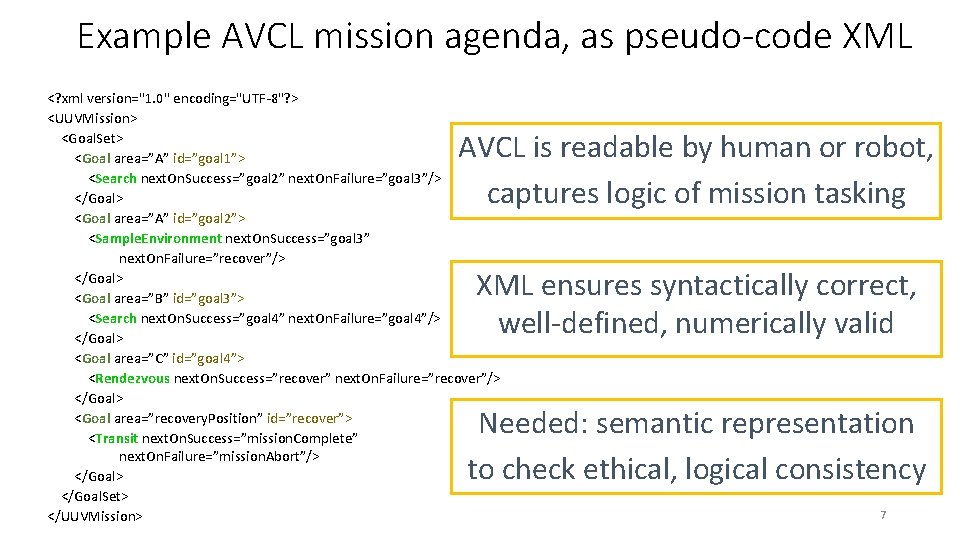
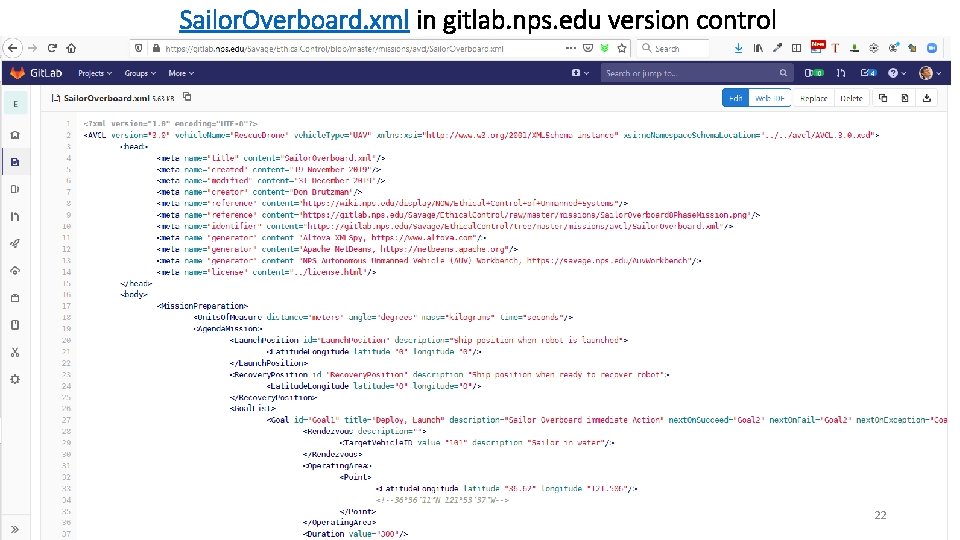
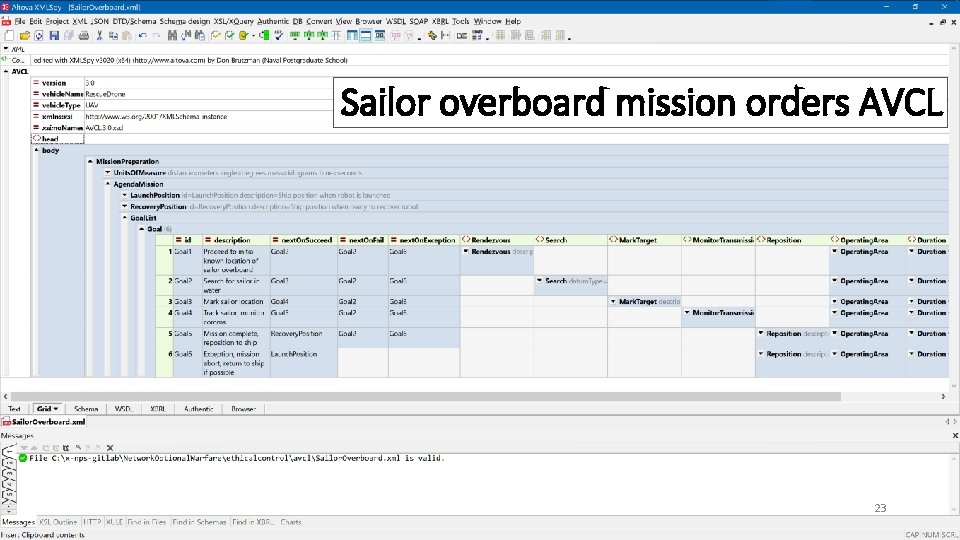
Example AVCL mission agenda, as pseudo-code XML <? xml version="1. 0" encoding="UTF-8"? > <UUVMission> <Goal. Set> <Goal area=”A” id=”goal 1”> <Search next. On. Success=”goal 2” next. On. Failure=”goal 3”/> </Goal> <Goal area=”A” id=”goal 2”> <Sample. Environment next. On. Success=”goal 3” next. On. Failure=”recover”/> </Goal> <Goal area=”B” id=”goal 3”> <Search next. On. Success=”goal 4” next. On. Failure=”goal 4”/> </Goal> <Goal area=”C” id=”goal 4”> <Rendezvous next. On. Success=”recover” next. On. Failure=”recover”/> </Goal> <Goal area=”recovery. Position” id=”recover”> <Transit next. On. Success=”mission. Complete” next. On. Failure=”mission. Abort”/> </Goal> </Goal. Set> </UUVMission> AVCL is readable by human or robot, captures logic of mission tasking XML ensures syntactically correct, well-defined, numerically valid Needed: semantic representation to check ethical, logical consistency 7
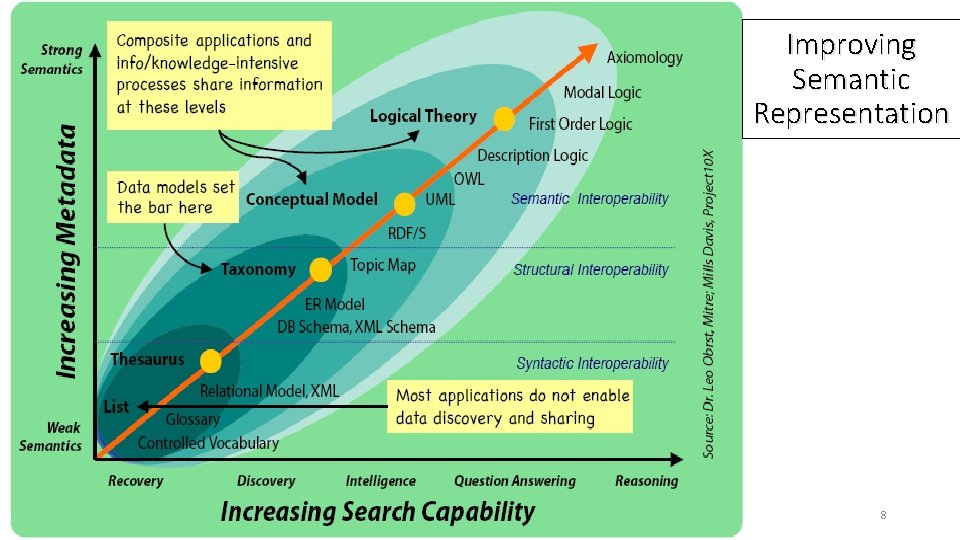
Ontology Spectrum Improving Semantic Representation 8
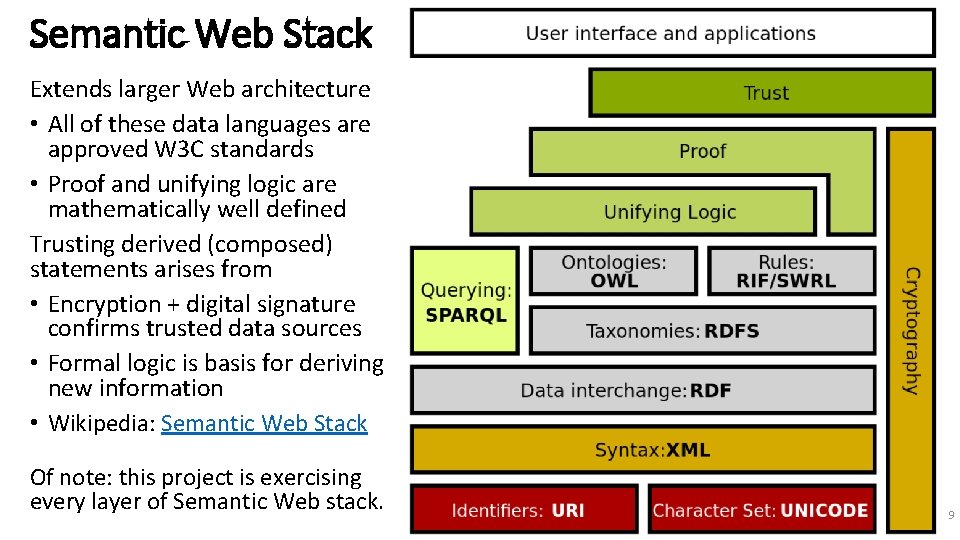
Semantic Web Stack Extends larger Web architecture • All of these data languages are approved W 3 C standards • Proof and unifying logic are mathematically well defined Trusting derived (composed) statements arises from • Encryption + digital signature confirms trusted data sources • Formal logic is basis for deriving new information • Wikipedia: Semantic Web Stack Of note: this project is exercising every layer of Semantic Web stack. 9
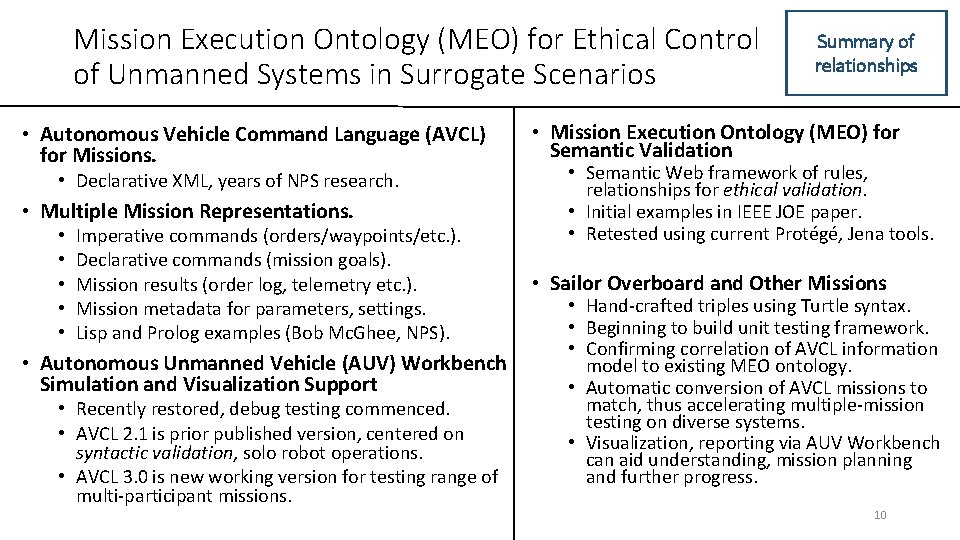
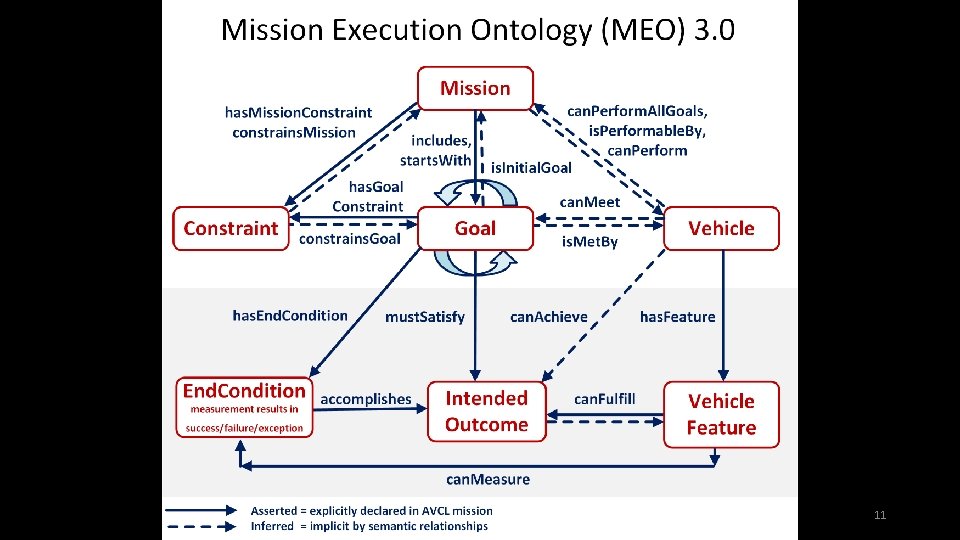
Mission Execution Ontology (MEO) for Ethical Control of Unmanned Systems in Surrogate Scenarios • Autonomous Vehicle Command Language (AVCL) for Missions. • Declarative XML, years of NPS research. • Multiple Mission Representations. • • • Imperative commands (orders/waypoints/etc. ). Declarative commands (mission goals). Mission results (order log, telemetry etc. ). Mission metadata for parameters, settings. Lisp and Prolog examples (Bob Mc. Ghee, NPS). • Autonomous Unmanned Vehicle (AUV) Workbench Simulation and Visualization Support • Recently restored, debug testing commenced. • AVCL 2. 1 is prior published version, centered on syntactic validation, solo robot operations. • AVCL 3. 0 is new working version for testing range of multi-participant missions. Summary of relationships • Mission Execution Ontology (MEO) for Semantic Validation • Semantic Web framework of rules, relationships for ethical validation. • Initial examples in IEEE JOE paper. • Retested using current Protégé, Jena tools. • Sailor Overboard and Other Missions • Hand-crafted triples using Turtle syntax. • Beginning to build unit testing framework. • Confirming correlation of AVCL information model to existing MEO ontology. • Automatic conversion of AVCL missions to match, thus accelerating multiple-mission testing on diverse systems. • Visualization, reporting via AUV Workbench can aid understanding, mission planning and further progress. 10
11
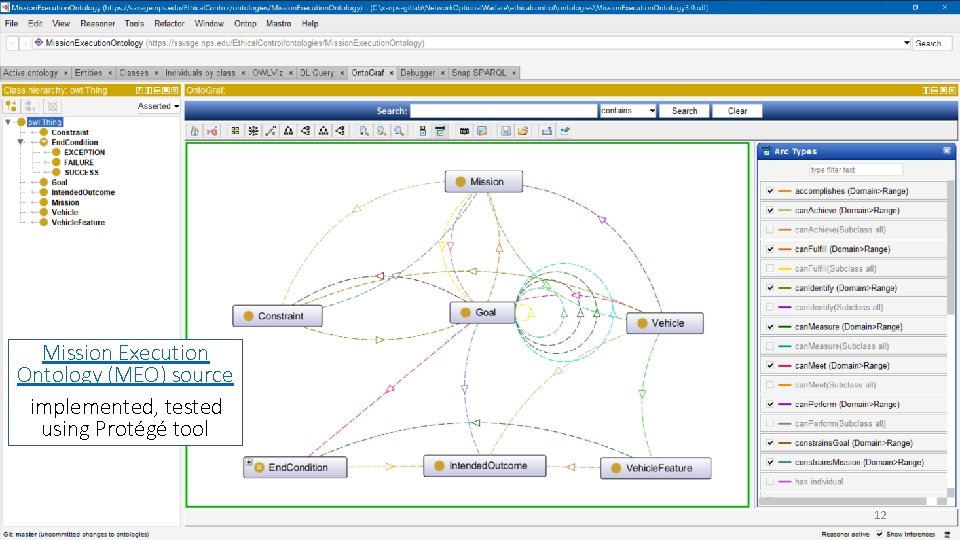
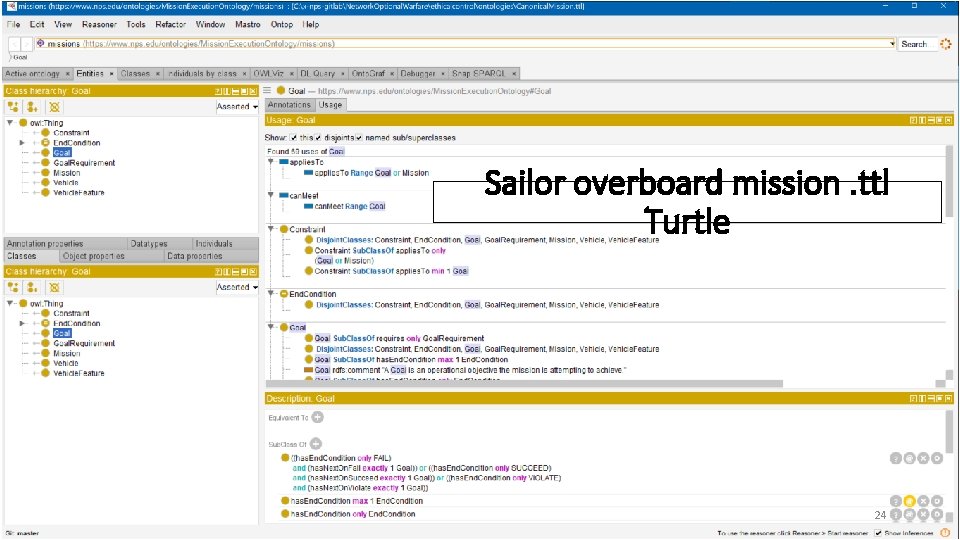
Mission Execution Ontology (MEO) source implemented, tested using Protégé tool 12
Core Considerations for Artificial Intelligence (AI) • Effective AI turns data into information for use by humans. • AI systems do not have capacity for rational thought or morality. • Unmanned systems require sophisticated control across time, space. • A large and involved body of internationally accepted law comprises Law of Armed Conflict (LOAC), bounding Rules of Engagement (ROE). • Only professional warfighters have moral capacity, legal culpability, and societal authority to direct actions applying lethal force. • Humans must be able to trust that systems under their direction will do what they are told to do, and not do what they are forbidden to do. • Successful Ethical Control of unmanned systems must be testable. 13
Mission clarity for humans – and robots • Simplicity of success, failure, and (rare) exception outcomes encourages well-defined tasks and unambiguous, measurable criteria for continuation. Confirmable beforehand: can a tactical officer (or commanding officer) review such a mission and then confidently say • “yes I understand approve this human-robot mission” or, equivalently, • “yes I understand this mission and my team can carry it out themselves. ” Converse: • if an officer can’t fully review/understand/approve such a mission, then likely it is ill-defined and needs further clarification anyway. Added benefit: missions that are clearly readable/runnable by humans and robots can be further composed and checked by C 2 planning tools to test for group operational-space management, avoiding mutual interference, etc. 14
Wrong question, right question Wrong question to ask first when planning a tactical operation: • “What are my robots doing out there? ” Right question to ask first when planning a tactical operation: • “What is my human-robot team doing out there? ” Human-robot team mission has to be understood first! • Robots complement humans, who must remain in charge throughout. • If you don’t have an OODA loop, you don’t have a competent plan. 15
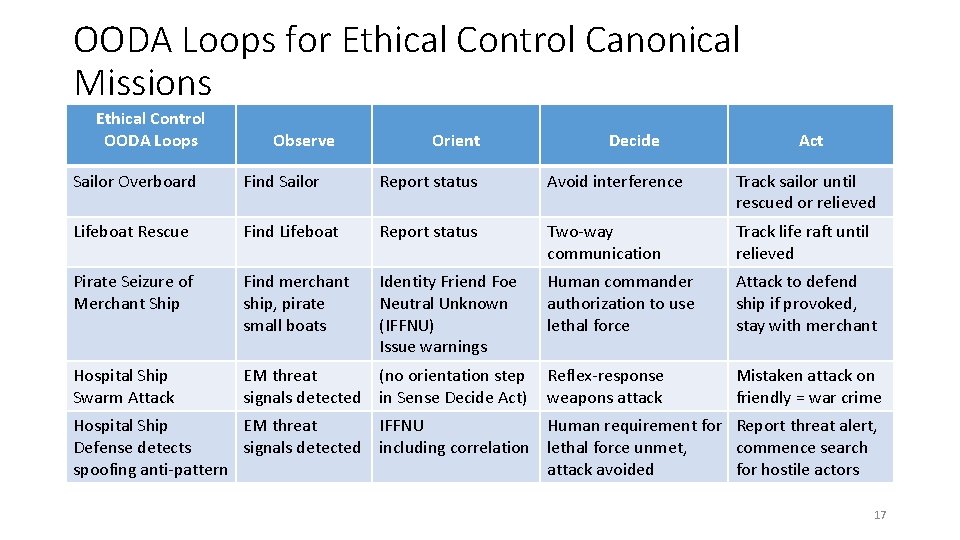
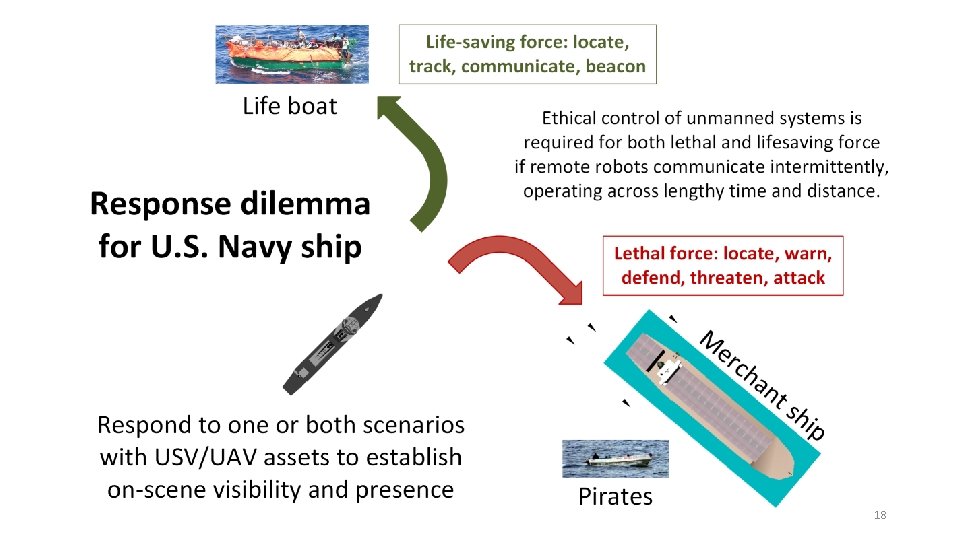
Canonical Ethical Mission Development 1 Progressive sophistication to test and evaluate Ethical Control design. a. Sailor Overboard for life-saving force under close coordination, b. Lifeboat Tracking for life-saving force under remote conditions, c. Pirate Boats Seizing Merchant for steady escalation to lethal force, d. Robot Swarm Attacks Hospital Ship to prevent hostile provocation of sense-decide-act vulnerabilities through Ethical Control safeguards. Two variants show fundamental importance of ethical constraints. Demonstrating a range of functionality tests majority of Ethical Control capabilities that are currently envisioned. These canonical capabilities also “set the stage” for further work on advanced problems of interest. 16
OODA Loops for Ethical Control Canonical Missions Ethical Control OODA Loops Observe Orient Decide Act Sailor Overboard Find Sailor Report status Avoid interference Track sailor until rescued or relieved Lifeboat Rescue Find Lifeboat Report status Two-way communication Track life raft until relieved Pirate Seizure of Merchant Ship Find merchant ship, pirate small boats Identity Friend Foe Neutral Unknown (IFFNU) Issue warnings Human commander authorization to use lethal force Attack to defend ship if provoked, stay with merchant Hospital Ship Swarm Attack EM threat (no orientation step Reflex-response signals detected in Sense Decide Act) weapons attack Mistaken attack on friendly = war crime Hospital Ship EM threat IFFNU Human requirement for Report threat alert, Defense detects signals detected including correlation lethal force unmet, commence search spoofing anti-pattern attack avoided for hostile actors 17
Ship response dilemma 18
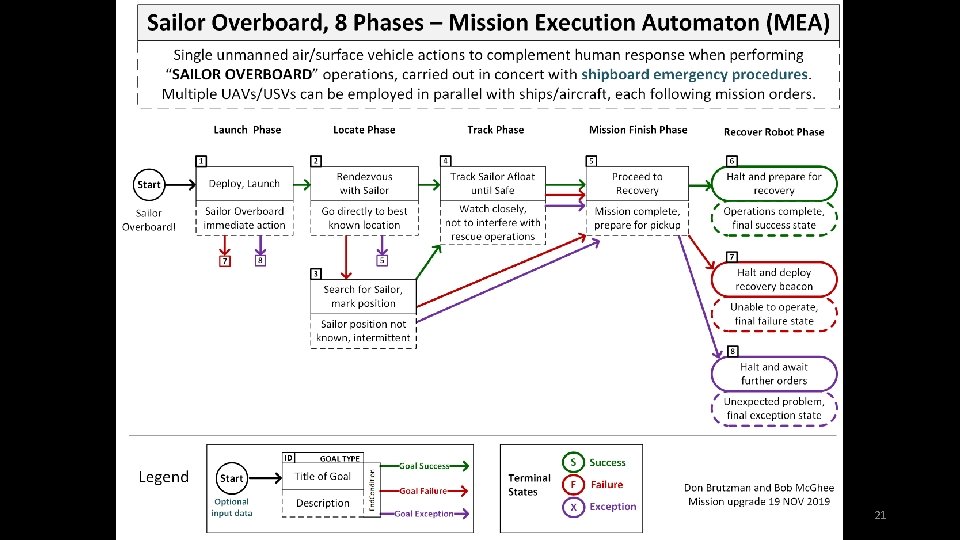
Sailor Overboard Mission: Design Motivations • Explore how life-saving force is complementary to lethal force, with many similar considerations for remote supervision. • First demonstrate human-system teaming in close proximity to ship, where direct override of robot control by human operator is possible. • No temporal delays, all actions and reactions must be immediate. • Show that mission design can complement shipboard procedures. Lessons learned • Good design patterns to visually represent AVCL mission satisfactorily. • Temporal flow (left to right, e. g. Gantt chart) best suited for diagram. 19
Sailor Overboard Mission: Description Purpose • Life saving: single unmanned air/surface vehicle actions to complement human responses when performing “SAILOR OVERBOARD” operations. • Carried out in direct concert with formal shipboard emergency procedures. • Multiple UAVs/USVs might be employed in parallel with ships and aircraft, avoid mutual interference by each following deconflicted mission orders. Phases • Deploy/Launch, Rendezvous, Track Sailor until Safe, Return/Recovery. Human Supervisory Role • Order standoff if interfering, manual control is possible due to proximity, can communicate to sailor via loudspeaker or beacon light. 20
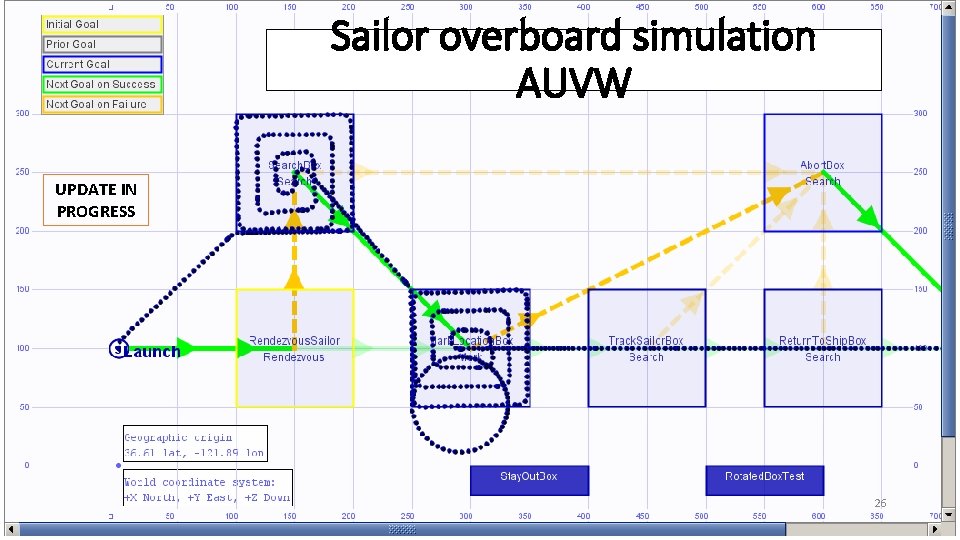
Sailor overboard mission diagram 21
Sailor. Overboard. xml in gitlab. nps. edu version control 22
Sailor overboard mission orders AVCL 23
Sailor overboard mission. ttl Turtle 24
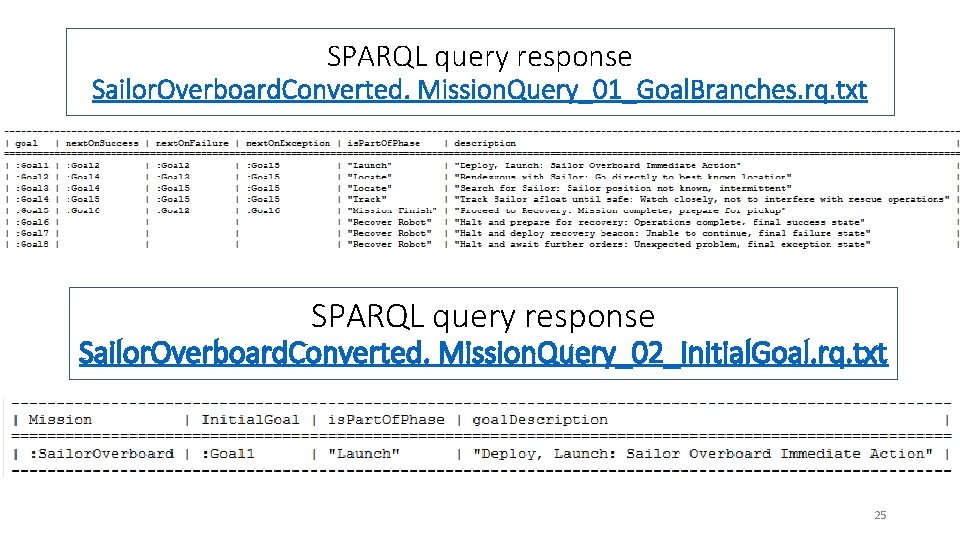
SPARQL query response Sailor. Overboard. Converted. Mission. Query_01_Goal. Branches. rq. txt SPARQL query response Sailor. Overboard. Converted. Mission. Query_02_Initial. Goal. rq. txt 25
Sailor overboard simulation AUVW UPDATE IN PROGRESS 26
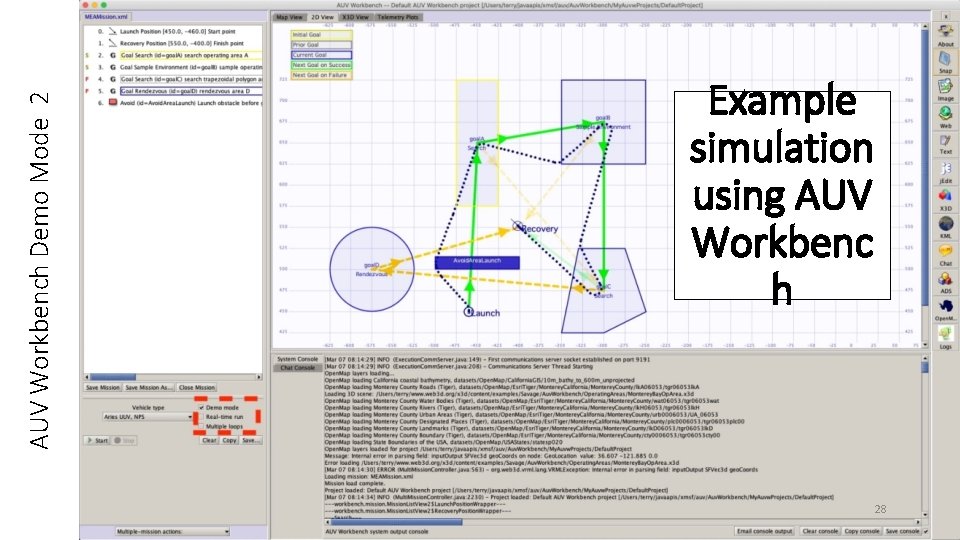
AUV Workbench Example open-source implementation • Autonomous Unmanned Vehicle (AUV) Workbench supports underwater, surface and air vehicles • • • Rehearsal of physics-based mission response Real-time task-level control of robot missions, and Replay of recorded results Industry-friendly open-source license, Sourceforge Basis: RBM 3 -level architecture, AVCL commands • Used to rehearse strategic-level agenda missions • https: //savage. nps. edu/Auv. Workbench 27
AUV Workbench Demo Mode 2 Example simulation using AUV Workbenc h 28
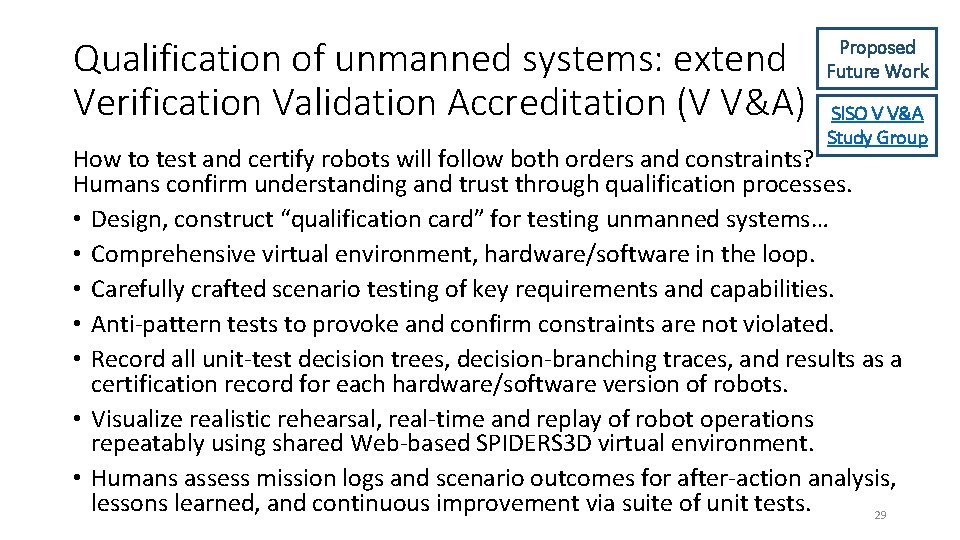
Qualification of unmanned systems: extend Verification Validation Accreditation (V V&A) Proposed Future Work SISO V V&A Study Group How to test and certify robots will follow both orders and constraints? Humans confirm understanding and trust through qualification processes. • Design, construct “qualification card” for testing unmanned systems… • Comprehensive virtual environment, hardware/software in the loop. • Carefully crafted scenario testing of key requirements and capabilities. • Anti-pattern tests to provoke and confirm constraints are not violated. • Record all unit-test decision trees, decision-branching traces, and results as a certification record for each hardware/software version of robots. • Visualize realistic rehearsal, real-time and replay of robot operations repeatably using shared Web-based SPIDERS 3 D virtual environment. • Humans assess mission logs and scenario outcomes for after-action analysis, lessons learned, and continuous improvement via suite of unit tests. 29
Data-Centric Security and Trust Compression, authentication, encryption, composability, blockchain ledger, and asymmetric advantages enable group communication of secure mission orders and responses. This is a Chain of Trust for distributed Command Authority. 30
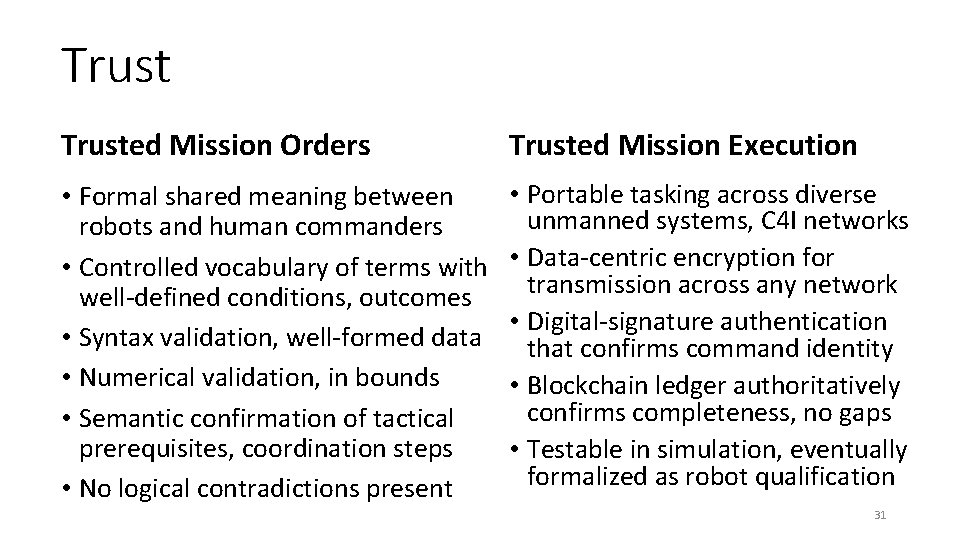
Trusted Mission Orders Trusted Mission Execution • Formal shared meaning between robots and human commanders • Controlled vocabulary of terms with well-defined conditions, outcomes • Syntax validation, well-formed data • Numerical validation, in bounds • Semantic confirmation of tactical prerequisites, coordination steps • No logical contradictions present • Portable tasking across diverse unmanned systems, C 4 I networks • Data-centric encryption for transmission across any network • Digital-signature authentication that confirms command identity • Blockchain ledger authoritatively confirms completeness, no gaps • Testable in simulation, eventually formalized as robot qualification 31
Related Ethical Activities Ethics of lethality and unmanned systems is an active area of work. The following synopses are distilled from each respective resource. 32
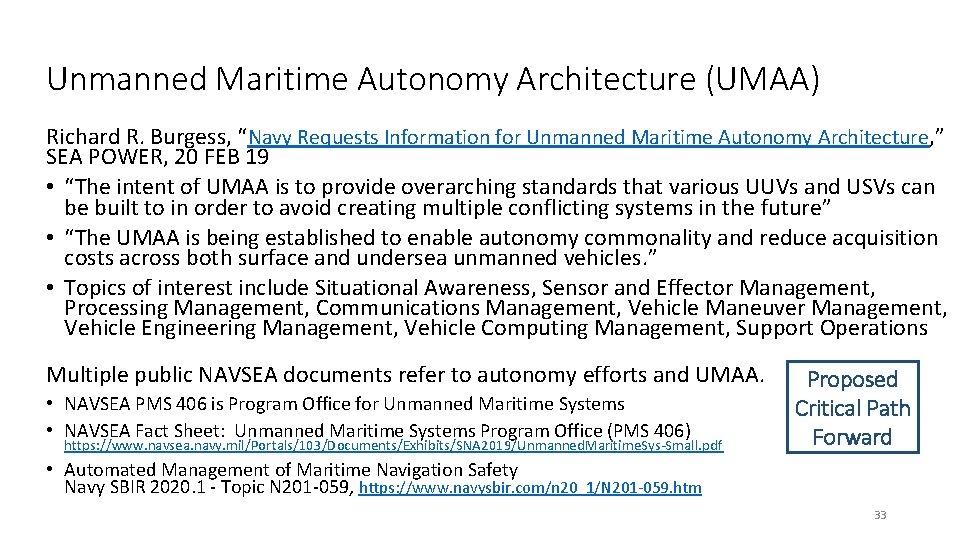
Unmanned Maritime Autonomy Architecture (UMAA) Richard R. Burgess, “Navy Requests Information for Unmanned Maritime Autonomy Architecture, ” SEA POWER, 20 FEB 19 • “The intent of UMAA is to provide overarching standards that various UUVs and USVs can be built to in order to avoid creating multiple conflicting systems in the future” • “The UMAA is being established to enable autonomy commonality and reduce acquisition costs across both surface and undersea unmanned vehicles. ” • Topics of interest include Situational Awareness, Sensor and Effector Management, Processing Management, Communications Management, Vehicle Maneuver Management, Vehicle Engineering Management, Vehicle Computing Management, Support Operations Multiple public NAVSEA documents refer to autonomy efforts and UMAA. • NAVSEA PMS 406 is Program Office for Unmanned Maritime Systems • NAVSEA Fact Sheet: Unmanned Maritime Systems Program Office (PMS 406) https: //www. navsea. navy. mil/Portals/103/Documents/Exhibits/SNA 2019/Unmanned. Maritime. Sys-Small. pdf Proposed Critical Path Forward • Automated Management of Maritime Navigation Safety Navy SBIR 2020. 1 - Topic N 201 -059, https: //www. navysbir. com/n 20_1/N 201 -059. htm 33
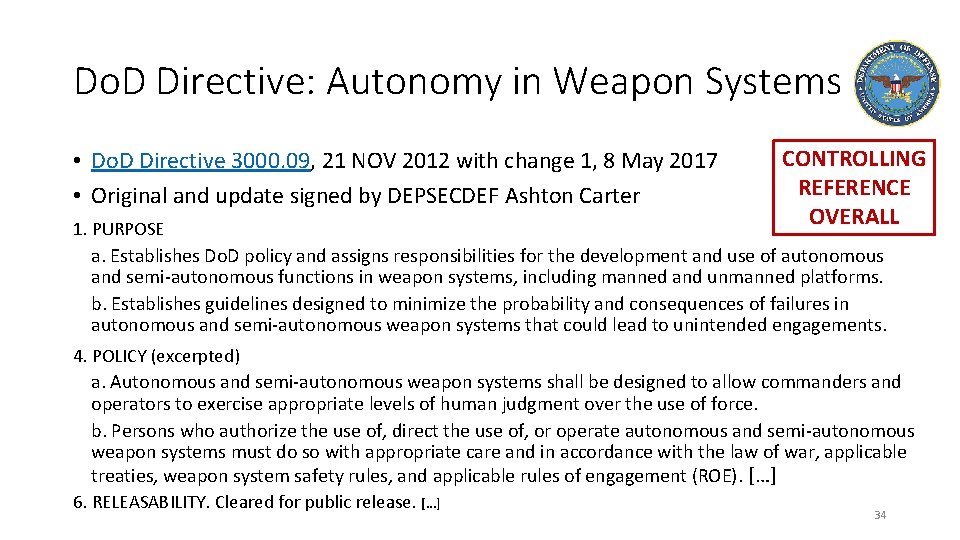
Do. D Directive: Autonomy in Weapon Systems • Do. D Directive 3000. 09, 21 NOV 2012 with change 1, 8 May 2017 • Original and update signed by DEPSECDEF Ashton Carter 1. PURPOSE CONTROLLING REFERENCE OVERALL a. Establishes Do. D policy and assigns responsibilities for the development and use of autonomous and semi-autonomous functions in weapon systems, including manned and unmanned platforms. b. Establishes guidelines designed to minimize the probability and consequences of failures in autonomous and semi-autonomous weapon systems that could lead to unintended engagements. 4. POLICY (excerpted) a. Autonomous and semi-autonomous weapon systems shall be designed to allow commanders and operators to exercise appropriate levels of human judgment over the use of force. b. Persons who authorize the use of, direct the use of, or operate autonomous and semi-autonomous weapon systems must do so with appropriate care and in accordance with the law of war, applicable treaties, weapon system safety rules, and applicable rules of engagement (ROE). […] 6. RELEASABILITY. Cleared for public release. […] 34
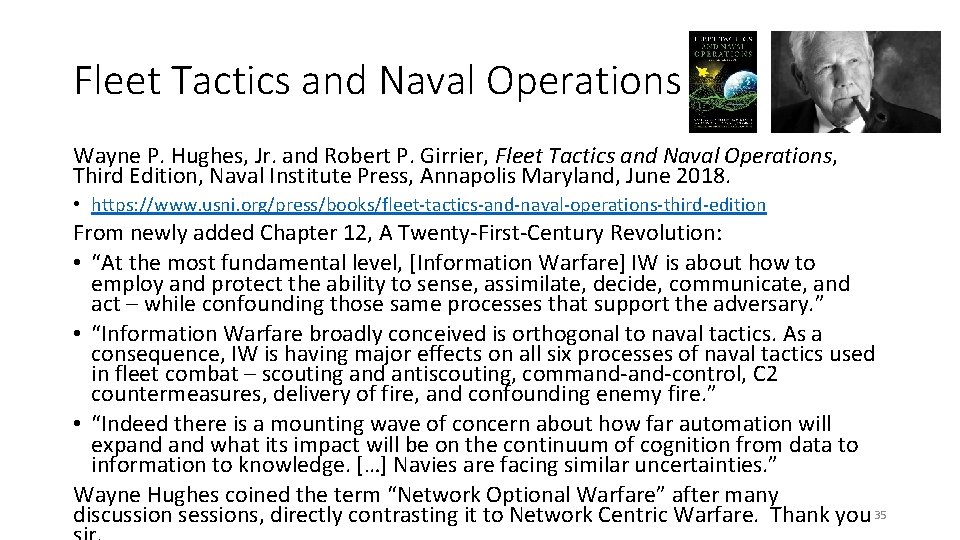
Fleet Tactics and Naval Operations Wayne P. Hughes, Jr. and Robert P. Girrier, Fleet Tactics and Naval Operations, Third Edition, Naval Institute Press, Annapolis Maryland, June 2018. • https: //www. usni. org/press/books/fleet-tactics-and-naval-operations-third-edition From newly added Chapter 12, A Twenty-First-Century Revolution: • “At the most fundamental level, [Information Warfare] IW is about how to employ and protect the ability to sense, assimilate, decide, communicate, and act – while confounding those same processes that support the adversary. ” • “Information Warfare broadly conceived is orthogonal to naval tactics. As a consequence, IW is having major effects on all six processes of naval tactics used in fleet combat – scouting and antiscouting, command-control, C 2 countermeasures, delivery of fire, and confounding enemy fire. ” • “Indeed there is a mounting wave of concern about how far automation will expand what its impact will be on the continuum of cognition from data to information to knowledge. […] Navies are facing similar uncertainties. ” Wayne Hughes coined the term “Network Optional Warfare” after many discussion sessions, directly contrasting it to Network Centric Warfare. Thank you 35
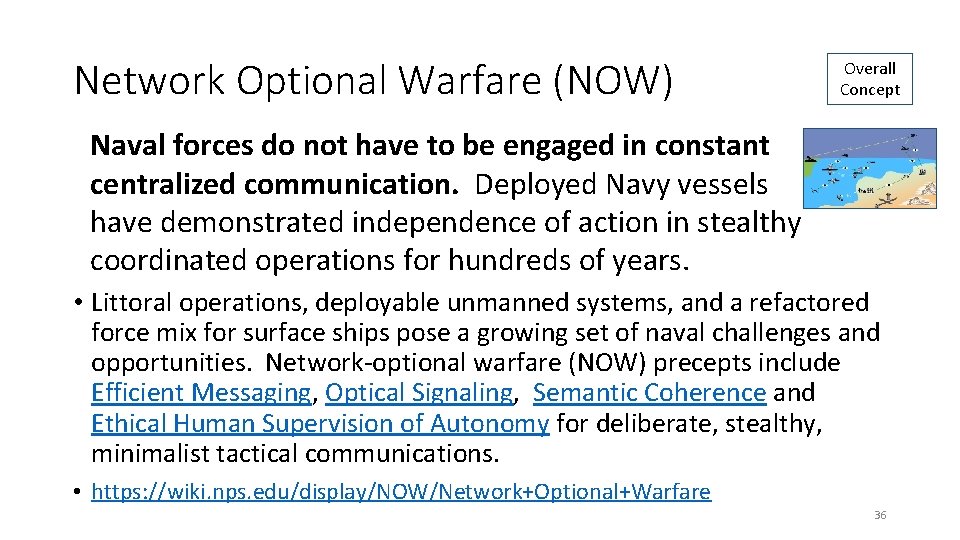
Network Optional Warfare (NOW) Overall Concept Naval forces do not have to be engaged in constant centralized communication. Deployed Navy vessels have demonstrated independence of action in stealthy coordinated operations for hundreds of years. • Littoral operations, deployable unmanned systems, and a refactored force mix for surface ships pose a growing set of naval challenges and opportunities. Network-optional warfare (NOW) precepts include Efficient Messaging, Optical Signaling, Semantic Coherence and Ethical Human Supervision of Autonomy for deliberate, stealthy, minimalist tactical communications. • https: //wiki. nps. edu/display/NOW/Network+Optional+Warfare 36
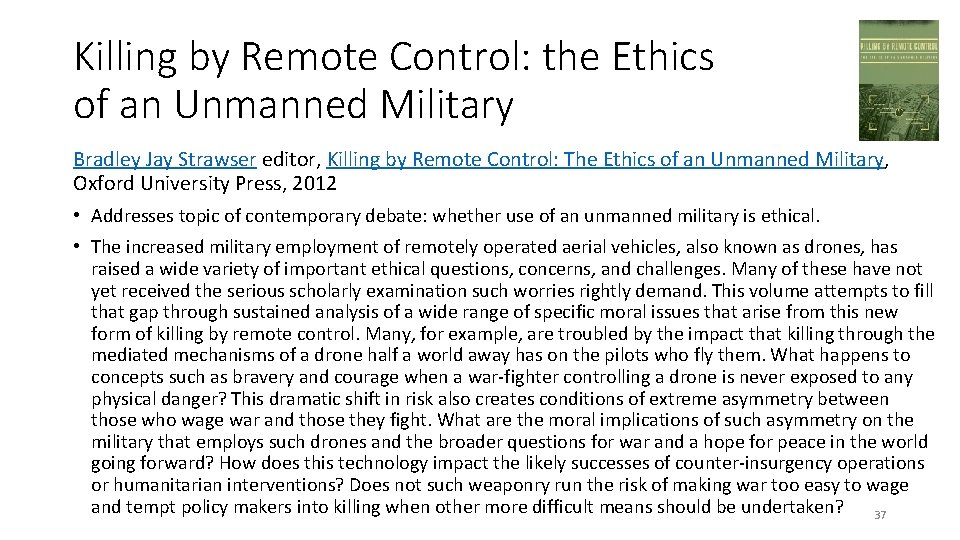
Killing by Remote Control: the Ethics of an Unmanned Military Bradley Jay Strawser editor, Killing by Remote Control: The Ethics of an Unmanned Military, Oxford University Press, 2012 • Addresses topic of contemporary debate: whether use of an unmanned military is ethical. • The increased military employment of remotely operated aerial vehicles, also known as drones, has raised a wide variety of important ethical questions, concerns, and challenges. Many of these have not yet received the serious scholarly examination such worries rightly demand. This volume attempts to fill that gap through sustained analysis of a wide range of specific moral issues that arise from this new form of killing by remote control. Many, for example, are troubled by the impact that killing through the mediated mechanisms of a drone half a world away has on the pilots who fly them. What happens to concepts such as bravery and courage when a war-fighter controlling a drone is never exposed to any physical danger? This dramatic shift in risk also creates conditions of extreme asymmetry between those who wage war and those they fight. What are the moral implications of such asymmetry on the military that employs such drones and the broader questions for war and a hope for peace in the world going forward? How does this technology impact the likely successes of counter-insurgency operations or humanitarian interventions? Does not such weaponry run the risk of making war too easy to wage and tempt policy makers into killing when other more difficult means should be undertaken? 37
Military Ethics and Emerging Technologies • Military Ethics and Emerging Technologies, edited by Timothy J. Demy, George R. Lucas Jr. , and Bradley J. Strawser, Routledge, 2014. • This volume looks at current and emerging technologies of war and some of the ethical issues surrounding their use. Although the nature and politics of war never change, the weapons and technologies used in war do change and are always undergoing development. Because of that, the arsenal of weapons for twenty-first century conflict is different from previous centuries. Weapons in today’s world include an array of instruments of war that include, robotics, cyber war capabilities, human performance enhancement for warriors, and the proliferation of an entire spectrum of unmanned weapons systems and platforms. Tactical weapons now have the potential of strategic results and have changed the understanding of the battle space creating ethical, legal, and political issues unknown in the pre-9/11 world. What do these technologies mean for things such as contemporary international relations, the just-war tradition, and civilmilitary relations? • This book was originally published in various issues and volumes of the Journal of Military Ethics. 38
Stockdale Center for Ethical Leadership, U. S. Naval Academy (USNA) • Authorized by the Secretary of the Navy in 1998, the Center for the Study of Professional Military Ethics (CSPME) undertook an ambitious mission – to promote and enhance the ethical development of current and future military leaders. In February 2006, the Superintendent of the Naval Academy directed the expansion of the Center, and the Center was renamed the Vice Admiral James B. Stockdale Center for Ethical Leadership. • The Center could not have a finer model as its namesake than this most distinguished graduate of the United States Naval Academy. Admiral Stockdale was a man of unsurpassed courage and integrity who clearly understood the gravity of a leader’s moment of ethical decision. 39
Marine Corps University (MCU) School of Advanced Warfighting Mission Statement. The School of Advanced Warfighting (SAW) develops lead planners and future commanders with the will and intellect to solve complex problems, employ operational art, and design/execute campaigns in order to enhance the Marine Corps’ ability to prepare for and fight wars. • Formulate solutions to complex problems and apply operational art in an uncertain geostrategic security environment. • Employ knowledge of the operational level of war, the art of command, and ethical behavior in warfighting. • Quickly and critically assess a situation, determine the essence of a problem, fashion a suitable response, and concisely communicate the conclusion in oral and written forms. • Demonstrate the competence, confidence, character, and creativity required to plan, lead, and command at high level service, joint, and combined headquarters. • Design and plan adaptive concepts to meet current and future challenges.
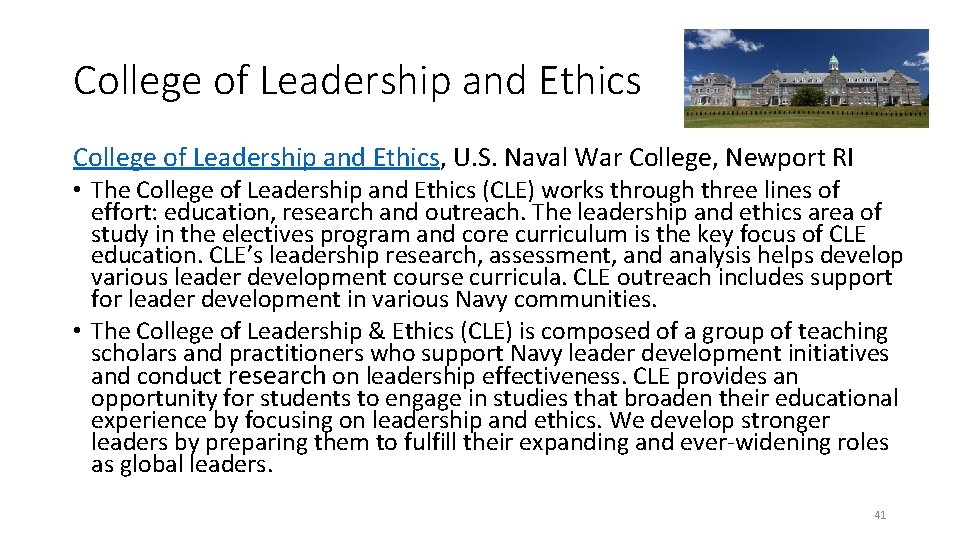
College of Leadership and Ethics, U. S. Naval War College, Newport RI • The College of Leadership and Ethics (CLE) works through three lines of effort: education, research and outreach. The leadership and ethics area of study in the electives program and core curriculum is the key focus of CLE education. CLE’s leadership research, assessment, and analysis helps develop various leader development course curricula. CLE outreach includes support for leader development in various Navy communities. • The College of Leadership & Ethics (CLE) is composed of a group of teaching scholars and practitioners who support Navy leader development initiatives and conduct research on leadership effectiveness. CLE provides an opportunity for students to engage in studies that broaden their educational experience by focusing on leadership and ethics. We develop stronger leaders by preparing them to fulfill their expanding and ever-widening roles as global leaders. 41
Joint Artificial Intelligence Center (JAIC) https: //www. ai. mil Do. D CIO Joint Artificial Intelligence Center (JAIC) tasked to execute Do. D AI Strategy. JAIC’s Guiding Tenets: • AI is critical to the future of United States’ national security, and the JAIC is the focal point for the execution of the Do. D AI Strategy. • We exist to create and enable impact for the Armed Services and Do. D Components across the full range of their missions – from the back office to the front lines of the battlefield. • Leadership in ethics and values is core to everything we do at the JAIC. • The JAIC attracts the best and brightest people from across Do. D, commercial industry, and academia. When they get here, they are empowered to bring their expertise to the Department’s transformation. 42
Execute Against Japan – The US Decision To Conduct Unrestricted Submarine Warfare • Joel Ira Holwitt, Texas A+M University Press • “. . . until now how the Navy managed to instantaneously move from the overt legal restrictions of the naval arms treaties that bound submarines to the cruiser rules of the eighteenth century to a declaration of unrestricted submarine warfare against Japan immediately after the attack on Pearl Harbor has never been explained. Lieutenant Holwitt has dissected this process and has created a compelling story of who did what, when, and to whom. ”—The Submarine Review • “Execute against Japan should be required reading for naval officers (especially in submarine wardrooms), as well as for anyone interested in history, policy, or international law. ” — Adm. James P. Wisecup, President, US Naval War College (for Naval War College Review) • “Although the policy of unrestricted air and submarine warfare proved critical to the Pacific war’s course, this splendid work is the first comprehensive account of its origins—illustrating that historians have by no means exhausted questions about this conflict. ”—World War II Magazine • “US Navy submarine officer Joel Ira Holwitt has performed an impressive feat with this book. . . Holwitt is to be commended for not shying away from moral judgments. . . This is a superb book that fully explains how the United States came to adopt a strategy regarded by many as illegal and tantamount to ‘terror’. ”—Military Review 43
Assessment of Current Thinking • Human supervision of potentially lethal autonomous systems is a matter of serious global importance. • Wide consensus is emerging on principles, aspects of the problem, elements of solutions, and need to achieve better capabilities. • Much philosophical concern but few concrete activities are evident. Ethical Control of Unmanned Systems project appears to provide a needed path towards practice, with the historic role of warfighting professionals more central than ever as weapons autonomy grows. 44
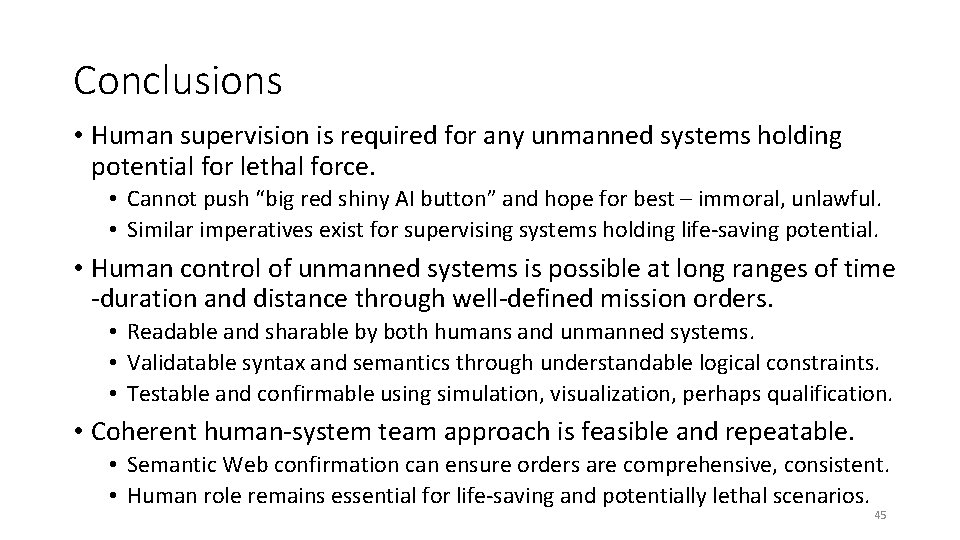
Conclusions • Human supervision is required for any unmanned systems holding potential for lethal force. • Cannot push “big red shiny AI button” and hope for best – immoral, unlawful. • Similar imperatives exist for supervising systems holding life-saving potential. • Human control of unmanned systems is possible at long ranges of time -duration and distance through well-defined mission orders. • Readable and sharable by both humans and unmanned systems. • Validatable syntax and semantics through understandable logical constraints. • Testable and confirmable using simulation, visualization, perhaps qualification. • Coherent human-system team approach is feasible and repeatable. • Semantic Web confirmation can ensure orders are comprehensive, consistent. • Human role remains essential for life-saving and potentially lethal scenarios. 45
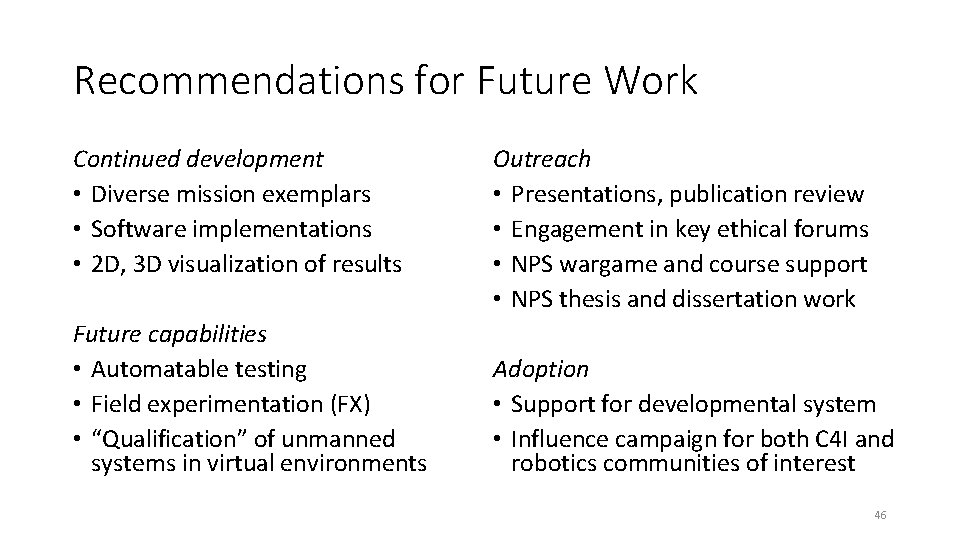
Recommendations for Future Work Continued development • Diverse mission exemplars • Software implementations • 2 D, 3 D visualization of results Future capabilities • Automatable testing • Field experimentation (FX) • “Qualification” of unmanned systems in virtual environments Outreach • Presentations, publication review • Engagement in key ethical forums • NPS wargame and course support • NPS thesis and dissertation work Adoption • Support for developmental system • Influence campaign for both C 4 I and robotics communities of interest 46
Recommendations for Future Work Your NPS efforts matter. Talk to us about a potential thesis! 47
Contact Don Brutzman brutzman@nps. edu http: //faculty. nps. edu/brutzman Code USW/Br, Naval Postgraduate School Monterey California 93943 -5000 USA 1. 831. 656. 2149 work 1. 831. 402. 4809 cell 48
Contact Curt Blais clblais@nps. edu home page Code MV/Bl, Naval Postgraduate School Monterey California 93943 -5000 USA 1. 831. 656. 3215 work 49
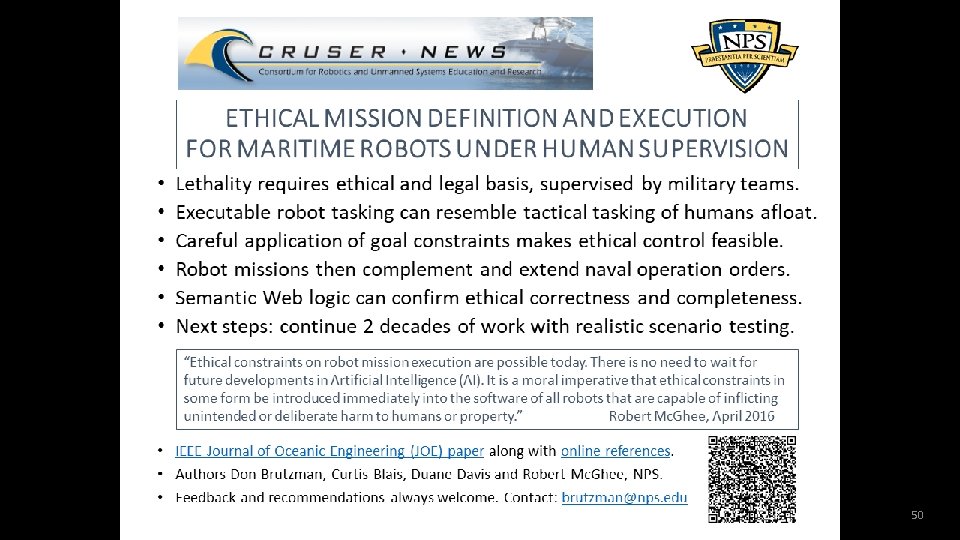
Ethical Control flyer 50