
Ethical Control of Unmanned Systems Mission Design and
- Slides: 27
Ethical Control of Unmanned Systems Mission Design and Semantic Web Exemplars for Human Supervision of Lethal/Lifesaving Autonomy Don Brutzman and Curt Blais, Naval Postgraduate School (NPS) U. S. Semantic Technologies Symposium (US 2 TS) Panel session: Hybrid AI for Context Understanding North Carolina State University, Raleigh, NC 9 -11 March 2020
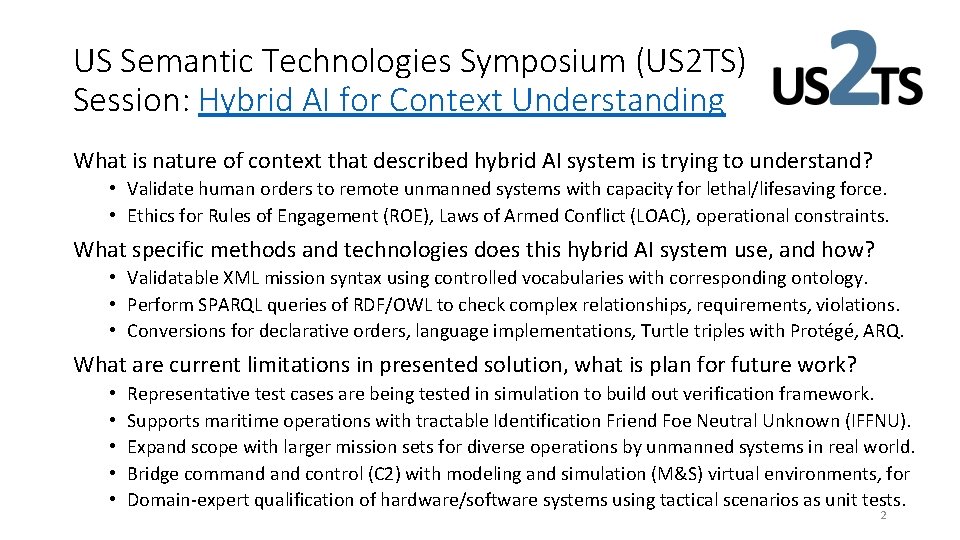
US Semantic Technologies Symposium (US 2 TS) Session: Hybrid AI for Context Understanding What is nature of context that described hybrid AI system is trying to understand? • Validate human orders to remote unmanned systems with capacity for lethal/lifesaving force. • Ethics for Rules of Engagement (ROE), Laws of Armed Conflict (LOAC), operational constraints. What specific methods and technologies does this hybrid AI system use, and how? • Validatable XML mission syntax using controlled vocabularies with corresponding ontology. • Perform SPARQL queries of RDF/OWL to check complex relationships, requirements, violations. • Conversions for declarative orders, language implementations, Turtle triples with Protégé, ARQ. What are current limitations in presented solution, what is plan for future work? • • • Representative test cases are being tested in simulation to build out verification framework. Supports maritime operations with tractable Identification Friend Foe Neutral Unknown (IFFNU). Expand scope with larger mission sets for diverse operations by unmanned systems in real world. Bridge command control (C 2) with modeling and simulation (M&S) virtual environments, for Domain-expert qualification of hardware/software systems using tactical scenarios as unit tests. 2
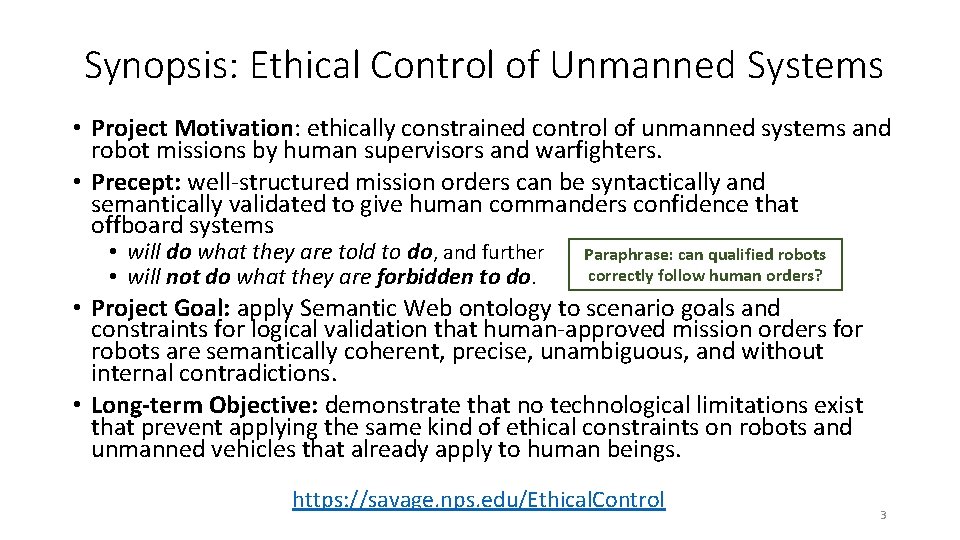
Synopsis: Ethical Control of Unmanned Systems • Project Motivation: ethically constrained control of unmanned systems and robot missions by human supervisors and warfighters. • Precept: well-structured mission orders can be syntactically and semantically validated to give human commanders confidence that offboard systems • will do what they are told to do, and further • will not do what they are forbidden to do. Paraphrase: can qualified robots correctly follow human orders? • Project Goal: apply Semantic Web ontology to scenario goals and constraints for logical validation that human-approved mission orders for robots are semantically coherent, precise, unambiguous, and without internal contradictions. • Long-term Objective: demonstrate that no technological limitations exist that prevent applying the same kind of ethical constraints on robots and unmanned vehicles that already apply to human beings. https: //savage. nps. edu/Ethical. Control 3
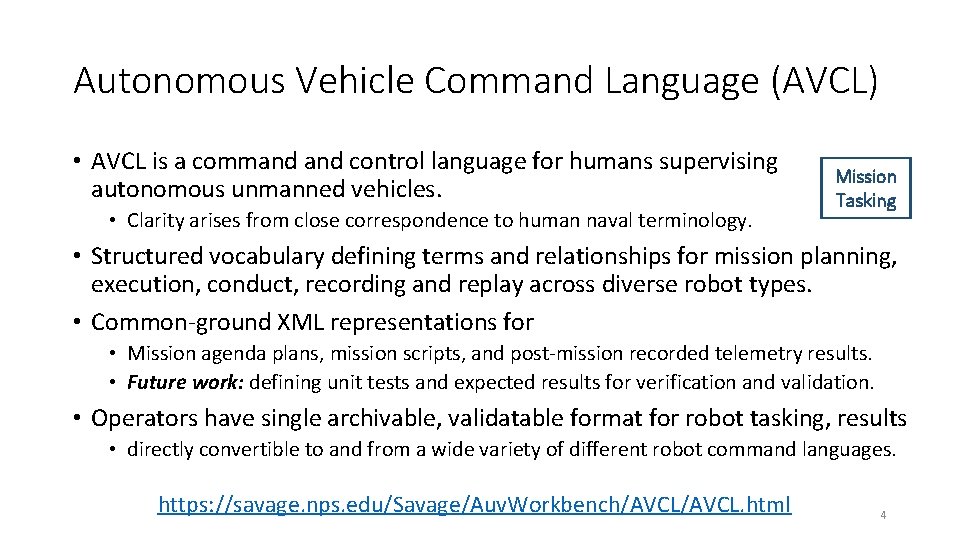
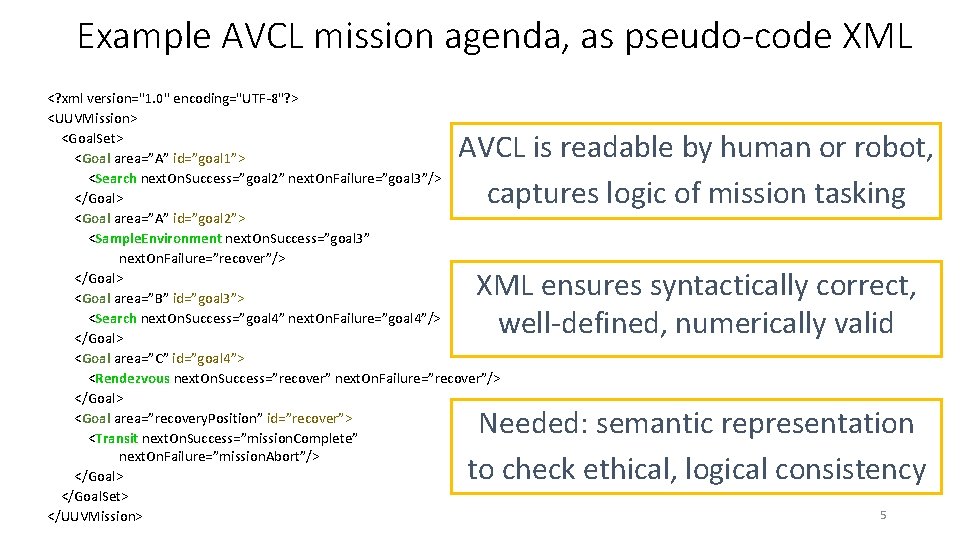
Autonomous Vehicle Command Language (AVCL) • AVCL is a command control language for humans supervising autonomous unmanned vehicles. • Clarity arises from close correspondence to human naval terminology. Mission Tasking • Structured vocabulary defining terms and relationships for mission planning, execution, conduct, recording and replay across diverse robot types. • Common-ground XML representations for • Mission agenda plans, mission scripts, and post-mission recorded telemetry results. • Future work: defining unit tests and expected results for verification and validation. • Operators have single archivable, validatable format for robot tasking, results • directly convertible to and from a wide variety of different robot command languages. https: //savage. nps. edu/Savage/Auv. Workbench/AVCL. html 4
Example AVCL mission agenda, as pseudo-code XML <? xml version="1. 0" encoding="UTF-8"? > <UUVMission> <Goal. Set> <Goal area=”A” id=”goal 1”> <Search next. On. Success=”goal 2” next. On. Failure=”goal 3”/> </Goal> <Goal area=”A” id=”goal 2”> <Sample. Environment next. On. Success=”goal 3” next. On. Failure=”recover”/> </Goal> <Goal area=”B” id=”goal 3”> <Search next. On. Success=”goal 4” next. On. Failure=”goal 4”/> </Goal> <Goal area=”C” id=”goal 4”> <Rendezvous next. On. Success=”recover” next. On. Failure=”recover”/> </Goal> <Goal area=”recovery. Position” id=”recover”> <Transit next. On. Success=”mission. Complete” next. On. Failure=”mission. Abort”/> </Goal. Set> </UUVMission> AVCL is readable by human or robot, captures logic of mission tasking XML ensures syntactically correct, well-defined, numerically valid Needed: semantic representation to check ethical, logical consistency 5
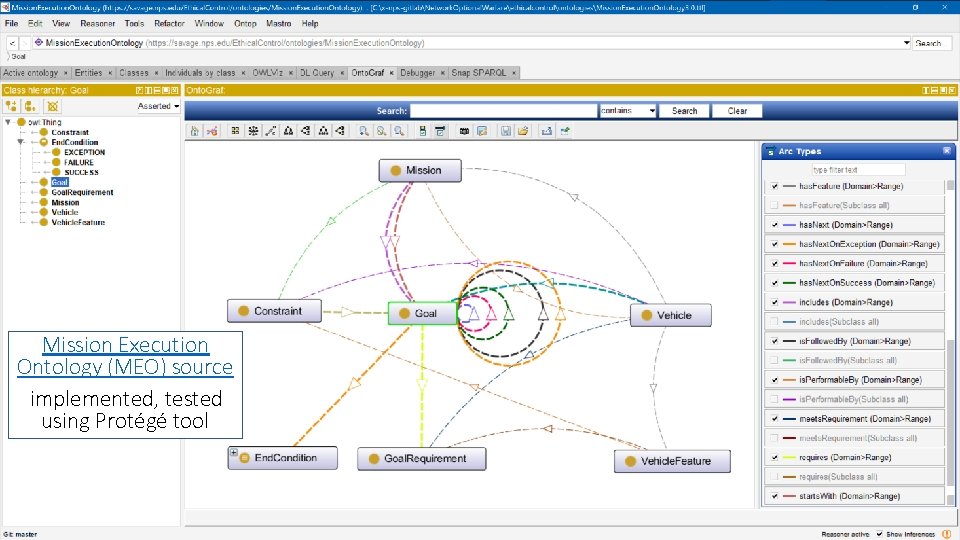
Mission Execution Ontology (MEO) source implemented, tested using Protégé tool
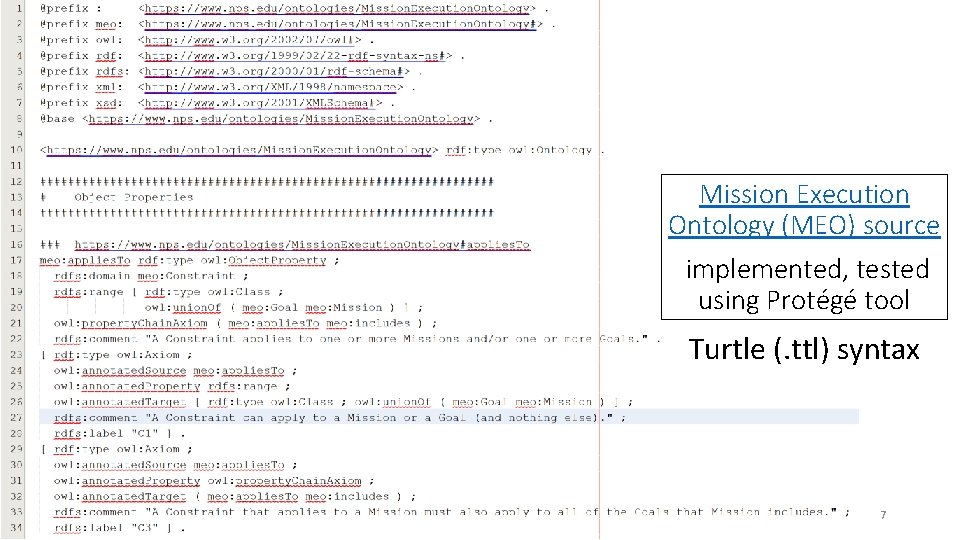
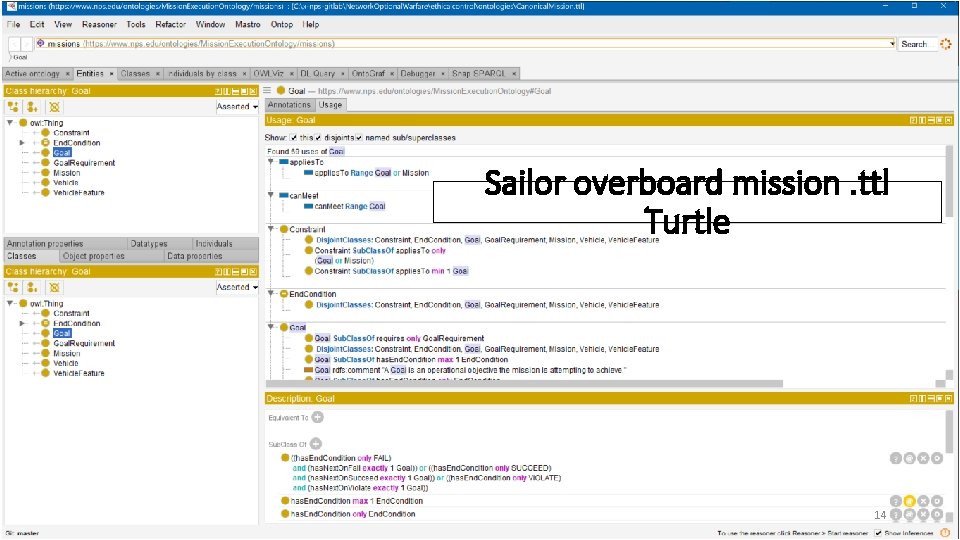
Mission Execution Ontology (MEO) source implemented, tested using Protégé tool Turtle (. ttl) syntax 7
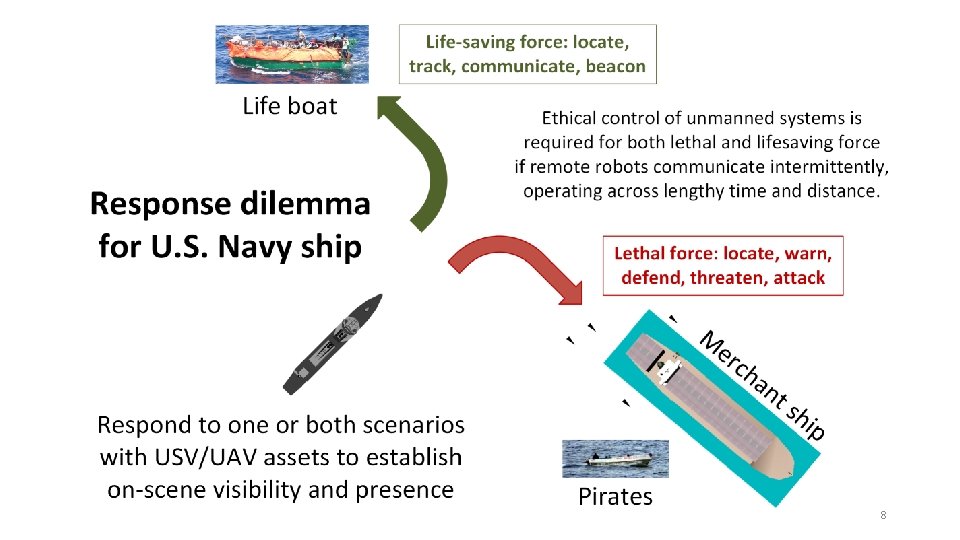
Ship response dilemma 8
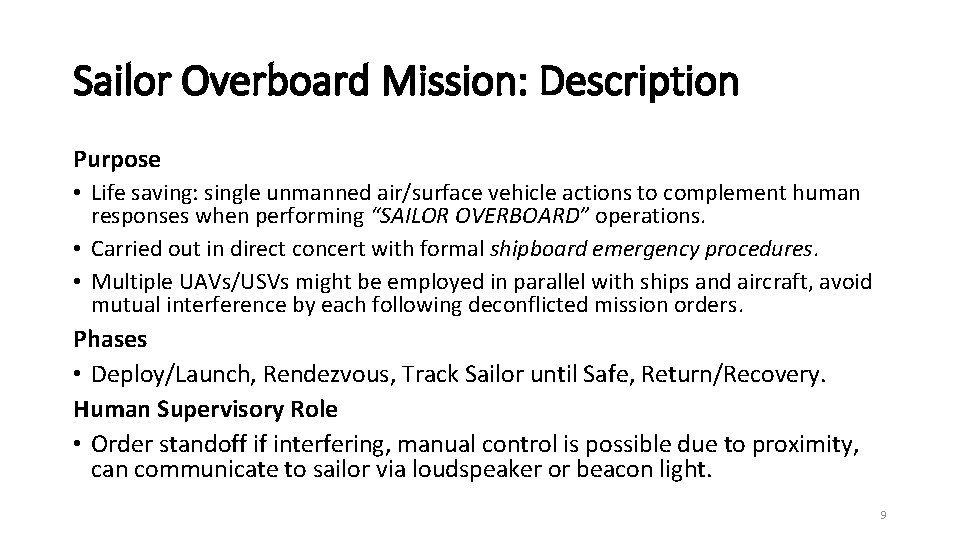
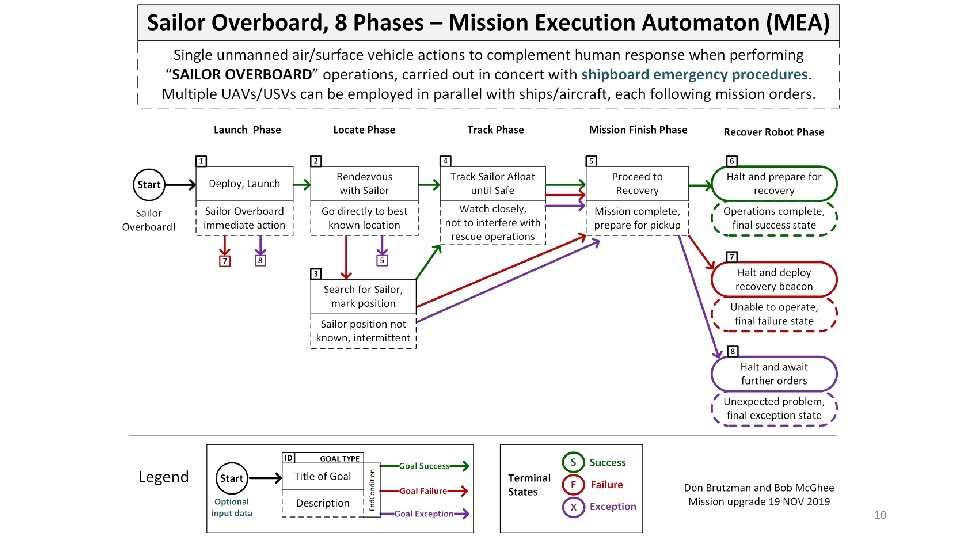
Sailor Overboard Mission: Description Purpose • Life saving: single unmanned air/surface vehicle actions to complement human responses when performing “SAILOR OVERBOARD” operations. • Carried out in direct concert with formal shipboard emergency procedures. • Multiple UAVs/USVs might be employed in parallel with ships and aircraft, avoid mutual interference by each following deconflicted mission orders. Phases • Deploy/Launch, Rendezvous, Track Sailor until Safe, Return/Recovery. Human Supervisory Role • Order standoff if interfering, manual control is possible due to proximity, can communicate to sailor via loudspeaker or beacon light. 9
Sailor overboard mission diagram 10
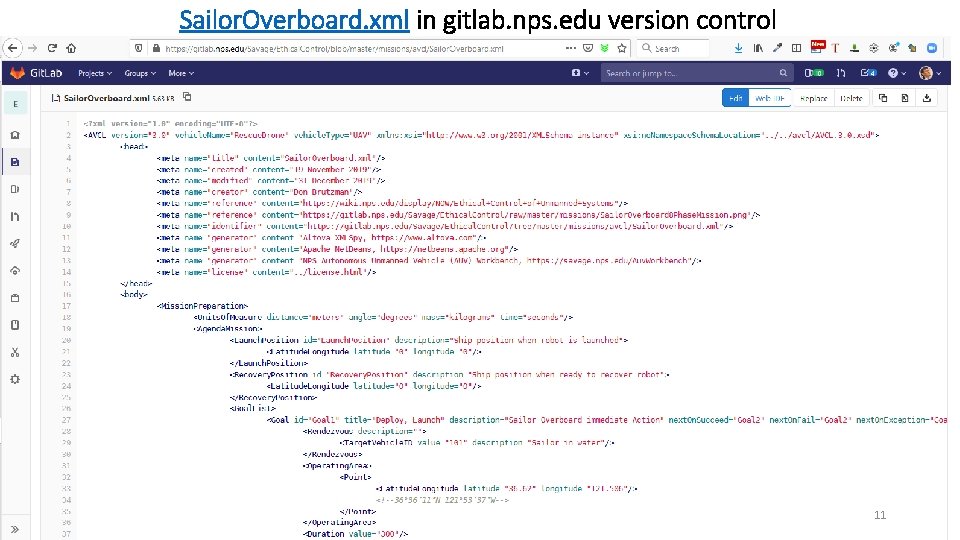
Sailor. Overboard. xml in gitlab. nps. edu version control 11
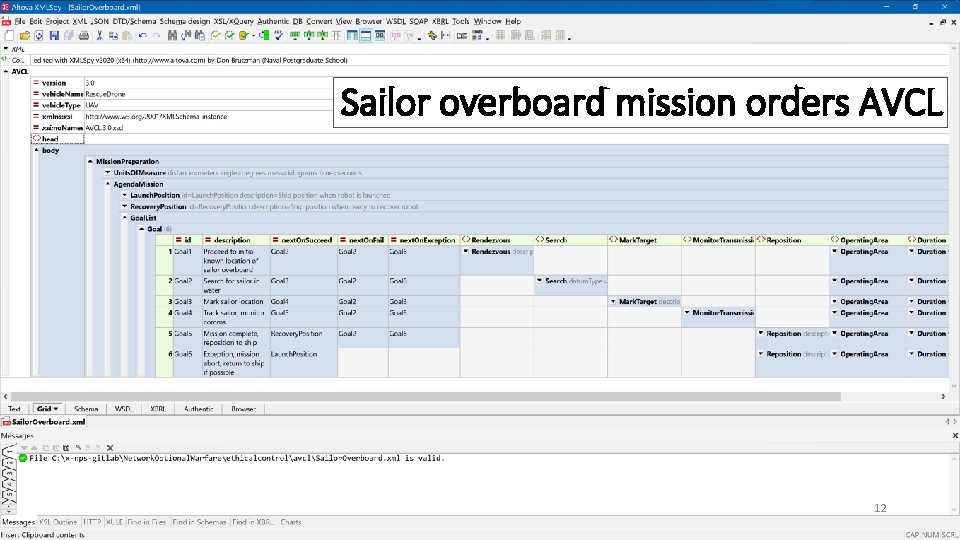
Sailor overboard mission orders AVCL 12
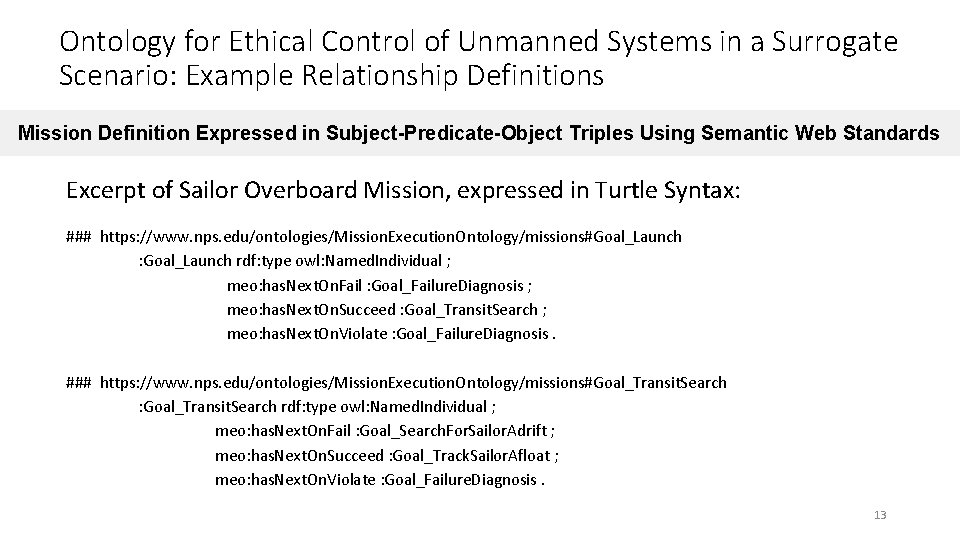
Ontology for Ethical Control of Unmanned Systems in a Surrogate Scenario: Example Relationship Definitions Mission Definition Expressed in Subject-Predicate-Object Triples Using Semantic Web Standards Excerpt of Sailor Overboard Mission, expressed in Turtle Syntax: ### https: //www. nps. edu/ontologies/Mission. Execution. Ontology/missions#Goal_Launch : Goal_Launch rdf: type owl: Named. Individual ; meo: has. Next. On. Fail : Goal_Failure. Diagnosis ; meo: has. Next. On. Succeed : Goal_Transit. Search ; meo: has. Next. On. Violate : Goal_Failure. Diagnosis. ### https: //www. nps. edu/ontologies/Mission. Execution. Ontology/missions#Goal_Transit. Search : Goal_Transit. Search rdf: type owl: Named. Individual ; meo: has. Next. On. Fail : Goal_Search. For. Sailor. Adrift ; meo: has. Next. On. Succeed : Goal_Track. Sailor. Afloat ; meo: has. Next. On. Violate : Goal_Failure. Diagnosis. 13
Sailor overboard mission. ttl Turtle 14
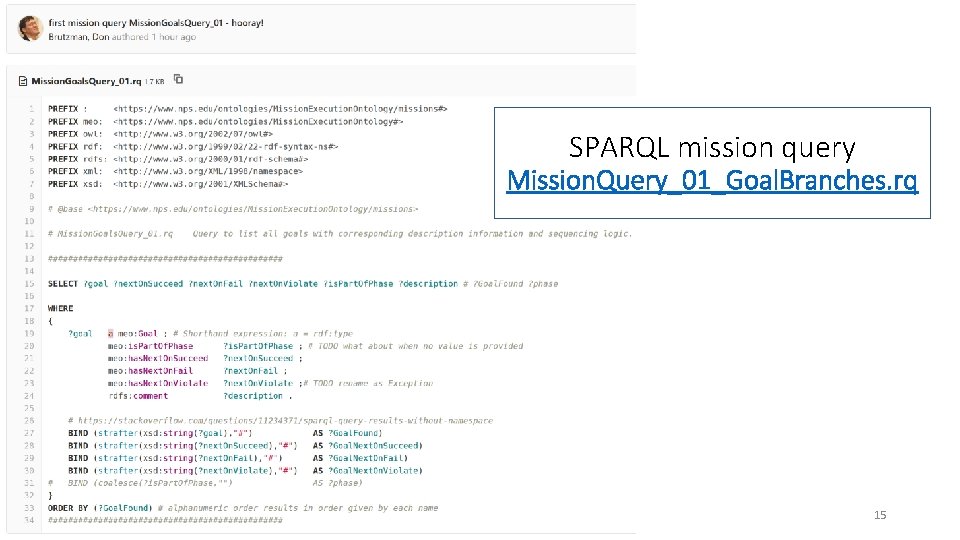
SPARQL mission query Mission. Query_01_Goal. Branches. rq 15
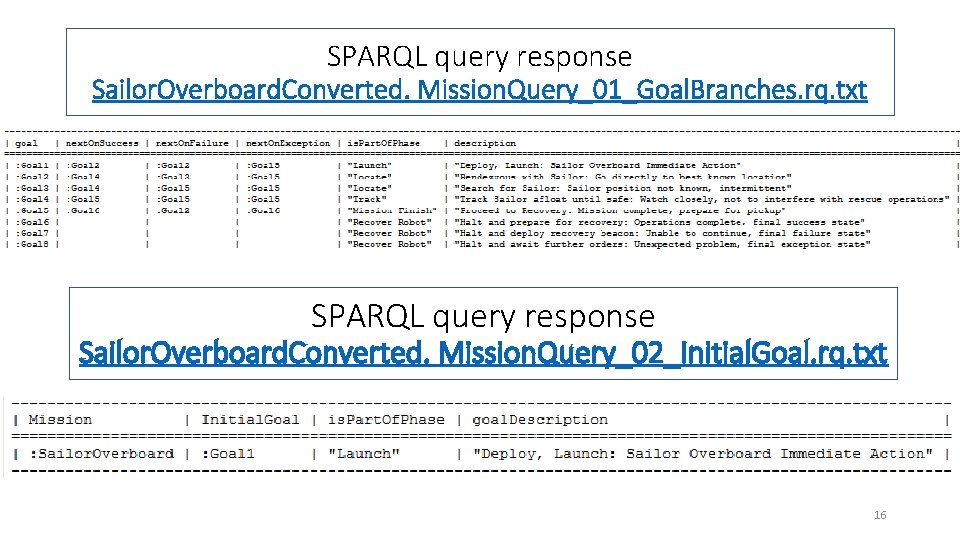
SPARQL query response Sailor. Overboard. Converted. Mission. Query_01_Goal. Branches. rq. txt SPARQL query response Sailor. Overboard. Converted. Mission. Query_02_Initial. Goal. rq. txt 16
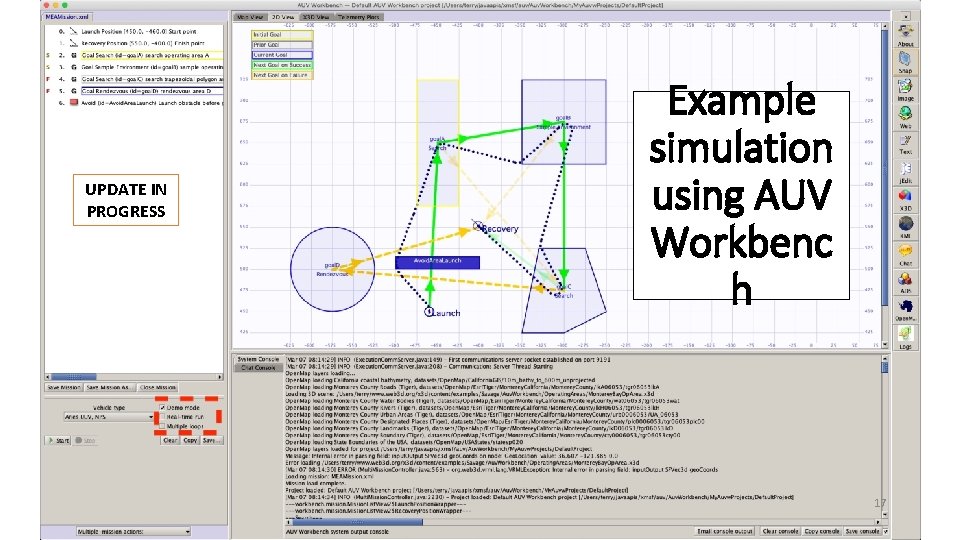
UPDATE IN PROGRESS Example simulation using AUV Workbenc h 17
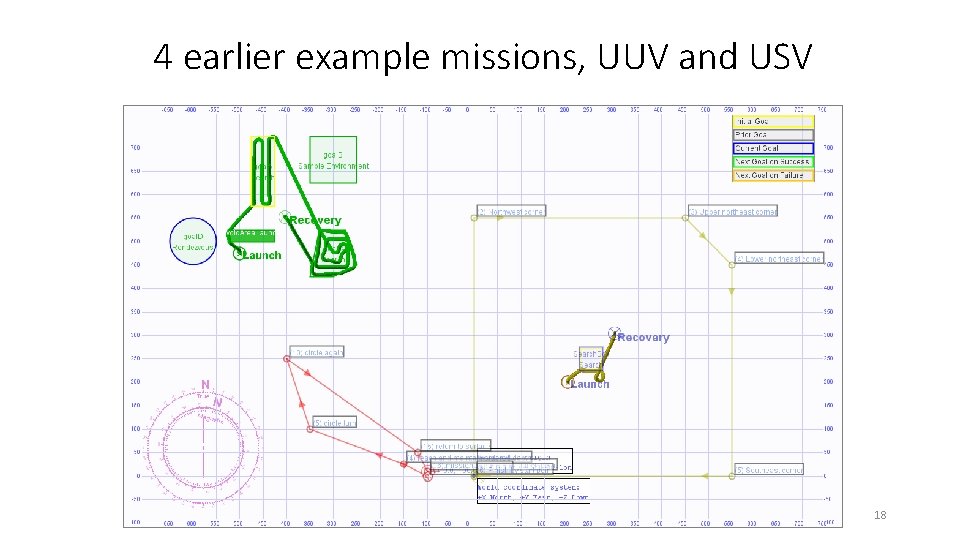
4 earlier example missions, UUV and USV 18
Not suitable for brute-force numerical computation • AI algorithms for Machine Learning (ML) and Data Mining are often based on statistically training against large datasets to find patterns for filters. • For example, convolutional neural networks, genetic algorithms, reinforcement learning, etc. • Often requires identifying right/wrong matches within large search spaces. • Such predictive analytics are useful for classification models using detailed and noisy sensor data. Given the central importance of IFFNU and some conditional communications to ethical control, ML filters can be helpful if carefully applied. • Nevertheless such approaches are not appropriate for carefully following Rules of Engagement (ROEs), Laws of Armed Conflict (LOAC) or other ethical prerequisites, especially when human expertise and judgement is essential for robot teams. • (Similarly, massive computation or Quantum Computing approaches might be useful in some problems, but are not of practical use for Ethical Control mission orders given by human commanders judiciously guiding remote mobile robots) Naval history has long shown that sound human judgement is crucial for assessing best strategies and courses of action in ill-structured contexts. Semantic Web approaches are preferable and actionable for Ethical Control. 19
OODA Significance for Ethical Control Classical robotic Sense-Decide-Act cycle for closed-loop control is insufficient for proper delegation of lethal (or lifesaving) force to unmanned systems. Observe-Orient-Decide-Act (OODA) Loop is essential for coherent operations. • Observe includes direct sensing and communication inputs. • Orientation includes thorough Rules of Engagement (ROE) constraints and identification friend/foe/neutral/unknown (IFFNU) of all relevant contacts. • Decision logic of unmanned system tactics, techniques, procedures (TTP) includes authorization and confirmation by human supervisors, either in realtime or in advance, for critical steps leading to lethal force. • Actions in tandem with direct or intermittent human supervisory command enables effective Ethical Control of remote systems. Feedback loops are essential, generally leading to… more effective operations. 20
IEEE P 7000 -series Standards Projects https: //ethicsinaction. ieee. org • • • • P 7000 Model Process for Addressing Ethical Concerns during System Design P 7001 Transparency of Autonomous Systems P 7002 Data Privacy Process P 7003 Algorithmic Bias Considerations P 7004 Standard on Child and Student Data Governance P 7005 Standard on Employee Data Governance P 7006 Standard on Personal Data AI Agent Working Group P 7007 Ontological Standard for Ethically driven Robotics and Automation Systems P 7008 Standard for Ethically Driven Nudging for Robotic, Intelligent and Autonomous Systems P 7009 Standard for Fail-Safe Design of Autonomous, Semi-Autonomous Systems P 7010 Well-being metrics Standard for Ethical Artificial Intelligence and Autonomous Systems P 7011 Stadard for the Porcess of Identifying and Rating the Trustworthiness of News Sources P 7012 Standard for Machine Readable Personal Privacy Terms P 7014 Standard for Ethical Considerations in Emulated Empathy in Autonomous and Intelligent Systems 21
IEEE Standards Project P 7007 for Ontological Standard for Ethically driven Robotics and Automation Systems • IEEE Global Initiative on Ethics of Autonomous and Intelligent Systems. • https: //ethicsinaction. ieee. org includes large document providing broad rationale. • Includes 15 separate working groups in IEEE Standards Association (IEEE-SA). • Relevant group: P 7007, Ethically driven Robotics and Automation Systems. • “IEEE P 7007 Standards Project for Ontological Standard for Ethically driven Robotics and Automation Systems establishes a set of ontologies with different abstraction levels that contain concepts, definitions and axioms that are necessary to establish ethically driven methodologies for the design of Robots and Automation Systems. ” • http: //standards. ieee. org/develop/project/7007. html • Must be IEEE member, observe patent-policy requirements to participate in working group. • “Not the intent to specify required ethical behaviors, but rather to formalize a vocabulary of terms, concepts, and relationships that can be used to enable unambiguous discussion among […] communities regarding what it means for autonomous systems to exhibit ethical behaviors. ” • Excellent forum with rich references, worth observation and participation. • Active work: align several Ethical Control terms, concepts, use cases with P 7007. 22
Key Insights regarding Human Ethical Control 1. Humans in military units are able to deal with moral challenges without ethical quandaries, • by using formally qualified experience, and by following mission orders that comply with Rules of Engagement (ROE) and Laws of Armed Conflict (LOAC). 2. Ethical behaviors don’t define the mission plan. Instead, ethical constraints inform the mission plan. 3. Naval forces can only command mission orders that are • Understandable by (legally culpable) humans, then • Reliably and safely executed by robots. Reference: CRUSER Tech. Con Overview 2016 https: //gitlab. nps. edu/Savage/Ethical. Control/tree/master/documents/presentations 23
Conclusions • Human supervision is required for any unmanned systems holding potential for lethal force. • Cannot push “big red shiny AI button” and hope for best – immoral, unlawful. • Similar imperatives exist for supervising systems holding life-saving potential. • Human control of unmanned systems is possible at long ranges of time-duration and distance through well-defined mission orders. • Readable and sharable by both humans and unmanned systems. • Validatable syntax and semantics through logical constraints. • Testable and confirmable using simulation and visualization. • Coherent human-system team approach is feasible and repeatable. • Semantic Web confirmation can ensure orders are comprehensive, consistent. • Human role remains essential for life-saving and potentially lethal scenarios. 24
Contact Don Brutzman brutzman@nps. edu http: //faculty. nps. edu/brutzman Code USW/Br, Naval Postgraduate School Monterey California 93943 -5000 USA 1. 831. 656. 2149 work 1. 831. 402. 4809 cell 25
Contact Curt Blais clblais@nps. edu home page Code MV/Bl, Naval Postgraduate School Monterey California 93943 -5000 USA 1. 831. 656. 3215 work 26
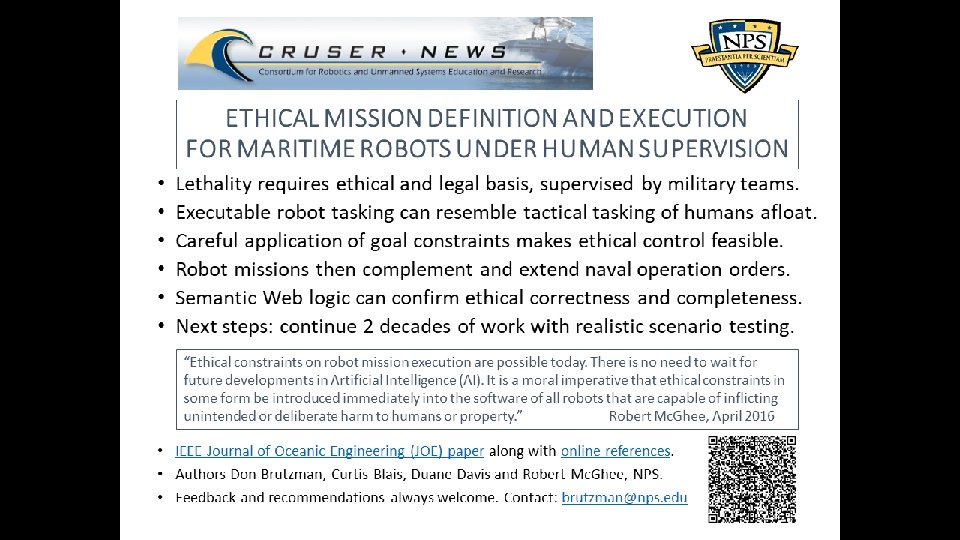
Ethical Control flyer