
ETHICAL CONSIDERATIONS WHAT ARE ETHICS ETHICS moral principles



- Slides: 21
ETHICAL CONSIDERATIONS
WHAT ARE ETHICS?
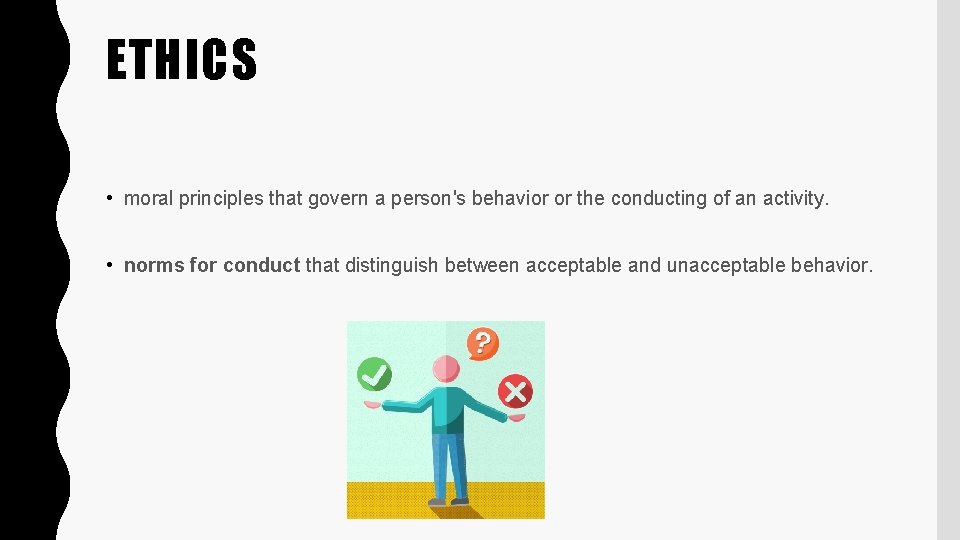
ETHICS • moral principles that govern a person's behavior or the conducting of an activity. • norms for conduct that distinguish between acceptable and unacceptable behavior.
BASIC PRINCIPLES OF ETHICS • You don’t want to people to get hurt from your study (physically, emotionally, etc. ) • You want to avoid any negative impacts on the participants as a result of your study. • You do not want to break the law with your study.
WHY ARE ETHICS IMPORTANT • To protect the welfare and wellbeing of subjects/ participants. • Protect the reputation of the researcher. • Protect the reputation of the field you are in.
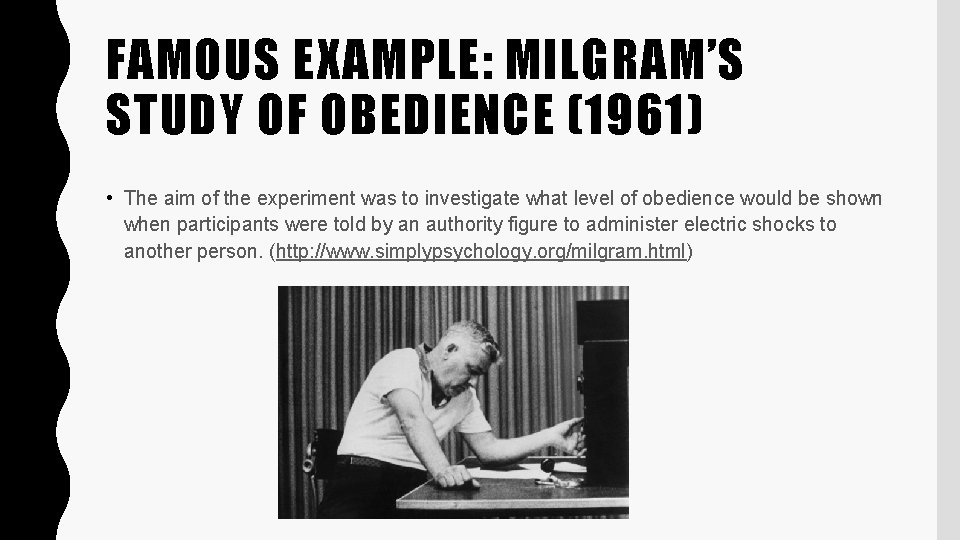
FAMOUS EXAMPLE: MILGRAM’S STUDY OF OBEDIENCE (1961) • The aim of the experiment was to investigate what level of obedience would be shown when participants were told by an authority figure to administer electric shocks to another person. (http: //www. simplypsychology. org/milgram. html)
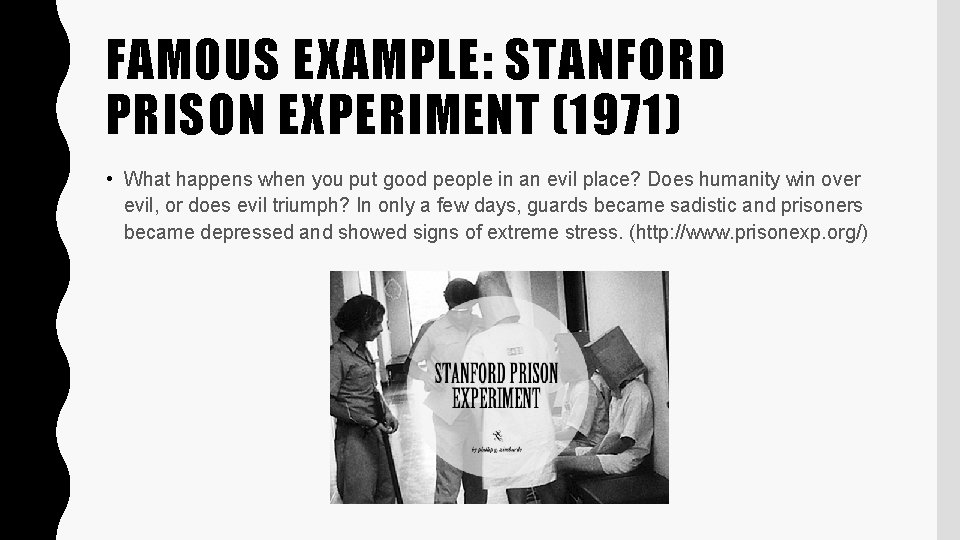
FAMOUS EXAMPLE: STANFORD PRISON EXPERIMENT (1971) • What happens when you put good people in an evil place? Does humanity win over evil, or does evil triumph? In only a few days, guards became sadistic and prisoners became depressed and showed signs of extreme stress. (http: //www. prisonexp. org/)
WHAT DO RESEARCHERS NEED TO DO? • Researchers must use a systematic process to collect data without interfering or harming your subjects. • Researchers must also consider any topics that may have the potential to emotionally trigger the participants.
ETHICAL PRACTICES
VOLUNTARY PARTICIPATION • Research participation should be voluntary and not forced or bribed. • Participants have the right to withdraw their participation at any time (before, during, or after).
TRANSPARENCY • Researchers should be clear about the purposes of their study and not mislead subjects about the purpose their research. (except for special circumstances) – Tell the participants as much as you can about your study – Let them ask you questions about your study – Let them know of any potential issues that they may encounter as a result of your study • Researchers should be transparent about the way they are representing the subjects. – Let them know how they are going to be represented in your study • Their views will be presented through interview excerpts • Their behavior will be discussed in relation to the topic of study • They will be represented as a character (narrative)
NO PHYSICAL OR PSYCHOLOGICAL HARM • Researchers should never put their subjects in a compromising position where there is a potential for danger. • Researchers should not harm or distress (physically or psychologically) their research subjects. • Throughout their research process (before, during, after) they must take all steps necessary to protect the wellbeing of their participants.
PRIVACY • A researcher should never breach a research subject's privacy. – Anonymity: refers to concealing the identities of participants in all documents resulting from the research. • Using pseudonyms (nicknames) – Confidentiality: is concerned with who has the right of access to the data provided by the participants.
GATEKEEPER ACCESS • If you are conducting research within a specific institution, you need to be given access by the institution before collecting data. • This means approaching the person in charge, giving them details about your study, and asking for access to the data collection site.
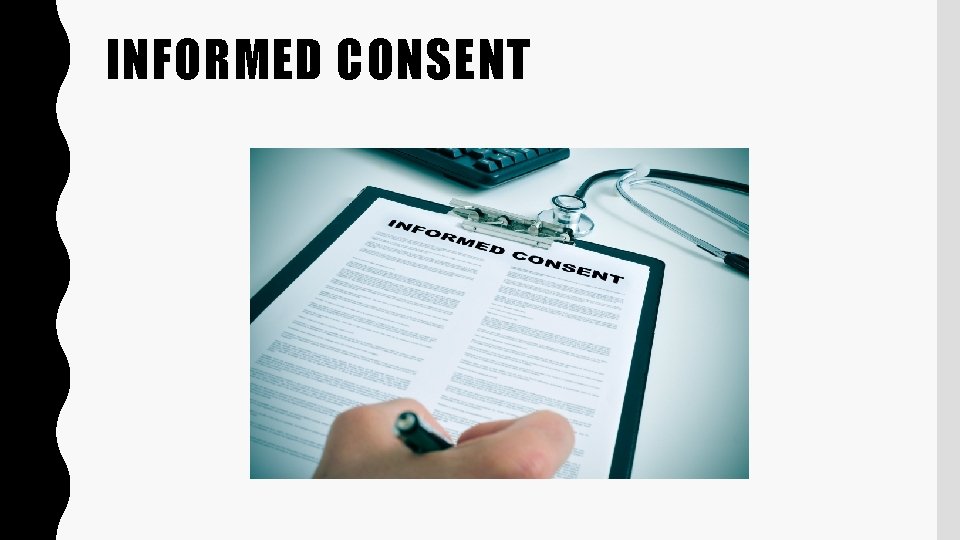
INFORMED CONSENT
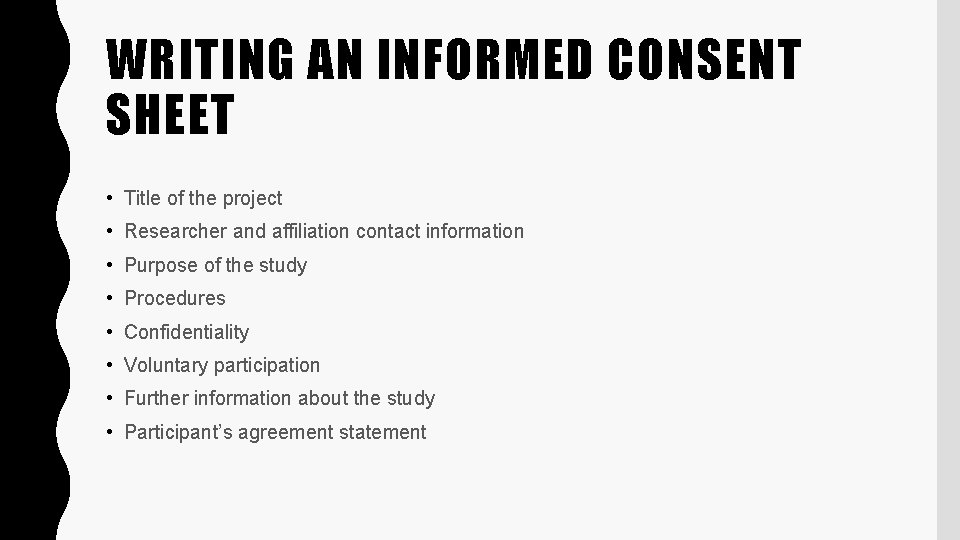
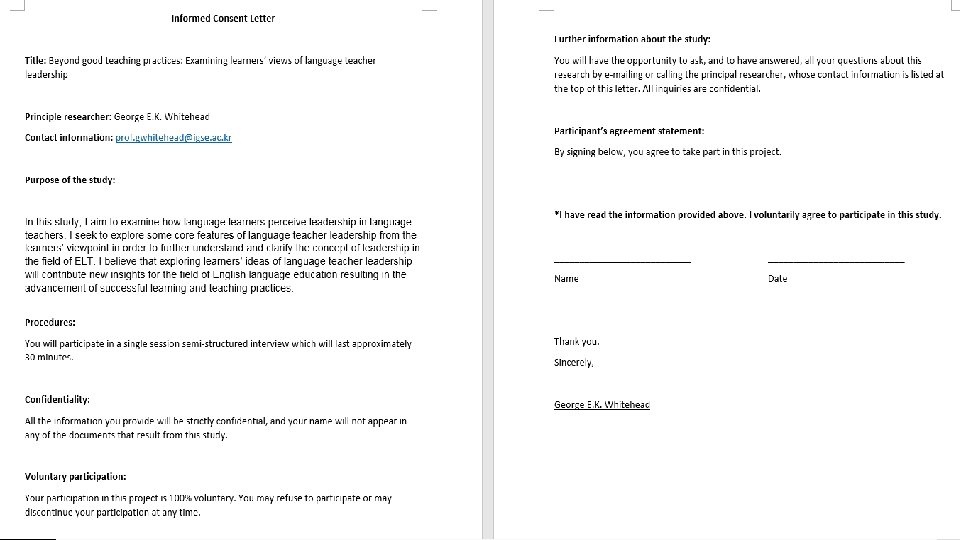
WRITING AN INFORMED CONSENT SHEET • Title of the project • Researcher and affiliation contact information • Purpose of the study • Procedures • Confidentiality • Voluntary participation • Further information about the study • Participant’s agreement statement
IF YOUR PARTICIPANTS ARE UNDERAGE • You need to get consent from their parents
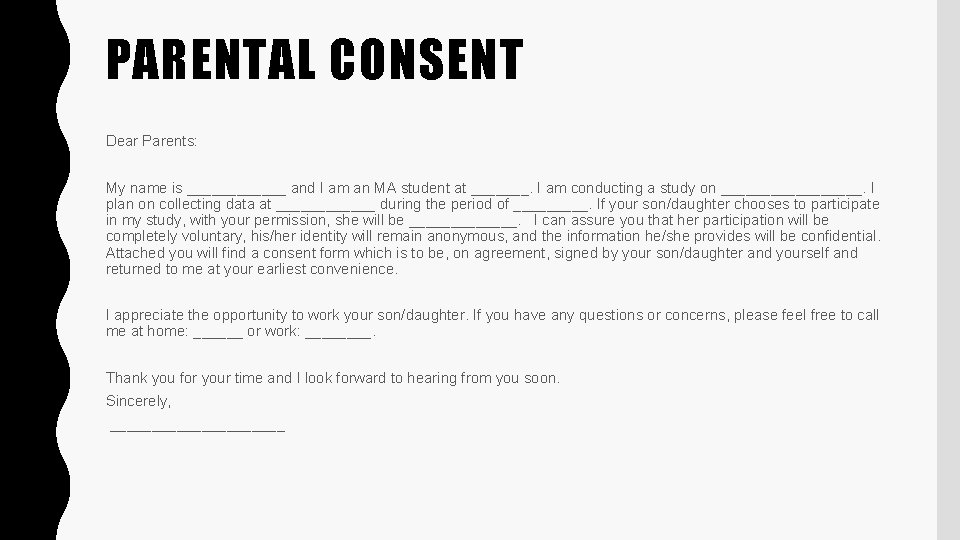
PARENTAL CONSENT Dear Parents: My name is ______ and I am an MA student at _______. I am conducting a study on _________. I plan on collecting data at ______ during the period of _____. If your son/daughter chooses to participate in my study, with your permission, she will be _______. I can assure you that her participation will be completely voluntary, his/her identity will remain anonymous, and the information he/she provides will be confidential. Attached you will find a consent form which is to be, on agreement, signed by your son/daughter and yourself and returned to me at your earliest convenience. I appreciate the opportunity to work your son/daughter. If you have any questions or concerns, please feel free to call me at home: ______ or work: ____. Thank you for your time and I look forward to hearing from you soon. Sincerely, ___________
REFLECTION/ DISCUSSION • What are some ethical considerations that are important when interviewing? • What are some ethical considerations that are important when observing? • What about when your write a paper using the data you collected?
HOMEWORK FAKE QUALITATIVE STUDY PLAN • What is the topic of your study? • Who will be your research participants? • Research question (s)? • Why is this study important? • What approach will you use?