
Ethanolinduced Hypothermia and Clearance Curve Across the Ages
- Slides: 1
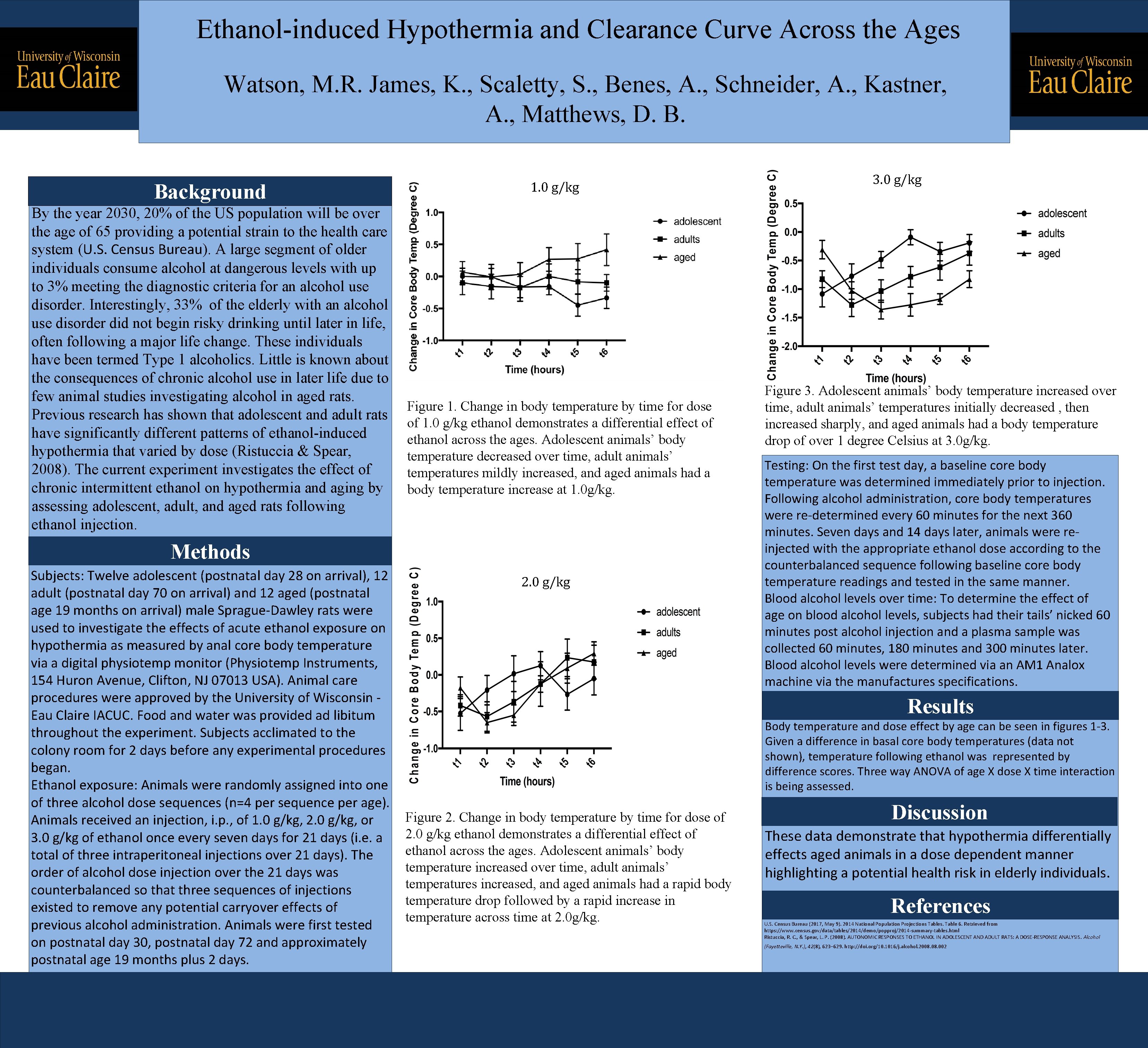
Ethanol-induced Hypothermia and Clearance Curve Across the Ages Watson, M. R. James, K. , Scaletty, S. , Benes, A. , Schneider, A. , Kastner, A. , Matthews, D. B. Background By the year 2030, 20% of the US population will be over the age of 65 providing a potential strain to the health care system (U. S. Census Bureau). A large segment of older individuals consume alcohol at dangerous levels with up to 3% meeting the diagnostic criteria for an alcohol use disorder. Interestingly, 33% of the elderly with an alcohol use disorder did not begin risky drinking until later in life, often following a major life change. These individuals have been termed Type 1 alcoholics. Little is known about the consequences of chronic alcohol use in later life due to few animal studies investigating alcohol in aged rats. Previous research has shown that adolescent and adult rats have significantly different patterns of ethanol-induced hypothermia that varied by dose (Ristuccia & Spear, 2008). The current experiment investigates the effect of chronic intermittent ethanol on hypothermia and aging by assessing adolescent, adult, and aged rats following ethanol injection. 1. 0 g/kg Figure 1. Change in body temperature by time for dose of 1. 0 g/kg ethanol demonstrates a differential effect of ethanol across the ages. Adolescent animals’ body temperature decreased over time, adult animals’ temperatures mildly increased, and aged animals had a body temperature increase at 1. 0 g/kg. Methods Subjects: Twelve adolescent (postnatal day 28 on arrival), 12 adult (postnatal day 70 on arrival) and 12 aged (postnatal age 19 months on arrival) male Sprague-Dawley rats were used to investigate the effects of acute ethanol exposure on hypothermia as measured by anal core body temperature via a digital physiotemp monitor (Physiotemp Instruments, 154 Huron Avenue, Clifton, NJ 07013 USA). Animal care procedures were approved by the University of Wisconsin Eau Claire IACUC. Food and water was provided ad libitum throughout the experiment. Subjects acclimated to the colony room for 2 days before any experimental procedures began. Ethanol exposure: Animals were randomly assigned into one of three alcohol dose sequences (n=4 per sequence per age). Animals received an injection, i. p. , of 1. 0 g/kg, 2. 0 g/kg, or 3. 0 g/kg of ethanol once every seven days for 21 days (i. e. a total of three intraperitoneal injections over 21 days). The order of alcohol dose injection over the 21 days was counterbalanced so that three sequences of injections existed to remove any potential carryover effects of previous alcohol administration. Animals were first tested on postnatal day 30, postnatal day 72 and approximately postnatal age 19 months plus 2 days. 2. 0 g/kg 3. 0 g/kg Figure 3. Adolescent animals’ body temperature increased over time, adult animals’ temperatures initially decreased , then increased sharply, and aged animals had a body temperature drop of over 1 degree Celsius at 3. 0 g/kg. Testing: On the first test day, a baseline core body temperature was determined immediately prior to injection. Following alcohol administration, core body temperatures were re-determined every 60 minutes for the next 360 minutes. Seven days and 14 days later, animals were reinjected with the appropriate ethanol dose according to the counterbalanced sequence following baseline core body temperature readings and tested in the same manner. Blood alcohol levels over time: To determine the effect of age on blood alcohol levels, subjects had their tails’ nicked 60 minutes post alcohol injection and a plasma sample was collected 60 minutes, 180 minutes and 300 minutes later. Blood alcohol levels were determined via an AM 1 Analox machine via the manufactures specifications. Results Body temperature and dose effect by age can be seen in figures 1 -3. Given a difference in basal core body temperatures (data not shown), temperature following ethanol was represented by difference scores. Three way ANOVA of age X dose X time interaction is being assessed. Figure 2. Change in body temperature by time for dose of 2. 0 g/kg ethanol demonstrates a differential effect of ethanol across the ages. Adolescent animals’ body temperature increased over time, adult animals’ temperatures increased, and aged animals had a rapid body temperature drop followed by a rapid increase in temperature across time at 2. 0 g/kg. Discussion These data demonstrate that hypothermia differentially effects aged animals in a dose dependent manner highlighting a potential health risk in elderly individuals. References U. S. Census Bureau (2017, May 9). 2014 National Population Projections Tables. Table 6. Retrieved from https: //www. census. gov/data/tables/2014/demo/popproj/2014 -summary-tables. html Ristuccia, R. C. , & Spear, L. P. (2008). AUTONOMIC RESPONSES TO ETHANOL IN ADOLESCENT AND ADULT RATS: A DOSE-RESPONSE ANALYSIS. Alcohol (Fayetteville, N. Y. ), 42(8), 623– 629. http: //doi. org/10. 1016/j. alcohol. 2008. 002