
Ethanol Corn Mash and Distillation Presentation for Middle
- Slides: 13
Ethanol - Corn Mash and Distillation Presentation for Middle School Teacher Workshop
Goals for today Budget • Corn Mash and Distillation lab • Actually do the lab and get comfortable with the procedure and materials. • Learn the different ways this lab can be differentiated • Be willing to ask questions • Share your knowledge 2019 Expenses $778, 404 with others and support each other • Learn how this lab can fit into a larger unit of Biofuel 2020 Proposed $753, 497 • Discover how this lab can fit into your existing classroom curriculum.
Why I Love this Lab! Budget • Very relevant to students lives • Connects to so many different science concepts • This lab uses a lot science equipment • Highly engaging • Feels like a lot but is able to be done with middle school 2019 Expenses $778, 404 students • There is no “one way” to do this lab. Student can be successful 2020 Proposed $753, 497 even if they “mess up” • Can easily be differentiated up or down depending on your students
Budget Background Information • The increasing demand of fuel for transportation, increased world-demand for oil (gasoline), and the negative consequences of global warming have all contributed to the increased use of corn-based sugar to produce ethanol. Ethanol is blended with gasoline and burned in many of today’s passenger cars and trucks. Most gas stations currently use 10% ethanol in their gasoline. However, it has also been used as 85% ethanol to 2019 Expenses $778, 404 15% gasoline at some gas pumps called, “E 85” or flex fuel. 2020 Proposed $753, 497
Materials for Day 1 • Hot plate • Beakers (100, 250, 600 ml) • Graduated cylinders (10 ml, 50 ml) • Digital thermometer • Scale or triple beam balance 2019 Expenses $778, 404 • Pipettes • Plastic Wrap $753, 497 2020 Proposed • Rubber band Budget • Distilled water • Ground corn (100 g) • Buffer solution p. H • Prepared yeast solution • Prepared amylase solution • Prepared glycosylase solution
Procedure Budget • Mass 100 g of ground corn and add to a 600 ml beaker. • Add 300 ml of warm distilled water to the ground corn. Stir the corn mixture. Place the beaker in a hot water bath on a hotplate. Gently boil the solution and continuously stir for 8 -15 minutes. Be careful not to let the corn mixture burn. • You waiting for the corn mash to thicken to a thin 2019 are Expenses $778, 404 oatmeal consistency. 2020 Proposed $753, 497
Procedure Budget • After boiling is completed, remove the beaker from the hotplate. Measure 100 ml of room temperature distilled water and add it to the corn mash solution and allow it to cool to between 55°C and 37°C. • Shake the amylase solution, then measure 10 ml of the amylase solution and add it to the corn mash. 2019 Expenses $778, 404 2020 Proposed $753, 497
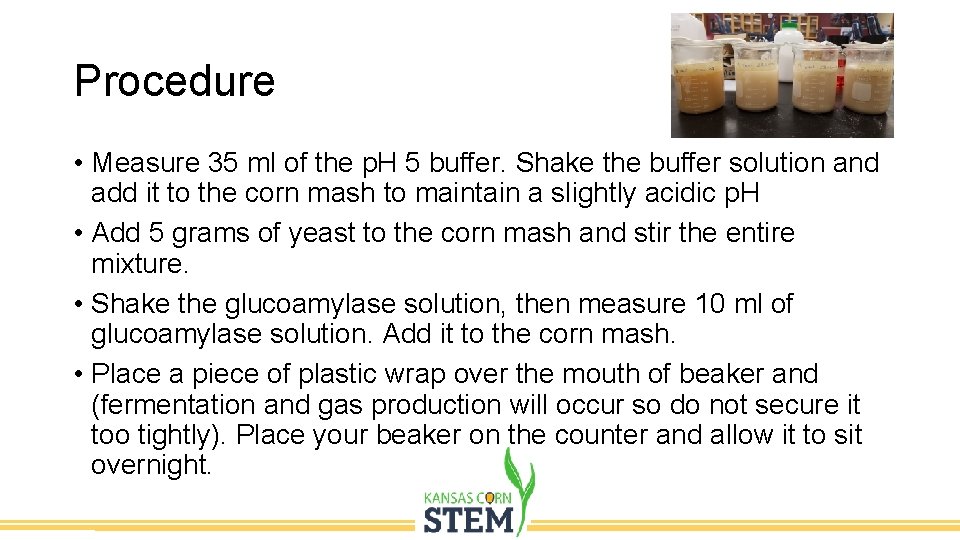
Procedure Budget • Measure 35 ml of the p. H 5 buffer. Shake the buffer solution and add it to the corn mash to maintain a slightly acidic p. H • Add 5 grams of yeast to the corn mash and stir the entire mixture. • Shake the glucoamylase solution, then measure 10 ml of glucoamylase solution. Add it to the corn mash. 2019 Expenses $778, 404 • Place a piece of plastic wrap over the mouth of beaker and (fermentation gas production will occur so do not secure it 2020 Proposed and $753, 497 too tightly). Place your beaker on the counter and allow it to sit overnight.
Procedure Day 2 Budget • Use a large strainer with a large bowl/beaker underneath to strain out any large solids from your fermented corn mash. Swirl the strainer as it drains. This will greatly reduce the time it takes to strain. • Collect the solids from the strainer. Place the solids in a large piece of cheesecloth. Wrap up the solids, then hand squeeze the liquid out of the solids into your beaker. • Line strainer with a new piece of cheesecloth. Pour your 2019 your Expenses $778, 404 liquid through the cheesecloth lined strainer into a bowl/beaker below. Collect the cheesecloth with the strained solids, and 2020 Proposed $753, 497 again hand squeeze the liquid out of the solids into your bowl/beaker. You should have removed most of the solids from this mixture at this time.
Time to Distill Budget • Set up the distillation apparatus. Make sure to either grease or wet the ground glass joints before connecting them. This helps to prevent any vapor from escaping the joints and to keep the joints from freezing together. 2019 Expenses $778, 404 2020 Proposed $753, 497
Distillation Procedure Budget • Pour the strained solution into the distillation flask. Heat the liquid and control the temperature. The best separation of alcohol will occur if the distillation is done slowly. Ethanol’s boiling point is 78. 37°C and water’s is 100°C; therefore, keep the temperature of the distillate between these two boiling points. • Collect the ethanol distillate samples into a small flask. Wrap the 2019 Expenses opening of the $778, 404 flask and end of the condensing tube with aluminum foil to help prevent evaporation of the ethanol. Pour 2020 Proposedsamples $753, 497 into a capped vial for storage until ready to the distillate do the Alcohol Flame Test
Alcohol Flame Test Budget • Use a pipet to remove a 2 ml sample of your distilled ethanol and place the ethanol on a watch glass or in a ceramic evaporating dish. Light the ethanol with a lighter. A quality sample will light with a pale blue flame. Time how long the flame burns. The longer the flame burns, the greater the alcohol concentration. 2019 Expenses $778, 404 2020 Proposed $753, 497
Budget This lab is made possible with the support and content contributions of the Kansas Corn Commission.