
ETHANE TAKING CONTROL OF THE ENTERPRISE VAMSHI REDDY
![Policy Language • Policy language to enforce network wide policies • [(usrc="bob")∧(protocol="http")∧(hdst="websrv")]: allow; •](https://slidetodoc.com/presentation_image_h2/5225aaca805d1f065add820f17d158bd/image-12.jpg "Policy Language • Policy language to enforce network wide policies • [(usrc=\"bob\")∧(protocol=\"http\")∧(hdst=\"websrv\")]: allow; •")
- Slides: 19
ETHANE: TAKING CONTROL OF THE ENTERPRISE VAMSHI REDDY KONAGARI
Why Network Control and Management is Important for enterprise networks? • Enterprise networks are large, they run a variety of apps and protocols • Need high reliability and security constraints • 62% of network downtime in multi-vendor networks comes from human errors and 80% spent on maintenance and operations. • Traditional ways to manage networks • Middle boxes to intercept traffic and enforce policies • Adding new layer of protocols on top of existing protocols to audit and manage hosts, networking devices using VLANS, ACLs, etc.
Problems with traditional ways to manage networks • Complexity of distributed protocols • Misconfigurations • No global view of network • Traffic can accidentally flow around middle boxes • Traditional management tools hide the complexity not reduce it.
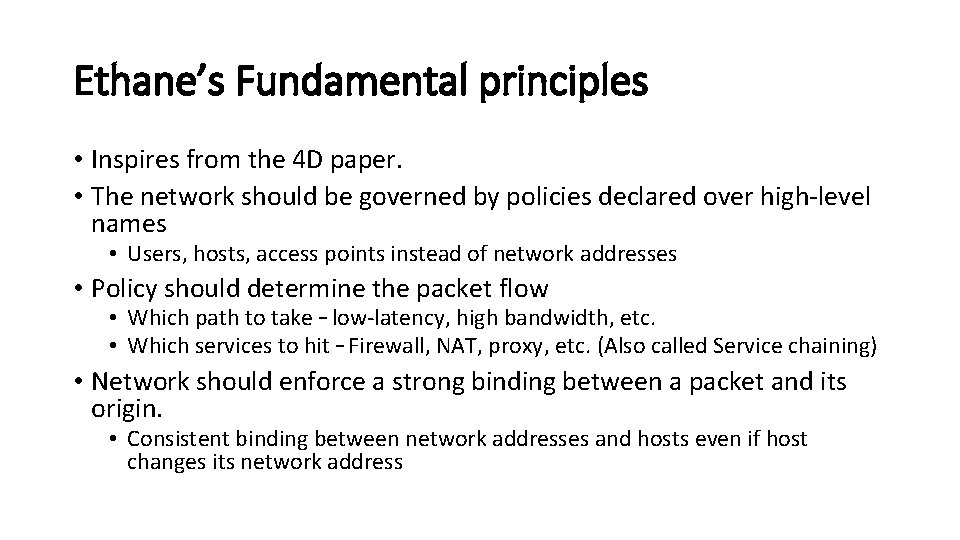
Ethane’s Fundamental principles • Inspires from the 4 D paper. • The network should be governed by policies declared over high-level names • Users, hosts, access points instead of network addresses • Policy should determine the packet flow • Which path to take – low-latency, high bandwidth, etc. • Which services to hit – Firewall, NAT, proxy, etc. (Also called Service chaining) • Network should enforce a strong binding between a packet and its origin. • Consistent binding between network addresses and hosts even if host changes its network address
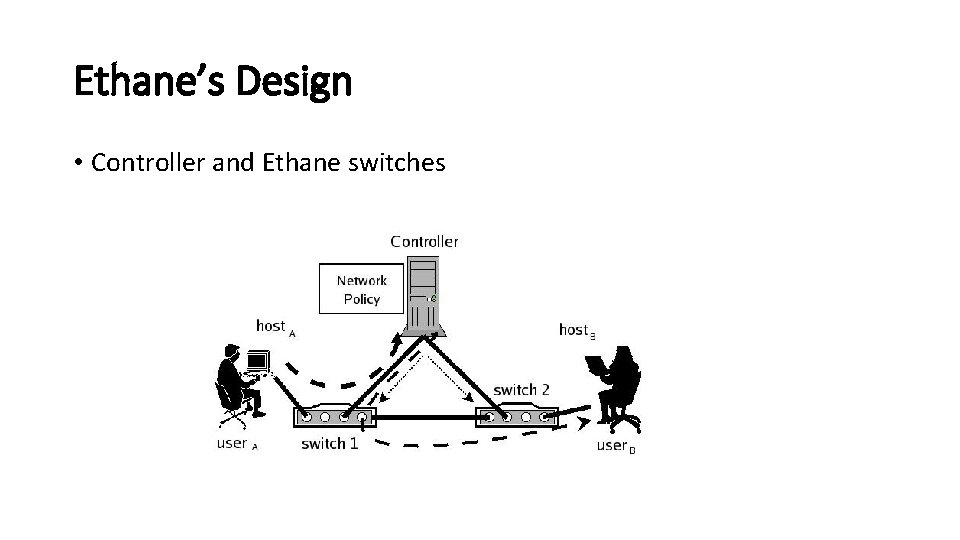
Ethane’s Design • Controller and Ethane switches
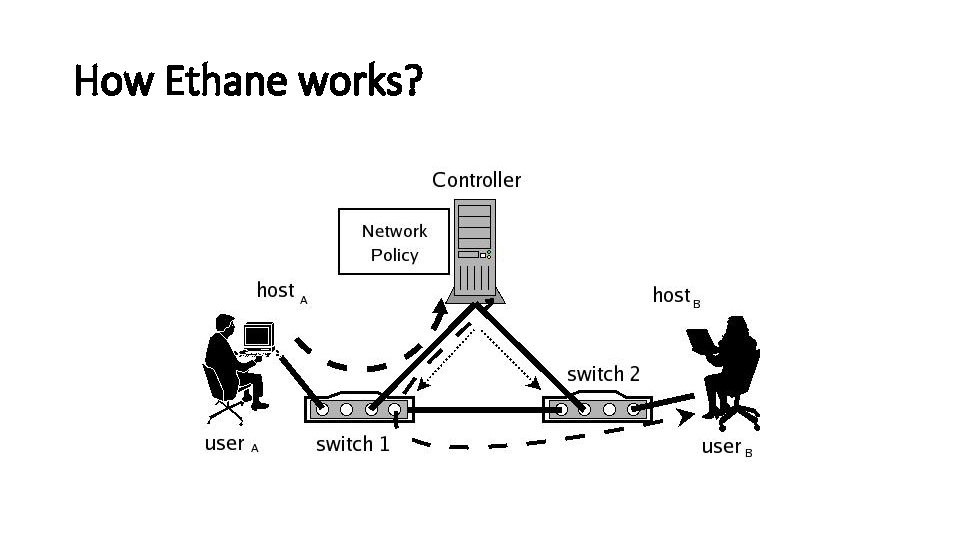
How Ethane works? • 5 basic activities • Registration • Hosts, users and switches register to the controller • Bootstrapping • Tree with controller as root • Switches connect to controller to setup secure channel • Authentication • Controller intercepts DHCP setup packets - associates host to IP, IP to MAC, MAC to switch port mappings. • Flow Setup • Controller decides whether to allow or deny flows • Forwarding • If a flow is allowed, rules to allow traffic are installed on switches
How Ethane works?
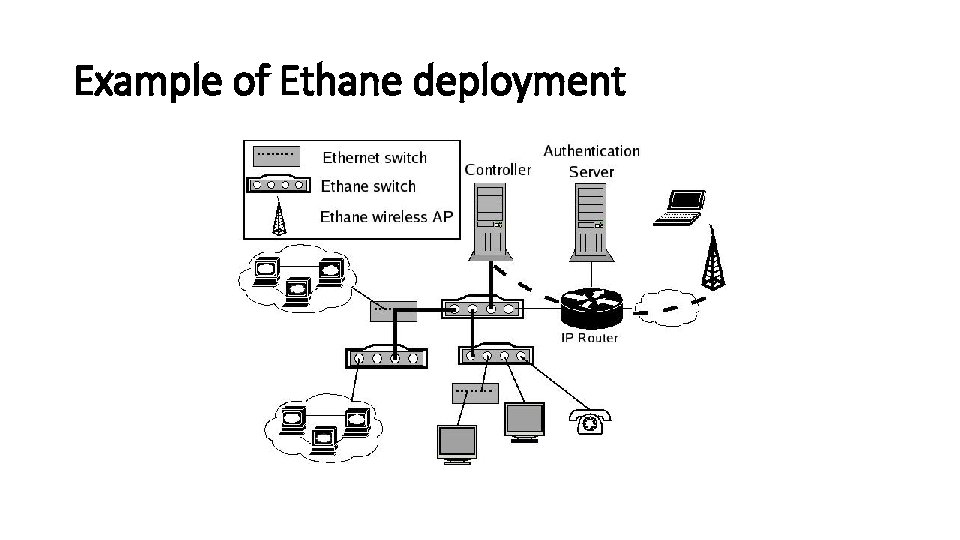
Example of Ethane deployment
Ethane Switch • L 2 - Dumb switches - no STP, L 2 Learning, VLAN support • L 3 - Dumb routers - no OSPF, RIP, ACLs, NAT, etc. • Flow tables and entries • • Match and action pairs with per-flow stats Drop, flood, send it to a port or send it to controller Queue packets in a particular queue Address translations • Logical switch manager • A process inside a switch to talk to controller to update link status, neighbours, etc.
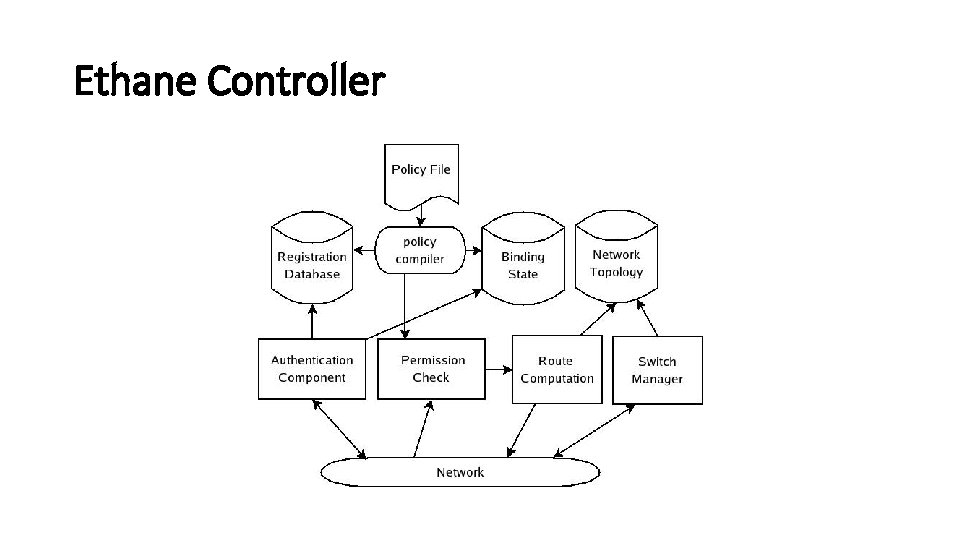
Ethane Controller
Replicating the controller: Fault-tolerance and scalability • Central controller - bottleneck • Possible approaches • Warm standby - Controllers monitor each other and do failover - need to synchronize bindings, etc. - network state is eventually consistent - might lose some info on primary failure. • Cold standby - backup controllers are waiting to take over the control. Switches do the failover. • Fully-replicated controllers - requests from switches are spread over multiple controllers using some hashing - round robin. • Weak semantics for consistency.
Policy Language • Policy language to enforce network wide policies • [(usrc="bob")∧(protocol="http")∧(hdst="websrv")]: allow; • Conditions are conjunction of zero or more predicates followed by an action. • Actions include allow, deny, outbound only (NAT), waypoints • If two or more rules match with conflicting actions, then highest priority rule wins
Prototype and deployment • Single PC based controller • 19 switches - Ethane switches (software and hardware), Ethane access points • 300 hosts - Laptops, printers, VOIP phones, desktop workstations, servers
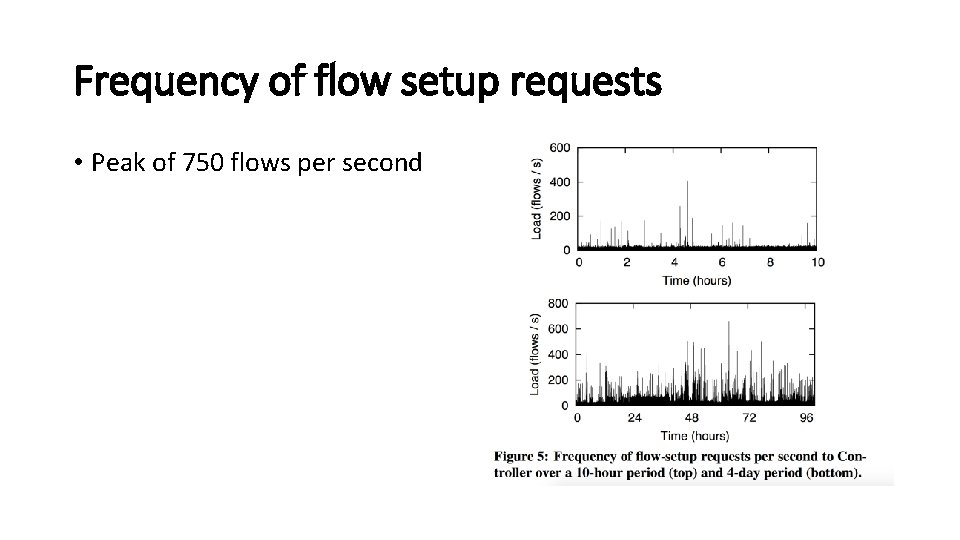
Frequency of flow setup requests • Peak of 750 flows per second
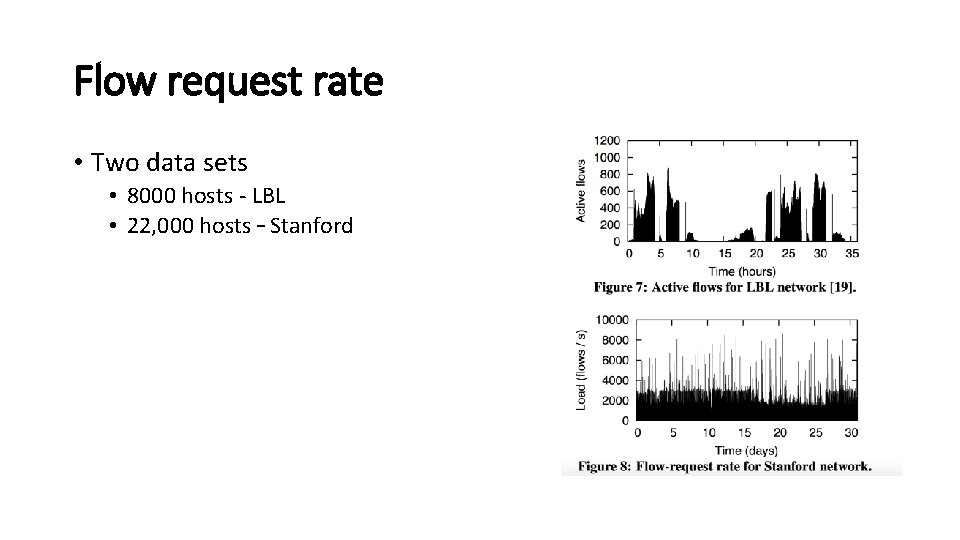
Flow request rate • Two data sets • 8000 hosts - LBL • 22, 000 hosts – Stanford
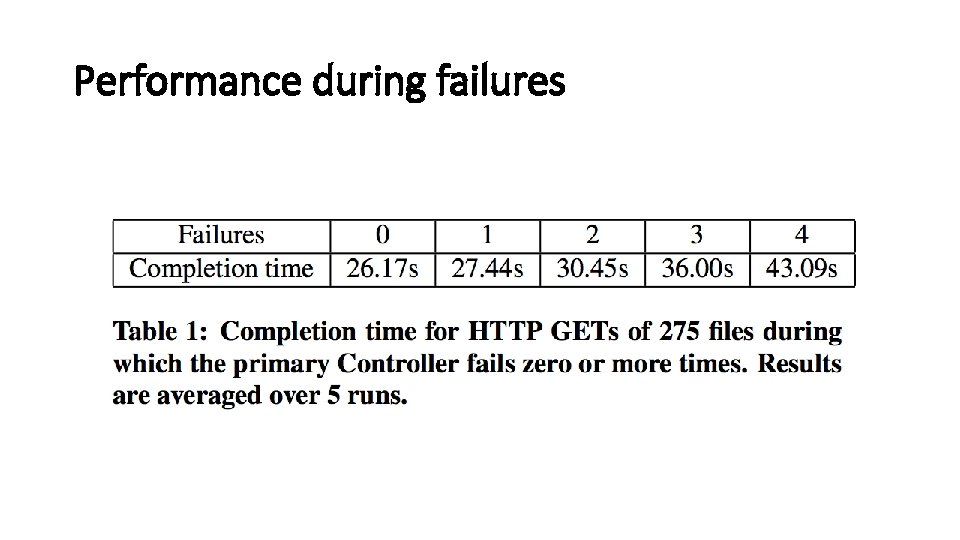
Performance during failures
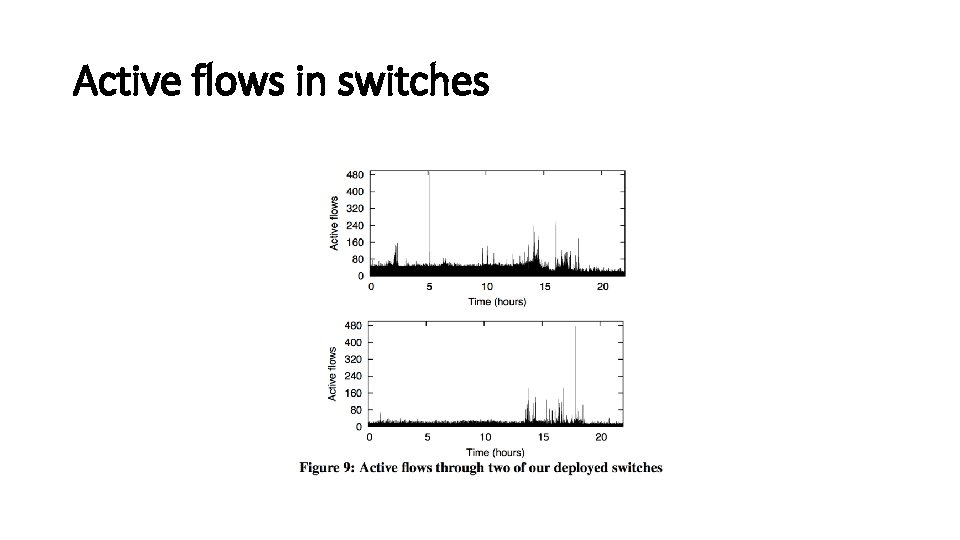
Active flows in switches
Shortcomings • Broadcast and service discovery • ARP, OSPF discovery • Leads to large number of flows • Application layer routing • If A can talk to B, but not to C. • B can talk to C. • B can relay A's traffic to C --- Ethane can't detect this • Spoofing Ethernet addresses
Conclusion • Switches are best when they are dumb • Ethane makes networks much easier to manage • Single controller can manage 10, 000 machines • Adding new users, switches, protocols, routing algorithms is very easy • Service chaining using ethane waypoints • Defining policies at a centralized location rather than distributed