
Eternal Blue Timeline Before It is discovered and

Eternal. Blue
Timeline ● Before: It is discovered and developed by the NSA (U. S. National Security Agency) ● April 14, 2017: it is released into by the Shadow Brokers hacker group ○ https: //github. com/misterch 0 c/shadowbroker ● April 24, 2017: it is used by Adylkuzz ○ a botnet cryptominer that puts a bot on your computer to mine Monero coin ● May 12, 2017: it is used in the Wanna. Cry ransomware ○ A ransomware that encrypted the files on a victim’s computer and would only be decrypted if a ransom is paid
cont’d ● June 27, 2017: it is used in the Not. Petya attack ○ A ransomware that would load on boot and tell the user to pay otherwise their files would be wiped ● September 22, 2017: Retefe the banking Trojan adds a component that uses Eternal. Blue ● October, 2017: Wanna. Mine uses Eternal. Blue as a part of how it gets into Windows computers ● March 20, 2017: This presentation

How was Eternal. Blue used ● The attacks would use Eternal. Blue to self-propagate ● Eternal. Blue targets a vulnerability in the SMB protocol to get into Windows though port 445 or TCP ● Wanna. Cry would randomly check IP addresses over a LAN about 25 address/second to find other computers with port 445 open
Server Message Block (SMB) ● The SMB protocol is used for file sharing over a network by Windows ● It uses multiple ports, but port 445 is used for file sharing over TCP ● For a SMB message requires is sent there is a max buffer size for a message and when it is greater than this, the rest of the message is sent as a Secondary Trans 2 request
Secondary Trans 2 Request ● There are two functions that handle the packets being sent ○ ○ SMB_COM_NT_TRANSACT SMB_COM_TRANSACTION 2 ● The secondary part is when it exceeds the SMB Max. Buffer. Size and these have their own functions that split up the packets ○ ○ SMB_COM_NT_TRANSACT_SECONDARY SMB_COM_TRANSACTION 2_SECONDARY
Lets dive into Eternal. Blue ● 1. 2. 3. 3 main bugs behind the exploit Wrong casting Wrong Parsing Function Non-paged pool allocation
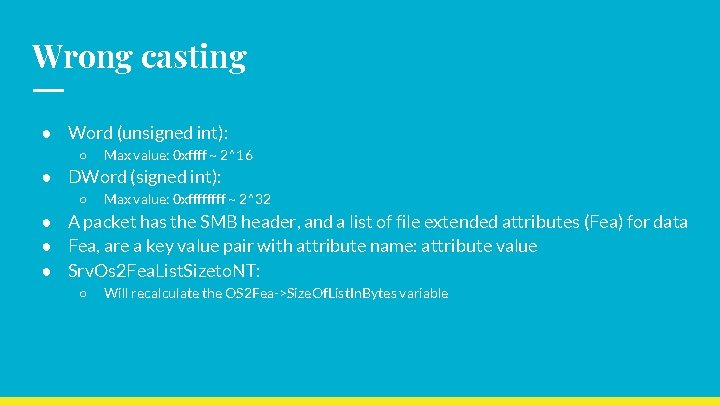
Wrong casting ● Word (unsigned int): ○ Max value: 0 xffff ~ 2^16 ● DWord (signed int): ○ Max value: 0 xffff ~ 2^32 ● A packet has the SMB header, and a list of file extended attributes (Fea) for data ● Fea, are a key value pair with attribute name: attribute value ● Srv. Os 2 Fea. List. Sizeto. NT: ○ Will recalculate the OS 2 Fea->Size. Of. List. In. Bytes variable
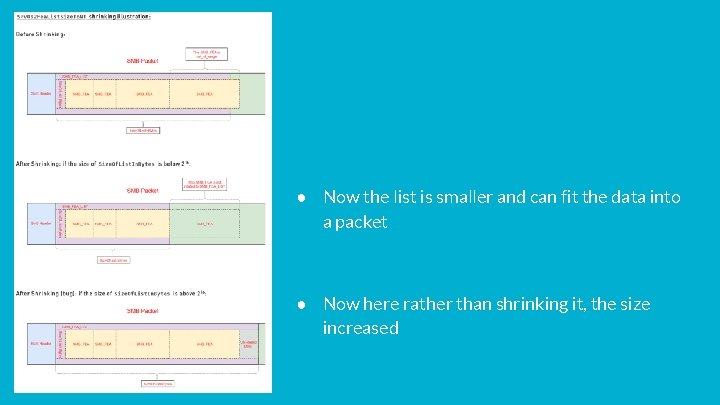
● Now the list is smaller and can fit the data into a packet ● Now here rather than shrinking it, the size increased
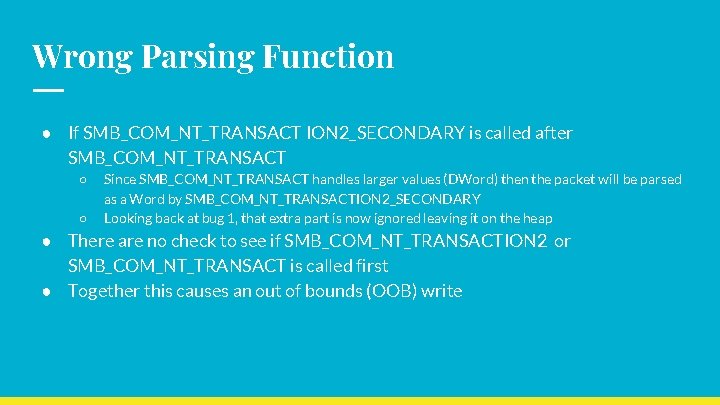
Wrong Parsing Function ● If SMB_COM_NT_TRANSACT ION 2_SECONDARY is called after SMB_COM_NT_TRANSACT ○ ○ Since SMB_COM_NT_TRANSACT handles larger values (DWord) then the packet will be parsed as a Word by SMB_COM_NT_TRANSACTION 2_SECONDARY Looking back at bug 1, that extra part is now ignored leaving it on the heap ● There are no check to see if SMB_COM_NT_TRANSACTION 2 or SMB_COM_NT_TRANSACT is called first ● Together this causes an out of bounds (OOB) write
Non-paged pool allocation ● Non-paged pool ○ ○ Where Window stores objects for processes, threads, mutexes, etc It has certain rules that when broken cause a IRQL_NOT_LESS_OR_EQUAL error that can crash your computer ● There’s a certain bug that when you want to setup the session and send it as extended security, the flag for extended security won’t be turned on and the bytesize is wrong cause there to be a hole in the memory ● Using these 3 bugs we will get a buffer overrun
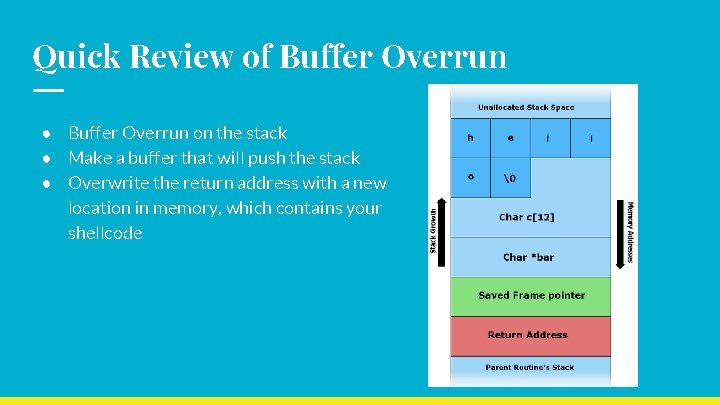
Quick Review of Buffer Overrun ● Buffer Overrun on the stack ● Make a buffer that will push the stack ● Overwrite the return address with a new location in memory, which contains your shellcode
Heap Buffer Overrun ● Heap Spraying ○ ○ You put a pointer to the shellcode within chunks of data filled with nops so that it is pushed towards something useful that is run within the heap These chunks are then put all over the heap ● Once this computer starts trying to read this pointer, the shellcode does it’s thing and is the same as a stack overrun
How is it used in Eternal. Blue ● There is a srvnet struct that is used and when closed will run a handler function ● So the pool is sprayed with these srvnet structs by opening multiple connections, this increases our chances of getting a overrun ● Once the hole is created somewhere in the pool, it will leave space for the OS 2 Fea and NTFea conversion to fill up and overwrite one of the srvnet structs and change it’s handler function to our shellcode
This is what Eternal. Blue is ● Buffer. Overun using the SMB protocol ● So now let’s take a look at the actual Overrun ○ ○ Thanks to metasploit/rapid 7 and Eleven. Paths https: //github. com/rapid 7/metasploitframework/blob/master/modules/exploits/windows/smb/ms 17_010_eternalblue. rb https: //github. com/Eleven. Paths/Eternalblue-Doublepulsar-Metasploit ● Let’s take a look at what happens when we run wireshark and run the exploit

Mitigation ● Eternal Blues: http: //omerez. com/eternalblues/ ● Double. Pulsar check: https: //github. com/countercept/doublepulsar-detectionscript ● It has been patched, so keep Windows updated ● Disable SMB and close port 445
Sources ● ● ● ● ● ● ● https: //www. fireeye. com/blog/threat-research/2017/06/petya-ransomware-spreading-via-eternalblue-exploit. html https: //www. fireeye. com/blog/threat-research/2017/05/threat-actors-leverage-eternalblue-exploit-to-deliver-non-wannacry-payloads. html https: //www. fireeye. com/blog/threat-research/2018/02/cve-2017 -10271 -used-to-deliver-cryptominers. html https: //www. fireeye. com/blog/threat-research/2017/05/wannacry-malware-profile. html https: //www. scmagazine. com/eternalblue-used-in-wannacry-now-with-nitol-backdoor-and-gh 0 st-rat/article/666426/ https: //isc. sans. edu/forums/diary/ETERNALBLUE+Windows+SMBv 1+Exploit+Patched/22304/ http: //www. wired. co. uk/article/what-is-eternal-blue-exploit-vulnerability-patch https: //www. rapid 7. com/db/modules/exploit/windows/smb/ms 17_010_eternalblue https: //www. fireeye. com/blog/threat-research/2017/05/smb-exploited-wannacry-use-of-eternalblue. html https: //www. fireeye. com/blog/products-and-services/2017/05/wannacry-ransomware-campaign. html https: //msdn. microsoft. com/en-us/library/windows/desktop/aa 365233(v=vs. 85). aspx https: //support. microsoft. com/en-ca/help/2696547/how-to-detect-enable-and-disable-smbv 1 -smbv 2 -and-smbv 3 -in-windows-and https: //en. wikipedia. org/wiki/Server_Message_Block https: //blog. skyboxsecurity. com/top-malware-in-2018 -what-to-watch-for/ https: //www. cisecurity. org/top-10 -malware-january-2018/ https: //www. theinquirer. net/inquirer/news/3025754/nsa-leaked-hack-eternalblue-back-and-powering-wannamine-cryptojacking-malware https: //blog. malwarebytes. com/cybercrime/2017/05/how-did-wannacry-ransomworm-spread/ https: //en. wikipedia. org/wiki/Heap_spraying https: //isc. sans. edu/forums/diary/Wanna. Crypt+Ransomware+Summary/22420 https: //github. com/misterch 0 c/shadowbroker/blob/master/windows/specials/Eternalblue-2. 2. 0. 0. xml https: //support. microsoft. com/en-us/help/2696547/how-to-detect-enable-and-disable-smbv 1 -smbv 2 -and-smbv 3 -in-windows-and https: //wiki. wireshark. org/SMB 2 https: //research. checkpoint. com/eternalblue-everything-know/ https: //github. com/rapid 7/metasploit-framework/blob/master/modules/exploits/windows/smb/ms 17_010_eternalblue. rb http: //resources. infosecinstitute. com/heap-overflow-vulnerability-and-heap-internals-explained/#gref
- Slides: 17