
Etching in dentistry provided by A radanipour E
Etching in dentistry provided by: A. radanipour & E. ahmadi 1
What is adhesion? The force that binds two dissimilar materials together when they are brought into intimate contact In dentistry, bonding refers to the process of attaching a restorative material to tooth structure by adhesion provided by: A. radanipour & E. ahmadi 2

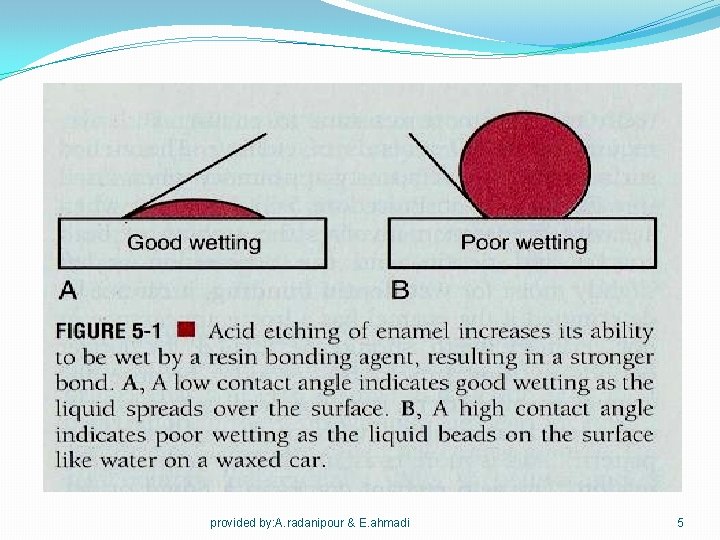
Basic principles in the bonding process Surface preparation to remove plaque & debris Acid etching with phosphoric acid, to remove mineral, create porosity, wettability Bonding agent applied and flows to fill the porosities and create resin tags (micromechanical retention) Resin applied and bonds chemically to underlying bonding agent (primary bonding) provided by: A. radanipour & E. ahmadi 3
Adhesion For proper adhesion to occur, intimate contact between the adhesive and the substrate is needed. This intimate contact is affected by: Wettability of the substrate surface The viscosity of adhesive The morphology or surface roughness, provided by: A. radanipour & E. ahmadi 4
provided by: A. radanipour & E. ahmadi 5
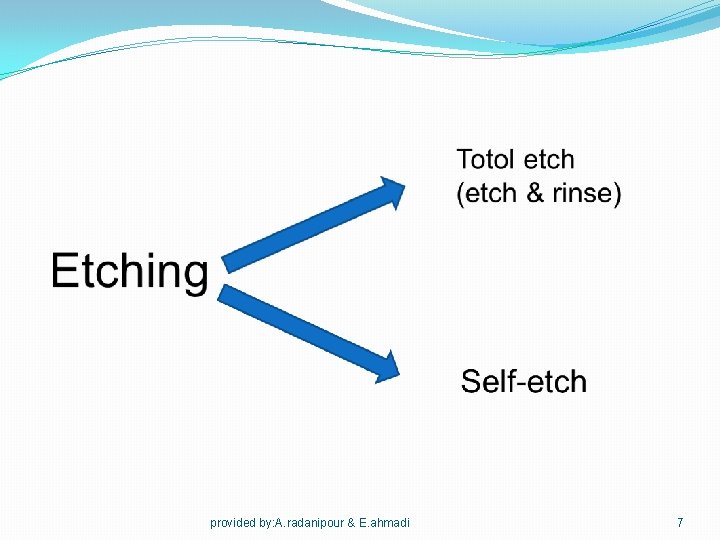
Etching Preparation of TOOTH surfaces and DENTAL MATERIALS with etching agents, usually phosphoric acid, to roughen the surface to increase adhesion or osteointegration. provided by: A. radanipour & E. ahmadi 6
provided by: A. radanipour & E. ahmadi 7
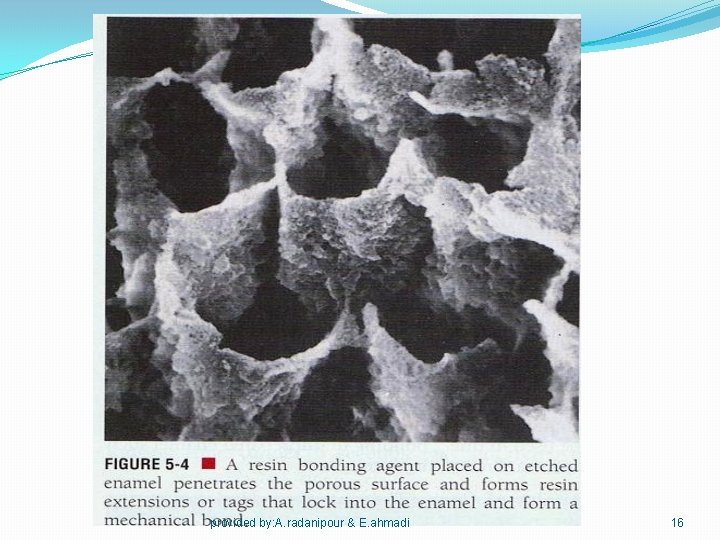
Enamel etching Introduced by Michael Buonocore in 1950 s Etching time: 10 -30 seconds (around 15 seconds) Primary teeth and fluoride treated teeth require more time Etched enamel looks frosty white when dried Etching produces a rough surface (pits) into which resin flows and forms resin tags = micromechanical retention provided by: A. radanipour & E. ahmadi 8
Enamel etching Resin tags may penetrate to a depth of 10 -20 microns in etched enamel The depth of penetration depends on: Etching time Rinsing time These two actors determine how effective etching was, and how well debris were removed from enamel surface provided by: A. radanipour & E. ahmadi 9
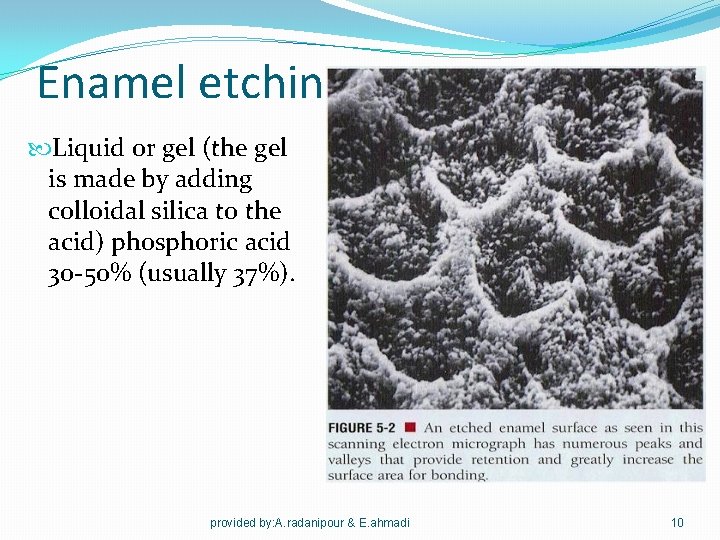
Enamel etching Liquid or gel (the gel is made by adding colloidal silica to the acid) phosphoric acid 30 -50% (usually 37%). provided by: A. radanipour & E. ahmadi 10
Procedure Acid etch is applied, how ? Etchant is applied for 15 seconds, or longer as mentioned previously Rinsing for 20 seconds then drying. Appearance of enamel? Enamel should be kept clean and contaminant free (saliva, blood, etc) If contamination occurs? Re-etch. provided by: A. radanipour & E. ahmadi 11
Enamel bonding In the past, etching and bonding involved only enamel. Currently, total etch technique is done, and bonding agents are applied to both enamel and dentine. Bonding agents used for enamel bonding were made from resin combined with diluents to lower viscosity. (Bis-GMA + TEGDMA) provided by: A. radanipour & E. ahmadi 12
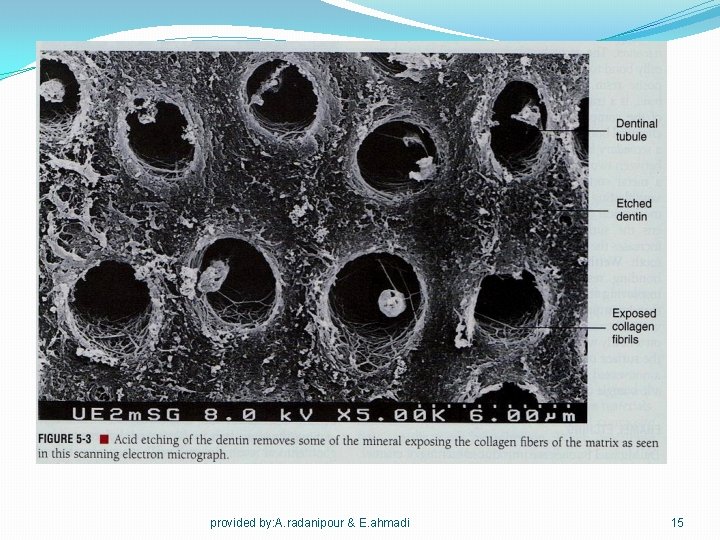
Dentine etching and bonding What makes dentine a challenge when it comes to adhesive bonding: Dentine is a living tissue (50% HA, 30% collagen, 20% fluid) Tubular nature of dentine (dentinal fluid) Branching patterns in tubules, may enhance retention Possible side effects on the pulp provided by: A. radanipour & E. ahmadi 13
Dentine etching 1979 etching was done for dentine as well as enamel using 37% phosphoric acid. Research proved enhanced bonding Over etching, effects on dentine structure and pulp? Over etching dentine leads to weaker bond and sensitivity Over drying should be avoided to prevent collapse of collagen and occluding tubules provided by: A. radanipour & E. ahmadi 14
provided by: A. radanipour & E. ahmadi 15
provided by: A. radanipour & E. ahmadi 16
provided by: A. radanipour & E. ahmadi 17
- Slides: 17