
Estimation Whole numbers Sums Differences Products and Quotients
Estimation Whole numbers, Sums, Differences, Products, and Quotients
What is an estimation? An approximate or close answer that is easier and faster to find. We round to compatible numbers or numbers that are close to the problem numbers and help us do mental math An estimate that is less than our exact answer is an underestimate. An estimate that is more than our exact answer is an overestimate.

Step 1: Underline the place value we are looking for. Step 2: Circle the number immediately to the right of our place value number. Step 3: If the circled number is: ◦ 5 or more, we raise the score (add 1 to our place value) ◦ 4 or less, we let it rest (leave the place value number the same) Step 4: We change all values after our underlined place value to a zero. Estimation Rules
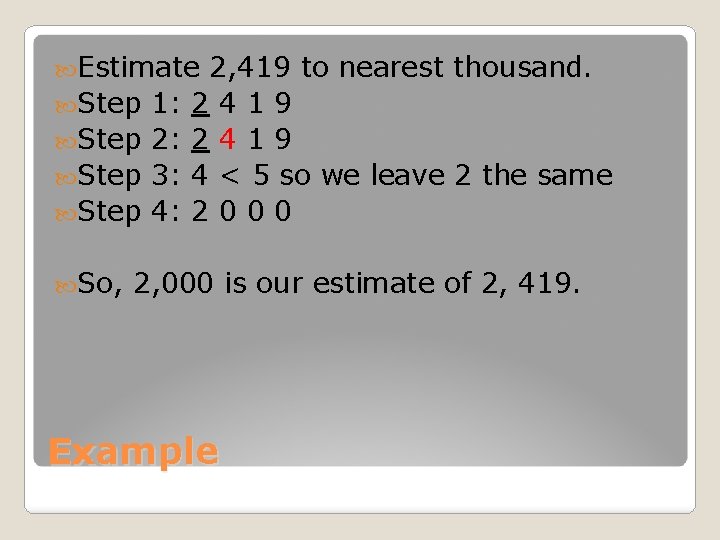
Estimate Step 1: Step 2: Step 3: Step 4: So, 2, 419 to nearest thousand. 2419 4 < 5 so we leave 2 the same 2000 2, 000 is our estimate of 2, 419. Example
Use your steps to estimate the following number: 53, 819 to the thousands place You Try
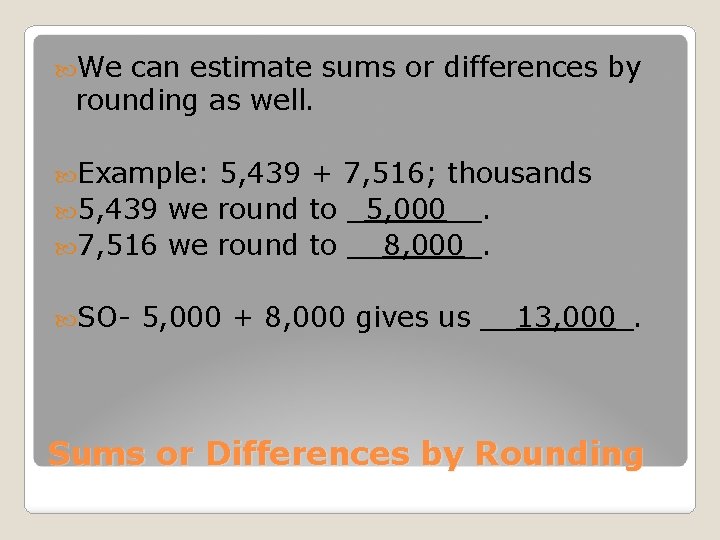
We can estimate sums or differences by rounding as well. Example: 5, 439 + 7, 516; thousands 5, 439 we round to _5, 000__. 7, 516 we round to __8, 000_. SO- 5, 000 + 8, 000 gives us __13, 000_. Sums or Differences by Rounding
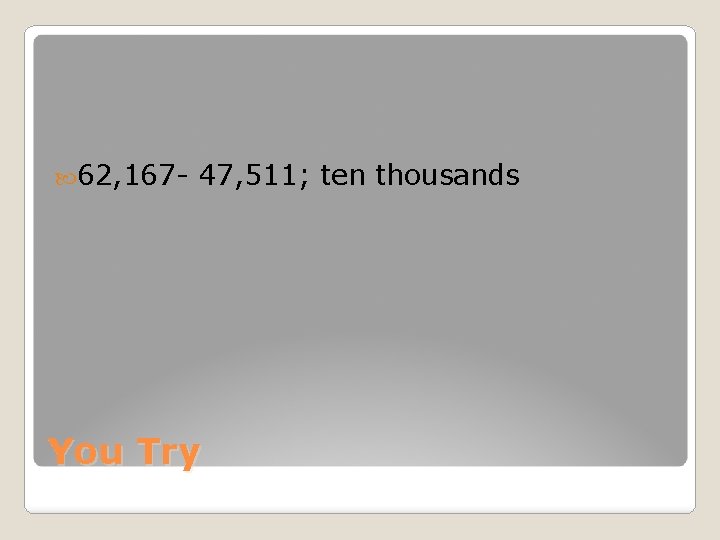
62, 167 - 47, 511; ten thousands You Try
- Slides: 7